
Intro
Choosing toys for a baby can feel surprisingly complex. Infants learn through sensory exploration, movement, repetition, and responsive interaction, yet they do not need expensive equipment or a crowded playroom. The most useful toy is usually one that matches the baby’s current abilities, invites active participation, and can be used safely under supervision.
Developmental toys are not treatments, and babies develop at different rates. Use play to offer opportunities rather than to test performance. A pediatrician, occupational therapist, or other qualified healthcare professional can help interpret concerns about motor, sensory, communication, or social development, particularly for babies born preterm or with medical conditions.
Highlights
Simple, age-appropriate toys can support sensory exploration, grasping, reaching, movement, early problem-solving, and social communication.
A caregiver’s responsive interaction often contributes more to learning than a toy’s price, complexity, or electronic features.
Toys should be selected according to developmental abilities, not only chronological age, especially for infants born preterm.
Supervision, regular inspection, and adherence to manufacturer guidance are essential because babies explore objects with their mouths.
What makes a toy developmentally useful?
A developmentally useful toy creates an opportunity for the baby to act, observe a result, and try again. A soft rattle may encourage visual tracking and grasping; a cloth book may invite reaching, mouthing, and shared attention; a stable container may support transferring objects from one hand to another. These experiences exercise emerging sensorimotor pathways, in which perception and movement become increasingly coordinated.
Good toys are safe, affordable, durable, and appropriate for the child’s abilities. They do not need to be branded as educational, contain screens, or perform many functions. Toys that respond predictably to a baby’s actions can support early cause-and-effect play. For example, shaking a rattle produces sound, pressing a large button may activate a simple response, and rolling a ball creates movement that the infant can follow.
Open-ended objects are particularly valuable because the caregiver can adjust the activity as skills change. The same soft ball may be used for visual tracking at three months, reaching and grasping at five months, rolling and crawling practice at eight months, and reciprocal play later in the first year. The toy is only one part of the experience: facial expression, language, turn-taking, and encouragement help transform manipulation into a social learning opportunity.
Best toys from birth to about 3 months
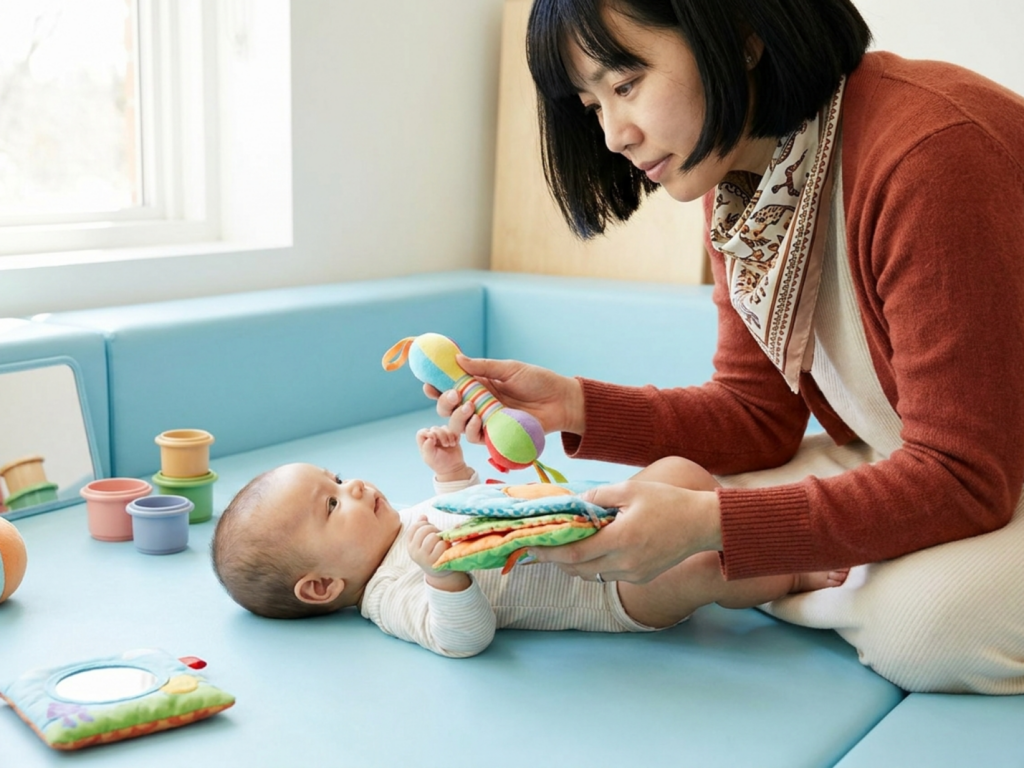
During the first months, infants spend much of their alert time observing faces, lights, patterns, and movement. Visual acuity is immature, and many babies respond well to objects with clear contrast, simple shapes, and slow movement. A caregiver’s face and voice remain among the most powerful sources of stimulation, so toys should complement rather than replace face-to-face interaction.
Useful choices include a firm, washable floor mat; high-contrast cards or fabric patterns; a soft rattle held by an adult; an unbreakable baby-safe mirror used during supervised awake play; and lightweight cloth books with varied textures. Place an object within the baby’s visual field and move it slowly from side to side, watching for signs of interest or fatigue. During supervised tummy time while awake, a toy placed just in front of the infant can encourage brief head lifting and visual orientation.
At this stage, avoid expecting a baby to hold or manipulate a toy consistently. Short sessions are normal. A baby may look away, fuss, yawn, or change posture when overstimulated. Pause, reduce noise, and return later. Avoid placing toys in the sleep space; the crib or bassinet should remain free of loose objects according to current safe-sleep guidance.
Best toys from about 3 to 6 months
Between approximately three and six months, many infants become more purposeful with their hands. They may reach toward an object, bring it to the mouth, grasp briefly, and begin to roll. Toys should be light enough to hold, large enough not to fit through the mouth, and easy to clean. Appropriate examples include large one-piece rattles, textured teethers made for infants, soft grasping rings, crinkle cloth books, activity mats, and unbreakable mirrors.
Offer one or two objects at a time so the baby can focus. Hold a toy slightly within reach, then allow the infant to initiate contact. If the baby grasps it, wait before taking it back. This supports motor planning and persistence. Place toys on either side during floor play to invite head turning and reaching across the body, while avoiding forced positioning or prolonged restraint in seats and activity devices.
Teething behavior is common, but not every product marketed for teething is safe. Inspect teethers for cracks, detached parts, liquid leakage, and excessive wear. Do not use necklaces, cords, or products containing small detachable components. Ask a healthcare professional about any teething product that contains medication or about symptoms that seem more significant than ordinary gum discomfort.
Best toys from about 6 to 9 months
As sitting, pivoting, rolling, and early crawling emerge, babies benefit from toys that encourage movement and bilateral hand use. Soft balls, large stacking cups, nesting containers, large linking rings, sturdy board books, simple pop-up toys with oversized parts, and fabric blocks can support reaching, transferring, releasing, and exploring spatial relationships.
Stacking cups can be used in several ways: the baby may mouth or bang them initially, then later grasp, separate, nest, or knock down a short tower. A caregiver can place a favorite toy just beyond reach to encourage movement, but should keep the challenge achievable and avoid creating frustration. Rolling a ball back and forth introduces reciprocity and anticipation. Hiding a toy partly under a cloth can support object permanence, the developing understanding that an object continues to exist when briefly out of view.
At this age, babies often investigate every object orally and may pull toys toward themselves. Play on a clear floor area rather than on elevated surfaces. Check that toys cannot be compressed into the mouth, have no loose eyes or buttons, and contain no accessible magnets or batteries. Keep household items separate from toy materials unless they have been specifically assessed for infant safety.
Best toys from about 9 to 12 months
During the latter part of the first year, many babies become increasingly mobile and interested in problem-solving. Suitable toys include sturdy push-along toys used with close supervision, large shape-sorters with simple openings, nesting and stacking objects, chunky blocks, board books with flaps that cannot be easily torn off, posting toys with large components, and containers that can be filled and emptied.
These toys can support fine motor practice, including more controlled grasping, releasing, and manipulation. They also invite early planning: the infant may discover that a block fits inside a container or that an object must be moved around an obstacle. Do not turn these activities into drills. Demonstrate once, then let the baby experiment. If the child uses a toy differently from its intended purpose but remains safe, that exploration may still be valuable.
For babies pulling to stand, stable furniture and a clear play surface are more useful than unstable walkers. A push toy should have a broad, stable base and should be used only when an adult is nearby. Avoid devices that allow rapid movement near stairs, doorways, water, or other hazards. Developmental timing varies widely, so toy selection should follow observed abilities and professional advice when there are medical or developmental concerns.
How caregivers make toys more effective
Play is most beneficial when it is reciprocal and responsive. Follow the infant’s attention, describe what is happening, imitate sounds, pause for a response, and give the baby time to act. If the child looks at a ball, say “ball,” roll it slowly, and wait. This supports early language reciprocity and joint attention, the shared focus of caregiver and child on the same object or event.
Change the level of challenge gradually. Begin with a toy close to the baby’s hands, then increase distance slightly as reaching improves. Present a familiar toy in a new safe context, such as inside a large open container. Rotate a small number of toys instead of displaying many at once. This can reduce visual clutter and make it easier to notice what captures the baby’s interest.
Research involving vulnerable newborns suggests that early exposure to appropriate play materials may support measurable motor outcomes, but findings should not be interpreted as a guarantee or as a substitute for clinical care. Toys cannot correct a neurologic, musculoskeletal, visual, or developmental disorder. When a baby loses a previously acquired skill, shows persistent difficulty feeding or moving, or does not respond as expected to sound or visual interaction, contact the child’s healthcare professional promptly.
Safety principles for every age
Read the toy’s age recommendations and inspect it before each use. Age labels reflect hazards and expected abilities, not a promise that the toy will produce a particular milestone. Discard or repair according to the manufacturer’s instructions if a toy breaks, splinters, develops sharp edges, or releases stuffing. Wash items as directed, especially those frequently mouthed.
Choking and aspiration risks include small parts, detachable components, inflated balloons, coins, button batteries, and high-powered magnets. Keep cords, ribbons, straps, and toys with long loops away from the neck. Battery compartments should require a tool or otherwise remain securely closed. Do not give infants toys designed for older children, even if an adult believes close supervision will be sufficient.
Use toys only in an appropriate play environment. Never attach objects to a crib, car seat, stroller, or infant carrier unless the product specifically permits it and the attachment is secure. Toys should not be used as substitutes for safe sleep practices. Check current product recalls, follow cleaning instructions, and ask a pediatrician or poison-control service for urgent guidance after suspected ingestion, choking, or exposure to a hazardous material.
Safety warnings
- Keep small parts, loose components, button batteries, and high-powered magnets away from infants.
- Never leave a baby unattended with a toy, particularly during mouthing, floor play, or early mobility.
- Do not place toys, pillows, or other loose items in an infant’s sleep space.
- Replace cracked teethers, damaged toys, and products with unsecured battery compartments.
- Seek urgent medical help after choking, suspected battery or magnet ingestion, breathing difficulty, or a sudden change in responsiveness.
Tools & Assistance
- Use the child’s pediatrician for developmental questions and individualized guidance.
- Consult an occupational or physical therapist when recommended for motor or sensory concerns.
- Check the manufacturer’s instructions and current consumer product recall notices.
- Use a local poison-control service for suspected ingestion or toxic exposure.
- Keep a simple rotation of clean, age-appropriate toys in a clear supervised play area.
FAQ
Do babies need expensive educational toys?
No. Safe, simple toys and ordinary caregiver interaction can support development effectively. Cost and electronic complexity do not determine developmental value.
Should toy selection be based on age or developmental ability?
Both matter, but observed abilities and safety are especially important. For infants born preterm, discuss whether corrected age should inform expectations and toy choices.
Are electronic toys better for language development?
Electronic features do not replace responsive conversation, imitation, and turn-taking. Toys that promote shared attention and active participation may be more useful than passive audiovisual stimulation.
How many toys should be available at one time?
There is no required number. A small selection of safe toys can reduce clutter and make it easier for the caregiver to follow the baby’s interests. Rotate items periodically.
When should I ask a professional about development?
Contact a healthcare professional if you are concerned about movement, vision, hearing, feeding, social responsiveness, or loss of skills. A clinician can assess the baby in context and recommend appropriate evaluation.
Sources
- PubMed — Selecting appropriate toys for young children: the pediatrician's role
- Seattle Children's — Toys and Play: Birth to 12 Months
- PubMed Central — Impact of Early Exposure to Play Materials on Motor Development in High-Risk Neonates
Disclaimer
This article provides general educational information and is not medical advice, diagnosis, or treatment. Consult your baby’s pediatrician or another qualified healthcare professional for individualized guidance, and seek urgent care for emergencies.














Please log in to leave a comment.