
Intro
Language development begins before a baby says a first word. Infants learn through hearing voices, watching faces, noticing gestures, experimenting with sounds, and taking part in responsive exchanges. Everyday caregiving moments can therefore become meaningful opportunities for communication without turning play into formal instruction.
The most helpful approach is warm, repetitive, and responsive. Follow your baby's attention, pause for a response, and adapt activities to their age, temperament, hearing, vision, energy, and developmental profile. Babies develop at different rates, but persistent concerns about communication should be discussed with a pediatrician or other qualified healthcare professional.
Highlights
Face-to-face interaction, imitation, and conversational pauses help babies learn the rhythm of communication.
Talking, singing, reading, and narrating routines can be incorporated into feeding, bathing, dressing, and travel.
Babbling, gestures, eye gaze, facial expressions, and body movements are important early communication behaviors.
Activities should be playful and brief, with breaks when a baby shows fatigue, frustration, or overstimulation.
How babies begin to communicate
During the first year, language development is a gradual progression from regulation and social attention to increasingly intentional communication. Newborns listen to the prosody, or rhythm and intonation, of speech and may quiet or orient toward a familiar voice. Over the following months, babies often become more alert to faces, smile socially, produce cooing sounds, laugh, and begin to exchange vocalizations with caregivers.
Later in infancy, canonical babbling may emerge. This refers to repeated consonant-vowel combinations such as ba-ba or da-da. Babbling is not necessarily a meaningful word, but it reflects important practice coordinating breathing, voice, and oral movements. Babies may also communicate through reaching, pointing, showing objects, shifting their gaze, vocalizing to gain attention, and using facial expressions or body movements.
Milestones describe patterns seen in many children, not a rigid timetable. A premature infant may be followed using corrected age, and individual variation is expected. The quality of a baby’s participation matters as much as the number of sounds they make: shared attention, response to voices, reciprocal smiles, and attempts to imitate are all useful observations. A baby does not need specialized toys to learn language. Repeated, emotionally attuned interaction is the central resource.
Use responsive face-to-face conversation
Choose a calm moment when your baby is awake and interested. Position yourself close enough for comfortable eye contact, use a natural expressive voice, and describe what your baby is doing: “You found the red cup,” or “You are looking at the window.” Child-directed speech often includes slightly slower pacing, clear pronunciation, repetition, and varied intonation. These features can make speech easier for an infant to notice while preserving the natural flow of conversation.
Imitation is a simple activity with substantial value. Copy a coo, squeal, rasp, lip movement, or facial expression, then pause. The pause creates space for a turn. When your baby responds, imitate again or add a small variation. This pattern teaches that vocal behavior can influence another person and introduces the structure of responsive turn-taking with infants.
Respond to nonverbal communication as well. If your baby looks toward a toy, name it and bring it into the interaction. If they reach, acknowledge the request: “You want the ball.” If they turn away, reduce stimulation and allow a break. This is sometimes called serve-and-return interaction: the baby initiates with a look, movement, sound, or expression, and the caregiver responds contingently. Such exchanges support shared attention, social communication, and early vocabulary associations.
Do not require eye contact or insist on a sound. Some babies communicate more through movement, gaze, or touch, and a responsive caregiver can treat those behaviors as meaningful attempts to connect.
Build language into everyday routines
Routine care provides frequent, predictable opportunities for language exposure. During a diaper change, name body parts, clothing, and actions. While dressing, use short phrases such as “shirt on” and “arm through.” During feeding, describe temperature, texture, and the baby’s cues. In the bath, label water, hands, toes, splash, and wet. Narrating routines helps connect words with repeated experiences, and the predictable sequence gives babies multiple chances to hear the same vocabulary in context.
Use a conversational style rather than delivering a continuous monologue. Say a phrase, pause, and watch for a response. Your baby may answer with a sound, kick, smile, glance, or change in facial expression. Treat that response as a turn and reply. You can expand a baby’s communication without correcting it. If your baby says “ba,” you might respond, “Ba, ball! You see the ball.” This repeats the sound while offering a meaningful word.
Include language during transitions and travel. Before lifting your baby, say, “Up we go.” Before turning off a light, say, “The light is going off.” Consistent words paired with consistent actions support receptive language, which is the ability to understand spoken communication. Counting steps, naming people who enter the room, and labeling sounds such as a door closing or a dog barking can also make ordinary environments linguistically rich.
Keep background media low when possible. A television or phone playing nearby can compete with the voice, face, and timing cues that make social language learning effective. Direct interaction is more valuable than passive exposure to recorded speech.
Sing, read, and play with sounds
Singing is useful because melody, rhythm, repetition, and pauses naturally attract attention. Sing a familiar lullaby, make up a short song about getting dressed, or repeat a simple refrain. Pause before an expected word or sound and give your baby time to react. Younger infants may listen or move their body; older infants may vocalize, clap, bounce, or anticipate the next part. The goal is shared enjoyment and participation, not accurate performance.
Sound imitation games can be short and varied. Copy your baby’s vocalization, then model a new vowel or consonant sound. Make animal sounds while looking at a picture or toy, and invite imitation without pressure. You can also contrast sounds, such as a quiet hum followed by a louder but comfortable “beep.” Avoid sudden loud noises close to the baby’s ears. If your baby startles repeatedly, cries, or turns away, stop and return to a calmer activity.
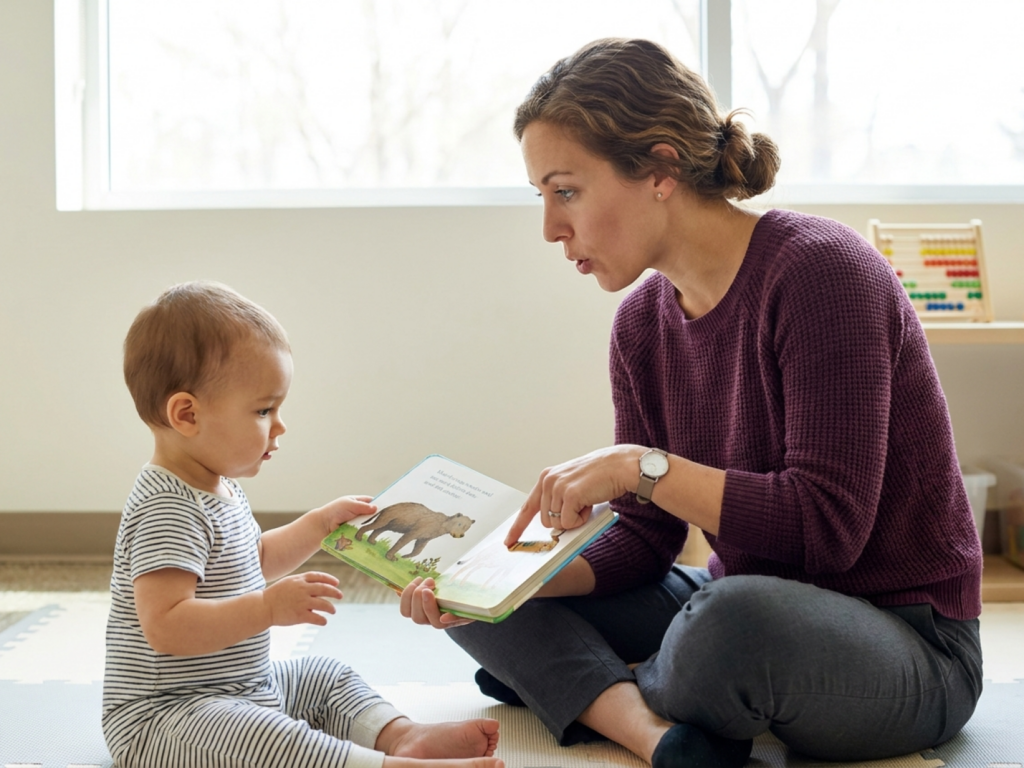
Shared book reading does not require a baby to sit through a complete story. Hold a sturdy board book where your baby can see it, point to one picture, and name it. Talk about colors, actions, and facial expressions. Let your baby touch, mouth, turn, or lose interest in the book. Re-reading the same book is beneficial because repetition helps babies recognize familiar sounds, words, and sequences. Texture books and books with flaps can add sensory interest, but the caregiver’s voice and contingent responses remain the primary language activity.
Peek-a-boo, hiding a toy under a cloth, and playful pauses in songs combine anticipation with communication. These games can support object permanence, attention, and the expectation that an interaction has a beginning, middle, and return.
Support gestures, sensory exploration, and shared attention
Language is multimodal. Before spoken words become consistent, babies may communicate through pointing, reaching, waving, giving, showing, looking between an object and a caregiver, or changing their vocal tone. Model simple gestures during meaningful moments: wave when someone leaves, open your hands for “all gone,” point toward a named object, and move your hands to a familiar song. Pair each gesture with speech rather than replacing spoken language.
Shared attention develops when a baby and caregiver attend to the same object or event while recognizing one another’s interest. Follow your baby’s gaze and comment on what they are watching. If they notice a ceiling fan, say, “The fan is turning.” If they examine a spoon, describe its shape, temperature, or sound. This responsive labeling helps connect words to the baby’s own experience and may be more effective than redirecting attention toward an adult-selected toy.
Supervised sensory play can create additional vocabulary. Offer safe, age-appropriate objects with different textures, such as a smooth cloth, a crinkly fabric book, or a cool teething ring, and use words such as soft, rough, cold, and noisy. Inspect every object for choking hazards, small detachable parts, sharp edges, and unsafe materials. Babies should be closely supervised, especially when mouthing objects.
As mobility increases, describe actions and locations: “The car rolled under the chair,” or “You crawled to the cushion.” Avoid overwhelming a baby with too many questions. A balanced exchange includes comments, imitation, waiting, and occasional simple questions that can be answered through gaze, gesture, or sound.
Adapt activities to age, temperament, and language background
For a young infant, prioritize holding, talking, singing, facial expressions, and brief sound exchanges. At approximately the middle of the first year, add longer pauses, imitation of babbling, peek-a-boo, songs with gestures, and picture naming. Toward the end of the first year, respond to pointing and showing, label familiar people and objects, imitate actions, and use simple words consistently in routines. These descriptions are broad, and a baby may enjoy activities associated with several age ranges.
Follow behavioral cues. Signs of engagement can include relaxed limbs, alert facial expression, smiling, vocalizing, reaching, or returning a gaze. Signs that the baby needs a pause may include turning away, arching, fussing, yawning, hiccupping, becoming unusually still, or losing coordination. Reduce the pace, lower your voice, change position, or end the activity. Language practice is most productive when the infant is regulated and feels safe.
Families who use more than one language can speak, sing, and read in the languages that feel most natural. Exposure to multiple languages does not need to be limited to one language for language learning to occur. Vocabulary may be distributed across languages, so assessment should consider the child’s complete linguistic environment. Consistency, emotional connection, and rich interaction matter more than trying to create a perfect lesson.
Caregivers do not need to fill every quiet moment. Sleep, unstructured movement, independent observation, and calm pauses also support regulation. The aim is a responsive communication environment woven through family life, not constant stimulation.
When to discuss communication concerns
Developmental surveillance involves observing progress over time and discussing concerns during routine healthcare visits. Contact a pediatrician if your baby does not appear to respond to loud sounds or familiar voices, loses a previously acquired communication skill, rarely vocalizes or engages socially, or shows a persistent lack of response to interaction. A caregiver’s concern is itself a valid reason to seek guidance, even when a milestone has not been clearly missed.
Hearing is central to speech and language learning. Temporary conditions such as middle-ear fluid can affect hearing, while other hearing differences may be present from birth or develop later. If hearing is uncertain, ask a healthcare professional whether a formal hearing evaluation is appropriate. Do not rely only on a baby’s response to household sounds, because visual cues, vibration, and inconsistent attention can make informal observations misleading.
A clinician may review the baby’s medical and developmental history, hearing status, social communication, motor skills, and exposure to languages. Depending on the findings and local services, they may recommend developmental screening, audiology, or referral to a speech-language pathologist or early intervention program. These services are not a judgment about parenting and do not require caregivers to stop enjoyable home activities. Early professional input can clarify what a baby is communicating and which supports are appropriate.
Seek urgent medical care for acute changes such as sudden loss of responsiveness, breathing difficulty, a seizure, or a serious injury. For nonurgent developmental questions, keep a brief record of sounds, gestures, responses, and situations in which communication is strongest. Videos taken safely and privately may help a clinician understand patterns, but they should not replace an in-person assessment.
Important safety and medical considerations
- Never leave a baby unattended with books, sensory materials, cords, water, or objects that could be mouthed.
- Avoid loud sounds near a baby's ears and stop an activity if the baby appears distressed or overstimulated.
- Do not compare one baby's language timeline rigidly with another baby's or attempt to diagnose a delay at home.
- A loss of previously acquired communication skills warrants prompt discussion with a pediatric healthcare professional.
- If hearing seems inconsistent, request professional guidance rather than relying on informal home testing.
Tools & Assistance
- A sturdy collection of age-appropriate board books and texture books
- A daily routine for noting new sounds, gestures, and responses
- A quiet floor space for face-to-face play and supervised exploration
- A pediatrician, family doctor, audiologist, speech-language pathologist, or early intervention service
- Songs, finger plays, and familiar family phrases in the languages used at home
FAQ
How much should I talk to my baby each day?
There is no required number of minutes. Talk, sing, read, and respond during ordinary routines, while also allowing quiet time and breaks. Short, frequent, emotionally responsive exchanges are appropriate.
Is babbling a form of language?
Babbling is an important precursor to spoken language and helps a baby practice vocal control and turn-taking. It may not yet carry a consistent meaning, but it should be answered as a communication attempt.
Can I support language if my family speaks two or more languages?
Yes. Use the languages that are natural and emotionally meaningful for your family. Rich interaction across languages supports communication, and a professional assessment should consider the baby's total language experience.
Should I correct my baby's sounds?
Direct correction is unnecessary. Imitate the sound, respond warmly, and model a related word or sound. For example, answer “ba” with “ba, ball” while keeping the exchange playful.
When should I ask about a possible language concern?
Discuss concerns if your baby rarely responds to voices or sounds, shows limited social communication, stops using a skill they previously had, or if your intuition says something is not right. A pediatrician can guide hearing and developmental evaluation.
Sources
- ZERO TO THREE — Supporting Language and Literacy Skills from 0-12 Months
- Mayo Clinic — Language development: Speech milestones for babies
- Raising Children Network — Play ideas for baby language & talking
Disclaimer
This article provides general educational information and is not a diagnosis or a substitute for individualized medical advice. Consult a qualified healthcare professional with concerns about your baby's hearing, communication, or development.

















Please log in to leave a comment.