
Intro
For many families, teething is one of the first milestones that is both ordinary and surprisingly uncertain. A baby may suddenly drool more, chew on anything within reach, or seem fussier than usual, and it is natural to wonder whether a tooth is about to appear. The short answer is that most babies start teething around 6 months of age, but healthy variation is wide.
That flexibility matters. Some babies begin a few months earlier, some a few months later, and many seem to move through a quiet period before the first tooth finally breaks through the gum. Teething is a normal developmental process, not a diagnosis, and the exact month is usually less important than the overall pattern of growth, comfort, and oral development.
Highlights
Most babies start teething around 6 months, but a normal range extends earlier and later than that.
The lower front teeth often appear first, and the full set of 20 primary teeth usually erupts gradually over the first few years.
Drooling, chewing, and gum tenderness can fit teething, but they do not prove that teething is the only explanation.
Supportive comfort measures are usually the main approach; persistent fever or significant illness should be evaluated separately.
The usual age range
Most babies start teething around 6 months of age. MedlinePlus describes the usual onset as between 6 and 8 months, and Mayo Clinic notes that some babies begin a few months earlier or later. That range is broad, and it is usually considered normal.
The timing reflects biology rather than parenting, feeding style, or anything a caregiver has done. The first tooth is simply the first visible sign that a process already underway inside the jaw has reached the gum line. In a healthy infant, the absence of a tooth at exactly 6 months is not, by itself, a reason for alarm.
Many families notice that the first tooth appears during the second half of the first year, but the exact month is less important than the overall pattern of growth. Some babies are comfortable, while others seem more aware of the change in their gums. Both experiences can fall within normal variation.
Which teeth usually come in first
The primary tooth eruption sequence usually starts with the lower central incisors, which are the two front teeth in the lower jaw. The upper central incisors often follow, then the lateral incisors, first molars, canines, and second molars. The teeth may appear one at a time or in pairs, and the order can vary slightly from child to child.
By about 3 years of age, most children have all 20 primary teeth. This does not happen all at once; eruption is gradual and can pause for weeks between teeth. A baby may seem to be teething for months, but the discomfort is often intermittent rather than constant.
Symmetry is helpful but not required. If one lower front tooth shows before the other, that is usually normal. Dentists and pediatric clinicians are generally more interested in the broader pattern: Are teeth erupting? Is the child growing well? Are the gums and mouth otherwise healthy?
What teething can look and feel like
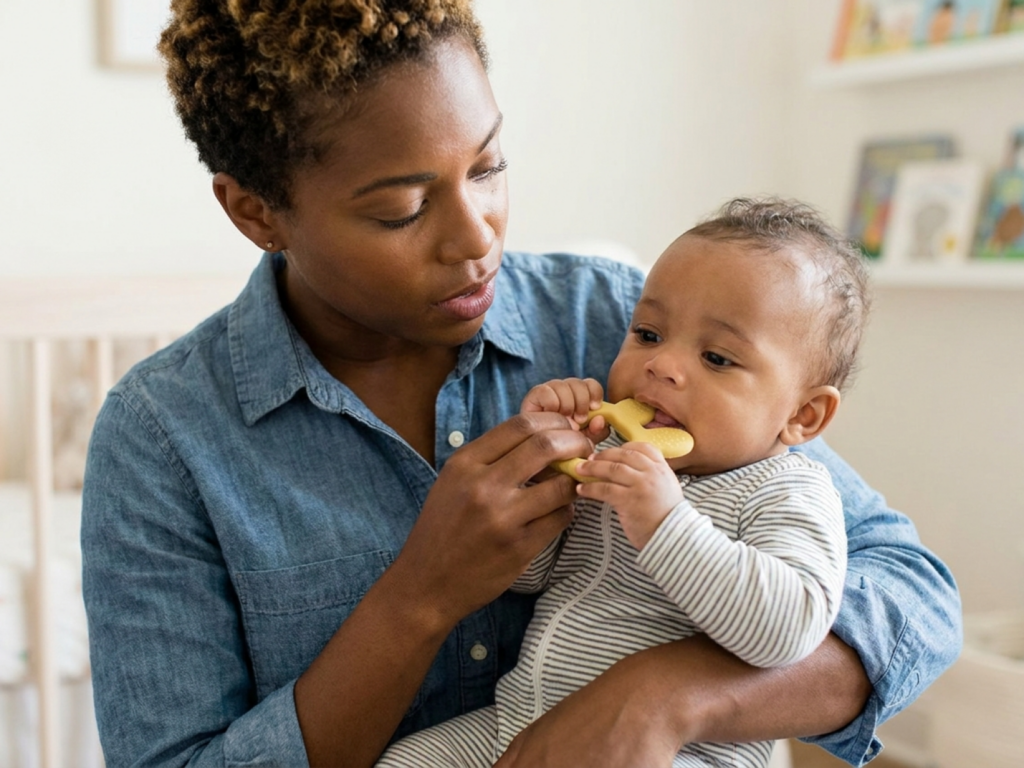
Teething is primarily a local process. The most common findings are gum swelling, redness, and tenderness near the erupting tooth. Babies often drool more, chew on fingers or toys, and seek pressure on the gums because it can feel soothing. Chewing behavior during teething is one of the clearest clues that the gums are uncomfortable.
Some infants also become fussier, wake more often, or want shorter, more frequent feeds. Others show only subtle changes. That variability can make teething hard to identify, especially in babies who are already going through sleep changes or developmental leaps.
It helps to remember that teething symptoms versus illness is an important distinction. Mild irritability and gum discomfort can fit teething, but high or persistent fever, marked lethargy, significant diarrhea, vomiting, or a baby who seems truly unwell deserves medical attention for another cause. Teething can coexist with an infection or other illness, so it should not be used as a catch-all explanation.
Comfort measures that are generally considered safe
Comforting a teething baby is usually about reducing pressure and supporting the gums. Gentle finger massage, a clean, cool, damp washcloth, or a firm teether that has been chilled in the refrigerator may help. Many babies prefer a little counterpressure rather than anything numbing.
- Use only age-appropriate teething objects and supervise them closely.
- Avoid frozen items that are too hard or too cold, which can injure the gums.
- Wipe drool from the chin and mouth area to reduce skin irritation.
- Offer feeds a little more often if your baby seems comforted by sucking.
- Ask a healthcare professional before using medicated gels, oral anesthetics, or any product marketed as a teething remedy.
These measures do not speed tooth eruption, but they can make the period easier to manage. If a method seems to help your baby settle, that is a useful sign. If your baby becomes more distressed, stop the intervention and check in with a clinician.
When teething starts later than expected
Variation in teething age is common. Some babies begin a few months earlier than average, and others do not show a tooth until later in the first year. Both patterns can still be normal, especially when a baby is otherwise developing well. Premature infants may also follow a slightly different timeline because their age is often considered both chronologic and corrected.
If no teeth have appeared by around 12 to 15 months, it is reasonable to mention this at a well-child visit or ask for a dental opinion. Delayed eruption does not automatically mean a disorder, but it gives the clinician a chance to review family history, overall growth, nutrition, and oral development. In rare cases, delay can be related to an underlying medical or dental issue that needs further assessment.
It is also worth seeking advice if eruption seems unusual in another way, such as a tooth coming through at birth, a persistent lesion on the gums, or very asymmetrical development. Those situations are uncommon, but they are best evaluated rather than watched indefinitely.
How to keep perspective during the teething months
For many caregivers, the most reassuring approach is to track what actually happens instead of trying to guess from one symptom. Make a simple note of when the first tooth appears, which tooth comes next, and whether your baby has gum tenderness, drooling, or feeding changes. That record can be helpful if you later speak with a pediatric clinician or dentist.
Once a tooth is visible, oral care begins to matter in a new way. Ask your clinician about age-appropriate brushing, fluoride guidance, and when the first dental visit should happen in your setting. Even if teething itself is temporary, the habits built around it can support oral health for years.
Most of all, remember that teething is a normal milestone and a very individual one. A baby who starts at 4 or 5 months is not automatically early in a concerning way, and a baby who starts closer to 9 or 10 months is not automatically late. The broader story is comfort, growth, and steady development.
Seek medical advice sooner if you notice these signs
- Persistent fever, marked lethargy, or a baby who seems genuinely ill should not be assumed to be teething.
- Poor feeding, fewer wet diapers, or signs of dehydration need prompt medical review.
- Inconsolable crying or worsening distress deserves assessment, especially if comfort measures do not help.
- Use caution with medicated teething gels, oral anesthetics, and unapproved teething remedies.
- Supervise teething devices closely to reduce choking or gum injury risk.
Tools & Assistance
- Pediatrician or family doctor
- Pediatric dentist
- Well-child visit notes or a simple teething diary
- Clinic nurse advice line or telehealth service
FAQ
When do most babies start teething?
Many babies start around 6 months, and a typical range is roughly 6 to 8 months. Some begin earlier or later and still fall within normal variation.
Which tooth usually comes in first?
The lower central incisors, the two bottom front teeth, are often the first to erupt.
Can teething cause fever?
Mild temperature changes may happen around the same time, but persistent or significant fever should not be blamed on teething alone and should be evaluated.
What if my baby has no teeth by 1 year?
That can still be normal for some babies, but it is a good reason to mention it at a well-child visit or ask a pediatric dentist.
Sources
- Mayo Clinic — Teething: Tips for soothing sore gums
- MedlinePlus — Teething: MedlinePlus Medical Encyclopedia
- PubMed — Teething - PubMed
Disclaimer
This article is for general informational purposes only and is not a substitute for personalized medical or dental advice. If you have concerns about your baby's symptoms, growth, or oral development, please contact a qualified healthcare professional.
















Please log in to leave a comment.