
Intro
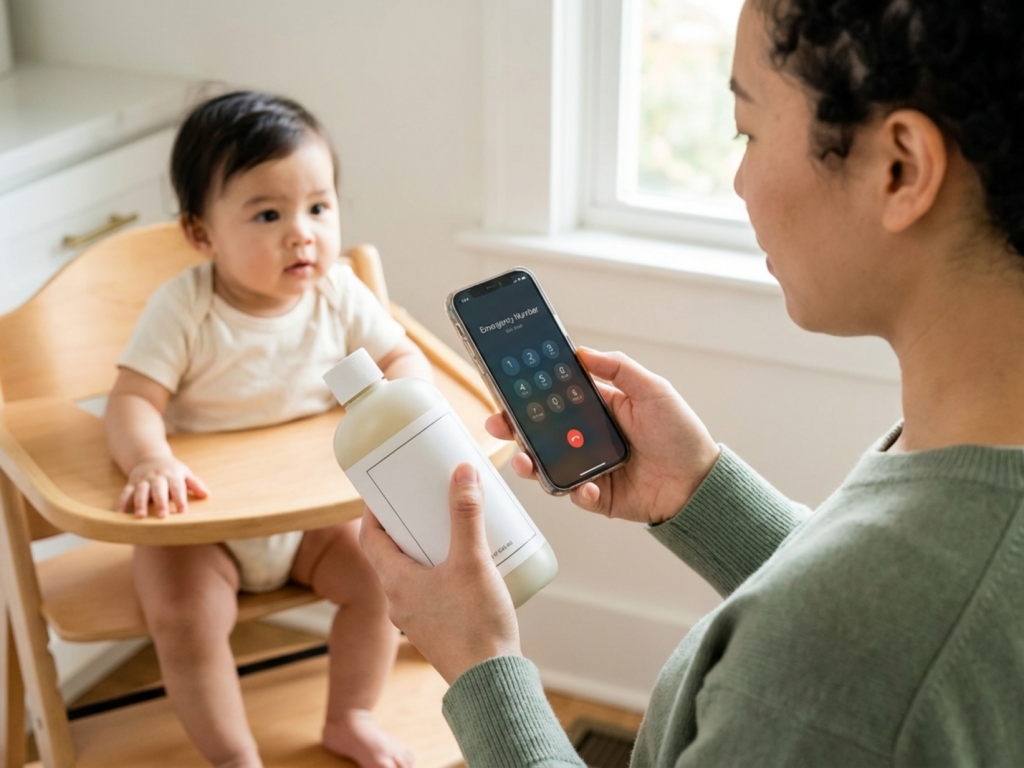
Discovering that a baby may have swallowed a nonfood item, medication, or household product is frightening. The most useful response is to stay as calm as possible, protect breathing, and contact an expert promptly rather than trying home treatments.
Babies can become unwell from relatively small amounts because of their size and developmental stage. Even when a baby looks well, timely advice from Poison Control, a pediatric clinician, or emergency services can help determine the safest next step.
Highlights
Remove any visible material from the baby's mouth only if it can be taken out easily and safely.
Do not induce vomiting or give food, drink, or medicines unless a poison expert or clinician specifically advises it.
A choking or breathing emergency requires emergency services immediately, rather than waiting for poison advice.
Keep the container, packaging, or a sample of the substance available for professional guidance.
Start with breathing and responsiveness
First, look at the baby rather than focusing only on the item. A baby who cannot breathe, cannot cry or cough effectively, becomes blue or gray around the lips, collapses, has a seizure, or is unusually difficult to wake needs emergency medical help immediately. Call your local emergency number. If you believe an object is obstructing the airway, use age-appropriate infant choking first-aid procedures if you have been trained, or follow dispatcher instructions.
Choking and ingestion are not the same problem. A baby who is coughing forcefully, crying, or making sounds may still be moving air, while a silent baby who cannot cough effectively may have a critical obstruction. Do not put fingers blindly into the mouth; this can push an object farther back or injure delicate tissues. Remove an item only when you can clearly see it and easily sweep or lift it out.
If the baby is breathing normally and alert, move away remaining tablets, liquid, plant material, or other objects. Gently clear residue from the mouth with a clean cloth or finger only when it is readily accessible. Then seek poison-specific advice without delay. Symptoms can be delayed, and a normal appearance immediately after exposure does not establish that an ingestion is harmless.
Call for poison-specific guidance promptly
For a possible poisoning in the United States, call Poison Help at 1-800-222-1222. This connects callers to a poison center that can assess the exposure in real time. In other countries, contact the local poison information service, emergency medical service, or a pediatric clinician. Call emergency services instead if the baby has severe symptoms or cannot be safely transported.
Poison specialists consider details that cannot be judged reliably by appearance alone: the baby’s age and weight, the product’s active ingredients and concentration, the maximum amount that could be missing, the time of exposure, and current symptoms. They may recommend observation at home, consultation with a clinician, or immediate emergency assessment. Follow their individualized advice exactly.
Do not rely on instructions printed on a package to decide what to do after ingestion. First-aid guidance on labels may be outdated or may not account for a baby’s age, the actual amount involved, or co-exposures. Calling promptly is appropriate even when you are uncertain whether the baby swallowed anything. It is better to report a possible exposure than wait for symptoms.
Avoid common but unsafe home responses
Do not make a baby vomit. Induced vomiting can cause choking, aspiration of material into the lungs, or renewed injury to the mouth and esophagus. This is particularly concerning with caustic products, hydrocarbons such as some fuels or lamp oils, and substances that impair alertness. Do not use salt water, mustard, syrup of ipecac, fingers in the throat, or other home methods.
Do not automatically give milk, water, food, activated charcoal, or medication. A drink may be inappropriate for some exposures, may interfere with planned treatment, or may create an aspiration risk if the baby vomits or becomes drowsy. Activated charcoal is a clinical intervention used only in selected circumstances and is not a routine home treatment for infants.
Do not wait to see whether symptoms develop before calling for advice. Equally, do not assume that a bad taste means a severe poisoning or that a pleasant-tasting product is safe. The exposure route matters too: a substance on the skin, in the eyes, or inhaled may require different first aid. If the product has contacted the skin or eyes, ask Poison Control or emergency services how to decontaminate safely while arranging help.
Gather the details professionals need
Bring the original container, blister pack, bottle, label, or object to the phone and, if advised, to the emergency department. Keep products in their original containers with labels intact. A photograph of the label can help when packaging must be handed to another caregiver, but it should not delay the call. Do not taste, smell closely, or handle an unknown substance without protection.
Be prepared to describe what happened in plain terms. Estimate the latest possible time of ingestion and the largest plausible amount, rather than assuming the amount was tiny. For medications, report the medicine name, strength per tablet or milliliter, formulation, and number potentially missing. For a plant, battery, magnet, cosmetic, detergent, alcohol-containing product, or nicotine product, provide the exact product name whenever possible.
- Baby’s age, current weight if known, and relevant medical conditions
- Substance or object involved, including ingredients or size
- Possible amount and whether any was spit out
- Time of exposure and whether another substance may also be involved
- Current signs such as coughing, vomiting, drooling, sleepiness, unusual behavior, burns, or breathing difficulty
Keep the baby under direct observation while you receive instructions. Avoid leaving them with another child or placing them to sleep simply because the immediate crisis seems to have passed.
Treat high-risk objects and substances as emergencies
Some ingestions are especially time-sensitive because they can injure tissue, obstruct the gastrointestinal tract, affect the heart or brain, or cause internal damage before obvious symptoms occur. A suspected button battery ingestion is an emergency. Batteries can cause serious esophageal burns rapidly, so go to emergency care immediately and do not wait for symptoms. Bring the battery packaging if available.
More than one magnet, a magnet with a metal object, or an unknown number of magnets also requires urgent emergency evaluation. Magnets in separate loops of bowel can attract through tissue and cause pressure injury, perforation, or obstruction. Sharp items, large objects, water beads, and objects that may lodge in the airway or gut likewise need prompt professional assessment.
Potential medication overdoses, nicotine or vaping liquids, cannabis products, alcohol, iron-containing supplements, concentrated essential oils, household cleaning products, detergents, and corrosive chemicals warrant immediate poison advice. Household chemicals and baby safety requires particular care because products vary widely in concentration and ingredients. Do not delay a call because the baby only licked a product; the correct response depends on the specific substance.
Monitor carefully while following professional advice
After you have contacted a poison center or clinician, follow the recommended observation period and return precautions. Watch for new or worsening vomiting, repeated coughing, drooling, refusal to feed, pain or persistent crying, abdominal swelling, unusual sleepiness, confusion, poor coordination, changes in skin color, or changes in breathing. In infants, reduced responsiveness or a meaningful departure from normal feeding and behavior deserves prompt reassessment.
If vomiting occurs, turn the baby onto their side or hold them in a supported side-lying position to help protect the airway, and seek urgent advice. Do not try to force fluids. Record the time and appearance of symptoms, but do not let note-taking replace direct observation. If a clinician or poison expert tells you to go to an emergency department, travel as directed and take the container or object with you.
Trust a worsening clinical picture. Emergency evaluation is appropriate when symptoms develop, when you cannot determine what was ingested, or when you cannot obtain timely poison guidance. This is especially true for young infants, whose small body mass can make an uncertain dose more consequential. Clear communication about suspected poisoning in an infant can help triage staff prepare for the baby’s arrival.
Reduce the risk of another ingestion
Prevention is most effective when it accounts for rapid developmental change. Babies begin mouthing, crawling, reaching, and opening containers sooner than many caregivers expect. Store medicines, vitamins, cleaning agents, nicotine products, alcohol, cosmetics, batteries, magnets, and small objects locked up and out of reach. Locked medication storage is safer than relying on a child-resistant cap, because child-resistant does not mean child-proof.
Return products to storage immediately after use, including during busy routines, visits, and travel. Keep medicines in their original containers; never refer to medicine as candy or transfer it to unmarked containers. Check floors, low tables, handbags, diaper bags, and sofa cushions for dropped pills, batteries, coins, and small objects. Ask visitors to keep purses and medications inaccessible.
Review hazards room by room and repeat the check as mobility changes. Use secure battery compartments on toys and remotes, and remove damaged items from use. Have the poison center number saved in caregivers’ phones and visible where feeding supplies are kept. Preparedness cannot prevent every event, but it can make the first minutes calmer and safer when an exposure is suspected.
Seek emergency help now
- Call emergency services immediately for trouble breathing, ineffective coughing, blue or gray color, collapse, seizure, or reduced responsiveness.
- Treat a suspected button battery, multiple magnet, sharp-object, or water-bead ingestion as an emergency.
- Do not induce vomiting or give anything by mouth unless a poison expert or clinician tells you to do so.
- Do not perform a blind finger sweep in a baby's mouth.
- A well-appearing baby can still need urgent assessment after a medication, chemical, nicotine, alcohol, or unknown ingestion.
Tools & Assistance
- United States Poison Help: 1-800-222-1222
- Local emergency medical services for breathing or consciousness emergencies
- Original product container, label, blister pack, or object
- Pediatrician or emergency department for directed assessment
FAQ
Should I give my baby milk or water after a possible ingestion?
Not unless Poison Control or a clinician specifically recommends it. The safest response depends on the substance, amount, and baby's condition.
What if I am not sure my baby swallowed the item?
Call Poison Control or a healthcare professional with the details you know. They can help assess the plausible risk even when the amount is uncertain.
When is a swallowed object an emergency?
Button batteries, multiple magnets, sharp objects, large objects, water beads, and any object causing breathing difficulty require urgent emergency assessment.
Can I wait if my baby has no symptoms?
Do not wait to seek poison-specific advice. Some harmful exposures cause delayed symptoms, and a poison specialist can determine the appropriate observation or treatment plan.
Sources
- UMass Memorial Health — Poisoning in Children
- Mayo Clinic — Poisoning: First aid
- Nationwide Children's Hospital — First Aid for Poisonings in a Child
Disclaimer
This article provides general educational information and is not a substitute for medical advice, diagnosis, or treatment. For a suspected ingestion, contact Poison Control, emergency services, or a qualified healthcare professional promptly.














Please log in to leave a comment.