
Intro
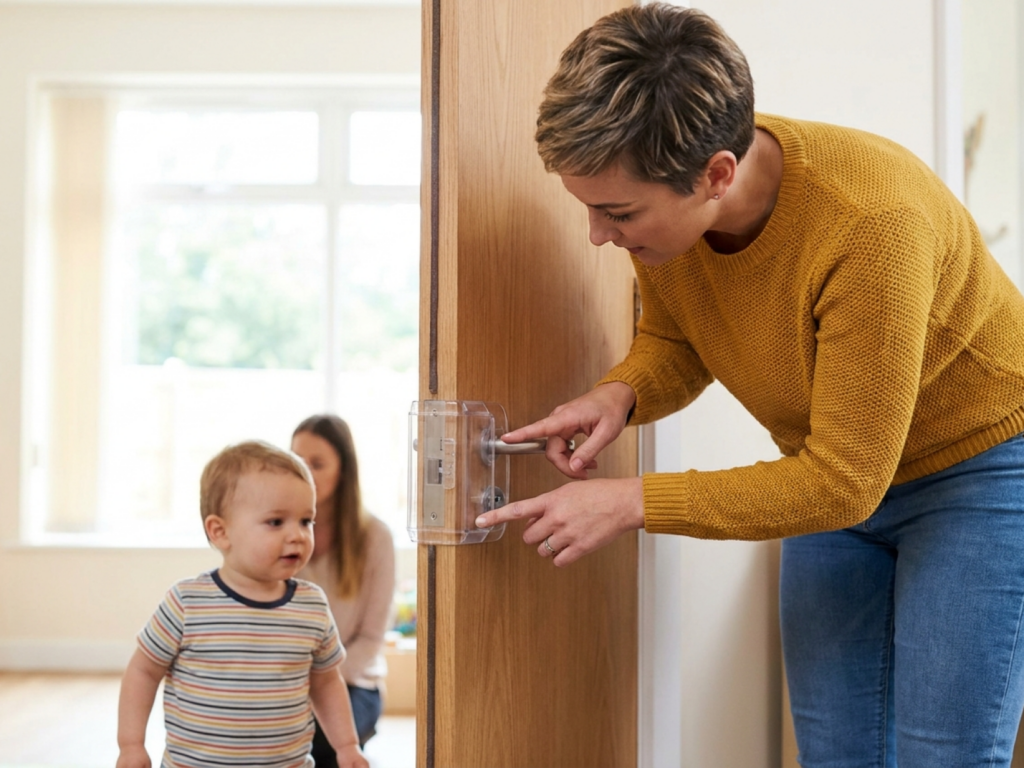
Doors are ordinary household fixtures, but for babies and young children they can create a serious crush and laceration hazard. A child may place fingers near the hinge side, pull a door toward the frame, or move through a doorway just as another person closes it. Because infants and toddlers have limited awareness of mechanical danger and may move unpredictably, prevention depends on changing the environment as well as supervising the child.
Effective protection combines suitable door hardware, regular maintenance, clear household routines, and age-appropriate teaching. The goal is not to make every door permanently unusable, but to identify where finger entrapment is most plausible and reduce the force, speed, or closing range that can injure small fingers.
Highlights
The hinge side of a door is a particularly important risk area because fingers can become trapped between the door leaf and frame.
Door stops, hinge-side guards, and controlled closing mechanisms address different parts of the hazard and may need to be used together.
A device is only protective if it is correctly installed, compatible with the door, and kept in working condition.
Supervision and consistent family routines remain necessary because no single product prevents every door-related injury.
A crushed, cut, swollen, deformed, pale, blue, or unusually painful finger should receive prompt medical assessment.
Why Doors Present a Distinct Risk
Door injuries are often compression injuries. When a door closes against its frame, the closing force is concentrated into a narrow gap. A small finger can be caught before a child has time to withdraw it. The injury may involve the skin, nail bed, distal phalanx, growth plate, tendon, or digital nerve. In younger children, even a seemingly minor injury can affect function or nail growth, so visible damage does not always reflect the full extent of tissue injury.
The hinge side deserves particular attention. As a door swings, the space between the hinge-side edge and the frame changes progressively. Children may explore this moving gap by placing fingers inside it or holding the frame while an adult opens or closes the door. The latch side can also cause injury when fingers are placed between the door edge and the frame, but hinge-side entrapment can be less obvious because the hazard is close to the pivot point and may not be visible from every angle.
Risk increases in rooms with frequent traffic, heavy or self-closing doors, doors that swing freely in a draft, and doors used by several children at once. A child who is crawling, cruising, or newly walking may reach a door before caregivers recognize the change in mobility. Baby-proofing therefore needs periodic reassessment as movement, reach, and curiosity develop.
Assessing Doors in the Home
Begin with a room-by-room inspection rather than buying the same product for every doorway. Observe how each door moves during normal use. Note whether it closes rapidly, swings because of air pressure, has a strong automatic closer, or can be pushed by a child. Look for gaps that are accessible at hand height, exposed hinges, loose trim, damaged weather stripping, and door leaves that sag or scrape against the frame.
Pay special attention to doors leading to bathrooms, kitchens, laundry areas, storage rooms, balconies, garages, and exterior steps. These locations may combine finger-pinch hazards with other common baby safety risks, including hot surfaces, cleaning products, water, or falls. A door that is not normally considered dangerous may become high risk when an older sibling repeatedly opens and closes it or when adults carry a baby through the doorway.
Consider the child’s likely position, not just the adult’s viewpoint. Kneel or sit at the child’s height and inspect what the child can reach. Check whether a door stop creates a new tripping or impact hazard, whether a detachable product could become a choking risk, and whether a guard leaves any accessible opening. Institutional guidance also emphasizes identifying high-risk doors and using procedures alongside hardware, especially where many children use the same entrances.
A written household checklist can help identify doors that need a stop, a hinge-side protection device, a closer adjustment, or a change in supervision. Recheck the assessment after moving furniture, installing a gate, changing a door’s swing, or when a baby begins pulling to stand.
Door Stops, Buffers, and Hinge-Side Protection
Door stops limit how far a door can close or open. Depending on their design and placement, they may prevent the door from reaching the frame or keep it from swinging into a wall. For finger-pinch prevention, the relevant question is whether the stop preserves a safe gap at the hazardous edge throughout the door’s movement. A stop placed only to protect a wall may not protect fingers near the hinges.
Some prevention systems use buffers or spacers that maintain a defined opening. Others cover the hinge-side gap so that fingers cannot enter the space as the door moves. Hinge-side protection is particularly useful where children have access to the doorway and where it is impractical to keep the door closed or fixed open. The BMJ-linked research on childhood finger injuries describes stops, buffers, and hinge-side designs as specific approaches for reducing entrapment.
Product selection should take account of the door’s weight, width, swing direction, hinge configuration, frame construction, and closing mechanism. A soft foam item may be unsuitable for a heavy door if it compresses, slips, or can be removed by a child. A rigid stop may protect one edge while creating a hard protrusion elsewhere. Products should be installed according to the manufacturer’s instructions, and their protective function should be tested from the child’s likely approach.
Do not rely on a small wedge or loose object that a child can pull out, mouth, carry, or place under another door. A door may also be required to close for fire safety, privacy, infection control, or security. When those requirements apply, a properly selected hinge-side guard or professionally adjusted closer may be safer than permanently wedging the door open.
Installation and Maintenance Matter
Even a well-designed device can fail if it is installed on the wrong surface or positioned where the door can bypass it. After installation, open and close the door slowly and at normal speed. Check the entire path, including the top and bottom corners, hinge barrels, latch edge, and the space between the door and adjacent wall. Confirm that the device remains attached when the door is used repeatedly and that screws, adhesive, or fittings do not loosen.
Inspect protective equipment regularly. Look for cracked plastic, compressed foam, peeling adhesive, missing fasteners, sharp edges, detached covers, and changes in alignment. A door may become more hazardous when hinges loosen, a closer is altered, a frame shifts, or flooring changes the door’s clearance. Maintenance guidance for schools and childcare environments recommends improving door-closure mechanisms and fitting finger protection devices where hinge-side hazards remain.
Closing speed deserves careful attention. A door that slams can produce more force and gives a child less time to move away. An overly strong closer may also encourage children to hold the door or place a hand on the frame for stability. A qualified maintenance professional can assess whether the closer, latch, hinges, and door alignment are functioning as intended. Caregivers should not disable a required fire door or make structural changes without understanding the relevant building and safety requirements.
After any repair or product change, repeat the risk assessment. A stop that works in one position may interfere with accessibility, ventilation, emergency egress, or the operation of a safety latch. The safest arrangement balances finger protection with the door’s other necessary functions.
Supervision and Everyday Routines
Hardware reduces exposure, but it does not replace supervision. Adults should avoid asking a young child to hold a door by the frame or to stand in the hinge-side gap. When carrying a baby, use a free hand to control the door and keep the child’s fingers away from both edges. If several children are moving through a doorway, one adult can manage the door while another monitors the children when staffing allows.
Simple, repeated language can build safer habits: “Hands away from the door edge,” “Wait until the door is still,” and “Walk through the middle.” Teaching should be calm and concrete rather than frightening. Children who are developmentally able can practice opening and closing lightweight interior doors under direct supervision, with an adult demonstrating where hands belong. Do not assume that a child who remembers a rule in one setting will apply it in a busy or unfamiliar doorway.
In nurseries and childcare settings, staff training should include the location of high-risk doors, the function of protective devices, reporting procedures for damaged equipment, and communication with families. Staff should know which doors must remain closed, which may be held open under policy, and how to supervise transitions. Written procedures are especially important during arrival, departure, classroom changes, and outdoor play, when attention is divided.
Households can designate safer routes for children and use gates or closed doors to limit access to utility areas. However, gates themselves should not create a new pinch point, and children should not be left to operate unfamiliar hardware without supervision.
What to Do After a Finger Injury
If a finger is caught in a door, first make the area safe and release the finger without forceful pulling. Look for bleeding, swelling, bruising, a wound, damage to the nail, loss of movement, abnormal angulation, numbness, or a change in color or temperature. A child may be unable to describe altered sensation, so observe whether the finger is unusually pale, blue, cold, or difficult to move.
For significant bleeding, apply gentle direct pressure with clean material while seeking medical advice. Keep any partly detached tissue in place and do not cut away a damaged nail or skin flap. Do not attempt to straighten a visibly deformed finger. A cold pack wrapped in cloth may reduce discomfort and swelling for a short period, but cold should not be applied directly to the skin and should not delay professional assessment.
Prompt medical evaluation is appropriate for an open wound, substantial swelling, severe or persistent pain, deformity, inability to flex or extend the finger, numbness, suspected nail-bed injury, or an injury involving the fingertip. Children with crush injuries may require examination and imaging to assess the bone and growth plate. Seek urgent emergency care if bleeding cannot be controlled, the fingertip is partially amputated, the finger becomes markedly pale or blue, or the child appears seriously unwell.
After care has been provided, review the door and the circumstances that caused the injury. The most useful prevention response is specific: identify whether the problem involved the hinge side, latch side, closing speed, supervision, or failed hardware, then correct that factor and document any needed maintenance.
Safety Warnings
- Never place a child’s fingers in the hinge-side gap to demonstrate how a door works.
- Do not use loose, detachable wedges or small door accessories within a baby’s reach.
- Do not disable required fire-door or emergency-closure functions without qualified safety guidance.
- Seek prompt medical assessment for deformity, uncontrolled bleeding, numbness, severe pain, or fingertip injury.
- Keep protective devices maintained; a loose or damaged guard may provide false reassurance.
Tools & Assistance
- Room-by-room door hazard checklist
- Manufacturer installation and maintenance instructions
- Qualified handyman, building-maintenance professional, or fire-door specialist
- Pediatric clinician or urgent care service for concerning injuries
- Childcare safeguarding and incident-reporting procedure
FAQ
Where is a child most likely to trap a finger in a door?
Both the hinge side and latch side can cause injury. The hinge-side gap is particularly important because it changes as the door swings and may be less obvious to adults supervising from the doorway.
Are foam door pinch guards enough on their own?
Not necessarily. Their effectiveness depends on design, placement, attachment, and the door’s weight and closing force. A hinge-side protection device, closer adjustment, supervision, or another approach may be needed.
Should every door in a home have a door stop?
No single product suits every door. Assess each doorway for access, movement, closing speed, fire-safety requirements, and other hazards before selecting a compatible protective measure.
When should a child see a healthcare professional after a door injury?
Seek medical advice for an open wound, significant swelling, severe or persistent pain, deformity, reduced movement, numbness, nail-bed damage, unusual finger color or temperature, or any suspected fingertip injury.
How often should door safety devices be checked?
Check them routinely and whenever a door is repaired, realigned, or used differently. Inspect for loosening, cracks, peeling adhesive, sharp edges, missing parts, and any gap that has become accessible.
Sources
- NCBI / BMJ via PubMed Central — Childhood finger injuries and safeguards
- Health & Safety Team — Finger Trapping in Doors
- Fingersafe USA — Door Finger Injuries: Reducing Risk & Liability
Disclaimer
This article is for general educational purposes and does not diagnose or treat injuries. Consult a qualified healthcare professional for individualized medical advice, and seek urgent care for serious or worsening symptoms.














Please log in to leave a comment.