
Intro
A baby scale can help parents and caregivers monitor an infant's weight between routine appointments, particularly when a clinician has asked for more frequent measurements. Used thoughtfully, it can provide useful trend information during periods of feeding adjustment, recovery from illness, or follow-up after an early discharge. It is not, however, a substitute for a clinical assessment or a complete evaluation of feeding, hydration, growth, and development.
The most useful home weighing routine is safe, consistent, and uncomplicated. Choosing an appropriate scale, placing it correctly, reducing movement, recording measurements carefully, and knowing when to contact a healthcare professional can make the information more meaningful while limiting unnecessary anxiety.
Highlights
Look for a stable infant scale with a secure, easy-to-clean weighing surface, a tare function, and a display that is easy to read.
Measure under similar conditions each time, ideally around the same time of day and before a feed when practical.
Use the scale on a firm, level surface, center the infant, and remain beside the baby throughout the measurement.
Interpret weight as a trend alongside feeding, urine output, alertness, and clinical findings rather than as a single isolated number.
What a Home Baby Scale Can and Cannot Tell You
Weight is one component of anthropometric assessment, which also includes measurements such as length and head circumference in appropriate clinical settings. Serial weight measurements can help show whether an infant is generally following an expected trajectory, but a home scale cannot explain why a weight has changed. A difference may reflect feeding timing, urine or stool output, clothing, scale technique, or true change in body mass.
Home weighing is most useful when it answers a defined clinical question. A pediatrician, family doctor, midwife, health visitor, or lactation professional may recommend a schedule and explain how the results should be communicated. Without that context, repeated weighing can become stressful and may encourage decisions based on small fluctuations that are within ordinary measurement variability.
Do not use a home scale to diagnose dehydration, inadequate milk transfer, illness, or failure to thrive. Weight should be considered with the infant’s clinical appearance, feeding behavior, wet and soiled diapers, physical examination, and growth-chart pattern. An infant who appears unwell needs clinical attention even if the scale reading seems reassuring, and a concerning reading deserves professional interpretation rather than self-directed treatment.
Features to Consider Before Buying or Borrowing
Choose a scale specifically designed for infants or young children, with a broad, stable tray and a clearly stated weight capacity that comfortably exceeds the infant’s current weight. The tray should help keep the baby centered without creating an opportunity for rolling or slipping. A smooth, wipeable surface is preferable because the scale may come into contact with milk, urine, stool, or cleaning products.
A tare or zero function is particularly useful. It allows you to place a thin clean sheet or paper towel on the tray and reset the display before weighing, so the covering is not included in the result. The scale should also have a readable display, a stable base, and controls that are unlikely to be pressed accidentally while the infant is on the tray. Battery status matters because a low battery can contribute to unreliable operation or cause the display to shut off during use.
Precision should match the purpose. Some clinical guidance recommends recording infant weights to the nearest 5 g when the equipment and setting support that level of accuracy. A display showing many decimal places does not necessarily mean the scale is truly accurate. Look for information about calibration, permitted error, operating temperature, and maintenance. A hold or stabilization feature can be convenient, but it does not replace keeping the infant safely positioned and waiting for a settled reading.
Consider whether a rental from a healthcare service is more appropriate than purchasing a device, particularly when frequent weighing is temporary. Ask how the scale is cleaned, checked, and returned, and whether the provider can explain its intended use. Avoid improvised methods such as weighing yourself while holding the infant and subtracting the two readings; that approach is usually less precise and introduces additional movement and calculation error.
Preparing a Safe and Consistent Weighing Area
Place the scale on a firm, level, non-slip surface away from the edge of a table, counter, bed, or changing station. A floor-level location can reduce the consequences of a fall, although you must still ensure that the scale is stable and that you can read the display without leaning over the infant. Keep pets, siblings, hot liquids, cords, and other distractions away from the area. Have the clean sheet, recording method, and any needed supplies ready before bringing the baby to the scale.
Turn on the scale and confirm that it reads zero when the tray is empty. If you are using a clean paper towel or thin sheet, place it on the tray first and use the tare function or reset the scale afterward. Check the manufacturer’s instructions because some models have a specific sequence for zeroing, locking a reading, or changing units. If the display does not return to zero, the scale rocks, or an error message appears, do not proceed as though the measurement is reliable.
Keeping conditions similar makes comparisons more useful. When practical, weigh around the same time of day and preferably before a feed, as recommended in home-measurement guidance. Use the same type of covering and similar clothing conditions each time. A clean diaper may be used if its weight is accounted for consistently, but weighing naked or in a consistent light covering is often easier for comparison. Never leave an infant unattended on the scale, even for a moment.
How to Weigh an Infant Step by Step
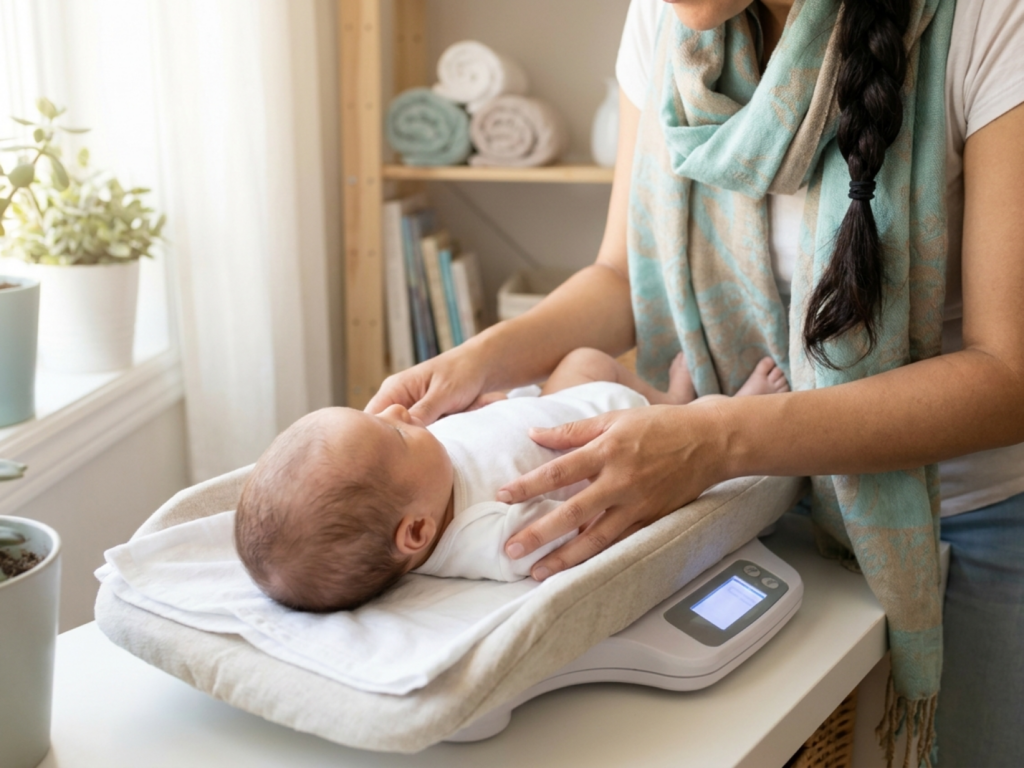
- Wash your hands and check that the scale, tray, and covering are clean and dry. Make sure the scale is on a firm, level surface.
- Turn the scale on and verify the zero reading. Place a thin sheet or paper towel on the tray if desired, then use tare so the covering is excluded.
- Undress the infant or use the same minimal clothing arrangement used for previous measurements. Remove bulky items, toys, blankets, and anything that is not part of the intended measurement.
- Lower the infant gently onto the center of the tray, supporting the head and body during placement. Keep your hand close without resting it on the scale or touching the infant in a way that adds weight.
- Keep one hand immediately available for safety and remain beside the infant. Do not allow the infant to lean against you, the wall, or another object. Calm movement may help, but never restrain the baby forcefully.
- Wait for the display to stabilize. If the infant is moving vigorously, note that the reading may be less reliable and repeat the measurement only after safely repositioning the baby.
- Record the result promptly, including the date, approximate time, clothing or diaper condition, and any relevant circumstances such as a recent feed. Lift the infant off the tray before changing settings or moving the scale.
The infant should be centered and fully supported by the weighing surface. If the baby is too active to obtain a stable measurement, stop rather than repeatedly weighing in a way that increases distress or risk. A clinician may suggest a different method or decide that the exact home number is not necessary.
Making Measurements Comparable Over Time
Consistency is more valuable than frequent weighing. Establish a schedule with the healthcare professional who requested monitoring. Daily measurements may be appropriate in some short-term situations, while in other circumstances they add little useful information. Weighing after every feed can magnify normal variation and may make it difficult to distinguish a meaningful pattern from noise.
Use one scale whenever possible. If you change devices, record the date and reason, because two scales may differ even when both are functioning correctly. Keep the scale in the same location and check the zero reading before each use. Avoid comparing a measurement taken with a full diaper and clothing to one taken without them. If a measurement seems unexpectedly different, first review the technique, units, zeroing, and recorded conditions before assuming that the infant’s weight has changed substantially.
A simple log can include the date, time, weight, scale used, diaper or clothing status, and notes about whether the infant had recently fed or passed urine or stool. Share the log rather than relying on memory. Growth is assessed through patterns over time and in relation to age, gestational age, prior measurements, and the infant’s overall condition. Your healthcare professional can determine whether a trend is clinically meaningful and whether an in-person examination is needed.
Understanding Readings and Knowing When to Seek Help
Small differences between consecutive readings are not automatically evidence of a problem. Feeding, elimination, movement, timing, and technical factors can all affect the number. Do not respond to a single low reading by changing feeding volume, frequency, formula concentration, supplements, or medications without professional guidance. Infants have individualized nutritional and medical needs, and an apparently logical adjustment can be unsafe.
Contact the infant’s healthcare professional according to the monitoring plan if the recorded trend is consistently outside the range they discussed, if measurements are repeatedly difficult to obtain, or if you are concerned about feeding or hydration. Seek prompt medical advice for markedly fewer wet diapers than expected for that infant, persistent vomiting, difficulty feeding, unusual sleepiness, worsening jaundice, breathing difficulty, fever in a young infant, or an infant who is difficult to wake. These signs require clinical assessment and should not be evaluated by scale readings alone.
Urgent or emergency care may be needed when an infant has significant breathing problems, is unresponsive, has a seizure, appears severely dehydrated, or has another acute emergency. Follow local emergency guidance. When contacting a clinician, provide the weight log, the scale model if known, the measurement conditions, feeding information, and the infant’s behavior and urine output. This context is more useful than reporting a number without its circumstances.
Safety reminders
- Never leave an infant unattended on a scale, table, counter, bed, or changing surface.
- Do not place a scale near an edge, water source, heat source, or loose electrical cord.
- Do not interpret a single reading as a diagnosis or change feeding or medication without professional advice.
- Stop weighing if the infant is rolling, slipping, highly distressed, or cannot be positioned safely.
- Seek medical care for concerning symptoms even when the home weight appears normal.
Tools & Assistance
- A dated weight log or secure health record
- A clean thin sheet or paper towel for the weighing tray
- A level, non-slip weighing location
- The scale manufacturer's instruction manual and battery information
- Your pediatrician, family doctor, midwife, health visitor, or lactation professional
FAQ
Should I weigh my baby before or after feeding?
When practical, weigh at a consistent time, preferably before a feed, because feeding and elimination can affect short-term readings. Follow the schedule and conditions recommended by your healthcare professional.
Can I weigh my baby in a diaper?
A clean diaper can be used if its weight is accounted for consistently. The key is to use comparable conditions each time and record what the infant was wearing.
How often should I use a baby scale at home?
There is no universal schedule. Use the frequency recommended for your infant's situation. More frequent measurements are not always more informative and can increase anxiety.
What should I do if the reading seems wrong?
Check the units, battery, surface stability, zero or tare setting, covering, and infant position. Repeat only when it is safe, and contact a healthcare professional if the result remains concerning or inconsistent.
Is a home baby scale a replacement for pediatric appointments?
No. A scale provides one measurement. Clinical care also considers examination findings, feeding, hydration, growth patterns, development, and other relevant history.
Sources
- American Academy of Pediatrics — Anthropometric Measurements
- Cambridge University Hospitals NHS Foundation Trust — Measuring weight and length at home for an infant less than two years old
- NSW Health — Guide to accurately weighing children using infant scales
Disclaimer
This article is for general informational purposes and does not provide medical diagnosis or treatment. Consult your baby's healthcare professional for individualized advice, and seek urgent care for emergency symptoms.
















Please log in to leave a comment.