
Intro
Tracking your baby’s growth at home can help you notice patterns, prepare useful questions, and share consistent information at health visits. It is understandable to feel reassured by a gain in weight or worried by a measurement that seems unexpected. A single number, however, rarely tells the whole story: clinicians interpret serial measurements in relation to age, sex, prematurity, feeding history, overall health, and the baby’s growth trajectory.
This guide explains how to measure weight and length as consistently as possible, how to record results, how growth charts are used, and when to contact a healthcare professional. Home measurements are complementary to routine clinical assessment, not a replacement for it.
Highlights
Use consistent conditions for each measurement, including similar timing, clothing, and equipment.
Weight and recumbent length are useful at home; head circumference is usually best measured by a trained healthcare professional.
Growth is interpreted from patterns over time rather than from one percentile or one home measurement.
Bring your records to the baby’s clinician, especially if feeding, wet diapers, illness, or activity has changed.
What baby growth measurements can tell you
Infant growth is commonly assessed using weight, recumbent length, and head circumference. Weight reflects total body mass and can respond relatively quickly to changes in intake, hydration, or illness. Recumbent length is measured while the baby is lying down and reflects linear growth. Head circumference, measured around the largest part of the head, helps clinicians monitor cranial growth and is generally obtained during scheduled health visits because small positioning errors can affect the result.
Growth assessment is longitudinal. A clinician may consider the absolute measurement, the rate of change, proportionality between weight and length, and whether the baby is following an established pattern. A baby who is smaller or larger than average may be healthy, while an abrupt change across measurements may deserve review. Premature infants may be assessed using corrected age for a period of time, so ask the healthcare professional which age should be used when interpreting the chart.
Home tracking is most useful when it supplies dependable observations rather than frequent reassurance-seeking measurements. Measuring repeatedly within short intervals can make ordinary scale variation appear clinically meaningful and may increase anxiety without improving decision-making.
How to weigh your baby at home
An infant scale designed for babies is generally the most practical option. If one is unavailable, some healthcare guidance describes weighing an adult alone and then weighing the adult while holding the baby, followed by calculating the difference. This method is less precise, so it should be used consistently and discussed with the baby’s clinician.
- Place the scale on a firm, level surface and check that it is set to zero before use.
- Remove bulky clothing, shoes, blankets, and diapers when feasible. Keep the conditions similar each time, while maintaining warmth and supervision.
- Put the baby centrally on the scale and keep one hand close without pressing on the platform. Never leave the baby unattended, even briefly.
- Wait for the display to stabilize and record the result in kilograms, ideally to the precision supported by the scale.
- If the result seems unexpected, repeat the measurement once or twice after checking the scale position. If repeated values are close, record the measurement and the conditions rather than repeatedly reweighing.
For comparability, measure at a similar time of day, before a feed when practical, and with similar clothing or no clothing. A feed, recent urine or stool, and clothing can all influence the displayed weight. Do not attempt to estimate clinical change from different scales unless the clinician knows that the equipment changed.
Record the date, time, scale used, clothing or diaper status, and any relevant context such as recent feeding, vomiting, diarrhea, or illness. These details can help a clinician distinguish a real trend from normal measurement variability.
How to measure infant length accurately
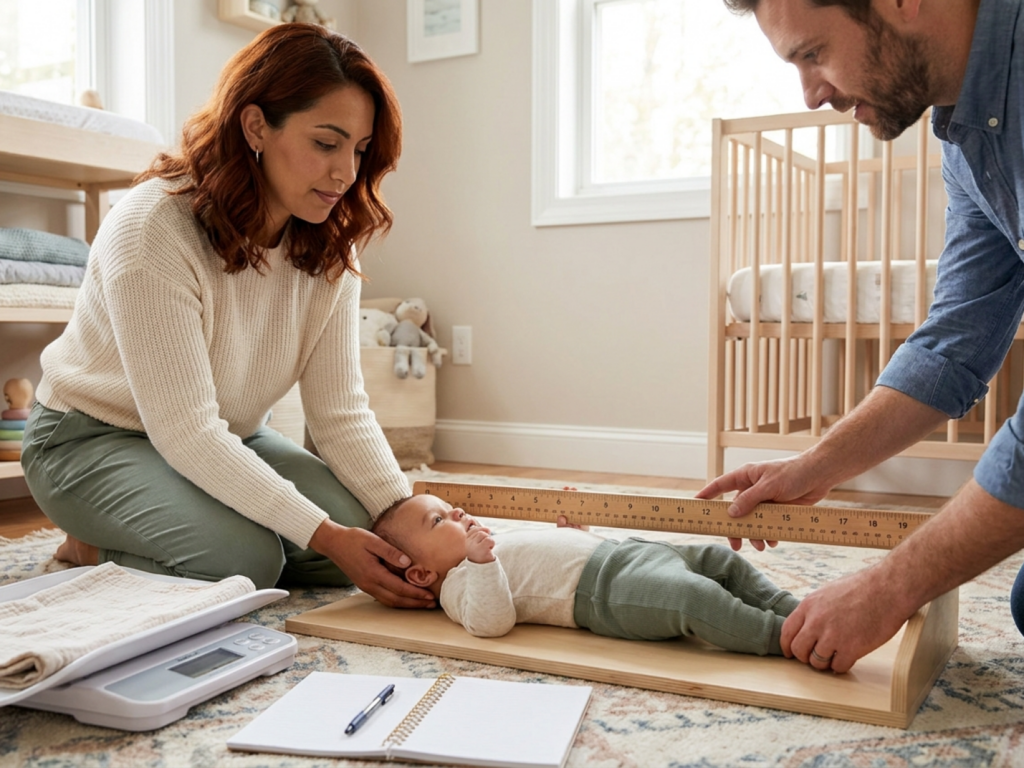
Infant length should be measured with the baby lying flat on a firm surface. Two adults make the task easier: one stabilizes the head and the other positions the legs and reads the measurement. Avoid measuring on a soft bed, changing mat, or uneven surface, where the body can curve and the reading can be distorted.
- Use a length board if available. Otherwise, place a rigid measuring surface alongside the baby, with a fixed object at the head and a movable right-angled object at the feet.
- Lay the baby on the back with the crown of the head gently touching the fixed headpiece. Keep the head facing upward and the neck in a neutral position.
- Ask the second adult to hold the legs together and gently extend them. Babies often flex their knees, so use steady, gentle positioning rather than force.
- Bring the footpiece firmly against the soles, keeping it perpendicular to the measuring surface.
- Read and record the length in centimetres. Repeat the measurement if positioning was difficult or the value does not seem plausible.
Length is sensitive to technique. A curved back, turned head, bent knees, or an angled footpiece can change the result by more than expected day-to-day growth. Do not compare a lying-down length measurement directly with a standing height measurement. Once children are old enough to stand reliably, clinicians use a different technique and may monitor height instead.
Home measurement of head circumference is easy to perform inconsistently because the tape must pass over specific anatomical landmarks. If you are concerned about head size or a change in head growth, ask a healthcare professional to measure it rather than relying on a home estimate.
Keep a useful growth record
A simple dated record is more valuable than a long list of isolated numbers. Use a notebook, spreadsheet, or secure health-record application and keep the original values rather than rounding them to a preferred percentile. Include:
- date and approximate time;
- weight in kilograms and length in centimetres;
- equipment and measurement conditions;
- feeding pattern and any notable feeding difficulty;
- wet and soiled diaper patterns when relevant;
- vomiting, diarrhea, fever, respiratory symptoms, or other illness;
- medications or supplements already recommended by a clinician; and
- the baby’s age, gestational age at birth, and corrected age if applicable.
Growth measurements over time should be stored with appointment dates and clinician-entered measurements so differences in technique are visible. A feeding and diaper log can provide important context, but it should not become a test that you feel compelled to complete perfectly. Focus on meaningful changes, such as a sustained reduction in intake, fewer wet diapers than usual, repeated vomiting, or unusual sleepiness.
Share the record at appointments or through the healthcare service’s approved patient portal. A clinician may prefer to use measurements obtained in the clinic for formal decisions, while using home observations to identify questions and decide whether an earlier assessment is appropriate.
Understand growth charts and percentiles
Clinicians commonly use the WHO Child Growth Standards for infants and young children. Depending on age and clinical context, measurements may be plotted as weight-for-age, length-for-age, weight-for-length, or body mass index-for-age. The chart compares a measurement with a reference population; it does not label a baby as healthy or unhealthy by itself.
A percentile describes relative position on the chart. For example, a measurement near the 25th percentile is lower than many reference measurements and higher than others. It is not a grade, and a lower or higher percentile is not automatically a problem. More important questions include whether the measurement is plausible, whether the baby’s proportions are consistent, and whether the trajectory is broadly stable.
Growth velocity means the rate of growth over a defined interval. It is usually more informative when calculated from accurate serial measurements taken far enough apart to reveal a meaningful trend. A temporary plateau during illness may have a different significance from a persistent change in weight-for-length or length-for-age. Clinicians also consider familial body size, birth history, nutrition, medical conditions, and developmental observations.
Online percentile calculators can be useful for orientation but cannot replace professional plotting and interpretation. Avoid comparing your baby with siblings, friends’ babies, social-media charts, or adult body-size expectations. If a clinician has explained a particular growth pattern, use that individualized interpretation rather than trying to reinterpret every new home value independently.
When to contact a healthcare professional
Contact the baby’s healthcare professional if you notice a sustained reduction in feeding, repeated vomiting, ongoing diarrhea, substantially fewer wet diapers, difficulty waking the baby for feeds, marked lethargy, breathing difficulty, or any concern that the baby is becoming acutely unwell. For very young infants, especially newborns, seek advice promptly when feeding or hydration seems abnormal because deterioration can occur quickly.
Arrange a growth review when several reliable measurements suggest little or no expected gain, a notable downward shift in weight or length, or a discrepancy between home measurements and the baby’s clinical appearance. Bring the scale details and written record. The clinician may repeat the measurement, assess hydration and feeding, review the physical examination, and decide whether additional follow-up is needed.
Do not respond to a concerning number by changing formula concentration, starting supplements, restricting feeds, or giving treatment without professional guidance. Nutritional needs vary with age, medical history, feeding method, and prematurity. A single low reading may reflect equipment or positioning, but a pattern deserves assessment.
Parents can also seek help for the emotional burden of monitoring. Feeling worried does not mean you are overreacting, and you do not need to interpret every fluctuation alone. The goal of home tracking is informed communication and timely care, not perfect control of the growth curve.
Seek prompt medical advice
- Marked sleepiness, difficulty waking, breathing difficulty, or a baby who appears acutely unwell
- Repeated vomiting, persistent diarrhea, or substantially fewer wet diapers than usual
- A sustained feeding reduction or inability to complete feeds
- Several reliable measurements suggesting poor gain or a rapid downward change
- Any concern about dehydration, especially in a newborn or young infant
Tools & Assistance
- Infant scale placed on a firm, level surface
- Length board or two-adult flat-surface measuring setup
- Dated notebook or secure digital growth record
- Feeding and diaper log for relevant clinical context
- Routine pediatric, family medicine, or child health appointments
FAQ
How often should I weigh my baby at home?
There is no universal schedule. Follow the plan from your healthcare professional. Frequent weighing can be useful for a specific clinical reason but may create confusing fluctuations when done without guidance.
Should I weigh my baby before or after feeding?
For consistency, weighing before a feed is often recommended when practical. Use similar timing and clothing conditions each time, and record the conditions so the clinician can interpret the result.
What if my baby’s percentile goes down?
Do not interpret a percentile change in isolation. Check the measurement technique and share serial values with the clinician, who can assess growth velocity, weight-for-length, feeding, hydration, and overall health.
Can I measure my baby’s head circumference at home?
You can ask a clinician to demonstrate the technique, but home measurements are easy to position incorrectly. Concerns about head growth should be assessed with a professionally obtained measurement.
Are growth charts the same for premature and full-term babies?
Interpretation may differ for premature infants, including use of corrected age and specialized follow-up. Ask the baby’s clinician which chart and age calculation apply.
Sources
- Cambridge University Hospitals NHS Foundation Trust — Measuring weight and length at home for an infant less than two years old
- Leicester Hospitals NHS Trust — Guide to weighing and measuring your child at home to check their growth
- World Health Organization — The WHO Child Growth Standards
Disclaimer
This article is for general educational information and does not diagnose, treat, or replace advice from a qualified healthcare professional. Contact your baby’s clinician promptly about concerning symptoms or changes in feeding, hydration, or growth.















Please log in to leave a comment.