
Intro
Baby size varies widely, and a single measurement rarely tells the whole story. Newborn weight, recumbent length, and head circumference are interpreted in relation to gestational age, sex, feeding history, family traits, and the pattern of measurements over time.
This article explains commonly used size ranges and how clinicians interpret them. The figures are reference points rather than targets. A baby who is smaller or larger than average may be healthy, particularly when growth follows an individual curve and the baby is feeding, alert, and developing as expected.
Highlights
Most healthy babies fall within a broad range of birth weights, lengths, and head circumferences.
Growth charts are designed to show patterns and percentiles, not to define one ideal baby size.
Weight, length, and head circumference should be interpreted together and measured accurately.
Premature infants are usually assessed using gestational age and corrected age.
A noticeable change in growth trajectory deserves discussion with a pediatric healthcare professional.
What “typical baby size” means
“Typical” does not mean average, and average does not mean optimal for every infant. In clinical practice, baby size is described using anthropometric measurements: body weight, recumbent length, and head circumference. These values are plotted on age- and sex-specific growth charts, commonly using the World Health Organization (WHO) Child Growth Standards for children from birth to 60 months.
A percentile describes how a measurement compares with those of a reference population. For example, a baby at the 25th percentile for weight is heavier than approximately 25% of babies of the same age and sex in the reference group, and lighter than approximately 75%. Percentiles are not school grades. A baby at the 10th percentile may be healthy, as may a baby at the 90th percentile, provided the overall pattern is appropriate.
Clinicians look especially closely at the trajectory across multiple visits. A stable pattern may be reassuring even when measurements remain below or above the median. Conversely, a substantial crossing of percentile lines, particularly when accompanied by feeding difficulty, illness, or developmental concerns, may require further evaluation.
Typical newborn weight ranges
For a full-term newborn, birth weight is often approximately 2.5 to 4.0 kilograms, or about 5 pounds 8 ounces to 8 pounds 13 ounces. Many healthy term babies fall outside this interval. Birth weight is influenced by gestational age, placental function, parental body size, genetics, fetal growth conditions, and maternal health. A baby born at 37 weeks should not be compared directly with one born at 41 weeks without considering the difference in gestational age.
Newborns commonly lose some weight during the first several days after birth as they adjust to feeding and fluid balance. The extent and duration of weight loss depend on factors such as delivery method, feeding effectiveness, urine and stool output, and medical conditions. Most infants begin regaining weight soon afterward and return to birth weight during the first couple of weeks, although the timing varies. A pediatric or maternity care professional should assess weight loss that is pronounced, persistent, or associated with poor feeding or reduced urine output.
During early infancy, weight gain is often relatively rapid. A broad clinical rule is that many babies approximately double their birth weight by around 4 to 6 months and triple it by about 12 months, but these are rough milestones rather than requirements. The article Average baby weight by age can provide additional context, while an individual clinician can interpret a baby’s measurements in relation to feeding and medical history.
Typical length and head circumference
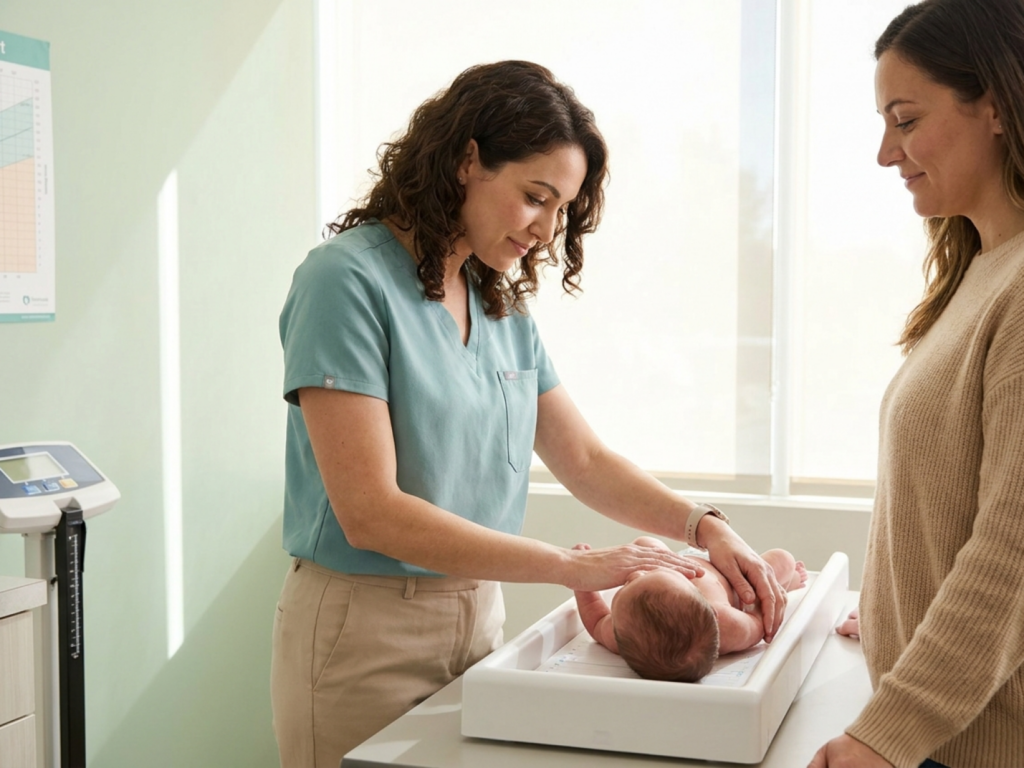
Term newborns commonly measure about 46 to 55 centimeters in recumbent length, with many clustering around 49 to 51 centimeters. Recumbent length is measured lying down because infants cannot reliably stand. Small differences in positioning, a flexed knee, or an incorrectly aligned measuring board can change the result, so length is best obtained by trained staff using a firm infant length board.
Length generally increases quickly during the first year, although the rate is not perfectly linear. Many infants gain roughly 20 to 25 centimeters in length between birth and 12 months. This estimate is intentionally broad: an infant’s genetic potential, gestational age, nutritional status, and health all influence the pattern. Average baby height by age is usually discussed as length in babies younger than 2 years because standing height is not yet the standard measurement.
Head circumference, measured around the largest circumference of the skull, is used as an indirect marker of brain and skull growth. A typical term newborn head circumference is approximately 32 to 37 centimeters. The measurement must be taken with a nonstretchable tape positioned consistently above the eyebrows and around the most prominent part of the back of the head. One isolated value is less informative than serial measurements recorded with careful technique. Head circumference should be interpreted alongside weight, length, neurological findings, and the baby’s overall clinical state.
How babies usually change during the first year
Growth is fastest during the newborn period and early infancy, then gradually slows. In the first few months, many babies gain weight steadily and become visibly longer. By the middle of the first year, growth velocity usually begins to decline. After approximately 6 months, changes in feeding, activity, intercurrent illness, and the introduction of complementary foods can affect the rate of weight gain.
There is no requirement for weight, length, and head circumference to remain on the same percentile. Some infants are naturally leaner or more compact, while others are longer or have a larger head circumference in keeping with family patterns. Clinicians therefore assess proportionality using indices such as weight-for-length, rather than relying on weight alone. A baby with a high weight percentile may be proportionate if length is also high; the same weight may have a different significance when length is much lower.
Growth measurements in babies explained in detail can help caregivers understand why accurate technique and repeated measurements matter. Home scales and informal length measurements may be useful for limited orientation, but they should not replace standardized clinical measurements. Differences of a few hundred grams or a centimeter may reflect equipment, clothing, timing, or positioning rather than a true biological change.
Using WHO standards and percentiles
The WHO standards describe how healthy children are expected to grow under conditions intended to support optimal growth. They include weight-for-age, length-for-age, weight-for-length, weight-for-height, and body mass index-for-age references. For infants, length-for-age can help identify a pattern of reduced linear growth, while weight-for-length helps assess whether weight is proportionate to body size.
Clinicians may also use z-scores, which express how far a measurement is from the reference median in standard deviation units. Percentiles are often easier for families to understand, whereas z-scores can be more useful for identifying the magnitude of deviation and monitoring change. Neither method makes a diagnosis by itself.
Growth Differences between babies are common and often reflect normal biology. What matters is whether the infant’s trajectory is coherent, whether measurements are internally consistent, and whether the clinical context supports healthy growth. A clinician may review feeding frequency and effectiveness, vomiting or diarrhea, stool and urine output, sleep and activity, chronic symptoms, medication exposure, and family growth patterns before deciding whether follow-up is needed.
Prematurity, corrected age, and special context
Premature infants should generally be assessed according to gestational age and, after birth, corrected age. Corrected age is calculated by subtracting the number of weeks born before 40 weeks from the infant’s chronological age. For example, a baby who is 16 weeks old but was born 8 weeks early has a corrected age of approximately 8 weeks. This adjustment helps avoid interpreting expected prematurity-related differences as abnormal growth.
Growth assessment in a preterm infant may also involve specialized preterm charts during the early postnatal period, followed by transition to standard infant charts according to local clinical practice. The timing depends on gestational age, birth circumstances, medical complications, and the healthcare team’s approach. Infants with complex medical needs may require more frequent measurements and assessment of fluid status, nutrition, and organ function.
Other contexts also affect interpretation. A newborn who is small for gestational age, a baby with a large or small family pattern, and an infant recovering from illness may each have a different expected trajectory. Corrected age for preterm babies and premature infant growth follow-up are useful topics to discuss directly with the child’s pediatric team rather than applying a generic chart without context.
When to seek professional advice about growth
Contact a healthcare professional when a baby is difficult to wake for feeds, consistently feeds poorly, vomits repeatedly, has markedly fewer wet diapers, appears dehydrated, or is losing weight rather than beginning to regain it after the expected newborn period. Prompt assessment is also appropriate when a baby has persistent diarrhea, breathing difficulty, fever in a young infant, unusual lethargy, or a sudden change in behavior.
Growth-related follow-up is particularly important when measurements repeatedly fall away from the established trajectory, weight-for-length is concerning, or head circumference changes faster or slower than expected. These findings do not establish a diagnosis. They indicate that accurate repeat measurements and a clinical review may be useful.
Caregivers can support an effective appointment by bringing prior growth records and noting feeding, wet diapers, stools, vomiting, and relevant symptoms. Avoid comparing a baby’s size with siblings, online averages, or clothing sizes as a substitute for professional interpretation. A short-interval weight check may be recommended in some situations, but the timing should be determined by the healthcare team.
When to get medical advice
- Seek prompt care for a young infant with fever, marked lethargy, breathing difficulty, or difficulty waking for feeds.
- Ask a healthcare professional about persistent poor feeding, repeated vomiting, or substantially fewer wet diapers.
- Do not interpret a single percentile or home measurement as a diagnosis.
- Discuss a clear drop across growth-chart percentiles or a sudden change in growth pattern.
- Use corrected age when considering growth in a premature infant.
Tools & Assistance
- Bring the baby’s personal health record and previous growth-chart measurements to appointments.
- Keep a brief newborn feeding and diaper log when feeding or hydration is a concern.
- Ask the clinic to explain weight-for-age, length-for-age, and weight-for-length together.
- Request a standardized repeat measurement if a result seems unexpected.
- Use the WHO Child Growth Standards as a reference, with interpretation from a healthcare professional.
FAQ
What is the average size of a newborn?
Many full-term newborns weigh about 2.5 to 4.0 kilograms and measure about 46 to 55 centimeters long. Healthy babies may be smaller or larger, and gestational age is essential when interpreting these measurements.
Is the 50th percentile the healthiest size?
No. The 50th percentile is the median of a reference population, not a health target. Babies can be healthy across a wide range of percentiles when growth is consistent and proportional.
Should premature babies be compared with full-term babies?
Premature babies are usually assessed using gestational age and corrected age, sometimes with specialized charts. Their growth should be interpreted by clinicians familiar with prematurity and the infant’s medical history.
Why can weight and length percentiles differ?
Weight and length measure different aspects of growth, and they do not need to track at the same percentile. Weight-for-length helps clinicians evaluate proportionality rather than focusing on weight alone.
How often should a baby be weighed?
Routine weighing occurs at scheduled healthcare visits, with additional checks when clinically indicated. Frequent home weighing can increase anxiety and may be misleading if equipment or technique varies.
Sources
- World Health Organization — WHO child growth standards: length/height-for-age, weight-for-age, weight-for-length, weight-for-height and body mass index-for-age: methods and development
- World Health Organization — WHO Child Growth Standards
- MedlinePlus — Growth chart: MedlinePlus Medical Encyclopedia
Disclaimer
This article is for general educational purposes and does not diagnose, treat, or replace advice from a qualified healthcare professional. Seek medical care for urgent symptoms or concerns about a baby’s feeding, hydration, or growth.














Please log in to leave a comment.