
Intro
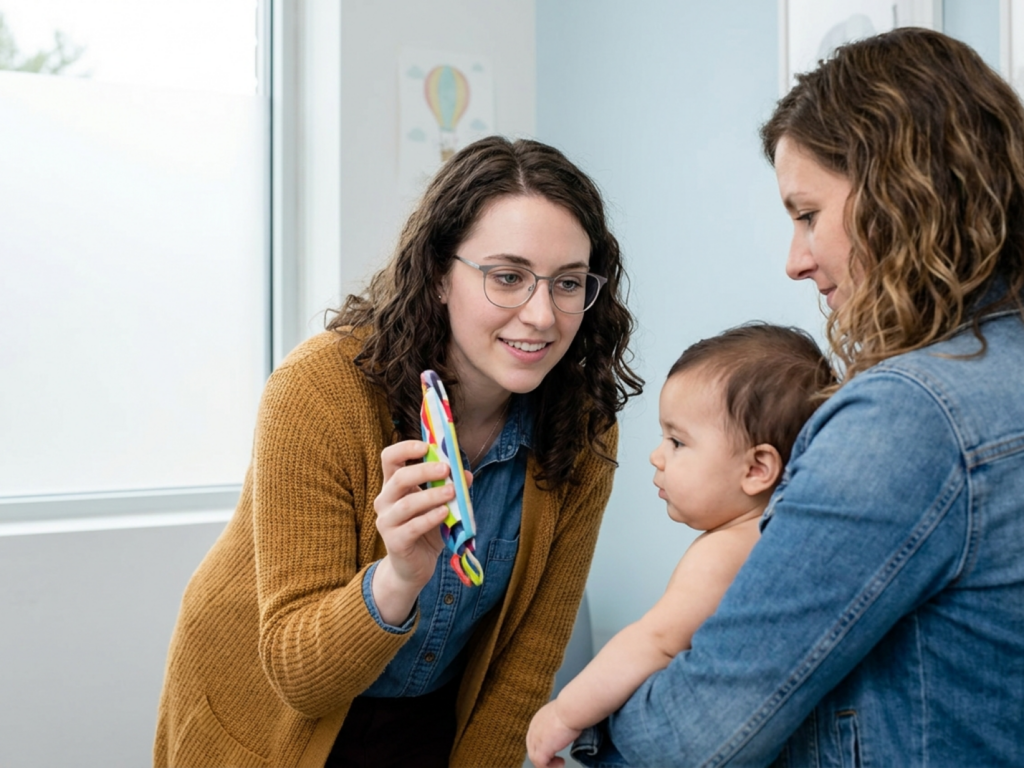
A baby’s stare can feel intense, sweet, funny, or even a little unsettling. Many caregivers wonder whether the baby is recognizing them, studying them, asking for something, or simply zoning out. In most cases, staring is a normal part of early visual, neurological, and social development.
Highlights
Babies are biologically drawn to faces, especially eyes and direct gaze, from the newborn period.
Staring often reflects early social attention, visual learning, curiosity, and developing brain networks rather than a deliberate judgment.
A baby may stare longer when a face is familiar, emotionally expressive, high contrast, moving, or paired with a familiar voice.
Most staring is harmless, but changes in alertness, abnormal eye movements, developmental regression, or poor visual tracking should be discussed with a clinician.
Staring is often early social attention
When babies stare at people, they are often doing something neurologically sophisticated: orienting toward the most informative stimulus in the room. Human faces carry dense social information, including eye direction, mouth movement, emotional expression, voice matching, and predictable patterns of response. Even before babies can speak or intentionally point, looking is one of their main tools for taking in the social world.
Research on newborn gaze suggests that infants are not neutral observers of all visual patterns. From very early in life, babies show a preference for faces that appear to engage them with direct gaze. This does not mean a newborn understands eye contact in the adult sense. It means the infant nervous system is already tuned to notice face-like stimuli and socially relevant cues, especially eyes that seem directed toward them.
For caregivers, this can feel deeply personal. A baby may stare quietly while being held, during feeding, or when someone speaks in a warm voice. That gaze may be part of an early reciprocal loop: the adult looks, smiles, talks, pauses, and the baby watches. Over time, these repeated exchanges help organize attention, emotional regulation, and social expectation. Staring is not merely passive; it can be part of the earliest form of social participation.
Why eyes and faces are so compelling
Faces are unusually rich visual targets. They have contrast, symmetry, movement, and repeated patterns that the developing visual system can process. The eyes are particularly salient because they change direction, open and close, widen with emotion, and often predict what will happen next. A caregiver’s eyes may be followed by a smile, a feeding cue, a song, or a gentle touch.
Newborn studies have found that babies may look longer at faces with direct eye contact than at faces with a faraway gaze. This supports the idea that babies are sensitive not only to faces, but also to whether a person appears to be addressing them. In practical terms, a baby may stare because the face in front of them is not just visually interesting; it is socially relevant.
Vision also develops rapidly during infancy. Newborns see best at close range, which happens to be the distance between a baby’s face and a caregiver’s face during holding or feeding. High-contrast areas such as eyes, eyebrows, lips, and the hairline can be easier to notice than subtle background details. As visual acuity and contrast sensitivity improve, babies may spend longer studying facial features, tracking movement, and comparing familiar and unfamiliar faces.
Staring can support bonding and learning
Caregiver-infant social interactions often unfold through small, repeated signals. A baby looks; the adult responds. The adult smiles; the baby watches. The adult speaks; the baby studies the face and voice together. These patterns are sometimes described as serve-and-return exchange because the infant initiates or responds, and the caregiver returns a matched, emotionally attuned response.
Mutual gaze can help babies learn that people are responsive and predictable. It may also support emotional co-regulation, meaning the caregiver’s calm face, voice, rhythm, and touch help the baby’s immature nervous system settle. For a medically literate reader, it may be helpful to think of staring as one observable behavior within a broader system involving sensory processing, autonomic regulation, attachment behavior, and early social cognition.
As infants mature, gaze becomes more coordinated. They begin to shift attention between a caregiver and an object, follow another person’s gaze, and eventually participate in joint attention. Joint attention is the shared focus between baby and adult on the same object or event, and it is an important foundation for language and social learning. A baby who stares at your face may be gathering cues about whether something is safe, interesting, surprising, or emotionally meaningful.
Why babies stare at strangers or certain people
Babies may stare at strangers because novelty demands more processing. A familiar caregiver’s face has been seen many times; a new person’s face may include unfamiliar patterns of movement, voice, smell, facial expression, glasses, facial hair, or posture. The baby may pause and stare while the brain compares this new information with stored expectations.
This does not always mean the baby likes or dislikes the person. In early infancy, staring may simply reflect curiosity and sensory intake. Later in infancy, as recognition memory and attachment hierarchy strengthen, babies may stare at unfamiliar people and then look back to a trusted caregiver for reassurance. This can overlap with stranger wariness in infancy, a normal developmental pattern in which babies become more selective about unfamiliar adults.
Some babies also stare more at people who are animated, expressive, or responsive. A person who uses infant-directed speech, pauses for the baby, mirrors facial expressions, or maintains gentle eye contact may be especially engaging. Other babies prefer quieter interaction and may look away if a face is too close, too loud, or too intense. Temperament matters: one observant baby may hold a long gaze, while another may glance briefly and then turn away to regulate stimulation.
When staring means the baby needs a break
Staring is not always a request for more interaction. Sometimes it is the opposite: a baby may freeze, widen the eyes, look fixedly, or become still when overstimulated. Infants have immature sensory and autonomic regulation, so bright light, loud voices, multiple people, strong smells, or rapid handling can become too much. A prolonged stare with tense body posture may be a sign that the baby is working hard to process the environment.
Helpful caregiver responses are usually simple and noninvasive. Lower your voice, soften your face, pause stimulation, reposition the baby, or offer a familiar rhythm such as gentle rocking. If the baby turns away, yawns, hiccups, arches, fusses, splays the fingers, or avoids eye contact, those may be cues to reduce input. Respecting these cues supports early self-regulation and helps the baby learn that their signals matter.
It is also useful not to overinterpret every stare. Adults naturally search for meaning in infant behavior, but babies do not yet have adult intentions, social judgments, or stable preferences. A stare may mean interest, fatigue, visual fixation, recognition, surprise, or the beginning of a social exchange. The best response is usually warm observation: notice the baby’s whole pattern, including breathing, tone, color, movement, feeding, sleep, and responsiveness.
Medical and developmental caution
Most staring at people is developmentally expected, but certain patterns should prompt discussion with a pediatrician, pediatric ophthalmologist, or developmental specialist. The concern is not ordinary eye contact or curiosity. The concern is staring that occurs with altered awareness, unusual eye movements, poor visual behavior, regression, or other neurological signs.
Seek professional guidance if staring episodes are difficult to interrupt, occur with rhythmic movements, color change, limpness, stiffening, abnormal breathing, repeated vomiting, or marked sleepiness afterward. Also mention concerns if the baby does not visually track faces or objects as expected for age, persistently turns one eye inward or outward, has cloudy pupils, shows abnormal light sensitivity, or seems not to respond to faces, voices, or social cues over time.
Developmental screening is designed for exactly this kind of uncertainty. Parents do not need to diagnose the cause of a behavior before asking for help. A clinician can place the staring in context with gestational age, birth history, vision, hearing, feeding, growth, sleep, neurological examination, and developmental milestones. If everything is normal, reassurance can be valuable. If evaluation is needed, early identification can improve support for the baby and family.
How to respond to a baby’s stare
A baby’s stare is an invitation to slow down and observe. You can respond with a calm face, gentle eye contact, soft speech, and pauses that allow the baby to answer with their own movements or sounds. This is especially useful during feeding, diapering, holding, and quiet alert periods, when the baby is awake but not overwhelmed.
Try simple serve-and-return interaction. Smile, wait, speak briefly, wait again, and notice whether the baby brightens, moves, vocalizes, or looks away. If the baby stays engaged, continue. If they avert their gaze or become fussy, reduce stimulation. This approach respects both social learning and infant sensory limits.
Caregivers can also protect themselves from unnecessary worry. Babies stare because their brains are learning from people. They stare at faces, expressions, shadows, movement, and novelty. They may stare at a parent with deep calm one moment and stare at a ceiling fan the next. The behavior is meaningful, but not always in a complicated way. In most cases, it is a normal sign of a baby using vision and attention to understand the human world.
When to seek advice
- Staring episodes are hard to interrupt or are followed by unusual sleepiness.
- Staring occurs with stiffening, limpness, rhythmic jerking, color change, or abnormal breathing.
- The baby does not seem to track faces, lights, or objects as expected for age.
- One or both eyes appear persistently misaligned, cloudy, or unusually sensitive to light.
- There is developmental regression, loss of social responsiveness, or a major change from the baby’s usual behavior.
Tools & Assistance
- Write down when staring happens, how long it lasts, and whether the baby responds to voice or touch.
- Record a short video of concerning episodes to show the pediatrician.
- Ask about vision screening if the baby does not track faces or objects well.
- Discuss developmental screening if staring occurs with reduced social responsiveness or regression.
- Use calm serve-and-return interaction during quiet alert periods.
FAQ
Is it normal for babies to stare at people?
Yes. In most cases, staring is normal social and visual learning. Babies are especially drawn to faces, eyes, movement, and familiar voices.
Does a baby staring mean they recognize me?
It may. Familiar faces, voices, smells, and caregiving routines can hold a baby’s attention, but staring can also reflect novelty, curiosity, or sensory processing.
Can too much eye contact overwhelm a baby?
Sometimes. If the baby turns away, stiffens, fusses, yawns, or seems tense, pause and reduce stimulation. Looking away can be a healthy self-regulation cue.
When should I worry about staring?
Ask a clinician if episodes are hard to interrupt, occur with abnormal movements or breathing, or if the baby has poor visual tracking, developmental regression, or reduced responsiveness.
Sources
- Proceedings of the National Academy of Sciences — Eye contact detection in humans from birth
- Scientific Reports — Newborns are sensitive to a direct versus a faraway gaze
- PubMed Central — On Privileging the Role of Gaze in Infant Social Cognition
Disclaimer
This article is for educational purposes only and does not replace medical evaluation. If you are concerned about your baby’s vision, awareness, movements, or development, consult a qualified healthcare professional.

















Please log in to leave a comment.