
Intro
Moving from purees to family foods is a gradual learning process rather than a single milestone. Babies are developing oral-motor skills, sensory tolerance, hand-to-mouth coordination, and confidence while continuing to receive most of their nutrition from breast milk or infant formula during the early complementary-feeding period.
Texture progression should follow developmental readiness and proceed at a pace that is appropriate for the individual child. The goal is not to eliminate purees quickly, but to offer increasingly varied textures safely, responsively, and with close supervision.
Highlights
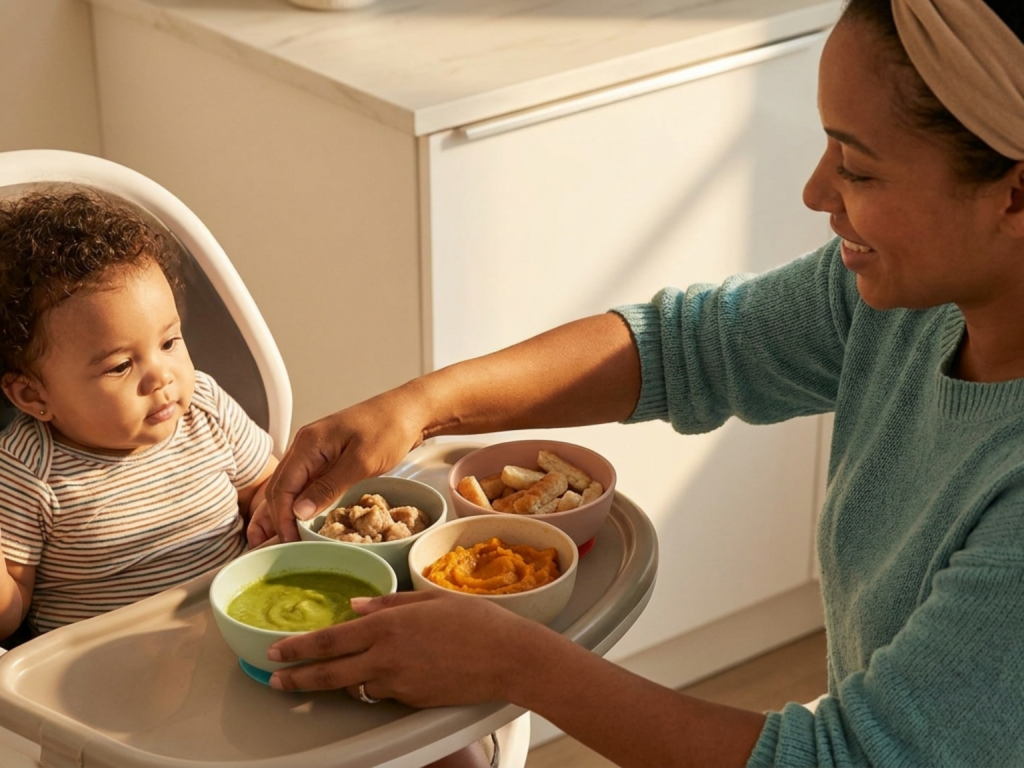
Texture progression usually moves from smooth purees to thicker purees, mashed or lumpy foods, dissolvable solids, soft finger foods, and appropriately modified family foods.
Readiness cues, including stable sitting and coordinated interest in food, matter more than a rigid timetable.
Small, gradual texture changes help babies practise chewing patterns, tongue movement, and controlled swallowing.
Family foods can often be adapted by cooking them until soft, removing hazards, and changing their shape or consistency.
Any concern about coughing, choking, recurrent vomiting, poor intake, or feeding skill should be discussed with a qualified healthcare professional.
Why Texture Progression Matters
Complementary feeding is both a nutritional transition and a period of neuromotor learning. A smooth puree requires relatively little chewing, whereas thicker, lumpy, and solid textures require the baby to use the tongue, jaw, lips, and cheeks in increasingly coordinated ways. These actions contribute to oral-motor coordination in infant feeding, including moving food laterally, forming a bolus, and transporting it safely toward the pharynx.
Texture exposure also has a sensory dimension. Babies encounter differences in temperature, moisture, resistance, shape, and taste. A baby may accept a familiar flavour in a smooth form but initially reject the same food when it is mashed or minced. This does not necessarily indicate a problem; repeated, pressure-free exposure can support acceptance.
Breast milk or infant formula generally remains an important source of energy and nutrients as solids are introduced. The early objective is skill-building and dietary expansion, not replacing milk feeds abruptly. Iron-rich complementary foods, such as appropriately prepared meat, beans, lentils, eggs, or iron-fortified foods, are particularly important to include according to individual clinical and dietary circumstances.
Recognising Readiness for Texture Changes
Readiness is a combination of postural stability, motor control, interest, and the ability to manage food. Common signs include sitting upright with support or independently as developmentally appropriate, maintaining head and neck control, reaching for food, bringing objects to the mouth, and showing improved coordination between seeing, grasping, and mouthing. A baby should be alert and able to participate in a supervised feeding experience.
Readiness does not mean that a baby will immediately manage every texture. A child may be ready to begin complementary foods but still need time to learn how to handle thicker consistencies. Caregivers can watch for the baby’s cues and introduce one manageable change at a time. Feeding in an upright, well-supported position is essential, and the baby should remain within the caregiver’s direct reach and visual supervision.
Prematurity, neuromotor differences, craniofacial conditions, reflux-related complications, or previous feeding difficulties may alter the expected sequence. In these situations, an individualized plan from a pediatrician, speech-language pathologist, occupational therapist, or registered dietitian may be more appropriate than a general age-based guide.
A Practical Sequence From Purees to Solids
Many feeding programs describe a broad progression from runny smooth purees to thicker smooth purees, mashed or lumpy foods, dissolvable solids, and later soft table foods. The stages overlap, and babies may continue to eat more than one texture at the same meal or on the same day.
- Runny smooth purees: These may be offered when a baby is beginning complementary feeding and has demonstrated readiness. The consistency is uniform and flows easily from a spoon.
- Thicker smooth purees: Gradually reducing added liquid creates more resistance and encourages the baby to manage a denser bolus. Foods can be blended less finely while remaining free of hard pieces.
- Mashed and lumpy foods: Soft foods can be mashed with a fork rather than fully blended. Small, soft lumps encourage tongue movement and early munching. The texture should be moist and easy to squash between fingers.
- Dissolvable and soft finger foods: Appropriately selected foods that soften readily in the mouth can support grasping, self-feeding, and hand-to-mouth coordination. Pieces should be large enough for a baby to hold initially and prepared so they do not remain hard or brittle.
- Modified family foods: As skills improve, a baby can share components of family meals when they are soft, appropriately shaped, low in added salt and sugar, and free from choking hazards.
Progression is not a race. It is reasonable to offer a familiar texture alongside a new one, allowing the baby to participate without hunger, fatigue, or pressure becoming the main features of the meal.
Adapting Family Foods Safely
Family meals can often be modified instead of preparing a completely separate menu. Before adding salt, spicy sauces, or other ingredients intended for adults, set aside a baby-appropriate portion. Cook vegetables until they are soft, shred or flake tender meat and fish, mash beans, and soften grains with a suitable liquid. Remove bones, gristle, tough skin, pits, and other inedible parts.
Shape and consistency are as important as the ingredient itself. A hard raw vegetable, whole nut, firm piece of meat, or round food may obstruct the airway even when it is nutritious. Avoid foods that are hard, sticky, rubbery, small and round, or difficult to break apart. Grapes and similar round foods require specific preparation, and foods such as nut butter should not be offered in thick spoonfuls. A clinician or trusted national infant-feeding resource can provide current, detailed choking-prevention guidance.
Soft finger foods for babies should be easy to grasp and sufficiently tender to yield under gentle pressure. Self-feeding can be messy and inefficient at first, but it gives the baby opportunities to practise. A caregiver should remain close throughout the meal, with the baby seated upright and never eating while lying down, walking, playing, or riding in a moving vehicle.
Supporting Responsive Feeding
Responsive feeding means observing the baby’s hunger, interest, stress, and satiety cues and responding without coercion. A baby may turn away, close the mouth, push food away, lose interest, or become distressed when they have had enough or need a break. Pausing or ending the meal respects communication and can help preserve a positive feeding relationship.
Caregivers can offer a manageable portion, eat together when possible, and model calm chewing and enjoyment. Presenting a new texture beside a familiar food may reduce pressure. It is normal for intake to vary from meal to meal. Spitting food out, making faces, coughing lightly while learning, or touching and smearing food can occur during skill acquisition, but these behaviours should be interpreted alongside the baby’s overall comfort and safety.
Do not force a bite, scrape food from the mouth, or use screens and distraction to override refusal. Avoid judging success solely by how much was swallowed. Handling food, mouthing it, and gradually tolerating its texture are meaningful parts of learning. Responsive feeding also includes considering cultural foods, family routines, allergies, and the child’s medical and developmental history.
Gagging, Choking, and Safety Monitoring
Gagging is a protective reflex that may occur as babies learn to move food around the mouth. It can involve coughing, noisy retching, facial redness, or bringing food forward. Choking is different: the airway is obstructed, and the baby may be unable to breathe, cry, or make an effective sound. Caregivers should learn age-appropriate infant choking first aid from a certified course and follow local emergency guidance. Never place fingers blindly into a baby’s mouth.
Every meal requires active supervision, not simply the presence of an adult in the same room. Check that the high-chair or seating system supports an upright posture, inspect food before offering it, and keep small objects away from the feeding area. Safe textures for infant feeding depend on preparation, shape, firmness, and the baby’s current skills; no food is made safe solely by being labelled “baby food.”
Seek urgent emergency help for a suspected serious choking event, breathing difficulty, bluish colour, loss of consciousness, or persistent respiratory symptoms. A healthcare professional should assess ongoing coughing during meals, wet or gurgly breathing after swallowing, repeated choking episodes, marked fatigue, or signs of aspiration.
When Progression Feels Difficult
Some resistance to a new texture is expected, especially when a baby has had limited exposure or is tired, unwell, constipated, or teething. Consider returning temporarily to a well-tolerated texture and trying again later without pressure. Keeping a brief record of textures offered, the baby’s responses, and any respiratory or gastrointestinal symptoms may help a clinician understand the pattern.
Discuss concerns promptly if the baby consistently refuses all textures beyond smooth purees, cannot manage age-appropriate soft foods, has prolonged meals, loses weight, shows poor growth, vomits frequently during feeding, or becomes unusually distressed around eating. Difficulty coordinating sucking, chewing, and swallowing may warrant a pediatric feeding assessment. Evaluation can address oral-motor function, swallowing safety, sensory responses, posture, and nutritional adequacy.
A specialist may recommend texture modifications, positioning strategies, pacing, or targeted therapy. These recommendations should be individualized rather than copied from another child’s plan. With appropriate support, many babies can continue progressing while maintaining adequate nutrition and a calm feeding relationship.
Making the Transition Manageable
A practical routine is to offer one familiar food and one texture-learning opportunity at a time, when the baby is rested and alert. Start with a small amount, allow exploration, and stop when the baby communicates that they are finished. Over days and weeks, vary thickness, softness, lump size, shape, and the degree of self-feeding while continuing to provide suitable milk feeds.
Family participation can make meals more predictable. Eating together allows babies to observe how food is handled, while caregivers can focus on posture, supervision, and cues rather than persuading the baby to eat. The same meal can be served in different forms: a vegetable may be mashed, offered as a soft spear, or mixed into a moist dish depending on the baby’s skills.
There is no requirement for every baby to follow an identical timetable. A supportive approach combines developmental readiness, safe preparation, gradual challenge, responsive feeding, and professional input whenever the child’s needs fall outside the expected range.
Safety Reminders
- Never leave a baby alone while eating or allow feeding while lying down.
- Learn infant choking first aid and know how to contact emergency services.
- Avoid hard, sticky, tough, small, round, or poorly prepared foods that may obstruct the airway.
- Seek urgent help for breathing difficulty, blue colour, collapse, or suspected severe choking.
- Ask a healthcare professional about persistent coughing, wet breathing, recurrent choking, poor growth, or prolonged stressful meals.
Tools & Assistance
- A supportive upright high chair with a stable footrest
- A small soft-tipped spoon and open cup for supervised practice when developmentally appropriate
- A food preparation method that softens, shreds, mashes, or finely minces family foods
- A brief feeding log for textures offered, responses, and concerning symptoms
- A certified infant choking first-aid course and local pediatric feeding resources
FAQ
When should a baby move beyond smooth purees?
When the baby shows developmental readiness and can participate safely, caregivers can gradually offer thicker purees and then mashed or lumpy textures. Timing varies, so the child’s skills and clinical context should guide progression.
Is gagging during texture learning always dangerous?
Gagging can be a normal protective learning response, but choking is an airway emergency. Caregivers should learn to distinguish the two and obtain urgent help when the baby cannot breathe, cry, or make an effective sound.
Can babies eat the same food as the rest of the family?
Often, yes, if the food is made soft, prepared in a suitable shape, free of bones and other hazards, and limited in added salt and sugar. Set aside an appropriate portion before adult seasonings are added.
What if my baby refuses lumpy foods?
Offer small, pressure-free opportunities and include a familiar texture at the same meal. If refusal is persistent or accompanied by coughing, distress, prolonged meals, vomiting, or poor growth, discuss it with a healthcare professional.
Does texture progression replace breast milk or infant formula immediately?
No. Milk feeds generally remain an important source of nutrition during the early complementary-feeding period. A pediatric clinician can advise on the balance of milk and solid foods for an individual baby.
Sources
- Boston Children’s Hospital — Feeding and Swallowing Program: Typical Progression of Textures
- Families for Life — Feeding Progression
- JMCCentre — Feeding your Baby: Moving from purees to table food textures
Disclaimer
This article is for general educational purposes and does not diagnose, treat, or replace advice from a pediatrician or qualified feeding professional. Seek prompt medical care for breathing difficulty, suspected choking, or other urgent symptoms.
















Please log in to leave a comment.