
Intro
Before a baby can sit independently, the nervous system is already performing complex work to organize the head, trunk, pelvis, and limbs against gravity. Sitting balance develops gradually through changing postural control, sensory feedback, and repeated opportunities to move, pause, and recover.
Understanding this stage can make caregiving feel less like watching for a single milestone and more like observing a dynamic learning process. Babies may appear close to sitting one day and need substantial support the next. Variation is common, while persistent asymmetry, loss of previously acquired skills, or caregiver concern deserves discussion with a qualified healthcare professional.
Highlights
Sitting balance usually develops in segments, with control progressing from the head and upper trunk toward the pelvis and lower trunk.
A baby may briefly maintain a sitting position before having reliable protective reactions or the ability to recover from a loss of balance.
Practice on safe, supervised floor surfaces gives infants opportunities to learn how posture changes affect stability.
Sitting is more than a motor milestone: it can expand visual exploration, hand use, communication, and social participation.
What Sitting Balance Means Before Sitting Alone
Sitting balance is the ability to keep the body’s center of mass sufficiently controlled over the base of support while the head, trunk, and limbs move. It is not simply a matter of having strong abdominal muscles. The brain must integrate vestibular information about orientation and movement, visual information about the environment, and somatosensory input from the skin, joints, and muscles.
Early sitting control is often supported by the hands. A baby may lean forward and place both palms on the floor, a posture sometimes called tripod sitting. This widens the base of support and gives the infant additional sensory information about body position. As control improves, the hands become increasingly available for reaching, manipulating toys, and interacting with a caregiver.
Balance is also task-dependent. A baby may remain upright while looking at a stationary object but lose stability when turning the head, reaching to one side, or becoming excited. These changes do not necessarily indicate regression. They show that postural control must be coordinated with movement, attention, and emotion rather than maintained in isolation.
How Control Progresses Against Gravity
Research examining the transition to independent sitting describes a segmental progression of upright control. Infants do not suddenly acquire one unified “sitting system.” Instead, control emerges through increasingly coordinated segments of the body. Head control and upper-trunk stability generally become more organized before the lower trunk and pelvis can consistently maintain the full sitting posture.
This pattern helps explain why a baby may hold the head upright while the trunk still sways, or why the upper body appears stable while the pelvis collapses backward or sideways. The infant is gradually learning to regulate muscle activity across multiple joints. Trunk muscles must produce enough activity to prevent collapse, but excessive stiffness can also restrict movement and make balance reactions less adaptable.
At first, postural adjustments may occur after the body has already moved away from a stable position. With experience, babies begin to anticipate the effects of reaching, turning, and shifting weight. These anticipatory postural adjustments are an important part of dynamic postural control, because they prepare the trunk and pelvis for an intended movement before the movement is fully completed.
Developmental timing varies. Some infants acquire independent sitting relatively early, while others spend a longer period using hand support or assistance. Premature infants may be assessed using corrected age, depending on the advice of their healthcare team. A milestone is best interpreted in the context of the baby’s overall motor pattern, medical history, and opportunities for movement.
Why Balance Looks Unsteady and Inconsistent
Variable performance is expected while sitting balance is being learned. A baby may sit for several seconds when rested and attentive, then topple when tired or distracted. One session may show a long, steady posture, while another may show repeated falls. Motor learning is influenced by arousal, fatigue, clothing, surface characteristics, motivation, and the position of the head and arms.
Studies of infants learning to sit show that they can adapt posture to different surface slopes and that sitting experience supports more effective postural responses. This finding is clinically meaningful because it demonstrates that balance is not a fixed ability that appears all at once. Infants actively explore how changes in body position and support affect stability.
A wide-legged posture, forward-leaning trunk, or frequent use of the hands may therefore be useful strategies rather than signs of failure. The infant is enlarging the base of support and reducing the demands placed on the trunk. Over time, more refined weight shifting allows the baby to reach farther, return toward midline, and use the arms for play without immediately losing balance.
Caregivers may notice that a baby consistently falls toward one side, turns the head only in one direction, or uses one arm much more than the other. A single observation can be situational, but persistent motor asymmetry in babies should be discussed with a pediatrician or pediatric physical therapist. The goal is not to label the baby based on a home observation, but to determine whether further assessment would be useful.
Safe Ways to Support Sitting Balance
Infants learn through active participation, so support should provide stability without holding the body rigidly in one position. Begin on a clear, firm floor surface away from stairs, furniture edges, cords, pets, and small objects. Stay within immediate reach. A baby who can sit briefly may still fall suddenly and may not yet have reliable protective extension of the arms.
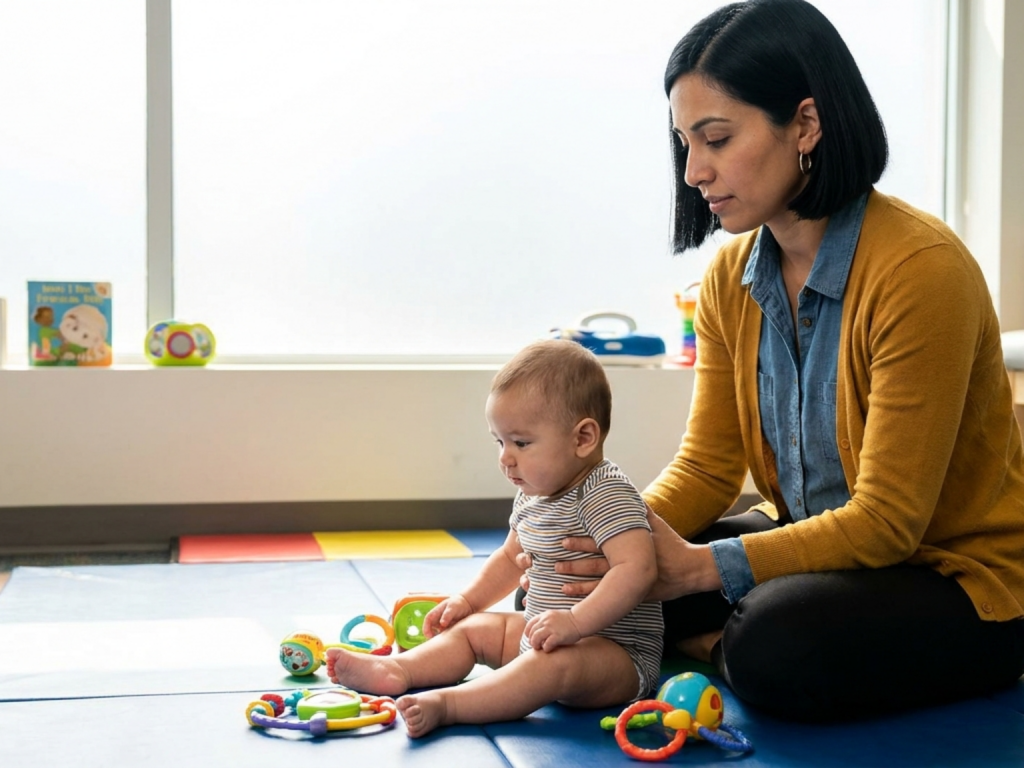
Short, frequent periods of supervised floor time are usually more useful than prolonged placement in a sitting device. You can sit behind the infant and offer support at the pelvis or lower trunk, adjusting your hands as the baby gains control. Support at the pelvis often allows the trunk to make small balance corrections, whereas holding the shoulders tightly may limit the infant’s opportunity to learn.
Place interesting objects slightly in front of and to either side, within a reachable distance. This encourages controlled forward and lateral weight shifting. Use toys that are large enough to avoid choking risk and avoid placing objects so far away that the infant must lunge. Allow pauses. The baby may need time to process a change in position and discover how to return toward midline.
Safe floor time for infants should include varied positions appropriate to the child’s current abilities, including back-lying, supervised prone play, side-lying, and supported sitting. Do not use pillows or soft furnishings as a substitute for supervision, and do not leave a baby unattended on a sofa, bed, table, or elevated surface. Equipment that restricts movement should not replace opportunities for freely initiated movement.
Sitting as a Context for Learning and Interaction
Improving sitting balance changes what a baby can see, touch, and communicate. An upright infant may be able to visually scan a room, watch a caregiver’s face, reach for a toy, bring objects to the midline, and coordinate both hands. These opportunities link postural control with early problem-solving, attention, hand skill, and social interaction.
Sitting also creates a new balance between stability and mobility. The baby must maintain enough trunk organization to remain upright while making small movements toward people and objects. Caregivers can support this process by responding to the infant’s interests rather than repeatedly repositioning the body. Talking, singing, and presenting a toy at different but manageable locations can encourage head turning and controlled reaching.
Responsive interaction remains important. If the baby becomes frustrated, fatigued, or overstimulated, a change of position or a quiet pause may be appropriate. A caregiver’s calm presence can help the infant regulate attention while attempting a difficult motor task. Sitting practice should feel like ordinary play and interaction, not a test that must be completed.
Research on infant sitting emphasizes that upright posture provides broader developmental opportunities, including exploration and social engagement. This is one reason clinicians consider the quality and adaptability of movement, not only whether a baby can hold a position for a particular number of seconds.
When to Seek Professional Guidance
Milestone ranges are broad, and a baby who is not yet sitting independently may still be progressing appropriately. Professional guidance is warranted when a caregiver notices a pattern that seems unusual, persistent, or different from the child’s previous abilities. Examples include marked stiffness or floppiness, inability to maintain head control appropriate for the child’s developmental stage, repeated collapse to one side, very limited movement of one arm or leg, or little progress over time.
Loss of a skill that was previously reliable should be reported promptly to the child’s healthcare professional. Other reasons to seek advice include difficulty tolerating floor play, frequent painful-looking reactions during movement, unusual episodes of altered responsiveness, or concerns related to prematurity, neurological conditions, musculoskeletal problems, vision, or hearing.
A pediatrician may perform a developmental examination and decide whether referral to a pediatric physical therapist, occupational therapist, or early intervention service is appropriate. An assessment may review head and trunk control, symmetry, muscle tone, range of motion, reflexes, sensory responses, and the infant’s ability to adapt posture during movement.
Caregivers can prepare by noting what the baby can do independently, which positions are easiest, whether the baby falls in a consistent direction, and how performance changes with fatigue. Short videos recorded in a safe environment may help a clinician understand a concern, but they should not replace an in-person evaluation when one is recommended. Early intervention services for infants can be helpful when a professional identifies a need, and requesting an assessment does not mean a diagnosis is certain.
Safety and Medical Cautions
- Never leave a baby unattended on an elevated surface or near a fall hazard.
- A baby who sits briefly may still lack reliable protective reactions.
- Do not force a posture, pull the infant by the arms, or use restrictive equipment as a replacement for floor movement.
- Discuss persistent asymmetry, abnormal tone, loss of skills, or stalled progress with a healthcare professional.
- Seek urgent medical care for acute injury, breathing difficulty, seizure-like activity, or markedly reduced responsiveness.
Tools & Assistance
- A clear, firm floor space for supervised movement
- A simple developmental observation log
- Age-appropriate, choke-safe toys for reaching practice
- Pediatrician or family physician consultation
- Pediatric physical therapist or early intervention evaluation when indicated
FAQ
Is it normal for a baby to wobble while learning to sit?
Yes. Wobbling, using the hands for support, and briefly falling within a safe supervised setting are common while postural control is developing. Persistent one-sided falling or other concerns should be discussed with a clinician.
Should I place my baby in a sitting position to practice?
Brief, supervised supported sitting can be part of play when the baby has appropriate head and trunk control. Offer support at the lower trunk or pelvis and allow active movement rather than holding the body rigidly.
How can I tell whether sitting balance is improving?
Look for gradual changes such as longer periods of upright control, more symmetrical use of the body, improved ability to return toward midline, and reaching without immediate collapse. Progress may fluctuate from day to day.
When should I ask about delayed sitting?
Ask the child’s healthcare professional whenever you are concerned, especially if there is little progress, loss of a previously acquired skill, marked stiffness or floppiness, poor head control, or persistent asymmetry.
Sources
- PubMed — Learning about gravity: segmental assessment of upright control as infants develop independent sitting
- PubMed Central (NIH) — Behavioral Flexibility in Learning to Sit
- PubMed Central (NIH) — Opportunities for learning and social interaction in infant sitting
Disclaimer
This article is for general educational purposes and does not diagnose, treat, or replace advice from a qualified healthcare professional. Contact your baby’s clinician for individualized developmental or safety guidance.

















Please log in to leave a comment.