
Intro
When a baby moves a toy from one hand to the other, the action may look simple, but it reflects several emerging abilities: visual attention, reaching, grasp formation, postural control, motor planning, and coordination between both sides of the body. Hand-to-hand transfer is an important early fine motor milestone because it allows an infant to explore an object from different angles and gradually use both hands together.
Developmental timing varies considerably. Babies may acquire transfer skills at somewhat different ages depending on their overall motor progression, opportunities for floor play, birth history, and individual temperament. The goal is not to accelerate a milestone, but to provide safe, responsive opportunities for practice while observing the quality and progression of movement.
Highlights
Hand-to-hand transfer develops through earlier skills such as reaching, grasping, holding, and bringing objects toward the midline.
Many infants begin transferring objects between hands during the second half of the first year, although the exact timing varies.
Early transfer may occur in two stages, followed by a more efficient one-stage movement as motor planning and coordination mature.
Safe, simple toys and responsive floor play provide useful practice without requiring formal drills.
A pediatric professional should assess persistent asymmetry, loss of skills, or broader developmental concerns.
What Hand-to-Hand Transfer Means
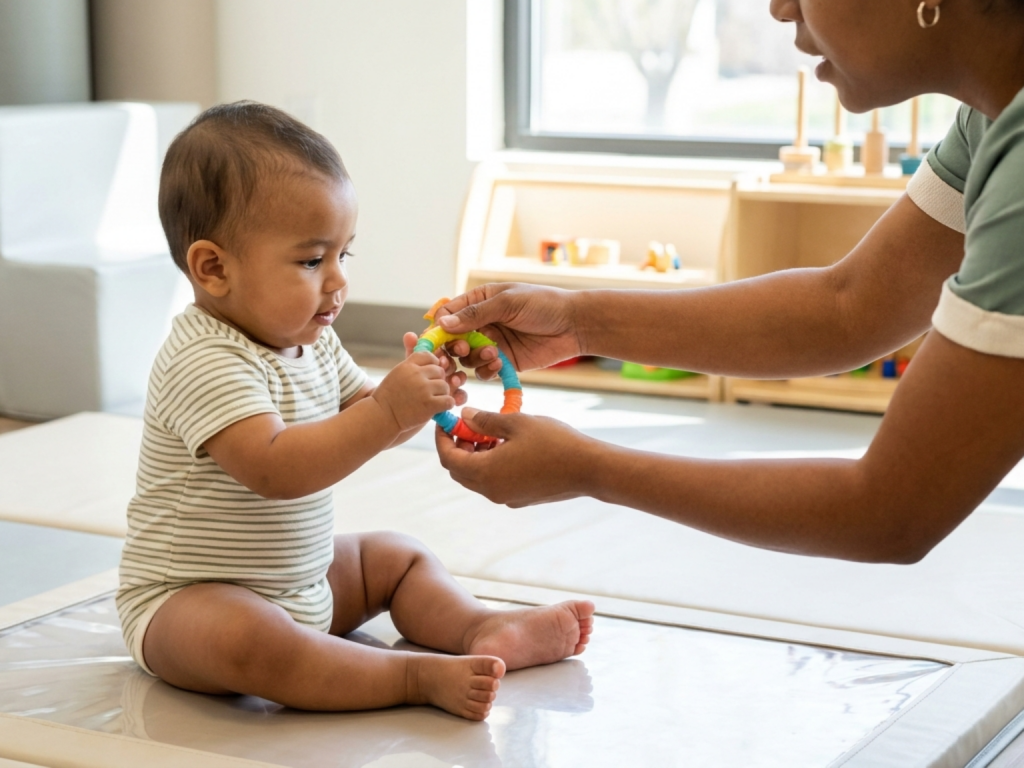
Hand-to-hand transfer is the intentional movement of an object from one hand to the other. A baby may hold a ring in the right hand, bring both hands together near the chest, and then grasp the ring with the left hand. This action is different from simply dropping an object and picking it up again. It requires the infant to maintain a grasp, orient the hands toward one another, and coordinate release and regrasp.
The skill is an early example of bilateral coordination, meaning that the two sides of the body work together toward a shared goal. It also involves visual-motor integration: the baby watches the object and adjusts hand position based on what is seen. Over time, transfer supports more complex activities such as holding a container with one hand while manipulating it with the other, exploring textures, and bringing two objects together.
Transfer is best understood as one part of a broader sequence rather than an isolated test. Earlier foundations include stable head and trunk control, purposeful reaching, grasping an object, bringing the hands toward the midline, and sustaining attention during exploration. Later skills include controlled release, finger isolation, and the pincer grasp used for small objects.
The Typical Developmental Sequence
Infant motor development follows a general progression, but the ranges overlap and are not strict deadlines. Early in life, hand movements are strongly influenced by reflexes. As voluntary control develops, babies begin to open their hands more consistently, visually attend to nearby objects, reach toward them, and close the fingers around an available target.
According to medically oriented developmental descriptions, an infant may initially transfer an object in two stages. The baby first holds the object in one hand, brings it against the chest or another surface, and then uses the opposite hand to take hold of it. This may emerge during the middle portion of the first year, often around the period when purposeful reaching and grasping are becoming more reliable.
With increasing coordination, transfer may become a one-stage movement. The baby brings the object directly from one hand to the other without needing to stabilize it against the body. This more efficient pattern commonly develops later in infancy. Voluntary release also becomes increasingly evident as the infant learns to open the hand intentionally rather than losing the object because of fatigue or an accidental change in grasp.
Resources from the FPG Child Development Institute and Children’s Hospital of Richmond at VCU describe reach, grasp, release, and transfer as related skills that emerge progressively. These references support using approximate age ranges as guideposts, while considering the whole developmental picture rather than a single observed performance.
Why the Skill Matters
Hand-to-hand transfer gives an infant a practical way to investigate objects. A toy can be rotated, mouthed, shaken, tapped, or examined from another viewpoint. These repeated actions contribute to sensorimotor learning, in which movement and sensory feedback are closely linked. The baby receives information about weight, shape, texture, sound, and resistance, then modifies the next movement based on that experience.
The action also supports emerging motor planning. The infant must anticipate where the receiving hand should be, adjust the grasp, and coordinate the timing of release. These demands are modest compared with later skilled actions, but they represent meaningful practice in sequencing and problem solving.
Transfer can also be relevant to symmetry. Many babies show temporary preferences related to an object’s position, the direction of their head turn, or the side that is easier to access. However, repeated use of both hands during play provides opportunities for bilateral reaching and grasping. Parents and clinicians generally interpret hand use in context, including posture, movement quality, reach across the midline, and whether one arm appears consistently less active.
Ways to Encourage Transfer During Play
Most infants learn these skills through ordinary interaction rather than structured instruction. Place a lightweight, easy-to-hold object within comfortable reach while the baby is awake, alert, and well supported. A soft ring, broad teether, fabric square, or appropriately sized rattle may be easier to grasp than a small or slippery toy.
- Offer the object near the midline so both hands can see and approach it.
- Once the baby grasps it, wait briefly rather than immediately repositioning the toy. This allows time for the infant to explore, bring the hands together, and attempt transfer.
- Present toys alternately from the right and left sides during supervised play, while avoiding forceful repositioning of the arms.
- Use toys that make a gentle sound or have contrasting textures to maintain visual and tactile interest.
- Allow safe mouthing and banging of suitable objects because these are normal forms of infant exploration.
Two-handed exploration is especially useful. A caregiver can offer one object at a time and remain close enough to respond, but the baby should retain control of the movement. The interaction can be quiet and unhurried. Smiling, talking, and following the baby’s attention may make practice more enjoyable without turning it into a performance.
For additional activity ideas, caregivers may find guidance on fine motor activities for older babies useful, particularly when an infant is beginning to combine grasping, transferring, and purposeful release.
Safety and Environmental Considerations
Because transfer skills involve grasping and mouthing, the play environment requires careful preparation. Use toys designed for the baby’s developmental stage and inspect them regularly for detached parts, cracks, loose seams, or pieces that could break off. Avoid objects small enough to fit completely through a toilet-paper roll, as they may present a choking hazard. Balloons, button batteries, magnets, and small household objects require particular caution.
Stay within immediate reach during play, especially when the baby is using teethers, rattles, or any object that could obstruct the airway. Floor play on a firm, clear surface is preferable to placing toys on elevated or unstable furniture. Babies should not be left unattended with objects, even if the objects are marketed as infant toys.
Positioning also matters. Practice should occur when the infant is awake and supervised, not during sleep or while the baby is feeding. A baby who is tired, hungry, overstimulated, or unwell may show less coordinated hand use. Pausing when the infant turns away, fusses, stiffens, or loses interest respects communication cues and usually produces better opportunities for learning.
When to Discuss Progress With a Professional
A single missed attempt does not establish a problem. Babies may transfer an object successfully one day and appear less interested the next, particularly when attention, positioning, or fatigue differs. Clinicians usually consider timing alongside the quality of movement and other milestones, including reaching with both arms, grasping, bringing hands to the mouth, sitting or trunk control, and purposeful release.
It is reasonable to raise questions with a pediatrician, child health nurse, or pediatric occupational or physical therapist if a baby shows persistent difficulty using one arm, rarely brings the hands together, consistently keeps one hand closed, appears unusually stiff or floppy, or does not seem to be progressing in several related skills. Persistent movement asymmetry deserves attention, especially if the infant avoids reaching with one side or cannot bear weight through an arm during age-appropriate activities.
Loss of a previously acquired skill should be discussed promptly with a healthcare professional. The same applies to concerns about vision, hearing, feeding, muscle tone, or general interaction, because these factors can influence motor exploration. A professional may observe the baby in different positions, review birth and medical history, and determine whether monitoring, developmental evaluation, or therapy referral is appropriate.
For babies born prematurely, corrected age may be used for developmental interpretation during the early period, although clinicians may individualize this approach. Families should ask the baby’s healthcare team how corrected age applies in their situation rather than relying on a rigid timetable.
Supporting Confidence Without Pressure
Early hand-to-hand transfer is strengthened by repetition, but repetition does not require constant prompting. Babies benefit from having time to initiate movement, make small errors, and discover how an object responds. A caregiver can place a toy within reach, describe what the baby is doing, and wait. If the infant drops the object, the caregiver can return it or offer another opportunity without framing the attempt as failure.
Development is also relational. Responsive caregiving, comfortable positioning, and shared attention help create the conditions for exploration. Routine care moments such as dressing, bathing, and feeding may offer gentle opportunities to notice how the baby opens the hands, reaches, holds, and releases. The most useful observation is often the pattern across days and settings, not one isolated session.
Families can keep brief notes or videos for a healthcare visit when they have concerns, provided recording does not replace supervision. These observations may help clarify whether a behavior is consistent, whether both sides are used, and whether a new skill is emerging. The central aim is a safe, supportive environment in which the baby can explore at an individual pace.
Safety and Medical Caution
- Never leave a baby unattended with a toy or object that could be mouthed, swallowed, or used to obstruct the airway.
- Keep button batteries, magnets, balloons, and small household objects completely out of reach.
- Seek prompt medical advice for loss of an acquired motor skill or marked, persistent one-sided movement.
- Discuss broader concerns about tone, vision, feeding, posture, or several delayed milestones with a qualified healthcare professional.
- Do not use forceful stretching, restraint, or unsupervised exercises to promote transfer.
Tools & Assistance
- A clear floor space with a firm play surface
- Age-appropriate lightweight rings, teethers, and textured toys
- A simple observation log noting reach, grasp, transfer, and release
- Routine developmental surveillance with the baby's pediatric healthcare professional
- Pediatric occupational or physical therapy evaluation when recommended
FAQ
At what age do babies usually transfer objects between hands?
Many infants begin transferring objects during the second half of the first year, often first using a two-stage pattern and later a more direct movement. Timing varies, so the broader developmental pattern is more informative than an exact age.
Is it normal for a baby to use one hand more often?
Temporary differences can occur because of toy position, posture, attention, or emerging coordination. Consistent avoidance of one arm, a persistently closed hand, or marked asymmetry should be discussed with a pediatric professional.
How can I help my baby practice hand-to-hand transfer?
Offer lightweight, safe toys near the midline during calm, supervised floor play. Give the baby time to bring the hands together and attempt the movement, and follow the baby's cues rather than repeatedly placing the object in a particular hand.
What if my baby drops the toy instead of transferring it?
Dropping is common while grasp and release are still developing. Voluntary release and controlled transfer mature over time. Continue offering safe opportunities and consult the baby's healthcare professional if there is little progress across related motor skills.
Does prematurity change how this milestone is assessed?
For babies born prematurely, clinicians may consider corrected age during early developmental assessment. Ask the healthcare team how corrected age and the baby's individual medical history should be applied.
Sources
- AccessPediatrics / McGraw Hill — Fine Motor Development
- FPG Child Development Institute, University of North Carolina at Chapel Hill — Reach/Grasp/Release - Early Learning Progressions
- Children's Hospital of Richmond at VCU — Fine motor skills: birth to 2 years
Disclaimer
This article provides general educational information and is not a diagnosis or a substitute for individualized medical advice. Consult a qualified healthcare professional about your baby's development, safety, or any concerning change.














Please log in to leave a comment.