
Intro
Baby development often looks sudden from the outside. One day an infant seems content to observe, and soon they are rolling, sitting, crawling, standing, communicating, or reaching deliberately. In reality, major milestones are usually supported by many smaller abilities that emerge gradually and overlap.
Noticing these early skills can help caregivers understand what a baby is practicing without turning development into a rigid timetable. The sequence and timing vary, particularly with prematurity, medical conditions, temperament, and opportunities for movement. Small skills are useful observations, but they are not diagnostic tests or guarantees of what will happen next.
Highlights
Major milestones usually develop from multiple smaller abilities involving posture, strength, coordination, attention, and motivation.
Transitional skills such as weight shifting, reaching across the body, pulling to stand, and cruising can precede independent walking.
Early communication, self-regulation, and social engagement are meaningful developmental skills even when they are less visible than motor achievements.
A single missed skill is rarely enough to explain a developmental concern; patterns, asymmetry, regression, and loss of function deserve professional attention.
Milestones Are Built From Overlapping Skills
A milestone is an observable functional achievement, such as sitting without support, taking an independent step, using a meaningful word, or responding consistently to a familiar request. It is helpful to remember that the visible event is usually the endpoint of several less obvious changes. The nervous system must coordinate sensory information, muscle activation, balance, motor planning, and motivation. These capacities develop together rather than appearing in a perfectly linear sequence.
For example, independent sitting is not only a matter of trunk strength. A baby also needs head control, postural endurance, the ability to adjust the pelvis, and protective responses that help prevent a fall. Crawling or another form of floor mobility may involve reciprocal limb movement, weight transfer, visual exploration, and the motivation to reach a desired object. Some babies use an unconventional but effective method of moving and later walk typically. Variation in the route does not automatically indicate a problem.
Research on developmental milestones suggests that earlier attainment of some motor skills, including standing, can be associated with later cognitive performance at a population level. These findings describe statistical relationships, not individual predictions. A baby who reaches a skill later may still develop normally, and an early skill does not determine future intelligence. The practical value is broader: early abilities can provide a window into how motor, sensory, and cognitive systems are becoming organized.
Posture and Movement Skills Before Mobility
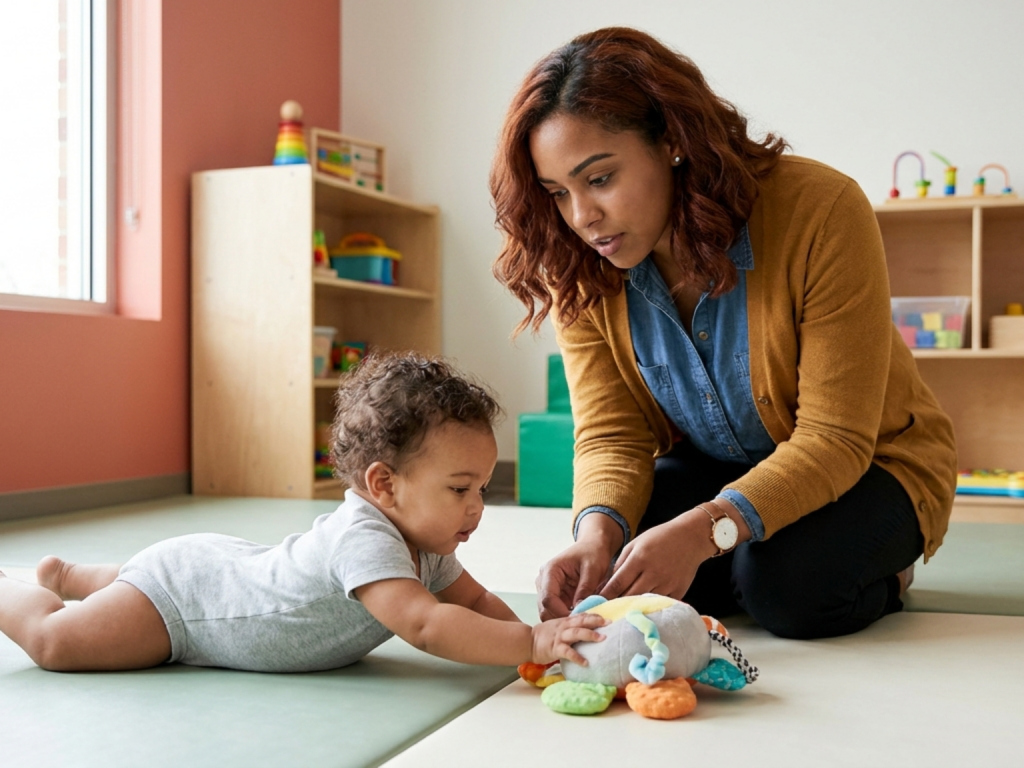
Before a baby crawls, pulls up, or walks, caregivers may notice shorter practice behaviors. During floor play, the infant may lift the chest, pivot around the abdomen, shift weight from one forearm to the other, push through the feet, or briefly move backward. These actions build shoulder stability, trunk control, hip strength, and the capacity to coordinate opposite sides of the body. A baby may also rock on hands and knees before they can move forward, using the position to test balance and movement timing.
Transitions are particularly informative because they show how a baby solves a motor problem. Moving from lying to sitting requires rotation, abdominal and trunk control, and the use of the arms for support. Moving from sitting to the floor requires controlled lowering rather than simply losing balance. A baby preparing to stand may kneel at furniture, place both hands on a stable surface, lean the trunk forward, and extend the hips and knees. These steps may appear awkward at first because the infant is learning how much force and stability are needed.
Before independent walking, common transitional skills include pulling to stand, standing while holding furniture, lowering from standing, cruising sideways, and taking supported steps. Studies of crawling, cruising, and walking show that these behaviors can form part of a developmental buildup, although the timing and order are not identical for every child. Some infants cruise extensively; others move quickly from supported standing to free steps. Caregivers can support practice by providing safe floor space and stable furniture, while avoiding forced positioning or unsafe devices.
Hand Skills That Prepare for Purposeful Play
Fine motor development in infancy begins with changes that may be easy to overlook. A newborn’s grasp is largely reflexive, but purposeful hand use gradually becomes more evident as visual control and voluntary movement mature. The baby may open the hands more often, bring them together at the midline, swipe toward a toy, hold an object briefly, or look back and forth between the object and the caregiver. These small behaviors reflect growing eye-hand coordination and motor planning.
Reaching across the body is another useful observation. An infant who stabilizes the trunk while reaching with one hand is practicing balance and bilateral coordination. Holding an object in both hands, transferring it from one hand to the other, and rotating it to inspect a different surface all expand the relationship between vision, touch, and movement. Later, more refined grasp patterns allow a baby to pick up small pieces of food or toys using the thumb and finger. The pincer grasp is not simply a hand milestone; it also depends on visual attention, sitting stability, and the ability to release an object intentionally.
Object exploration also supports cognition. A baby who bangs two objects together, drops a toy repeatedly, searches for a partially hidden item, or changes strategy after a failed attempt is gathering information about cause and effect. These experiments can be repetitive for adults but are meaningful learning opportunities. Offer age-appropriate objects that are too large to swallow, supervise closely, and let the infant initiate exploration. Avoid small loose parts and other choking hazards.
Communication Begins Before First Words
Spoken language is preceded by a long period of communication practice. Early signs may include quieting to a familiar voice, orienting toward sound, making reciprocal vocal exchanges, varying pitch, smiling socially, imitating facial movements, and using gaze to share attention. Babbling becomes increasingly varied as infants explore consonant-like and vowel-like sounds. These behaviors are not merely noise or entertainment; they involve auditory processing, breath control, oral-motor coordination, memory, and social motivation.
Joint attention is an important bridge to later communication. A baby may look at a caregiver, glance toward a toy, and then look back as if sharing the experience. Pointing, reaching to request, showing an object, or following another person’s gaze can emerge before a child has words. Responsive interaction with infants helps strengthen this exchange. Caregivers can pause after speaking, imitate the baby’s sounds, label objects during ordinary routines, and respond to gestures as meaningful communication.
Understanding often develops before expressive language. An infant may recognize a familiar person, anticipate a routine, respond to their name, or react differently to a warm voice and a firm interruption. These observations should be interpreted in context because hearing, attention, fatigue, and the complexity of the interaction all affect responses. A healthcare professional can assess communication concerns and consider hearing evaluation when appropriate.
Self-Regulation and Social-Emotional Preparation
Some of the most important early skills are behavioral rather than physical. Infants gradually learn to shift attention, tolerate a short delay, recover after becoming upset, and use a caregiver’s presence to settle. Early self-regulation is not independent emotional control. It develops through co-regulation, in which a responsive adult provides predictable routines, calm vocal tone, physical comfort, and manageable stimulation.
A baby may show emerging regulation by turning toward a voice after startling, pausing during an exciting game, bringing a hand to the mouth, looking away briefly when overstimulated, or returning to play after reassurance. These behaviors can support later attention and participation in routines. Research reviewing early life skills has linked self-regulation, attention, and emotional control with later educational, social, and health outcomes. Such associations are influenced by many factors, including relationships, health, environment, and access to support.
Social reciprocity also develops in small increments. Smiling in response to interaction, anticipating a familiar song, copying an expression, seeking help, and checking a caregiver’s reaction in a new situation all show that the infant is learning within relationships. Temperament affects how these skills look. A cautious baby may observe longer before joining an unfamiliar interaction, while a highly active baby may communicate through movement. Neither pattern alone establishes a developmental concern.
How to Observe Progress Without Creating Pressure
Observation is most useful when it focuses on patterns across time and settings. Note what the baby can do spontaneously, what happens with support, which side of the body is used, and whether the skill is becoming more consistent. Consider the full developmental profile rather than concentrating on a single age-based checklist. Motor, communication, social-emotional, adaptive, and sensory behaviors may progress at different rates.
Everyday opportunities can encourage development without turning practice into a test. Provide supervised tummy time while awake, allow free movement on a safe surface, place interesting objects within reachable distance, and make space for face-to-face interaction. Follow the infant’s cues and stop when they show fatigue or distress. Safe sleep remains separate from awake play: infants should be placed on their backs on a firm, uncluttered sleep surface according to current safe-sleep guidance.
For preterm infants, clinicians may use corrected age for a period when interpreting milestones. Medical history, neonatal complications, vision or hearing differences, and neuromuscular conditions can also affect the timing and appearance of skills. Developmental surveillance at routine visits allows a clinician to combine caregiver observations with physical examination and validated screening tools. Bring videos or written examples if a behavior is difficult to reproduce in the clinic.
When a Small Skill Deserves Professional Review
Developmental variation is common, but concerns should not be dismissed simply because a baby is young or because a relative developed differently. Contact the child’s pediatrician or other qualified healthcare professional if a baby consistently uses one side much less than the other, appears unusually stiff or floppy, has difficulty feeding or coordinating movement, or is not progressing across several areas. Persistent infant movement asymmetry can have multiple explanations and should be assessed rather than interpreted at home.
Regression is especially important. A loss of a skill that was previously used consistently warrants prompt medical discussion. Seek urgent care for acute changes such as sudden weakness, unresponsiveness, breathing difficulty, a seizure, or a serious injury. For less urgent concerns, keep a record of when the behavior began, what situations bring it out, and whether the infant can perform related skills.
A professional evaluation is not a judgment about parenting and does not automatically lead to a diagnosis. It is a way to clarify what the infant is doing, identify strengths, and decide whether monitoring, hearing or vision assessment, physical or occupational therapy, or early intervention services may be useful. Early support is often individualized and can be appropriate even while the underlying reason for a difference is still being evaluated.
When to Seek Medical Advice
- A previously acquired skill is lost or the baby shows clear developmental regression.
- Persistent asymmetry, unusual stiffness, marked floppiness, or difficulty using an arm or leg is observed.
- The baby has feeding difficulty, breathing problems, seizures, sudden weakness, or a significant acute change.
- Several developmental areas appear stalled, or your concern persists despite reassurance from others.
- Use urgent services for emergencies and contact the pediatric clinician for ongoing developmental questions.
Tools & Assistance
- Keep a brief dated log of new movements, sounds, gestures, and social responses.
- Record short videos of behaviors that are difficult to describe or reproduce during an appointment.
- Ask the pediatric clinician about developmental surveillance and validated screening questionnaires.
- Use local early intervention services when a qualified professional recommends assessment or support.
- Review age-appropriate choking prevention, safe sleep, and supervised floor-play guidance.
FAQ
Do babies always develop skills in the same order?
No. Many skills follow a broad pattern, but the order, timing, and preferred movement strategy vary. A clinician considers the overall pattern, function, symmetry, and progression rather than one isolated sequence.
Does early walking predict intelligence?
Research has found population-level associations between earlier attainment of some motor milestones and later cognitive outcomes. This does not predict an individual child's intelligence or future achievement.
What can I do to encourage these skills?
Offer safe, supervised opportunities for free movement, floor play, reaching, conversation, and responsive social interaction. Follow the baby's cues and avoid forcing positions or comparing them with peers.
Should I worry if my baby skips crawling?
Some babies use other forms of mobility or move from sitting and pulling to standing toward walking. Discuss the pattern with a healthcare professional if there is marked asymmetry, limited mobility, regression, or concern in other developmental areas.
How are milestones interpreted for premature babies?
Clinicians may use corrected age for a period after birth, depending on gestational age and local guidance. Ask the baby's healthcare professional how corrected age should be applied in your situation.
Sources
- PubMed Central — Infant Developmental Milestones and Subsequent Cognitive Function
- PubMed Central — Developmental Continuity? Crawling, Cruising, and Walking
- University College London — The Impact of Early Life Skills on Later Outcomes
Disclaimer
This article is for general educational purposes and does not diagnose, treat, or replace advice from a qualified healthcare professional. Seek medical care for urgent symptoms, developmental regression, or persistent concerns about a baby.














Please log in to leave a comment.