
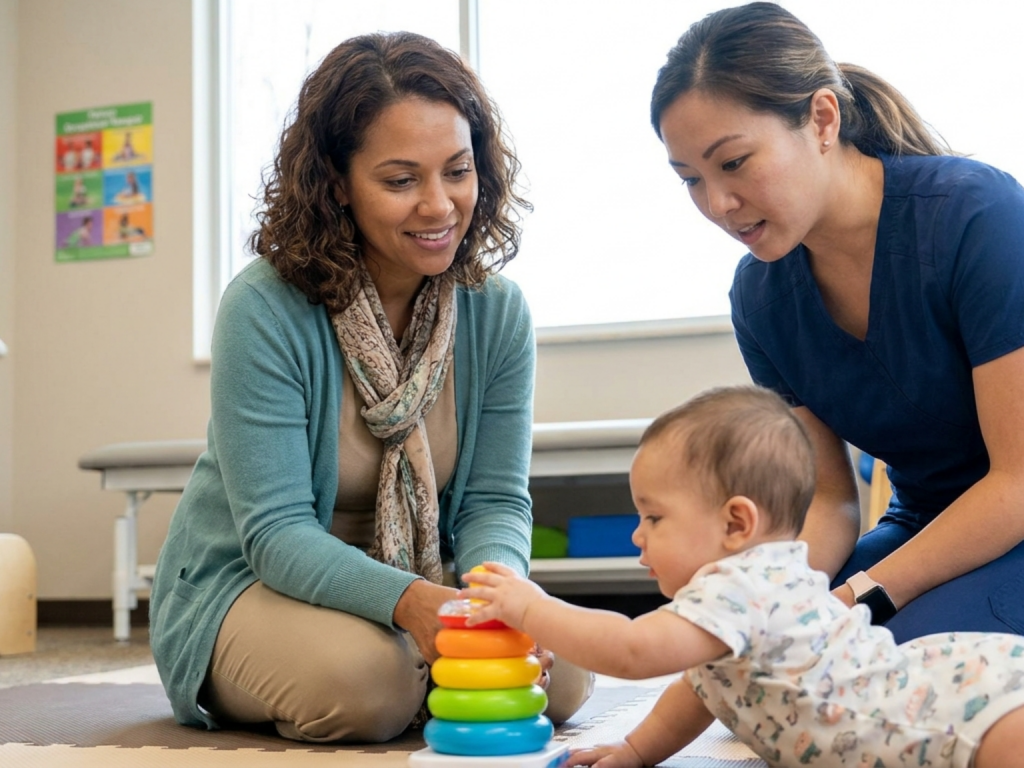
Intro
Babies gradually learn to coordinate the right and left sides of the body through ordinary movement: turning toward a voice, reaching for a toy, bringing both hands together, rolling, crawling, and eventually walking. This coordination is not a single milestone but an evolving set of sensory, postural, visual, and motor skills.
Understanding bilateral movement can help caregivers offer supportive opportunities without turning play into a test. Babies develop at different rates, and variation is expected. The most useful approach is to observe patterns over time, provide safe floor-based experiences, and discuss persistent concerns with a pediatrician or other qualified healthcare professional.
Highlights
Using both sides of the body supports postural control, visual-motor coordination, and exploration.
Reaching usually develops from same-side movements toward midline and, later, across the body.
Rolling, crawling, and playing with two hands give babies natural practice in bilateral coordination.
A preference for one side can be temporary, but persistent asymmetry or loss of skills warrants professional discussion.
What bilateral coordination means
Bilateral coordination is the ability to use the two sides of the body together, either in similar ways or in complementary roles. A baby may stabilize a soft block with one hand while exploring it with the other, bring both hands together at the chest, or shift weight between the arms and legs during crawling. These actions require communication among the brain, spinal cord, sensory systems, muscles, and joints.
The body’s midline is an imaginary vertical line dividing the body into right and left halves. When a baby reaches from the right side toward an object positioned on the left, the hand crosses this midline. Midline crossing is one visible example of increasing coordination between the brain’s hemispheres, but it should not be treated as an isolated test of neurological health.
Early bilateral coordination also depends on trunk stability. A baby who can maintain head and torso control has a stronger base for reaching, rotating, and shifting weight. Consequently, a movement that looks like a hand skill may also reflect gross motor control, balance, visual attention, and body awareness.
How coordination emerges in early infancy
Early reaching is often organized around the side of the body where an object appears. Classic developmental evidence describes a progression from reaching toward objects on the same side, to reaching at the midline, and later to reaching across the body. This sequence reflects developing visual guidance, postural control, and the ability to coordinate movement across the body’s center.
In the first months, a baby may look toward a toy and make broad, somewhat inaccurate arm movements. Gradually, visual fixation becomes more stable and the hands become more purposeful. Bringing the hands together, touching the knees, holding an object at the center of the body, and transferring an object from one hand to the other are all useful observations of emerging coordination.
These patterns are not rigid deadlines. A baby may temporarily use one arm more often because of position, fatigue, motivation, or the location of an object. The meaningful question is usually whether movement is becoming more varied and effective over time, rather than whether every action looks perfectly symmetrical on a particular day.
Movement experiences that use both sides
Babies learn through repetition embedded in responsive care. During supervised, awake floor time, place interesting objects within reach at the midline and then slightly to either side. Allow the baby time to look, rotate, reach, grasp, and adjust position. Objects should be large enough to reduce choking risk and appropriate for the baby’s developmental stage.
Rolling is an important bilateral experience because it requires the head, trunk, pelvis, and limbs to work in sequence. You can encourage attention toward both sides by alternating where you position your face or a safe toy. Avoid forcing a roll or pulling a baby by the arms. Gentle interaction and adequate time to initiate movement are more supportive than physically completing the maneuver.
As babies become mobile, reaching for toys while lying on the stomach, pivoting, crawling, moving between sitting and the floor, and climbing over a low caregiver’s leg can promote weight shifting and coordination. Crawling patterns vary, and some babies move in other effective ways before walking. The goal is a broad repertoire of self-initiated movement, not one prescribed form.
Supporting play without creating pressure
Play should be enjoyable, brief, and adapted to the baby’s state. A baby who is hungry, overstimulated, or tired may show less coordinated movement even when development is progressing normally. Follow the baby’s cues, pause when the baby turns away or becomes distressed, and return to the activity later.
Simple activities can provide rich practice. Offer a lightweight object at the center so both hands can explore it. Place a toy just outside the preferred reaching area, alternating sides, so the baby can turn or shift weight voluntarily. During sitting play, position objects at different heights and angles while staying close enough to prevent falls. For older infants, containers, stacking objects, and safe household materials can support early problem-solving and fine motor practice.
Caregivers can learn more from observing than from comparing. Note which positions the baby enjoys, whether both arms and legs participate, whether the baby can move in and out of positions, and whether new skills are appearing. A calm record of these observations can be more useful to a clinician than a single demonstration performed under pressure.
The relationship to later motor skills
Bilateral coordination contributes to functional movement across infancy and early childhood. During crawling, one side of the body often advances while the opposite side provides support or counterbalance. During walking, the legs alternate and the arms and trunk adjust to maintain equilibrium. Later activities such as carrying an object, using utensils, dressing, drawing, and manipulating fasteners require increasingly precise cooperation between the two sides.
Midline crossing becomes especially relevant when a child can reach across the body rather than repeatedly switching hands or repositioning the entire trunk. MyHealth Alberta notes that children may begin showing crossing-midline behavior around 8 to 12 months and become more comfortable with it by approximately 3 to 4 years. These ranges describe broad patterns, not pass-or-fail requirements.
Hand preference also develops over time. Strong, consistent hand dominance is not expected in young babies, and early switching between hands is common. Encouraging a child to use a particular hand before a stable preference emerges is unnecessary. Offering objects centrally and allowing self-selected movement supports exploration without imposing a lateral preference.
When asymmetry deserves attention
Temporary asymmetry is common. A baby may favor one side when reaching because a toy is positioned there, one direction is easier, or the baby is recovering from a minor discomfort. Nevertheless, persistent or pronounced asymmetry is worth bringing to a healthcare professional’s attention, particularly if it is accompanied by reduced movement, unusual stiffness, marked floppiness, difficulty bearing weight, or a clear difference in muscle use.
Seek prompt medical advice if a baby suddenly stops using an arm or leg, appears to be in significant pain, has a new change after an injury, or loses a previously acquired skill. A clinician may assess tone, strength, range of motion, reflexes, vision, posture, and the broader developmental pattern. Depending on the findings, they may recommend monitoring, a pediatric physical or occupational therapy assessment, or another evaluation.
Caregivers should not diagnose a neurological or orthopedic condition from videos or milestone charts alone. Prematurity, corrected age, medical history, birth complications, vision or hearing differences, and temperament can all influence movement. Professional assessment is the appropriate way to interpret a concerning pattern.
Making movement practice safe
Provide movement opportunities on a clear, stable surface with continuous supervision. Floor time is generally preferable to placing a baby on elevated furniture, where a sudden roll or reach can result in a fall. Keep small objects, cords, plastic bags, and other choking or entanglement hazards out of reach. Follow current safe-sleep guidance: awake play positions and sleep positions are different, and babies should be placed for sleep according to guidance from their healthcare professional and public health authorities.
Support the head and neck of a young infant when lifting or carrying. Do not pull a baby by the hands or arms to encourage sitting, standing, or walking. Avoid equipment that restricts natural movement for long periods, and use carriers, seats, and activity devices according to manufacturer and clinical safety guidance.
For a practical overview, caregivers may consult How to support baby body safely when considering handling, floor positioning, and head and neck support. Movement is most beneficial when it is comfortable, voluntary, and integrated into warm interaction rather than treated as a performance.
A balanced way to observe progress
There is no need to count every reach or make both sides perform identical actions. Instead, look for gradual expansion: Does the baby attend to objects on both sides? Can the baby bring the hands together? Is the baby beginning to rotate the trunk, shift weight, or use one hand to stabilize while the other explores? Can the baby recover from small balance challenges with increasing control?
Keep expectations flexible and consider the whole child. Sleep, illness, feeding, sensory preferences, opportunities for floor movement, and the family environment all affect what a baby demonstrates on a given day. The wider context is more informative than a single milestone.
For broader background, Physical development in babies explained can help place bilateral movement within the larger pattern of infant motor development. When questions remain, share specific observations with the child’s pediatrician, family physician, public health nurse, or pediatric therapist. Early discussion can provide reassurance when variation is typical and timely support when assessment is indicated.
When to seek medical advice
- A baby consistently uses one side much less than the other across multiple activities.
- An arm or leg is suddenly not being used, especially after an injury or with apparent pain.
- There is persistent unusual stiffness, marked floppiness, or difficulty controlling the head and trunk.
- A baby loses a previously acquired motor skill.
- Movement concerns are accompanied by feeding, vision, hearing, or responsiveness concerns.
Tools & Assistance
- A clear floor space for supervised, awake movement
- Large, age-appropriate objects for reaching and two-handed exploration
- A brief observation log noting positions, sides used, and new skills
- A pediatrician, public health nurse, or pediatric physical or occupational therapist
- Current infant safety and safe-sleep guidance from a qualified healthcare source
FAQ
Should I make my baby use both hands equally?
No. Offer objects at the midline and on both sides, but allow the baby to choose how to move. Early hand switching is common, and forced use can create frustration.
Is it concerning if my baby does not crawl?
Not necessarily. Crawling styles and pathways to walking vary. Discuss concerns if movement is persistently asymmetric, skills are regressing, or the baby has difficulty with posture, weight bearing, or mobility.
When do babies typically cross the midline?
Some babies begin showing this behavior around 8 to 12 months, with increasing comfort over the following years. Broad age ranges are not strict deadlines.
Can toys improve bilateral coordination?
Toys can create opportunities for reaching, grasping, transferring, and stabilizing. The interaction and movement experience matter more than a particular branded product.
Who can assess a persistent movement difference?
Start with the baby's pediatrician or family physician. They can decide whether referral to pediatric physical therapy, occupational therapy, or another specialist is appropriate.
Sources
- PubMed — Crossing the midline: limits of early eye-hand behavior
- MyHealth Alberta — Fine motor skills (3/7): Crossing midline
- Pathways.org — What is “Midline” and Why Does it Matter for Baby?
Disclaimer
This article provides general educational information and is not a diagnosis or a substitute for individualized medical advice. Consult a qualified healthcare professional about your baby's development, safety, or any concerning change.














Please log in to leave a comment.