
Intro
A birthing ball can provide a stable, adaptable surface for upright movement during pregnancy and labor. Sitting, rocking, pelvic rotation, leaning, and supported squatting may help some people manage discomfort, vary pelvic positions, and remain mobile when standing or walking feels tiring.
These movements are comfort measures, not a way to control the course of birth. The safest choices depend on gestational age, pregnancy complications, fetal position, membranes, analgesia, monitoring, balance, and local clinical guidance. Discuss birthing-ball use with your midwife or obstetric clinician, and stop any movement that causes pain, dizziness, bleeding, fluid loss, shortness of breath, or concern.
Highlights
A correctly sized, fully inflated birthing ball can support upright posture and gentle mobility.
Sitting, rocking, pelvic circles, forward leaning, and supported squatting are common options.
Movement may improve perceived comfort and may shorten some stages of labor, but the evidence is low to moderate quality and does not guarantee a particular birth outcome.
The ball should be used on a nonslip surface with a nearby support person or stable structure.
Clinical advice is especially important with epidural analgesia, continuous monitoring, reduced mobility, bleeding, or other obstetric concerns.
What a birthing ball can offer
A birthing ball is usually a large, inflatable exercise ball made from burst-resistant material. During pregnancy, it may be used as a temporary alternative to a chair for supported sitting, or as a surface for gentle mobility. During labor, its main role is to facilitate position changes while keeping the pelvis relatively open and the trunk upright. It may also allow a laboring person to rest while continuing small rhythmic movements.
Research has examined birthing balls for labor pain, duration, and mode of delivery. Systematic reviews and a recent meta-analysis of randomized controlled trials suggest that birthing-ball use may reduce reported labor pain and may shorten the first and second stages of labor. However, the certainty of evidence is limited: studies vary in the interventions used, comparison groups, sample sizes, and clinical settings. The findings should therefore be interpreted as possible benefits rather than predictable effects.
Movement can also have psychological value. Choosing whether to rock, pause, change direction, or rest may give a person a practical sense of participation during an intense and changing experience. It should remain flexible. A ball is not necessary for a physiologic labor, and declining it is entirely reasonable.
Choosing and preparing the ball
Size matters because a ball that is too small or too large can place the hips and knees in an awkward relationship and increase instability. When seated, the hips are generally most comfortable at approximately knee height or slightly higher, with both feet flat and the knees separated enough to maintain balance. Height-based sizing guides can be useful, but body proportions and the intended position also matter. A maternity unit, physiotherapist, or childbirth educator can help check the fit.
Before use, inspect the ball for cuts, worn areas, valve damage, or loss of firmness. Inflate it according to the manufacturer’s instructions; overinflation can make it harder to control, while underinflation may reduce support. Place it on a dry, nonslip floor away from sharp edges. A ball base or stabilizing ring may reduce rolling, although it does not replace supervision or a stable handhold.
Wear footwear or use bare feet according to what provides reliable traction. Keep a sturdy chair, bed, wall rail, or support person within reach. Do not use a wheeled chair, a movable bedside table, or another unstable object for balance. Before labor, practicing a few gentle movements can make the equipment feel familiar without creating pressure to use it later.
Gentle exercises during pregnancy and early labor
For an uncomplicated pregnancy, many people find a short period of supported sitting comfortable. Sit near the center of the ball with the feet wider than hip distance and the spine relaxed rather than rigid. A partner can stand in front or beside you while you test your balance. Use the position for ordinary activities such as resting, talking, or practicing slow breathing, rather than remaining seated for a prolonged period if the hips or back become uncomfortable.
Small pelvic tilts can be performed while seated. Gently move the pelvis forward and backward through a comfortable range, keeping the shoulders relatively quiet. The movement should be subtle and controlled. If it increases pelvic girdle pain, sacroiliac pain, pubic symphysis pain, or lumbar symptoms, stop and ask a clinician or pelvic health physiotherapist about alternatives.
Pelvic circles involve slowly moving the pelvis around the circumference of a small circle. Begin in one direction, then reverse if both feel comfortable. The purpose is not to force the pelvis open or reposition the fetus, but to provide rhythmic mobility and reduce static loading. In early labor, circles can be combined with slow breathing and periods of standing, walking, side lying, or rest.
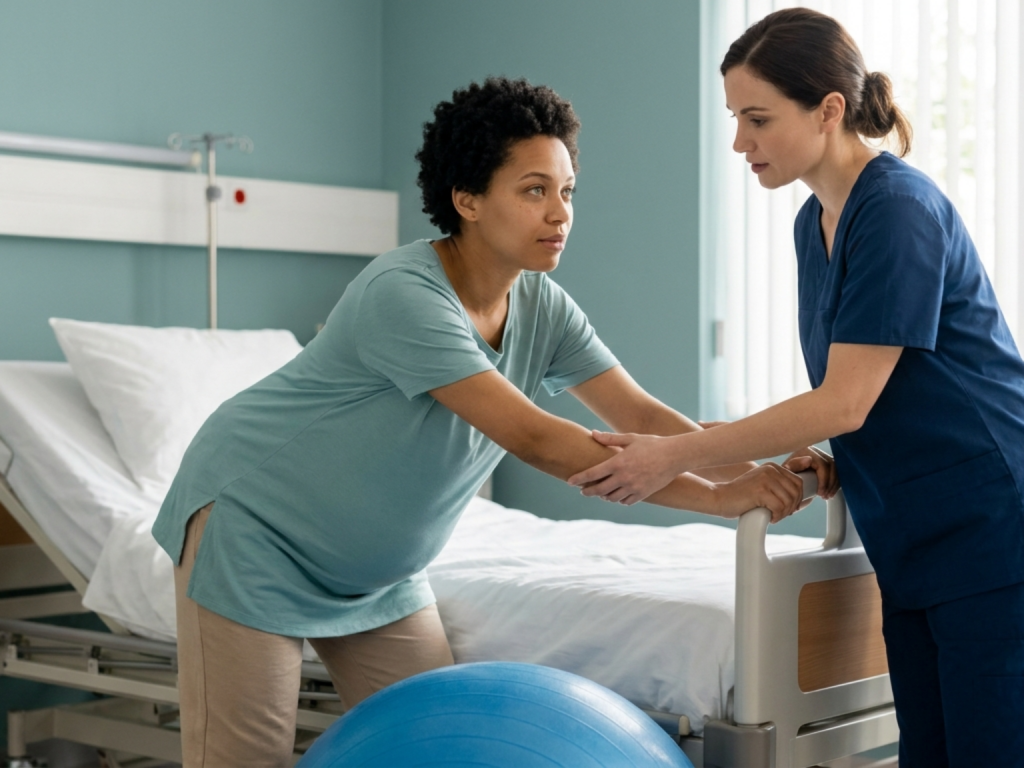
Gentle side-to-side swaying is another low-intensity option. Keep the feet planted and move only as far as balance allows. A forward lean over the ball can be useful when sitting feels uncomfortable: kneel on a padded surface or stand with the ball on a secure bed, then rest the upper body over it while keeping the neck neutral. The exact setup should be supervised, particularly when fatigue, contractions, or reduced balance are present.
Movements during active labor
During a contraction, some people prefer a repetitive movement that requires little decision-making. Seated rocking can be performed from front to back or side to side, with the movement initiated from the pelvis rather than the shoulders. The laboring person may hold a partner’s hands, a fixed rail, or the sides of a stable bed. Between contractions, reduce the range of motion or become still so the body can recover.
Pelvic rotations can be performed slowly during or between contractions. A partner may provide firm support at the shoulders or hips, but should not push the pelvis into a position that feels painful. Some people prefer asymmetry, such as placing one foot on a low, stable step while seated, but this should be attempted only if balance is secure and the clinical team agrees.
Forward leaning over the ball may reduce pressure in the lower back for some laboring people. It can be adapted to standing, kneeling, or sitting, depending on fatigue and available support. On hands and knees with the torso supported on the ball, a person may gently shift the hips backward and forward. This can be comfortable during back labor, although persistent or severe back pain warrants assessment rather than relying on movement alone.
Supported squatting over or in front of the ball is a more demanding option. The ball can be placed between the back and a wall, or the laboring person can hold it while lowering the pelvis. Squatting changes the relationship between the pelvis and the pelvic outlet, but it also requires adequate leg strength and balance. Use a spotter and a secure surface, and come out of the position slowly. A supported squat is not appropriate if the person feels faint, has significant weakness, or has been advised to limit weight-bearing.
Using the ball with monitoring or epidural analgesia
Birthing-ball movement can often be adapted to hospital care, but the monitoring plan determines what is practical. External fetal monitoring may be compatible with sitting or gentle rocking if the transducers remain well positioned. If the tracing is intermittent, unclear, or concerning, the clinical team may ask for a different position or less movement so fetal assessment is reliable. Movement should never interfere with urgent evaluation.
With an epidural, sensory and motor changes can impair proprioception, which is the body’s awareness of joint position. A person may not accurately detect an unstable foot, excessive hip rotation, or developing pressure injury. Ball use after epidural analgesia therefore requires direct assistance and unit-specific policy. Some hospitals use a supported seated position or a peanut-shaped ball in bed instead of an independent round ball. Do not attempt to transfer onto a birthing ball alone after an epidural.
Intravenous lines, urinary catheters, oxygen tubing, and other equipment also affect movement choices. Ask staff to help organize the equipment before changing position. A partner can support communication and comfort, but the clinician remains responsible for assessing whether a movement is medically suitable.
Breathing, rest, and responding to contractions
The most useful movement is usually the one that matches the person’s current energy and pain pattern. During early labor, walking, standing, sitting, and short periods on the ball can be alternated with food or fluids when permitted, sleep, and quiet rest. During active labor, the ball may be used for several contractions and then set aside if a different position becomes more comfortable. There is no requirement to keep moving.
Pair movement with a relaxed exhalation. For example, inhale gently without forcing a large breath, then lengthen the exhalation while rocking or circling. This can reduce breath-holding and unnecessary shoulder tension. A partner can offer a steady rhythm, remind the laboring person to release the jaw and hands, or apply touch if requested. Breathing patterns should remain adaptable; hyperventilation, tingling, panic, or light-headedness are signals to pause and breathe normally.
Comfort measures should be evaluated by their actual effect. If the ball makes pain worse, causes pelvic pressure, or produces fatigue, change position or rest. Pain intensity is not a reliable measure of whether labor is progressing, and movement should not be used to delay assessment when symptoms are concerning.
Safety limits and when to stop
Ask a maternity professional before using a birthing ball if you have a high-risk pregnancy, placenta previa or unexplained bleeding, ruptured membranes with specific movement restrictions, significant hypertension, preterm labor concerns, severe pelvic girdle pain, marked balance problems, or instructions to limit activity. The advice may change as labor develops or after an intervention.
Stop and seek immediate clinical guidance for vaginal bleeding, suspected cord prolapse, sudden fluid loss with a concerning change in fetal movement, severe or constant abdominal pain, chest pain, significant shortness of breath, fainting, new neurological symptoms, or a fall. Contact the maternity service for concerns about regular contractions, ruptured membranes, reduced fetal movement, or any symptom that feels different from expected labor.
Use a spotter when mounting or dismounting, especially late in pregnancy or during strong contractions. Move slowly, keep both feet grounded when seated, and avoid bouncing. Do not sleep on the ball, use it on stairs, or use it when alone if balance is uncertain. After a fall, even without obvious injury, contact the appropriate maternity service for individualized assessment.
Creating a flexible movement plan
A practical plan can list several options rather than a fixed sequence: supported sitting, pelvic circles, side-to-side rocking, forward leaning, hands-and-knees, walking, side lying, and rest. Discuss these preferences during antenatal care and include circumstances that might require modification, such as continuous monitoring, induction, intravenous medication, or epidural analgesia.
Consider who will provide physical support and how the ball will be cleaned or supplied in the birth setting. Partners should ask permission before touching or moving someone, watch for fatigue, and call staff rather than trying to manage a fall or sudden clinical change. The laboring person remains the decision-maker whenever they have capacity, and changing the plan is not a failure.
Evidence supports offering movement as one component of individualized labor care, alongside analgesia options, hydration when appropriate, emotional support, and ongoing maternal and fetal assessment. The goal is comfort, mobility, and a sense of control, not achieving a particular posture or outcome.
Important safety warnings
- Use the ball only on a stable, nonslip surface and keep a secure support within reach.
- Never mount or dismount alone if balance is reduced, contractions are strong, or an epidural has affected sensation.
- Stop for bleeding, faintness, severe pain, shortness of breath, fluid loss with concern, or reduced fetal movement.
- Follow instructions about fetal monitoring, intravenous lines, catheters, and weight-bearing.
- Ask a midwife or obstetric clinician before use when pregnancy or labor includes complications.
Tools & Assistance
- A correctly sized, burst-resistant birthing ball
- A nonslip floor or manufacturer-approved stabilizing base
- A sturdy chair, bed rail, or support person
- A padded mat for kneeling positions
- A maternity clinician, physiotherapist, or childbirth educator for individualized guidance
FAQ
Can a birthing ball start labor?
There is no reliable evidence that sitting or exercising on a birthing ball initiates labor. It may support comfort and mobility, but it should not be used to induce labor without professional advice.
How long should I sit on a birthing ball?
There is no universal duration. Use short, comfortable periods and alternate with walking, standing, side lying, and rest. Stop if you develop pain, fatigue, dizziness, or instability.
Can I use a birthing ball after an epidural?
Only with direct clinical guidance and assistance. An epidural can reduce sensation and leg strength, increasing the risk of falling. A supported bed position or peanut ball may be more appropriate.
Does a birthing ball change the mode of delivery?
Current reviews do not establish a clear effect on cesarean or vaginal delivery rates. Possible improvements in pain or labor duration should not be interpreted as a guaranteed change in birth outcome.
What if rocking on the ball increases back or pelvic pain?
Stop that movement and try a different supported position or rest. Persistent, severe, or unusual pain should be discussed with the maternity team because movement should not substitute for assessment.
Sources
- PubMed — Birthing ball and peanut ball use for labor pain, delivery duration, and mode of delivery: a meta-analysis of randomized controlled trials
- PubMed — Birthing ball for reducing labor pain: a systematic review and meta-analysis
- PubMed — Birthing balls to decrease labor pain and peanut balls to aid labor and delivery
Disclaimer
This article provides general educational information and does not diagnose, treat, or replace individualized medical advice. Consult your midwife, obstetric clinician, or maternity service before using a birthing ball, particularly if complications or interventions are present.

















Please log in to leave a comment.