
Intro
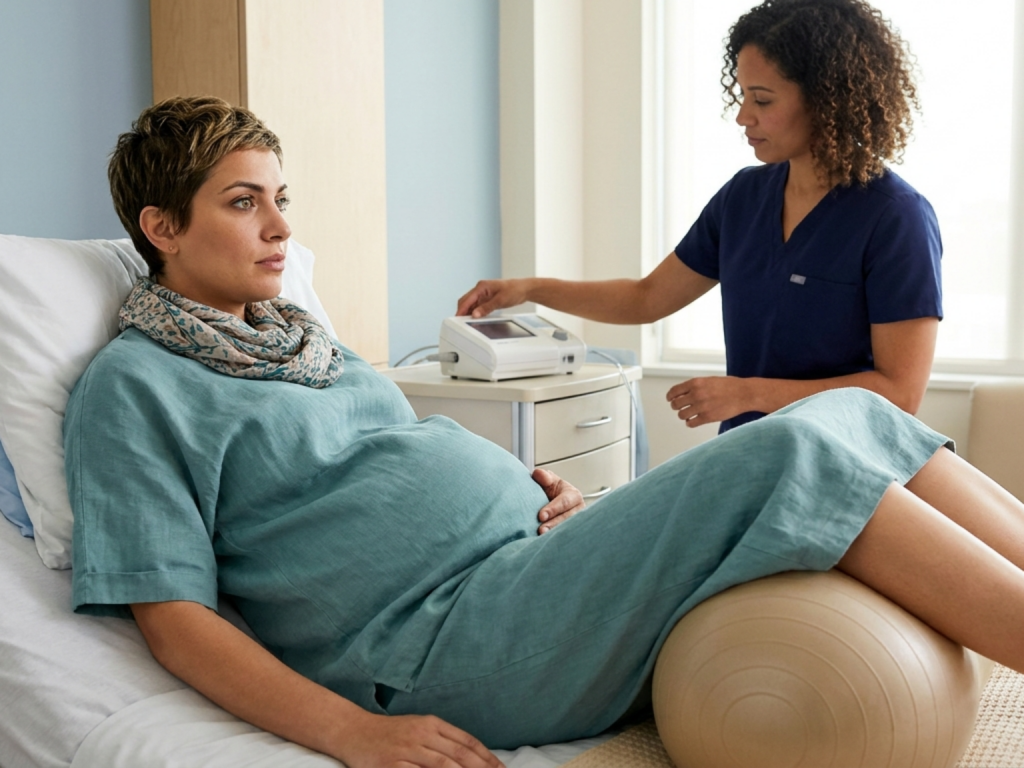
The side-lying position during labor is a practical, physiologically sensible option that can support rest, pelvic comfort, fetal oxygenation, and controlled pushing. It means laboring on the left or right side, usually with the upper knee flexed and supported by pillows, a peanut ball, or a birth partner’s hands.
Highlights
Side-lying can be useful in both first-stage labor and the second stage of labor, especially when rest, epidural analgesia, or fetal heart rate concerns limit upright movement.
The position may reduce pressure from the uterus on major maternal blood vessels compared with lying flat on the back, supporting uteroplacental blood flow.
Side-lying is adaptable: small changes in hip flexion, knee support, and upper-leg position can change pelvic space and maternal comfort.
It is not automatically the best position for everyone; the safest choice depends on maternal condition, fetal status, pain relief, monitoring needs, and clinical guidance.
What the side-lying position is
The side-lying position during labor means resting on one side rather than lying flat on the back, sitting upright, kneeling, or standing. The lower leg may be slightly bent, while the upper leg is usually flexed at the hip and knee. That upper leg can rest on pillows, a peanut ball between the knees, a stirrup, or a support person’s hands. The torso may be slightly forward, neutral, or gently reclined depending on comfort and fetal monitoring needs.
In early and active labor, side-lying is often used as a resting position. It can help conserve energy during a long labor while still allowing the uterus, pelvis, and fetal head to work with contractions. In the pushing phase, side-lying can become a more active birth position: the upper leg is lifted or supported, the pelvis opens asymmetrically, and the birthing person pushes with contractions while remaining off the sacrum and away from a fully supine posture.
There is no single correct version. Some people feel better on the left side, others on the right. Clinicians may suggest a particular side based on fetal heart rate patterns, fetal position, blood pressure, epidural density, or where the baby appears to be rotating in the pelvis. The key is that side-lying should be supported enough to feel stable, not like the laboring person must hold the posture with muscular effort.
Why position matters physiologically
Labor position can influence maternal comfort, venous return, uterine perfusion, pelvic mechanics, and the ability to cope with contractions. One concern with lying flat on the back is aorto-caval compression during labor. In late pregnancy, the enlarged uterus can compress the inferior vena cava and, to a lesser extent, the aorta when the person is supine. This may reduce venous return to the heart, lower maternal cardiac output, and affect blood flow to the uterus and placenta.
Side-lying helps shift uterine weight away from those major vessels. This does not mean every moment on the back is dangerous, but prolonged flat supine positioning can be less favorable for some laboring people, particularly if blood pressure drops, nausea develops, or fetal heart rate changes occur. A lateral tilt or full side-lying posture is a common clinical adjustment when maternal hypotension or fetal heart rate decelerations are being evaluated.
Position also matters because the pelvis is not a fixed ring during labor. The sacrum, coccyx, soft tissues, and maternal hips all contribute to available space and fetal movement. A supported side-lying position can reduce direct pressure on the sacrum while allowing one hip to flex more than the other. This asymmetry may be helpful when the baby is descending or rotating, although individual response varies and should be assessed in real time.
Benefits during first-stage labor
During the first stage of labor, the cervix dilates and effaces while contractions gradually become more intense. Side-lying can be especially useful when the birthing person is tired, has been upright for a long time, is coping with back discomfort, or needs continuous monitoring. It offers rest without necessarily returning to a fully supine position.
For pain coping, side-lying may reduce unnecessary muscular tension. When the shoulders, abdomen, pelvic floor, and jaw can soften between contractions, some people find it easier to breathe steadily and recover. A pillow under the head, one behind the back, and one between the knees can reduce strain through the hips and lumbar spine. A warm pack, sacral counterpressure, or gentle hip compression may be added if the care team says it is appropriate.
Side-lying can also fit well with clinical realities. If continuous fetal monitoring is needed, the monitor belts or wireless sensors may remain easier to keep in place than during frequent standing or walking. If membranes have ruptured and the team wants a particular position because of fetal heart rate patterns, side-lying can provide a stable, observable posture while preserving comfort. It is a flexible middle ground: restful, but not passive.
Some people alternate side-lying positions every 20 to 40 minutes, depending on contraction pattern, fetal response, and comfort. Others stay longer on one side if it is clearly helping. Any schedule should remain flexible; labor is dynamic, and the best position is often the one that supports both maternal coping and fetal wellbeing in that moment.
Side-lying with an epidural
Side-lying is commonly used after epidural analgesia because mobility, leg strength, and balance may be reduced. With an epidural, changing position still matters. The person may not be walking, but they can often rotate from left side to right side, use a peanut ball, sit upright in bed, or move into a supported semi-reclined posture with help from nurses, midwives, physicians, doulas, or partners.
Laboring down with an epidural refers to allowing passive fetal descent after full dilation before active pushing begins, when clinically appropriate. Side-lying can support this by allowing rest while contractions continue to move the baby lower. In some settings, side-lying is also used during the second stage of labor because it permits pushing without requiring strong leg control or an upright posture.
A peanut ball between the knees may be used to maintain hip flexion and pelvic opening when the person cannot comfortably hold the upper leg. Different peanut ball sizes and placements create different hip angles. For example, the upper knee may be supported forward and high, or the legs may be arranged in a more neutral stacked position. These details should be individualized, because excessive hip flexion or external rotation can cause discomfort, numbness, or joint strain when sensation is reduced.
With an epidural, position changes should be assisted. The care team will consider blood pressure, catheter lines, fetal monitoring, motor block, and fall risk. If the epidural is dense on one side, rotating positions may also help distribute analgesia more evenly, although medication adjustment is a clinical decision for the anesthesia team.
Using side-lying for pushing and birth
In the second stage of labor, side-lying can be used for active pushing or for a slower, more controlled birth of the head. The upper leg is usually supported so the pelvis can open without the birthing person straining to hold the position. The lower shoulder and hip should be comfortable, and the spine should not be twisted sharply. A clinician may stand or sit at the bedside to monitor descent, perineal stretching, fetal heart rate, and the pace of birth.
Some people push with directed coaching; others use open-glottis pushing, exhaling or vocalizing as they bear down rather than holding the breath for a prolonged count. The most appropriate approach depends on maternal preference, fetal status, epidural effect, and local clinical practice. Side-lying can pair well with gentler pushing efforts because the body is supported and the perineum may stretch more gradually.
For some births, side-lying may be chosen when there is concern about rapid crowning or perineal tension. A slower emergence may allow the clinician to support the perineum and guide the birth carefully. However, no position can guarantee prevention of severe perineal trauma, shoulder dystocia, operative birth, or fetal distress. These outcomes depend on many factors, including fetal size and position, tissue elasticity, labor speed, prior births, and clinical events that cannot always be predicted.
Side-lying may also help when fetal descent and rotation need time. Because the pelvis is asymmetrical in this posture, switching from one side to the other can sometimes change pressure points and encourage rotation. If progress stalls, the care team may suggest alternating sides, sitting, kneeling, hands-and-knees, or another position that better matches the clinical situation.
How to set it up safely
A safe side-lying setup starts with stability. The head and neck should be supported, the lower arm should not be trapped uncomfortably, and the upper leg should rest on something firm enough to prevent the pelvis from collapsing inward. The abdomen should be free, not compressed into the mattress. If the person feels short of breath, dizzy, nauseated, numb, or sharply painful, the position should be adjusted and the care team should be told promptly.
Practical setup options include:
- Place a pillow under the head and another behind the back for a sense of security.
- Support the upper knee with pillows or a peanut ball so the hip can relax.
- Keep the lower leg slightly bent to reduce strain through the low back.
- Use the bed rail, partner support, or staff assistance when turning, especially after epidural analgesia.
- Change sides periodically if clinically appropriate and if the current position is no longer comfortable.
During contractions, the support person can help maintain the upper leg, offer counterpressure, or remind the birthing person to release the shoulders and pelvic floor between surges. During pushing, staff may cue leg positioning and monitor whether the baby tolerates the posture. The position should serve the laboring person, not become a rigid instruction. If it stops helping, it can be changed.
When side-lying may not be enough
Side-lying is a tool, not a treatment for every labor challenge. It may be uncomfortable for people with hip pain, shoulder pain, certain pelvic girdle conditions, severe reflux, or numbness from regional anesthesia. It may also be impractical during some procedures, urgent assessments, or operative births. If fetal heart rate abnormalities persist, if maternal blood pressure is unstable, or if labor progress requires a different approach, clinicians may recommend another position or intervention.
It is also important not to interpret position as a moral choice or performance measure. Some people feel powerful upright; others feel safest lying down; many need several positions over time. The value of side-lying is that it expands options. It can be restful, medically practical, and mechanically useful, particularly when standing or squatting is not possible.
Before labor, it can help to discuss position preferences with a midwife, obstetrician, doula, or childbirth educator. Ask how the birth setting supports movement with monitoring, epidural analgesia, induction medications, intravenous lines, and different pushing positions. During labor, the best decisions are made in partnership with the care team, using maternal feedback and fetal monitoring rather than a fixed birth plan alone.
Seek clinical help promptly
- Tell the care team immediately about dizziness, faintness, chest pain, shortness of breath, or sudden severe pain.
- Ask for assessment if contractions, pushing, or a position change is followed by concerning fetal heart rate changes.
- Do not turn or stand unassisted after an epidural unless staff confirm it is safe.
- Report new numbness, hip pain, shoulder compression, or inability to move comfortably.
- Follow urgent instructions from the clinical team if maternal bleeding, cord concerns, or fetal distress is suspected.
Tools & Assistance
- Discuss labor position options during a prenatal visit with an obstetrician or midwife.
- Ask the birth unit whether peanut balls, wireless monitoring, and position aids are available.
- Practice supported side-lying position changes with a childbirth educator or doula.
- Use pillows, a peanut ball, bed controls, and staff assistance to reduce strain.
- Request help reassessing position if pain, pressure, or fetal monitoring patterns change.
FAQ
Is left side-lying always better than right side-lying?
Not always. Left side-lying is commonly used to reduce vena cava compression, but the right side may be more comfortable or clinically useful depending on fetal position, monitoring, and maternal response.
Can I give birth while side-lying?
Yes, many people can push and give birth in side-lying if the clinical situation allows. The care team will consider fetal status, maternal mobility, perineal support, and whether urgent intervention is needed.
Is side-lying compatible with an epidural?
Yes. Side-lying is often used with epidural analgesia because it allows rest and position changes in bed. Turning should be assisted because leg strength and balance may be reduced.
Does side-lying prevent tearing?
No position can guarantee prevention of tearing. Side-lying may support a controlled birth of the head for some people, but perineal outcomes depend on many maternal, fetal, and clinical factors.
How often should I switch sides in labor?
There is no universal schedule. Some people change every 20 to 40 minutes, while others stay longer if maternal comfort and fetal monitoring are reassuring. Ask your care team what fits your situation.
Sources
- PubMed Central — Non-Supine (e.g., Upright or Side-Lying) Positions for Birth
- PubMed Central — Upright versus lying down position in second stage of labour in nulliparous women with low dose epidural: BUMPES randomised controlled trial
- Mayo Clinic — Labor positions
Disclaimer
This article is for general medical education and does not replace individualized advice from an obstetrician, midwife, anesthesiologist, or other qualified healthcare professional. Always follow your care team’s guidance during labor.


















Please log in to leave a comment.