
Intro
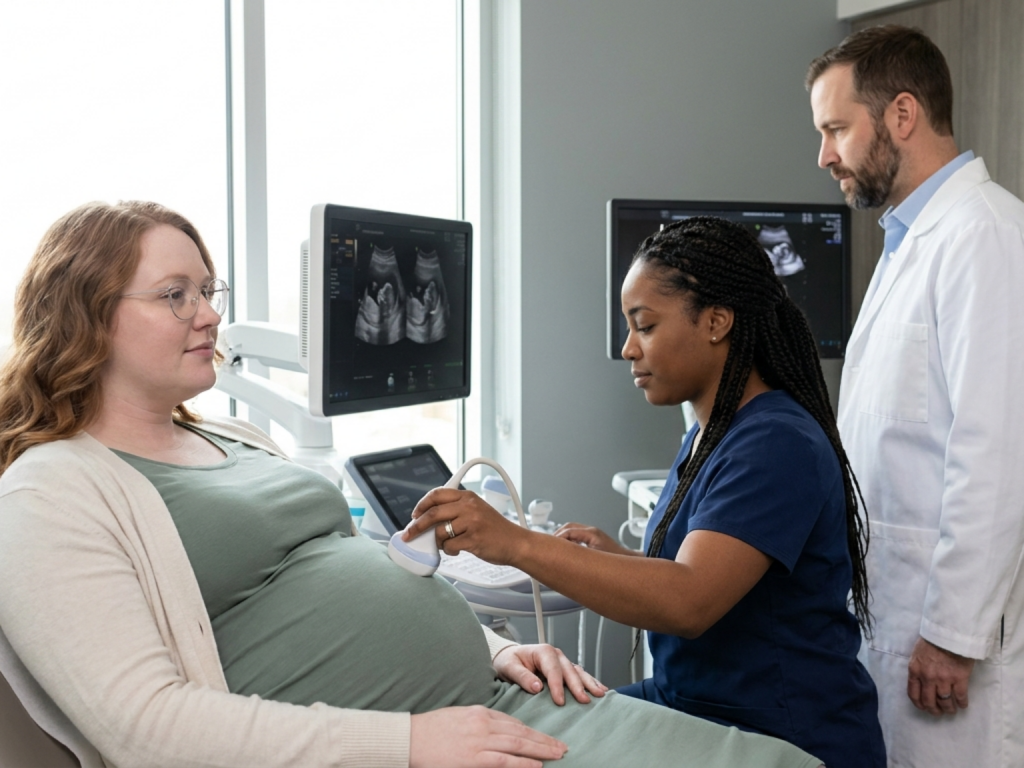
Learning that twins are breech, unusually large, or affected by another high-risk factor can make birth planning feel suddenly complicated. These findings do not determine the outcome by themselves, but they can change which delivery options are considered safest and where birth should take place.
Management is highly individualized. Presentation of the first twin, gestational age, estimated fetal weights, growth discordance, placental anatomy, maternal health, fetal monitoring, and the experience of the obstetric team all matter. A maternal-fetal medicine specialist or obstetrician familiar with complex twin delivery can explain how these factors apply to a specific pregnancy.
Highlights
The presentation of Twin A usually has the greatest influence on whether vaginal birth is considered.
Ultrasound weight estimates are useful but imprecise, so decisions should not rest on a single measurement alone.
Breech presentation introduces risks such as cord prolapse, birth trauma, and difficulty delivering the aftercoming head.
Safe planning depends not only on clinical findings but also on immediate access to anesthesia, neonatal care, ultrasound, and emergency cesarean delivery.
Why this combination requires individualized assessment
Twin pregnancy already carries higher rates of preterm birth, fetal growth abnormalities, hypertensive disorders, operative delivery, postpartum hemorrhage, and neonatal admission than singleton pregnancy. Breech presentation, suspected large fetal size, or a major difference in size between the twins can add further complexity, although none of these findings should be interpreted in isolation.
Breech means that the buttocks or feet, rather than the head, are closest to the cervix. It is more common in twins because each fetus has less room to turn and because fetal positions can be influenced by the other twin, placental location, amniotic fluid volume, uterine anatomy, and gestational age. The key distinction is whether Twin A, the fetus closest to the cervix, is breech. A breech Twin A presents different challenges from a nonvertex Twin B after the first baby has been born.
The phrase large fetal size in twins also requires context. Clinicians consider estimated fetal weight, abdominal circumference, gestational age, each twin’s growth trajectory, and the percentage of growth discordance. Maternal diabetes, prior obstetric history, pelvic factors, placental function, and signs of fetal compromise may alter the interpretation.
Understanding fetal presentation and weight estimates
Ultrasound usually establishes whether each fetus is cephalic, breech, or transverse. Breech subtypes include frank breech, with hips flexed and knees extended; complete breech, with hips and knees flexed; and footling breech, in which one or both feet are below the buttocks. Footling presentation generally carries a greater cord prolapse risk because the presenting part may not fill the pelvis effectively.
Presentation can change, particularly for Twin B after Twin A is delivered. Ultrasound may therefore be repeated near birth and used during labor. Placental mapping is also important: monochorionic twins share a placenta, while monoamniotic twins share both a placenta and an amniotic sac. These arrangements have distinct risks and may substantially change delivery planning.
Estimated fetal weight is calculated from ultrasound measurements rather than measured directly. Its margin of error becomes clinically relevant near thresholds used in local protocols. A baby suspected to be large may ultimately weigh less than predicted, and the reverse is also possible. Clinicians generally review serial growth, proportionality, fluid volume, Doppler findings when indicated, and the relationship between the twins rather than treating one estimate as certain.
How Twin A influences the planned route of birth
A first twin cephalic presentation often makes planned vaginal birth for twins a possible option when other maternal and fetal criteria are reassuring. If Twin A is breech or transverse, many hospitals recommend planned cesarean delivery because the first baby must open the cervix and birth canal while presenting buttocks or feet first. Potential complications include cord prolapse, incomplete cervical dilation around the aftercoming head, fetal head or neck trauma, and difficulty completing delivery promptly if fetal status deteriorates.
Published evidence specifically addressing a breech first twin is limited and largely observational. One multicenter retrospective study reported that vaginal delivery did not appear unsafe for selected breech first twins weighing at least 1,500 grams, while adverse outcomes were more frequent below that weight. Another retrospective study identified a traumatic vaginal delivery followed by neonatal death and concluded that cesarean delivery may be safer when Twin A is nonvertex. These older studies do not establish a universal weight cutoff or guarantee safety for an individual pregnancy.
Current decisions therefore depend on more than fetal weight. Relevant considerations include gestational age, breech subtype, flexion of the fetal head, congenital anomalies, fetal well-being, pelvic assessment, previous uterine surgery, labor progress, and the availability of an obstetrician experienced in vaginal breech delivery. Local guidelines and professional expertise vary, so recommendations may differ between hospitals.
Managing a nonvertex second twin
When Twin A is born vaginally, Twin B may remain cephalic, turn spontaneously, become transverse, or present breech. Second twin delivery management is therefore dynamic. The team typically reassesses presentation, fetal heart rate, membrane status, and the position of the umbilical cord and placenta immediately after the first birth.
Depending on the circumstances and the clinician’s expertise, options may include allowing a cephalic Twin B to descend, performing an assisted breech extraction, attempting internal podalic version followed by breech extraction, or proceeding to cesarean delivery. These are specialist obstetric procedures rather than techniques that can be planned solely according to parental preference. They require appropriate fetal selection, adequate anesthesia, continuous monitoring, ultrasound access, and an operating room that can be used without delay.
A combined delivery, in which Twin A is born vaginally and Twin B by cesarean, is sometimes necessary. Although teams try to avoid this situation, an urgent cesarean may become the safest response to persistent fetal heart rate abnormalities, cord prolapse, placental separation, an unstable lie, failed extraction, or inability to achieve a safe presentation. Discussing this possibility beforehand can make an unexpected change in plan less distressing.
What suspected large size changes
There is no single definition of a large twin that automatically determines the delivery route. Absolute estimated weight, percentile for gestational age, maternal pelvic and obstetric history, and the size relationship between the twins all contribute. Marked growth discordance may be more relevant than both babies simply measuring above average.
If Twin A is cephalic and suspected to be large, clinicians may discuss labor dystocia, operative birth, shoulder dystocia, and postpartum hemorrhage. Shoulder dystocia concerns a cephalic birth and is not the same as entrapment of the aftercoming head in breech delivery. In a breech fetus, concern may center on whether the body can deliver before a larger or extended head becomes trapped. Conversely, very low birth weight and extreme prematurity also increase vulnerability because small fetuses are more easily injured and may have a relatively large head compared with the body.
A planned caesarean for fetal size should not usually be based on an ultrasound number without broader assessment. The clinician may review measurement uncertainty, diabetes status, previous births, fetal proportions, presentation, and institutional thresholds before discussing reasonable options.
Safety requirements during labor and birth
When labor is considered appropriate in a complex twin pregnancy, it is generally planned in a hospital with emergency cesarean capability. Continuous fetal monitoring for twins helps the team follow both heart rates, although maintaining two distinct signals can be technically challenging. Bedside ultrasound may confirm which tracing belongs to each fetus and reassess presentation.
Intravenous access, laboratory testing, blood products, anesthesia, neonatal resuscitation personnel, and an operating room should be readily available. Some units recommend epidural analgesia because it can facilitate urgent operative procedures, but the appropriate anesthesia plan should be discussed with an anesthetist rather than assumed. The birth may take place in or close to an operating theatre even when vaginal delivery is intended.
Urgent intervention may be required for a nonreassuring fetal heart rate pattern, cord prolapse, heavy bleeding, suspected placental abruption, arrest of labor, uterine rupture, or head entrapment in breech birth. After delivery, twin gestation and uterine overdistension increase the risk of uterine atony after twin birth, so the team monitors bleeding and uterine tone closely. Newborn teams assess breathing, temperature, glucose stability, birth trauma, and the need for higher-level care.
Creating a flexible and supportive birth plan
A useful birth plan separates preferences from safety contingencies. Questions may cover the recommended delivery route, what would make the recommendation change, who has breech and twin-procedure expertise, whether delivery occurs in an operating room, and how anesthesia and neonatal support are organized. Families may also ask what happens if labor begins before the scheduled date or if an unexpected breech presentation is discovered on admission.
Planning should include several possible pathways: intended vaginal birth, scheduled cesarean, urgent intrapartum cesarean, and combined vaginal-cesarean delivery. It can also address immediate skin-to-skin contact, support-person access, feeding assistance, neonatal unit visitation, and recovery needs when medically feasible. Flexibility is not a failure of preparation; it is a practical response to fetal positions and clinical conditions that can change quickly.
It is reasonable to request a second specialist opinion when recommendations are unclear or when a preferred option is unavailable locally. However, traveling to pursue a particular delivery method should be weighed against the risk of spontaneous or preterm labor and the receiving hospital’s ability to manage complications. Shared decision-making works best when the care team explains absolute and relative risks, acknowledges uncertainty, and respects the family’s values without minimizing clinical danger.
Seek urgent maternity assessment
- Contact maternity services immediately for heavy bleeding, severe abdominal pain, collapse, or difficulty breathing.
- Report reduced or absent fetal movement promptly rather than waiting for the next appointment.
- Possible labor, ruptured membranes, or a visible or felt cord requires urgent assessment, especially with breech presentation.
- Severe headache, visual disturbance, right upper abdominal pain, or sudden swelling may indicate a hypertensive emergency.
- Follow the hospital’s emergency instructions if contractions begin before a planned twin cesarean.
Tools & Assistance
- Maternal-fetal medicine consultation for individualized risk review
- Late-pregnancy ultrasound for presentation, growth, fluid, and placental assessment
- Anesthesia consultation when operative or complex vaginal delivery is possible
- Hospital tour or birth-planning visit focused on operating-room and neonatal capabilities
- Written emergency plan with maternity triage contact details
FAQ
Can twins be born vaginally if one is breech?
Sometimes. A nonvertex Twin B can often be managed vaginally by an experienced team, but breech Twin A commonly leads to a recommendation for cesarean delivery. Eligibility depends on the full clinical picture and local expertise.
Does a large estimated weight make cesarean mandatory?
Not automatically. Ultrasound estimates have uncertainty, and presentation, gestational age, growth pattern, maternal factors, and the relationship between the twins also influence the recommendation.
Can a breech twin be turned before birth?
External cephalic version is primarily used in selected singleton pregnancies and is not routinely performed for Twin A. After Twin A is born, a specialist may reposition or extract Twin B in carefully selected circumstances.
Why might a planned vaginal twin birth end with cesarean delivery?
Reasons include fetal heart rate abnormalities, poor labor progress, cord prolapse, bleeding, unstable presentation of Twin B, or inability to complete delivery safely.
Is a 1,500-gram threshold proof that vaginal breech twin birth is safe?
No. That threshold comes from limited observational evidence and should not be treated as a universal rule. Individual assessment and current local protocols remain essential.
Sources
- PubMed — Delivery of breech first twins: a multicenter retrospective study
- PubMed — Breech presenting twin A: is vaginal delivery safe?
- Cleveland Clinic — Breech Baby: Causes, Complications, Turning & Delivery
Disclaimer
This article provides general medical information and is not a diagnosis or individualized birth recommendation. Consult your obstetrician or maternal-fetal medicine specialist about your circumstances, and seek urgent care for warning signs.

















Please log in to leave a comment.