
Intro
Labor is coordinated by a changing network of hormones, uterine signaling pathways, the cervix, placenta, fetal tissues, and mechanical pressure from the presenting part. Oxytocin is one of the best-known hormones in this network because it can intensify uterine contractions, but it is not the sole initiator or controller of labor. Its effects depend on oxytocin-receptor expression, prostaglandin activity, cervical readiness, and the broader hormonal environment.
Understanding this physiology can make the pattern of labor and the clinical use of synthetic oxytocin easier to discuss with a midwife, obstetrician, or other maternity professional. Individual labor varies considerably, so general physiology cannot predict exactly how a person’s contractions or treatment will progress.
Highlights
Oxytocin binds to receptors in the uterine myometrium and promotes coordinated contractions.
Estradiol, progesterone withdrawal at the tissue level, prostaglandins, and inflammatory signaling help prepare the uterus and cervix for labor.
Stretch of the cervix and lower uterus can amplify oxytocin release through a positive-feedback pathway.
Synthetic oxytocin may be used for induction, augmentation, or prevention and treatment of postpartum bleeding, with close maternal and fetal monitoring.
Contraction frequency, duration, and strength must be interpreted alongside cervical change and fetal well-being.
The hormonal transition into labor
Parturition, or the process of birth, is not usually triggered by a single hormonal event. It develops through progressive activation of the uterus, cervix, fetal membranes, placenta, and maternal neuroendocrine pathways. During pregnancy, progesterone supports uterine quiescence by reducing excitability and limiting coordinated contractile activity. Near term, the uterus becomes more responsive to stimulation despite continued circulating progesterone; this is often described as a functional withdrawal of progesterone at the tissue level rather than necessarily a dramatic fall in blood progesterone concentration.
Estradiol contributes to the transition toward labor by increasing myometrial excitability, promoting formation of gap junctions between smooth-muscle cells, and increasing oxytocin-receptor expression. Gap junctions permit electrical activity to spread through the uterine muscle, helping contractions become more synchronized. Estradiol also supports production of prostaglandins in the decidua, cervix, and fetal membranes. These changes make the uterus more capable of responding to oxytocin and other uterotonic signals.
Inflammatory mediators and local tissue remodeling also participate. The cervix softens, shortens, and becomes more distensible through changes in collagen organization, water content, leukocyte activity, and prostaglandin signaling. Consequently, labor contractions are most effective when the uterus and cervix have undergone this preparatory maturation.
How oxytocin produces a uterine contraction
Oxytocin is synthesized primarily in the hypothalamus and released into the maternal bloodstream from the posterior pituitary. During labor, it acts on oxytocin receptors located on smooth-muscle cells of the myometrium. Receptor density generally rises toward term, increasing uterine sensitivity to circulating oxytocin. Oxytocin is also produced locally in reproductive tissues, and local signaling may be important even when circulating concentrations do not appear markedly elevated.
At the cellular level, oxytocin receptor activation stimulates a G-protein-coupled signaling pathway, principally involving phospholipase C, inositol trisphosphate, and release of calcium from intracellular stores. Increased cytosolic calcium activates myosin light-chain kinase, allowing actin and myosin to interact and generate smooth-muscle contraction. Oxytocin can also promote calcium entry across the cell membrane and enhance synthesis or release of prostaglandins, which further support contractile activity.
The clinical result is not simply a stronger isolated squeeze. Coordinated electrical and biochemical activity across the myometrium produces a contraction with a rising phase, peak, and relaxation interval. The uterus must relax between contractions to permit maternal recovery and continued uteroplacental blood flow. A clinically useful contraction pattern therefore involves adequate activity as well as sufficient rest.
The positive-feedback loop during labor
One important mechanism linking cervical change to oxytocin is the neuroendocrine Ferguson reflex. As the fetal presenting part descends and stretches the cervix and upper vagina, sensory signals travel through the spinal cord to the hypothalamus. The posterior pituitary then releases pulses of oxytocin. Oxytocin stimulates the myometrium, increasing uterine force and supporting further descent and cervical dilation. The additional stretch can produce more oxytocin release, creating a positive-feedback loop.
This loop helps explain why labor often becomes more organized and intense as cervical dilation progresses. It does not mean that oxytocin alone determines the pace of labor. The response is influenced by receptor abundance, parity, fetal position, cervical condition, uterine anatomy, analgesia, stress physiology, and other biological factors. Oxytocin secretion is pulsatile, and its relationship to contraction strength is complex; a high blood concentration is not a reliable standalone measure of labor effectiveness.
Oxytocin also has important roles beyond uterine contraction. After birth, nipple stimulation can trigger oxytocin release and the milk-ejection reflex. Oxytocin released after delivery also contributes to uterine involution and contraction of the placental bed, helping reduce blood loss. These postpartum effects are physiologically related to, but distinct from, the mechanisms that support cervical dilation during labor.
Prostaglandins, estradiol, and progesterone: the wider network
Prostaglandins are locally produced lipid mediators with major roles in cervical ripening and uterine contractility. Prostaglandin E2 is associated particularly with cervical softening and remodeling, while prostaglandin F2α can promote myometrial contraction. Oxytocin can increase prostaglandin production, and prostaglandins can increase the uterus’s responsiveness to oxytocin. This interaction creates amplification within the parturition network rather than a simple linear sequence.
Estradiol supports this network by increasing oxytocin-receptor expression, connexin-mediated gap junctions, and prostaglandin synthesis. Progesterone generally opposes premature myometrial activation, although the balance between progesterone and estradiol effects is tissue-specific. Near labor, reduced progesterone signaling and increased estrogenic and inflammatory activity make the uterus more excitable. Fetal and placental signals, including changes associated with maturation of the fetal hypothalamic-pituitary-adrenal axis, may contribute to this transition.
These pathways also clarify why contractions can occur before active labor without leading immediately to birth. Irregular uterine activity may not be accompanied by sufficient cervical remodeling or coordinated myometrial activation. Conversely, when the hormonal and mechanical systems are aligned, contractions generally become more regular, painful, and effective at producing effacement and dilation.
Contractions, cervical change, and labor progression
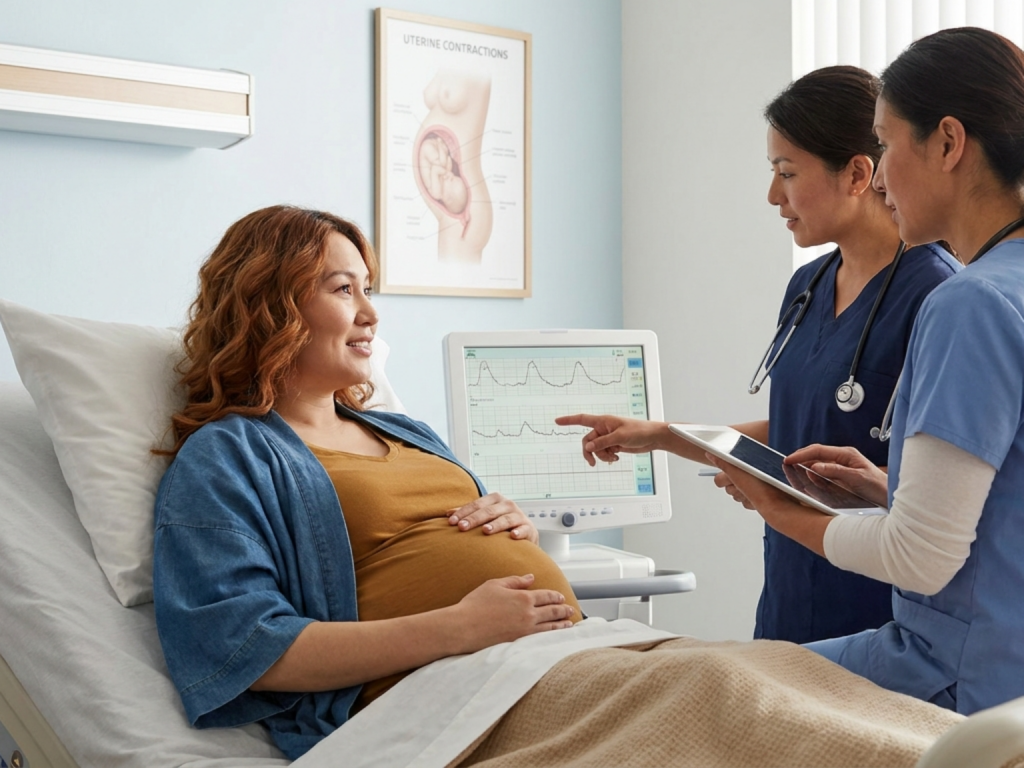
A contraction is commonly described by frequency, duration, and intensity, but these measures do not independently establish whether labor is progressing. Frequency refers to the interval from the beginning of one contraction to the beginning of the next. Duration is the length of each contraction, and intensity may be assessed by palpation or, in selected clinical settings, with an intrauterine pressure catheter. External monitoring can record timing and approximate duration but does not directly measure uterine pressure.
Clinicians interpret contraction patterns together with cervical effacement and dilation, fetal descent, fetal heart-rate findings, maternal vital signs, pain, hydration, and the overall clinical context. A pattern that feels intense may produce limited cervical change, while a person may experience substantial progress with a less dramatic subjective sensation. Analgesia, uterine anatomy, fetal position, and previous births can all influence the relationship between sensation and physiological effect.
During the first stage, contractions help efface and dilate the cervix. During the second stage, they work with maternal expulsive efforts to assist fetal birth. After delivery, uterine contractions help separate and expel the placenta and maintain uterine tone. Excessive uterine activity, particularly contractions that are too frequent or insufficiently separated by relaxation, can reduce recovery time for the uterus and may affect fetal oxygenation. This is why contraction assessment is paired with fetal surveillance when clinically indicated.
Synthetic oxytocin in maternity care
Synthetic oxytocin is chemically equivalent or closely analogous to endogenous oxytocin and is administered in clinical settings for specific indications. It may be used to induce labor when the benefits of delivery are judged to outweigh continued pregnancy, or to augment labor when contractions are inadequate and progress is slower than expected. It is also widely used after birth to promote uterine contraction and reduce the risk or severity of postpartum hemorrhage.
When used intravenously for induction or augmentation, oxytocin is generally titrated according to the response of the uterus, cervical findings, and fetal status. Because uterine sensitivity varies, the amount required cannot be inferred from another person’s experience. The care team may adjust or stop the infusion if contractions become too frequent, fetal heart-rate patterns become concerning, or another clinical issue develops. Continuous or intermittent fetal heart-rate and contraction assessment depends on the indication, medication use, local protocols, and the pregnant person’s risk profile.
Potential concerns include uterine tachysystole, defined clinically by excessive contraction frequency, which can compromise fetal recovery between contractions. Rare but serious complications can include uterine rupture in particular risk contexts, water intoxication with prolonged high-dose administration, and adverse effects related to the underlying indication or other interventions. These risks must be considered against the risks of continuing pregnancy or of inadequate uterine tone after birth. Questions about synthetic oxytocin during labor are appropriately addressed through shared decision-making with the maternity team.
Supporting informed and individualized care
Hormonal physiology is useful for understanding labor, but it should not be used to judge whether a person is laboring correctly or to imply that one birth pathway is morally or medically superior. Endogenous oxytocin release occurs in a context of safety, sensory input, cervical and uterine stretch, and neuroendocrine regulation. Calm, respectful care and the ability to ask questions may support coping and participation, although no environmental strategy can guarantee a particular hormone level or labor outcome.
A practical discussion with the care team can include the indication for any proposed oxytocin, the expected goal, alternatives, monitoring plan, criteria for changing the dose, and how progress will be evaluated. It is also reasonable to ask how contraction frequency will be assessed, how fetal well-being will be monitored, and what findings would lead clinicians to pause or discontinue the medication. People with a prior uterine scar, multiple pregnancy, malpresentation, placental complications, hypertension, or other medical conditions may need especially individualized planning.
Seek urgent maternity advice for suspected labor, vaginal bleeding, rupture of membranes, markedly reduced fetal movement, severe or persistent abdominal pain, fever, severe headache or visual symptoms, or contractions that become unusually frequent and do not allow meaningful relaxation. Local maternity services can advise on the appropriate response based on gestational age and personal history.
When urgent assessment is needed
- Contact maternity services promptly for heavy vaginal bleeding or severe, persistent abdominal pain.
- Seek urgent advice after suspected rupture of membranes, especially with fever, abnormal fluid color, or reduced fetal movement.
- Contractions that are very frequent, prolonged, or leave little time for relaxation require clinical assessment.
- During oxytocin administration, concerning fetal heart-rate changes or excessive uterine activity require immediate attention by the clinical team.
- Do not change, stop, or request a labor medication dose based solely on online information.
Tools & Assistance
- A written list of questions for the obstetrician, midwife, or labor nurse
- A birth preferences document that includes monitoring and medication questions
- A contraction-timing app used as a communication aid rather than a diagnostic tool
- The local maternity triage telephone number
- A record of medications, allergies, prior uterine surgery, and relevant pregnancy conditions
FAQ
Does oxytocin start every labor?
No. Labor emerges from interacting hormonal, inflammatory, mechanical, and cervical processes. Oxytocin is important for strengthening and coordinating contractions, but it is not the only factor that initiates labor.
Why can oxytocin make contractions stronger?
It binds to myometrial oxytocin receptors and raises intracellular calcium, which activates the smooth-muscle contractile apparatus. It can also increase prostaglandin production, further supporting uterine activity.
What is the Ferguson reflex?
It is a positive-feedback pathway in which cervical and vaginal stretch promotes oxytocin release, and oxytocin strengthens contractions that may cause further descent and stretch.
How do clinicians know whether contractions are effective?
They consider contraction timing and duration alongside cervical effacement and dilation, fetal descent, fetal heart-rate findings, and maternal clinical status. Contraction intensity alone is not enough.
Is synthetic oxytocin the same as natural oxytocin?
Synthetic oxytocin acts at the same principal receptor, but intravenous administration produces a controlled medication exposure rather than the naturally pulsatile release pattern of endogenous oxytocin. Its use requires individualized monitoring.
Sources
- American Journal of Obstetrics and Gynecology — The physiology and pharmacology of oxytocin in labor and in the peripartum period
- PMC / journal article — The hormonal control of parturition
- Society for Endocrinology — Oxytocin | Hormones
Disclaimer
This article is for general education and does not diagnose, treat, or replace advice from a qualified maternity professional. Seek individualized guidance from your obstetrician, midwife, or local maternity service.


















Please log in to leave a comment.