
Intro
Many pregnant people are asked to watch blood pressure at home, and that can feel both reassuring and unsettling. Reassuring, because it gives you more information between prenatal visits; unsettling, because one high number can trigger a lot of worry. The good news is that blood pressure monitoring at home is a validated part of out-of-office care when it is done with the right device and technique.
In pregnancy, home readings matter because blood pressure can change gradually, spike suddenly, or look normal in clinic while being higher elsewhere. Careful tracking helps your clinician interpret trends, identify possible hypertensive disorders earlier, and decide whether additional evaluation is needed. This article focuses on how to measure accurately, how to record patterns, and which warning signs should prompt urgent medical advice.
Highlights
Home blood pressure tracking is most useful when it is done with a validated device, a consistent routine, and a written log. A single reading is less informative than a pattern over several days.
Pregnancy adds urgency because hypertension can develop quietly and then become clinically significant quickly. Symptoms matter as much as the numbers.
Accurate technique reduces false alarms. Seated posture, correct cuff size, rest before measuring, and repeated readings all improve reliability.
Warning signs such as severe headache in pregnancy, vision changes in pregnancy, or shortness of breath should be taken seriously even if the home monitor does not show a dramatic number.
Why home readings matter in pregnancy
Home measurements are not a replacement for prenatal care; they are a way to extend it. In pregnancy, blood pressure can vary with stress, sleep, pain, hydration, time of day, and the clinical setting itself. Some people have higher readings in the office than at home, while others have the opposite pattern. Out-of-office measurement helps clinicians see the real day-to-day picture instead of relying on one number taken under one set of conditions.
That distinction is especially useful when a pregnancy is at risk for gestational hypertension or preeclampsia. These conditions may present first as a trend: a gradual rise, a few borderline readings, or a home reading that is repeatedly higher than expected. A well-kept record can support timely decisions about follow-up, laboratory testing, or closer surveillance.
It is also worth remembering that home tracking has an emotional function. Many pregnant people feel less powerless when they can document patterns instead of guessing. The goal is not to self-diagnose. The goal is to give your care team cleaner data and to help you recognize when a change is no longer something to simply watch.
Choosing a device and preparing to measure
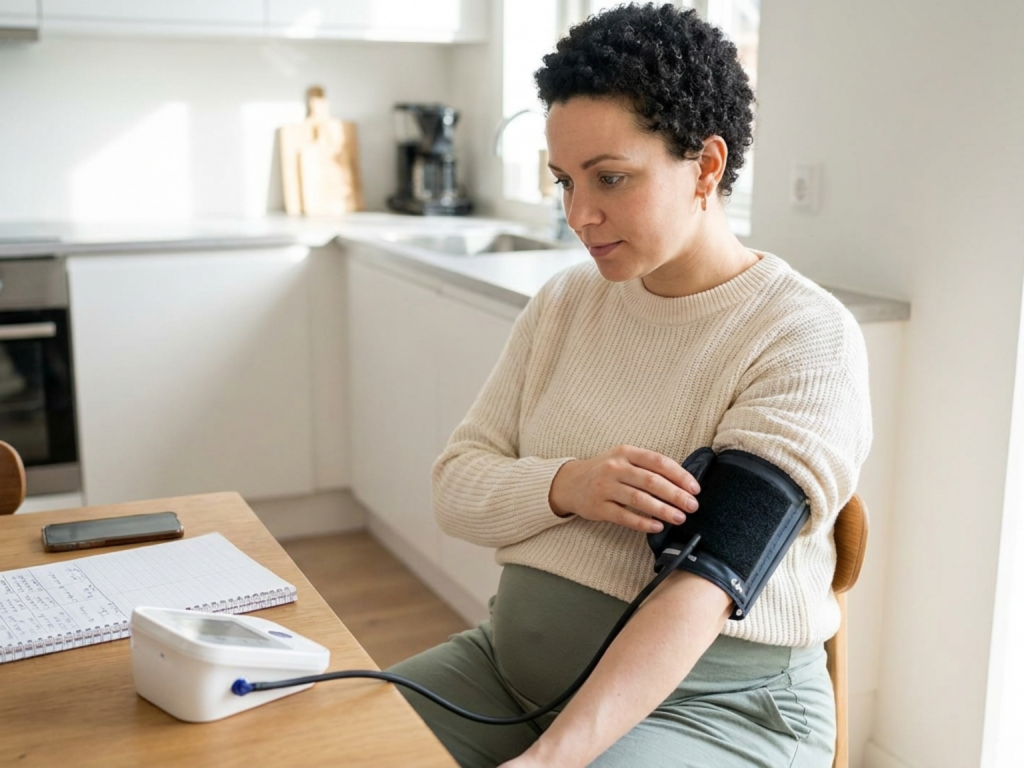
For pregnancy, use a pregnancy-validated blood pressure monitor when possible, and prefer an upper-arm cuff over a wrist device. The cuff should fit your arm correctly; a cuff that is too small can overestimate blood pressure, while one that is too large may underestimate it. If you are unsure, ask your prenatal clinic, pharmacist, or home-care team to check the device and cuff size with you.
Preparation matters as much as the device. Rest quietly for at least five minutes before measuring. Sit with your back supported, feet flat on the floor, legs uncrossed, and arm supported at heart level. Avoid caffeine, nicotine, exercise, and a heavy meal shortly before the reading if possible. Talking, scrolling, or rushing through the measurement can all distort the result.
If your monitor has not been compared with a clinic device, bring it to an appointment. A quick side-by-side check can confirm that the readings are reasonably aligned. That small step can prevent days of anxiety over a monitor that is simply not giving accurate numbers.
How to take and record reliable readings
A common home routine is to measure at the same times each day, often morning and evening, unless your clinician gives different instructions. Take two readings one minute apart and record both, or record the average if your clinician prefers that format. Over several days, trends are more informative than a single isolated result. The practical value of home tracking comes from repetition.
Keep your blood pressure logs simple and consistent. Include the date, time, systolic and diastolic numbers, pulse if your device provides it, and any relevant context such as a headache, poor sleep, anxiety, missed medication, or swelling. If you use an app, make sure the data can be shown easily in clinic. A notebook is perfectly acceptable if it is easier to maintain.
It can also help to pair the numbers with a simple symptom log. For example, note whether you had visual spots, upper abdominal pain, or reduced well-being at the time of the reading. This makes it easier for your clinician to interpret whether a borderline reading is part of a larger pattern. In uncertain situations, pattern recognition in pregnancy is often more useful than chasing a single exact threshold.
Warning signs that should not wait
Some warning signs deserve prompt medical review even before you know whether the home blood pressure is high. A persistent severe headache in pregnancy, vision changes in pregnancy, shortness of breath, new chest pain, right upper abdominal pain, or sudden marked swelling can signal a problem that needs same-day guidance. These symptoms can occur with hypertensive disorders, but they can also reflect other urgent conditions.
From the blood pressure side, repeated high readings are more important than one outlier. If a reading reaches the severe-range blood pressure in pregnancy threshold as defined by your care team, or if the number stays high after repeating it with correct technique and a period of rest, contact your maternity provider promptly. Do not wait until the next routine appointment if the number is far outside your usual range.
Be especially attentive if you are postpartum. Blood pressure can worsen after delivery, and some people develop postpartum preeclampsia symptoms or other complications after they have already left the hospital. If symptoms are escalating, or if you have neurologic symptoms, fainting, or a seizure, seek emergency help immediately. Severe disease can include HELLP syndrome, which requires urgent evaluation.
How to interpret fluctuations and avoid common pitfalls
Not every elevated home reading means something dangerous is happening, and not every normal reading is fully reassuring if symptoms are concerning. Blood pressure is dynamic. A reading can rise because you were talking, tense, dehydrated, or sitting incorrectly. It can also be lower after rest than it is during a busy day. That is why clinicians usually focus on repeated values and the overall trajectory.
Common pitfalls include using the wrong cuff size, measuring over clothing, crossing the legs, not supporting the arm, and taking readings immediately after walking in from the car. Even small technique errors can matter. If you get an unexpected number, repeat it after a calm rest period and confirm that the setup was correct before deciding what it means.
It is also useful to remember that home data and clinic data are meant to inform one another, not compete. If your home values are consistently different from office readings, bring the monitor, the log, and any symptom notes to your next visit. That combination helps your clinician decide whether the pattern looks like measurement error, white-coat effect, masked hypertension, or something that deserves closer surveillance.
What to discuss with your prenatal team
Ask your prenatal team what blood pressure range should trigger a call, what symptoms matter most for your specific pregnancy, and how often they want you to check at home. The answer can depend on your history, gestational age, medication plan, and whether you have already had elevated readings. A clear plan reduces uncertainty and makes it easier to act early if something changes.
You may also want to ask how home data should be shared. Some clinics want a printed log, others prefer portal messages or uploaded photos of the monitor screen. If you are using antihypertensive medication, do not change the dose on your own unless a clinician has specifically instructed you to do so. Instead, report the trend and ask for guidance.
If your pregnancy becomes more complex, your clinician may recommend additional evaluation such as urine protein testing in pregnancy, laboratory work, or maternal-fetal medicine evaluation. That does not automatically mean there is a crisis. It means the data need expert interpretation. The value of home tracking is that it supports earlier conversations, more precise follow-up, and a better-informed plan for both pregnancy and the postpartum period, including postpartum blood pressure follow-up.
Seek urgent care when
- A home blood pressure stays in the severe range after a repeat check with correct technique.
- You have severe headache in pregnancy, vision changes in pregnancy, or shortness of breath that is new or worsening.
- You develop chest pain, right upper abdominal pain, fainting, a seizure, or heavy bleeding.
- Symptoms worsen after delivery, even if you recently left the hospital or your last reading was normal.
Tools & Assistance
- A validated upper-arm blood pressure monitor with the correct cuff size
- A written or digital blood pressure log for dates, times, and symptoms
- Your prenatal clinic phone number and after-hours triage line
- Your monitor manual for technique and error-message troubleshooting
- A simple reminder routine for morning and evening readings
FAQ
How often should I check my blood pressure at home in pregnancy?
Follow your clinician’s instructions. Many people are asked to measure once or twice daily for a period of time, but the schedule should be individualized.
Can I use a wrist monitor instead of an upper-arm cuff?
Upper-arm devices are preferred because they are generally more reliable. If a wrist device is your only option, ask your clinician to confirm that it is appropriate and that your technique is accurate.
What should I do if one reading is high?
Sit quietly and repeat it after a few minutes with correct positioning. If the value remains very high or you have concerning symptoms, contact your prenatal team promptly.
Should I track symptoms along with numbers?
Yes. Symptom notes can help your clinician interpret borderline or changing readings and decide whether further evaluation is needed.
Do blood pressure checks matter after delivery?
Yes. Blood pressure can rise or worsen postpartum, so follow-up after birth is important even if the pregnancy itself seemed stable.
Sources
- Circulation / American Heart Association — Home Blood Pressure Monitoring
- PMC / NIH — Guidance on home blood pressure monitoring
- Centers for Disease Control and Prevention — Measuring Your Blood Pressure
Disclaimer
This article is for education only and does not replace individualized prenatal, postpartum, or emergency medical care. If you have concerning blood pressure readings or warning symptoms, contact a qualified clinician promptly.
















Please log in to leave a comment.