
Intro
School supplies are more than stationery. For many children, the right pencils, notebooks, backpack, lunch items, and organizing tools help translate classroom expectations into daily routines they can manage. For families, supply lists can also feel financially and emotionally stressful, especially when requirements vary by grade, teacher, or school.
This guide explains common school supplies for children, why they are used, how to choose them safely and practically, and how to adapt them for children with sensory, motor, attention, medical, or learning needs. It is informational and supportive, not a substitute for advice from your child’s teacher, clinician, occupational therapist, or school support team.
Highlights
Most children need a core set of writing, paper, organizing, art, and hygiene supplies, but the exact list should come from the school or teacher.
Comfort and fit matter medically: a poorly fitted backpack, hard-to-use scissors, or sensory-irritating clothing labels can increase fatigue, distress, or avoidance.
Community classroom supplies are common in early grades and may include shared tissues, glue sticks, crayons, or disinfecting materials managed by the teacher.
Children with motor, sensory, visual, attention, or chronic health needs may benefit from individualized supply adaptations coordinated with school staff.
Why school supplies matter for children
School supplies are external supports for a child’s developing executive functions: planning, working memory, task initiation, organization, and self-monitoring. A folder is not just a folder; it can become a predictable place for homework, permission slips, and teacher notes. A pencil pouch can reduce the cognitive load of searching for materials. A labeled notebook can help a child connect a subject, a teacher, and an assignment without relying entirely on memory.
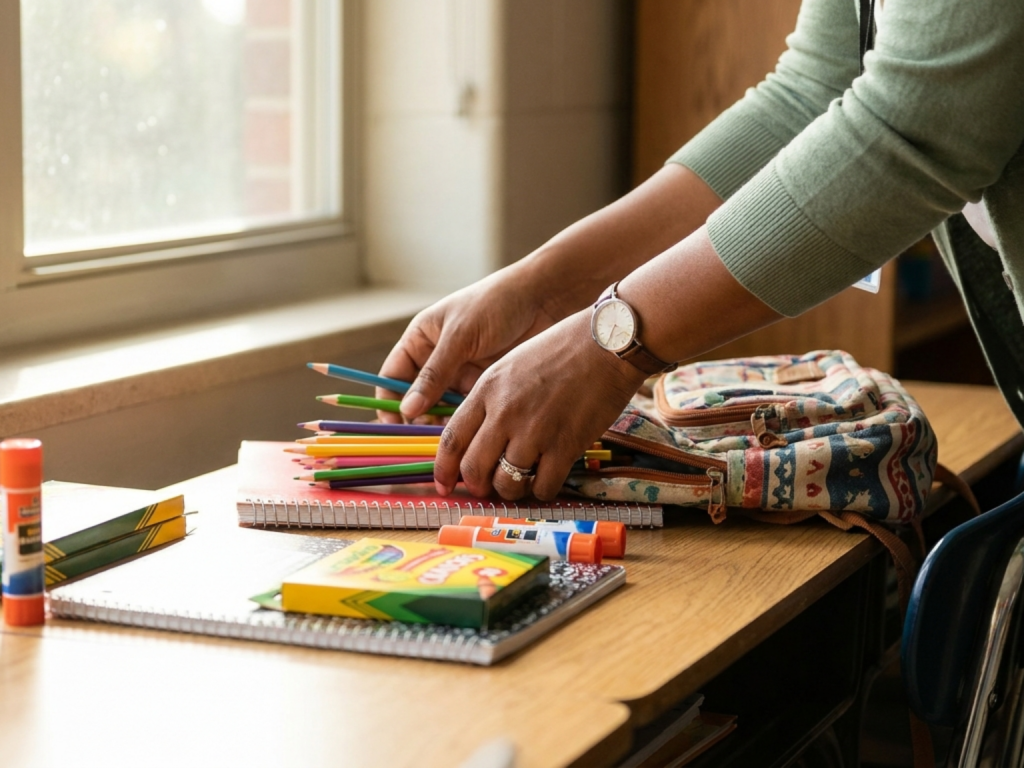
For younger children, supplies also support fine-motor development and sensory learning. Crayons, glue sticks, blunt-tip scissors, and thick pencils allow practice with bilateral coordination, grip strength, visual-motor integration, and hand dominance. These skills develop unevenly, so a child who struggles with handwriting or cutting is not being lazy. They may need time, instruction, adaptive tools, or assessment by an occupational therapist if difficulties are persistent and impairing.
Supplies can also influence emotional regulation. When a child has the materials expected in class, they may feel more secure and less exposed to embarrassment. Conversely, missing or confusing supplies can amplify school stress, especially during school transitions in children, new classrooms, or after an absence. The goal is not perfection. The goal is to create a manageable system that helps the child participate, ask for help, and recover when something is forgotten.
Core supplies by age and grade
Most school supply lists include a familiar core: pencils, erasers, pencil sharpeners, crayons or colored pencils, markers, glue sticks, child-safe scissors, notebooks, folders, binders, loose-leaf paper, rulers, and sometimes calculators. The National Education Association describes supply needs by grade level and emphasizes that items differ across classrooms. A preschool child may need a rest mat, art smock, change of clothes, and washable supplies, while a high school student may need subject-specific binders, pens, graph paper, index cards, and a scientific or graphing calculator.
In early elementary school, supplies should be simple and durable. Thick crayons, washable markers, wide-ruled paper, and easy-open folders usually work better than complicated systems. Children in later elementary grades often begin managing multiple subjects, so color-coded folders or notebooks can be helpful if the system is taught clearly. Middle and high school students may need more independent organization, but they also may need explicit coaching; adolescence does not automatically produce mature executive function.
A useful approach is to separate supplies into four categories: writing tools, paper and organization, art and project materials, and personal care items. Personal care may include tissues, water bottle, menstrual supplies when relevant, hand sanitizer if permitted, and a small backup of items the child may need privately. For children with medical conditions, school supplies may overlap with health planning, such as safe storage of approved snacks, hydration access, or a clearly labeled medical information card if recommended by the school nurse or clinician.
Personal supplies and community classroom supplies
Parents are sometimes surprised when supplies they purchase are pooled for the class. In many elementary classrooms, teachers use community supplies so children can access crayons, glue sticks, tissues, wipes, or pencils as needed, without constant individual ownership disputes. This can reduce interruptions and support equity, especially when some families cannot replace items frequently.
Personal supplies are items intended for one child’s daily use, such as a backpack, lunch box, water bottle, pencil case, headphones, planner, binder, or specific notebook. Community supplies are teacher-managed items used by many students, such as shared paper, art materials, tissues, dry-erase markers, or cleaning materials. If a supply list does not clarify which items are shared, it is reasonable to ask the teacher before buying specialty or personalized products.
For some children, shared supplies need special consideration. A child with severe allergies, immunocompromise, dermatologic sensitivity, or sensory aversion may need an individualized plan. For example, scented markers, latex-containing items, fragranced wipes, or certain hand sanitizers can be problematic for some children. Families should discuss medically significant concerns with the school nurse and teacher rather than relying on the child to self-advocate alone. If accommodations are needed, documentation from a healthcare professional may help the school create a practical and safe plan.
Backpacks, ergonomics, and physical comfort
A backpack is one of the most important school supplies because it affects daily musculoskeletal load. Children should generally carry only what they need, and the bag should fit the child’s torso rather than hanging low or pulling backward. Wide padded shoulder straps, a chest or waist strap when appropriate, and multiple compartments can distribute weight more evenly. A rolling bag may help some children, but it is not always allowed and can be difficult on stairs, buses, or crowded hallways.
Watch for discomfort signals: shoulder grooves, neck pain, back pain, tingling, frequent switching of shoulders, leaning forward while walking, or irritability when packing the bag. These signs do not diagnose injury, but they suggest the system may need adjustment. If pain is persistent, severe, associated with weakness or numbness, or limits normal activity, families should consult a healthcare professional.
Ergonomics also applies to smaller supplies. Pencil grips may help some children, but they are not universally necessary. Scissors should match hand size and handedness when possible. A child with low muscle tone, developmental coordination disorder, cerebral palsy, hypermobility, tremor, or post-injury limitations may need adaptive tools chosen with occupational therapy input. The best supply is not always the newest or most expensive; it is the one the child can use comfortably and reliably in the real classroom environment.
Sensory, attention, and learning needs
Some children experience school supplies through a sensory lens. The smell of markers, the scratch of a pencil, the sound of a sharpener, the pressure of a backpack strap, or the visual clutter of a binder can be genuinely dysregulating. Sensory overload in classrooms may look like avoidance, shutdown, irritability, fidgeting, or refusal, not simply dislike. A supportive response begins with curiosity: which part of the supply is hard, and what alternative would reduce the barrier?
Children with attention difficulties in the classroom may benefit from fewer choices and more visible organization. One folder for “bring home” and one for “return to school” can work better than a complex multi-tab system. Transparent pouches, color coding, checklists, and duplicate supplies at home and school can reduce repeated lost-item crises. However, too many tools can become another demand. Systems should be simple enough that the child can use them on a tired day.
For children with dyslexia, dysgraphia, visual impairment, or language-based learning differences, supplies may include assistive technology: headphones, keyboard access, speech-to-text tools, pencil grips, slant boards, highlighted paper, or audiobooks if included in an education plan. These decisions should be made with educators and specialists. Parents do not need to diagnose the problem alone. If a child consistently avoids writing, cannot keep materials organized despite support, or shows academic decline and emotional distress, it is appropriate to request a school meeting or professional evaluation.
Budgeting, timing, and reducing family stress
Back-to-school shopping can create pressure to buy everything immediately, but many educators advise waiting for the teacher’s list when possible. Schools often post grade-level lists, yet individual teachers may prefer specific folder colors, notebook types, or shared classroom contributions. Buying early can be useful for sales, but keep receipts and avoid personalizing items until you know whether they will be kept individually or used as community supplies.
A practical budget plan starts with essentials: backpack if needed, writing tools, paper or notebooks, folders, and any school-required items. Optional extras, decorative items, and duplicate sets can come later. Families can also ask schools about supply drives, parent-teacher organizations, community programs, or discreet assistance. Needing help with supplies is common and not a reflection of parenting quality.
It can help to involve children in limited, structured choices. For example, “Choose one folder color and one pencil pouch” is easier than an open-ended shopping trip. This supports autonomy without overwhelming the child or the budget. For children prone to anxiety or rigidity, previewing the list, store plan, and spending limit can prevent conflict. A calm school morning checklist, packed the night before, often matters more than the brand of notebook. The best supply routine is the one your family can repeat with the least distress.
Labeling, storage, and daily maintenance
Labeling can prevent loss, but it should be done thoughtfully. Put the child’s name on personal items such as backpacks, lunch boxes, water bottles, jackets, calculators, headphones, and pencil cases. For privacy and safety, avoid displaying the child’s full name prominently on the outside of items where strangers can easily read it. Internal labels, initials, or classroom identification systems may be safer.
Home storage should be predictable. A single “school supplies home base” near the homework area or exit door can reduce searching. Younger children may need picture labels or bins for pencils, crayons, glue, and paper. Older children may prefer a drawer, shelf, or backpack station. The system should match the child’s developmental level rather than adult ideals of neatness.
Daily maintenance works best when brief. A two-minute backpack reset can include throwing away trash, checking the take-home folder, replacing pencils, and putting lunch containers in the kitchen. Weekly, families can restock supplies and remove old papers. If this repeatedly becomes a major conflict, consider whether the child needs more adult scaffolding, a simpler organization system, or school collaboration. Chronic disorganization can be related to executive function and school stress, sleep problems, anxiety, attention differences, or excessive workload, so compassion is more effective than shame.
When to seek extra support
- Persistent back, neck, shoulder, hand, or wrist pain related to school items should be discussed with a healthcare professional.
- Severe allergies, asthma triggers, skin reactions, or immune concerns require coordination with the school nurse and clinician.
- Ongoing refusal, panic, shutdown, or distress around school materials may signal sensory, anxiety, learning, or executive function needs.
- A child who cannot use scissors, pencils, zippers, or containers at an age-expected level may benefit from occupational therapy input.
- Do not add medical devices, supplements, medications, or treatment tools to a school bag without following school policy and clinical guidance.
Tools & Assistance
- Ask the teacher for the final supply list before buying specialty items.
- Create a labeled home supply station and a brief weekly restocking routine.
- Consult the school nurse about allergies, chronic illness, medication policies, and safe storage.
- Request an occupational therapy or school support discussion if supplies are hard for your child to use.
- Use community supply drives, school offices, or parent-teacher organizations if cost is a concern.
FAQ
Should I buy every item on the school supply list?
Usually yes for required items, but ask the teacher if something is unclear, expensive, or duplicated. Some items may be community supplies rather than personal supplies.
How heavy should my child’s backpack be?
There is no single rule for every child, but the backpack should not cause pain, numbness, leaning, or fatigue. Persistent discomfort should be reviewed with a clinician.
Are expensive supplies better for learning?
Not necessarily. Durable, easy-to-use, school-approved supplies are usually more helpful than costly or complicated products.
What if my child keeps losing supplies?
Use labels, simplify the system, keep duplicates if possible, and create a short daily reset routine. If the problem is persistent and impairing, discuss executive function supports with the teacher.
Can my child use adaptive supplies at school?
Often yes, especially when they support access and participation. Coordinate with the teacher, school nurse, occupational therapist, or education plan team when needed.
Sources
- National Education Association — What Back-to-School Supplies Should I Be Getting?
- Cult of Pedagogy — Community Supplies in the Classroom: Clearing Up the Confusion
- Raymond Geddes — Essential Guide to School Supplies for Students
Disclaimer
This article is for informational purposes only and does not diagnose, treat, or replace medical, developmental, or educational advice. Consult your child’s healthcare professional, school nurse, teacher, or specialist for individualized guidance.














Please log in to leave a comment.