
Intro
A daily routine for a 10- to 12-year-old is not about controlling every minute. It is a predictable framework that helps a preteen move through school, friendships, family expectations, body changes, and increasing independence with less friction. At this age, children often want more autonomy but still benefit from adult scaffolding, especially around sleep, food, homework, screens, hygiene, and emotional regulation.
Highlights
A consistent routine can support executive function, self-regulation, school engagement, and calmer family communication.
Preteens usually need 9 to 12 hours of sleep per night, so the day should be built backward from a realistic bedtime.
The most useful routines are flexible, collaborative, and developmentally appropriate rather than rigid or punitive.
Daily structure should protect time for movement, meals, schoolwork, decompression, hygiene, chores, family connection, and unstructured play.
Why routine matters at ages 10 to 12
Between ages 10 and 12, children are in a transition zone: no longer little children, not yet adolescents. Their prefrontal cortex, which supports planning, inhibition, task switching, and working memory, is still developing. A predictable daily rhythm reduces the number of decisions a preteen must make when tired, hungry, emotionally activated, or distracted. This is why routines can feel calming even for children who initially resist them.
Research on family routines links regular bedtimes, meals, chores, and structured daily patterns with stronger cognitive development, emotional regulation, and school performance. The mechanism is not mysterious: repetition externalizes executive function. Instead of asking a child to remember every step from scratch, the environment cues the next action. A backpack by the door, a visual checklist, a regular homework start time, and a consistent bedtime routine for preteens all reduce cognitive load.
Routines also support parent-child relationships. When expectations are discussed in advance, fewer daily interactions become negotiations. This matters because preteens are increasingly sensitive to fairness, autonomy, and tone. A routine that is co-created rather than imposed can preserve dignity while still setting limits. The goal is not perfection; it is a predictable sequence that helps the child recover after inevitable disruptions.
A realistic morning routine
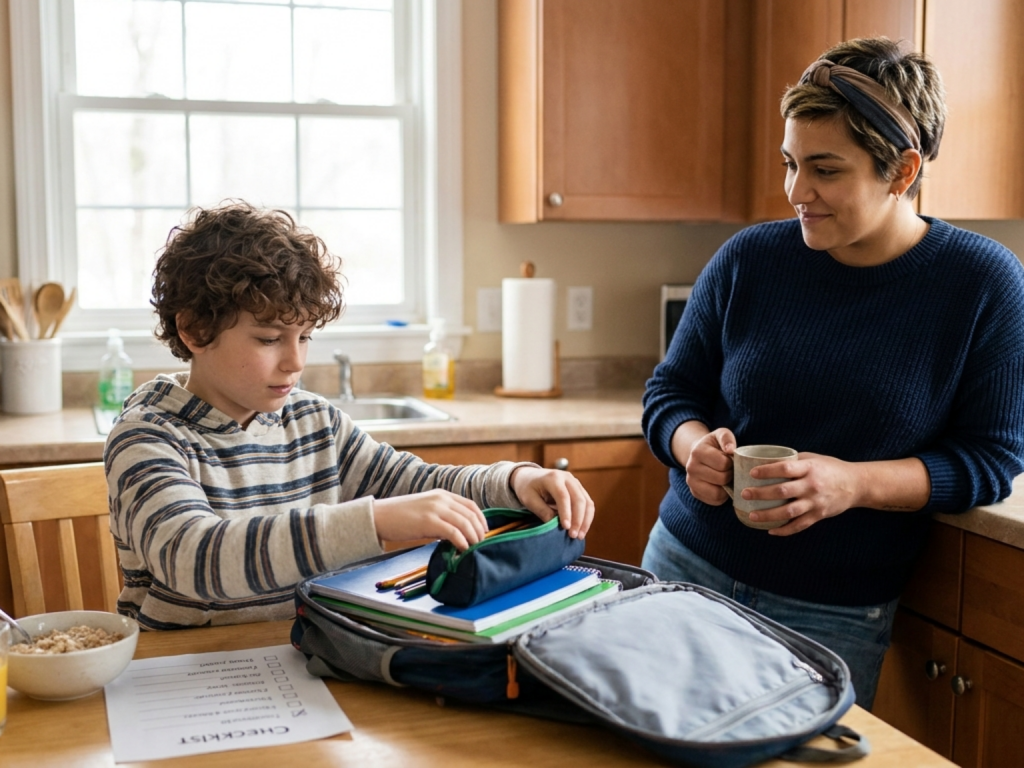
A strong morning usually begins the night before. Clothes, school materials, sports gear, lunch items, and signed forms should be prepared in advance when possible. Many families find that a short evening reset prevents the morning from becoming a cascade of stress hormones, raised voices, and missed breakfasts.
For a school-day morning, the routine should be simple and visible. A 10- to 12-year-old can often manage several steps independently, but reminders may still be needed, especially for children who are sleepy, anxious, neurodivergent, or adjusting to puberty-related sleep shifts. A practical sequence may include waking at a consistent time, using the bathroom, dressing, eating breakfast, brushing teeth, checking the backpack, and leaving with a small buffer.
Breakfast is clinically relevant because prolonged fasting can worsen irritability, reduced attention, headaches, or low energy in some children. A balanced morning meal does not need to be elaborate. It can include a protein source, a carbohydrate with fiber when available, and fluid. Families working on preteen nutrition may also use breakfast as a low-pressure time to include calcium, vitamin D, iron-containing foods, fruit, or whole grains according to the child’s needs and cultural food patterns.
The emotional climate matters. A calm greeting, predictable lighting, and limited criticism can help a preteen transition into the day. If mornings are consistently chaotic, consider whether the wake time is too late, bedtime is too late, the child is not getting enough sleep, or the routine has too many steps for the available time.
School, homework, and after-school decompression
After school, many preteens are cognitively and socially saturated. They may have held themselves together through academic demands, peer comparison, noise, transitions, and adult expectations. A daily routine should not assume that a child can immediately begin complex homework the moment they walk in the door.
A useful after-school pattern often includes food, hydration, movement or quiet decompression, then homework. The exact order depends on the child. Some children do best with a 20- to 30-minute reset before schoolwork; others become more dysregulated if homework is delayed too long. The key is to observe function, not ideology. Homework organization for preteens may include a designated work area, a written task list, breaking assignments into smaller units, and a planned finish time.
Studies of time use in 12-year-olds show that homework and watching TV are among the most frequent activities. This is realistic and useful information for families: screens are not a rare exception in modern preteen life, and homework can occupy meaningful time. The routine should acknowledge both rather than pretend they will disappear. For example, screen time may be scheduled after homework, chores, and physical activity, or used as a short decompression tool with clear boundaries.
Parents should remain available without taking over. At this age, supported independence in preteens is more helpful than either micromanagement or total withdrawal. Ask, “What is your plan?” before giving instructions. If a child repeatedly cannot start, sustain, or complete schoolwork despite support, it may be worth discussing learning, attention, mood, sleep, or vision/hearing concerns with a qualified professional.
Movement, chores, and activities without over-scheduling
Physical activity in preteens supports cardiometabolic health, musculoskeletal development, sleep pressure, mood regulation, and attention. A daily routine should make movement normal rather than treating it as an optional luxury. This can include organized sports, walking, cycling, playground time, dance, martial arts, active chores, or informal games. The best activity is one the child can repeat without shame, pain, or excessive pressure.
Chores are also part of development. They teach sequencing, responsibility, contribution, and self-efficacy. A 10- to 12-year-old may be able to pack part of a lunch, feed a pet, take out trash, fold laundry, wipe counters, load a dishwasher, or manage a bedroom reset. Chores should be specific and teachable. “Clean your room” may be too vague; “put dirty clothes in the hamper, books on the shelf, and trash in the bin” is more actionable.
Families often ask how many activities for 10- to 12-year-olds are appropriate. There is no universal number. The better question is whether the child still has time for sleep, meals, homework, hygiene, family connection, free play, and recovery. Activity-related fatigue in children can show up as irritability, headaches, worsening school performance, frequent conflicts, recurrent stomachaches, or loss of enjoyment. These symptoms are not specific to over-scheduling and should not be self-diagnosed, but they are signals to reassess the routine and seek medical advice if persistent or concerning.
Unstructured time is not wasted time. It supports creativity, social negotiation, boredom tolerance, and self-directed problem-solving. A healthy routine has margins.
Meals, hydration, hygiene, and body changes
Preteens may enter puberty at different times, and daily routines need to accommodate body changes without embarrassment. Hygiene may need to become more explicit: regular bathing, deodorant when appropriate, dental care twice daily, menstrual supplies if needed, clean clothes, and care for sports gear. These conversations should be calm, private, and matter-of-fact.
Meal routines are equally important. Family meals, even when brief, are associated with structure and connection. They provide an opportunity to notice appetite changes, mood, fatigue, restrictive eating, excessive preoccupation with body size, or stress around food. Because growth patterns vary widely at this age, caregivers should avoid casual comments about weight, “good” or “bad” bodies, or dieting. Concerns about growth, appetite, gastrointestinal symptoms, or eating behavior should be discussed with a pediatrician or qualified dietitian.
Hydration can be built into the day: water on waking, a bottle for school if allowed, fluid after physical activity, and water with meals. Children in sports, hot climates, or illness may need closer attention to fluid status. Signs such as dizziness, fainting, persistent vomiting, confusion, or inability to keep fluids down warrant medical assessment.
Routines around the body should preserve privacy. A preteen may want closed doors, more control over clothing, and less public correction. Respectful support strengthens trust, which becomes increasingly important as puberty progresses.
Screens, social connection, and emotional regulation
Digital life is often part of peer-centered social development. A daily routine should therefore include clear expectations about devices without framing technology as the enemy. Preteens may use screens for school, entertainment, creativity, and friendship. The clinical concern is not simply minutes; it is displacement. Are screens replacing sleep, physical activity, homework, meals, face-to-face connection, or emotional recovery?
Families can set device “parking” times, such as during meals, homework blocks, and the final part of the evening. Evening screen exposure can delay sleep onset for some children through stimulating content, social stress, or light effects on circadian signaling. If a preteen becomes distressed when a device is removed, the response should be calm and consistent. Escalating into a power struggle often makes regulation harder.
Emotional regulation at this age is uneven. A child may reason maturely in the morning and melt down after school. This does not necessarily mean manipulation; it may reflect fatigue, hunger, social stress, or limited regulatory capacity. Build in predictable pauses: a snack, a walk, music, drawing, quiet reading, breathing exercises, or a few minutes alone. Family communication with preteens works best when adults validate feelings while maintaining boundaries: “I understand you are upset, and the homework plan still starts at 4:30.”
If a child shows persistent sadness, severe anxiety, withdrawal from usual activities, self-harm talk, aggression, marked sleep changes, or major decline in school functioning, caregivers should seek professional help promptly.
Evening rhythm and sleep protection
Sleep is the anchor of a preteen routine. Many 10- to 12-year-olds need 9 to 12 hours of sleep per night. To make this practical, families can work backward from the required wake time. A child who must wake at 6:30 a.m. may need lights out early enough to allow both sleep onset and total sleep time, not just time spent in bed.
An evening routine should gradually reduce stimulation. Dinner, homework completion, packing the backpack, bathing, reading, quiet conversation, and lights out can occur in a predictable order. The routine should be short enough to repeat and gentle enough to signal safety. A bedtime routine for preteens may still include a parent check-in, even when the child seems “too old” for it. Many preteens disclose worries at night because the day has finally slowed down.
Consistent wake times help stabilize circadian rhythm in preteens. Weekend schedules can be somewhat flexible, but large shifts may create a social jet lag effect, making Monday mornings harder. Caffeine, late intense exercise, conflict near bedtime, and unsupervised late-night devices can all interfere with sleep quality.
Some sleep problems need medical evaluation. Loud habitual snoring, witnessed pauses in breathing, restless sleep with daytime impairment, chronic insomnia, morning headaches, excessive daytime sleepiness, or sudden changes in sleep behavior should be discussed with a healthcare professional. Families should avoid using sleep medications or supplements for a child without medical guidance.
Adapting the routine to the child and the family
The best routine is not the one that looks ideal on paper; it is the one a real family can repeat most days. Work schedules, caregiving responsibilities, transportation, cultural practices, shared bedrooms, financial constraints, and school start times all shape what is possible. A compassionate routine starts with the family’s reality.
Invite the preteen into planning. Offer limited choices: “Would you rather shower before dinner or after homework?” “Do you want the checklist on paper or on the fridge?” “Should we pack your bag before or after brushing teeth?” Choice increases cooperation because it supports autonomy within safe boundaries.
Review the routine every few weeks or after major changes, such as a new school term, sports season, puberty milestone, family stressor, illness, or sleep disruption. If the routine is failing, assume it needs adjustment before assuming the child is being difficult. Too many steps, unclear expectations, inconsistent enforcement, untreated anxiety, learning challenges, sleep deprivation, or unrealistic timing can all undermine success.
A daily routine for ages 10 to 12 should communicate one central message: “You are growing, and we trust you with more responsibility, but you do not have to manage everything alone.” That balance of independence and support is the heart of healthy preteen structure.
When to seek professional guidance
- Persistent sleep loss, loud snoring, breathing pauses during sleep, or excessive daytime sleepiness should be discussed with a healthcare professional.
- Major changes in appetite, weight trajectory, eating behavior, or body image distress warrant pediatric or dietetic evaluation.
- Ongoing sadness, anxiety, withdrawal, aggression, self-harm statements, or functional decline need prompt mental health support.
- Frequent headaches, abdominal pain, dizziness, fainting, or unexplained fatigue should not be assumed to be routine-related.
- Do not give sleep aids, supplements, or medications to a child without guidance from a qualified clinician.
Tools & Assistance
- Create a one-page weekday routine with wake time, meals, schoolwork, movement, chores, screen limits, and bedtime.
- Use a visual checklist for morning and evening tasks instead of repeated verbal reminders.
- Schedule a pediatric visit if sleep, growth, mood, attention, or school functioning changes persist.
- Hold a weekly 10-minute family routine review to adjust expectations before conflicts build.
- Coordinate with teachers, school counselors, coaches, or clinicians when academic or activity demands become overwhelming.
FAQ
What time should a 10- to 12-year-old go to bed?
It depends on the required wake time, but many preteens need 9 to 12 hours of sleep. Work backward from morning obligations and allow time for falling asleep.
Should a preteen have the same routine every day?
The core rhythm should be predictable, but not rigid. Sleep, meals, schoolwork, hygiene, and family expectations benefit from consistency, while weekends and special events can be flexible.
How much independence should a preteen have in the routine?
Most 10- to 12-year-olds can manage parts of the day independently with reminders, checklists, and adult oversight. Independence should increase gradually as the child demonstrates readiness.
Is screen time always bad for preteens?
No. Screens can support learning, creativity, and social connection. The concern is when screens displace sleep, movement, homework, meals, in-person relationships, or emotional regulation.
What if my child refuses the routine?
Start by simplifying the routine, offering limited choices, and checking whether fatigue, anxiety, learning difficulties, or unrealistic timing are involved. Seek professional guidance if refusal is severe or linked with functional decline.
Sources
- Journal of Family Theory & Review (Wiley) — Routines and child development: A systematic review
- National Institutes of Health / PubMed Central — Patterns of Time Use among 12-Year-Old Children and Their Life Quality
- Texas Children's Hospital — Why daily routines and good sleep habits matter
Disclaimer
This article is for informational purposes only and does not replace medical, developmental, nutritional, or mental health advice from a qualified professional. Consult a healthcare clinician for concerns about a child’s sleep, growth, mood, behavior, or functioning.


















Please log in to leave a comment.