
Intro
Children benefit enormously from sports: stronger bones and muscles, better cardiometabolic fitness, coordination, confidence, friendships, and stress relief. At the same time, a child’s growing skeleton, developing neuromuscular control, and enthusiasm for play can make injuries more likely when safety systems are inconsistent.
Highlights
Most pediatric sports injuries are not random events; risk can often be lowered through conditioning, supervision, rest, and sport-specific protective gear.
Helmets, mouthguards, eye protection, pads, shin guards, and properly fitted shoes work best when they are approved for the sport and replaced when damaged.
Overuse injuries deserve as much attention as sprains and fractures because children’s growth plates and tendons can be vulnerable to repetitive load.
A culture that encourages children to report pain early helps prevent reinjury and reduces pressure to play through concerning symptoms.
Why children’s sports injuries need a prevention plan
Sports are supposed to help children grow, not make families fearful. A prevention plan does not remove all risk; it creates layers of protection so children can move, compete, and learn safely. This is especially important because children are not simply smaller adults. Their bones contain growth plates, their coordination changes during growth spurts, and their judgment about fatigue, pain, and danger is still developing.
Pediatric sports injuries are often grouped into three broad categories. Acute injuries happen suddenly, such as ankle sprains, wrist fractures, ligament injuries, contusions, lacerations, and concussions. Overuse injuries occur when repetitive stress exceeds the tissue’s capacity to recover, affecting structures such as tendons, apophyses, cartilage, or growth plates. Reinjuries happen when a child returns before strength, range of motion, balance, confidence, and sport-specific mechanics have adequately recovered.
Prevention works best when it is shared. Parents and caregivers check equipment, schedules, sleep, hydration, and symptoms. Coaches teach safe technique, enforce rules, and avoid unsafe pressure. Children learn to speak up when something hurts, when equipment feels wrong, or when they feel dizzy, overheated, or unusually fatigued. This same layered approach is central to outdoor safety for children, where supervision, preparation, and environment all matter.
Start with the right protective gear
Protective gear should be sport-specific, properly fitted, in good condition, and consistently used in both practice and games. A helmet designed for cycling is not the same as one designed for football, hockey, baseball batting, or skateboarding. Safety standards also matter. Depending on the activity, families may see labels or certifications such as CPSC for bicycle helmets, ASTM for some recreational and sport helmets, or NOCSAE for football, lacrosse, and baseball/softball protective equipment.
A helmet should sit level on the head, cover the forehead without blocking vision, and remain stable when the child opens the mouth or gently shakes the head. Straps should be snug, not twisted, and fastened every time. Any helmet involved in a significant impact should be inspected and often replaced, even if cracks are not obvious. Hand-me-down helmets are risky if their history is unknown.
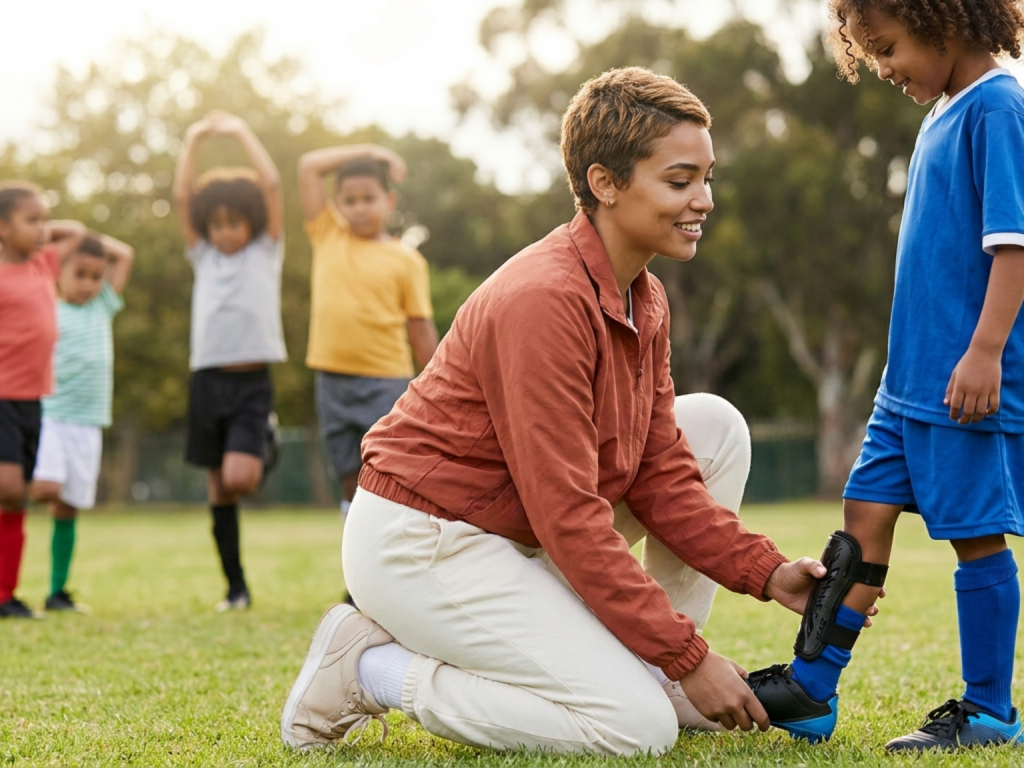
Mouthguards can reduce dental trauma and soft-tissue injury in contact and collision sports. They should fit securely, allow breathing and speaking, and be cleaned regularly. Eye protection is important in sports with balls, sticks, racquets, or close contact; everyday eyeglasses are not a substitute for sport-rated protective eyewear. Shin guards, shoulder pads, elbow pads, wrist guards, groin protection, and chest protectors should match the sport, the child’s size, and the level of contact.
Footwear is also protective gear. Shoes should fit the child’s current foot size, suit the playing surface, and provide appropriate traction without excessive grip that could increase twisting forces. Cleats, skates, and court shoes should be checked frequently during growth spurts.
Prepare the body before activity
A good warm-up raises muscle temperature, increases blood flow, and prepares the nervous system for faster, more coordinated movement. For most children and teens, a dynamic warm-up is preferable before sport: light jogging, skipping, side shuffles, lunges, high knees, arm circles, and progressive sport-specific drills. Static stretching can be useful for flexibility but is usually better placed after activity or as part of a broader mobility plan rather than as the only pregame preparation.
Conditioning should be age-appropriate and progressive. Children who jump from inactivity to intense tournaments, two-a-day practices, or long preseason sessions have a higher risk of pain and injury. A gradual increase in duration, intensity, and technical complexity allows tendons, muscles, bones, and cardiovascular fitness to adapt. Cross-training can help because it reduces repetitive stress while building overall strength, balance, agility, and endurance.
Strength training can be safe and beneficial when supervised, technique-focused, and developmentally appropriate. The goal is not maximal lifting; it is movement quality, trunk control, landing mechanics, joint alignment, and confidence. Children should learn how to squat, hinge, land softly, decelerate, pivot, and fall safely when relevant to the sport.
Hydration and fueling are part of injury prevention. Dehydration and inadequate energy intake can impair concentration, reaction time, thermoregulation, and muscle function. Children may need reminders to drink because they do not always recognize thirst early. Hot or humid conditions require extra caution, scheduled breaks, shade, and attention to heat illness warning signs.
Prevent overuse injuries and burnout
Overuse injuries can be emotionally difficult because they often begin as mild soreness that seems manageable. A child may say, “It only hurts after practice,” or “It goes away once I warm up.” Those comments deserve attention. Pain that persists, changes movement, causes limping, limits performance, wakes a child at night, or returns whenever activity increases should be discussed with a qualified healthcare professional.
Growth plates are areas of developing cartilage near the ends of bones. Because they are mechanically vulnerable, repetitive traction, compression, or twisting may cause pain in growing athletes. Common examples include heel pain in running and jumping sports, knee pain around the tibial tubercle, shoulder or elbow pain in throwing athletes, and back pain in gymnasts, dancers, football players, or rowers. These patterns should not be dismissed as simply “growing pains” without appropriate assessment.
Rest is not laziness; it is tissue repair. Many pediatric sports medicine experts encourage at least one to two days off from organized sport each week and periodic breaks from a single sport across the year. Children who specialize early, play on multiple teams, or attend overlapping camps may accumulate more load than adults realize. Tracking weekly hours, pain episodes, sleep, mood, and fatigue can help families identify when a schedule is becoming excessive.
Burnout is also a safety issue. A child who feels constant pressure may hide symptoms, skip recovery, or ignore unsafe technique. Supportive language helps: ask what feels strong, what feels sore, and whether the child still enjoys the activity. The aim is long-term participation, not short-term performance at the expense of health.
Make rules, supervision, and surfaces part of safety
Protective gear cannot compensate for unsafe environments or poor rule enforcement. Coaches should teach proper tackling, checking, sliding, landing, spotting, and equipment use before children are expected to perform skills at speed. Rules against dangerous contact should be applied consistently, including during informal scrimmages when supervision sometimes relaxes.
Playing surfaces matter. Holes, wet floors, uneven turf, loose gravel, exposed sprinkler heads, poorly maintained ice, and cluttered sidelines can contribute to falls and collisions. Families can help by arriving early enough to notice obvious hazards and by encouraging children to report unsafe field or court conditions. Weather also changes risk: heat, lightning, poor air quality, and slippery surfaces may require delay, modification, or cancellation.
Age and size matching are important in contact sports. Large differences in body mass, speed, and maturation can increase injury risk even when children are the same chronological age. Coaches and leagues should consider skill level, physical development, and safety policies when grouping athletes.
Communication is another protective layer. Children should know who to tell if they are injured, where the first-aid kit is kept, and that reporting symptoms will not be treated as weakness. Adults should have emergency contacts, relevant medical information, and a plan for asthma, severe allergies, diabetes, seizure disorders, or other known conditions. This preparation is similar to a broader approach to Common safety risks for children: anticipate the likely hazard before it becomes an emergency.
Responding when an injury happens
When a child is injured, the first step is to stop activity and assess calmly. Do not encourage a child to “run it off” when pain is significant, movement is abnormal, or symptoms involve the head, neck, chest, abdomen, breathing, or neurologic function. If there is visible deformity, severe swelling, inability to bear weight, suspected fracture, uncontrolled bleeding, or concerning head injury symptoms, seek urgent medical care.
For minor strains, sprains, or contusions, many coaches and clinicians use the RICE framework in the early phase: rest from painful activity, ice wrapped in cloth for short intervals, gentle compression if appropriate, and elevation. This is a first-aid approach, not a diagnosis or a substitute for medical evaluation when symptoms are significant or persistent. Avoid applying ice directly to skin, wrapping too tightly, or giving medications without following pediatric dosing guidance from a healthcare professional.
Possible concussion symptoms include headache, dizziness, confusion, balance problems, nausea, visual changes, light sensitivity, slowed responses, memory difficulty, sleep changes, mood changes, or simply “not feeling right.” A child with suspected concussion should be removed from play and should not return the same day. Return to school and sport should follow medical guidance and a gradual protocol.
Return to play after any meaningful injury should be based on function, not just the calendar. The child should have pain-free daily activity, appropriate range of motion, strength, balance, and sport-specific skills before full competition. Reinjury prevention may require physical therapy, technique correction, bracing, workload modification, or updated equipment.
Build a family checklist for safer participation
A practical checklist makes prevention easier during busy weeks. Before the season, schedule any needed sports physical or medical review, especially for children with chronic conditions or previous injuries. Confirm that the coach knows emergency information and that the league has policies for concussion, heat, lightning, and first aid. Check whether required equipment meets current standards and whether it still fits.
Before each practice or game, ask simple questions: Is the child rested? Have they eaten and hydrated? Is there pain today? Does any gear feel loose, tight, cracked, or uncomfortable? Are weather and field conditions safe? These brief checks can catch problems early.
- Pack a water bottle, weather-appropriate clothing, sunscreen when needed, and any medically necessary supplies.
- Inspect helmets, straps, pads, mouthguards, shoes, and laces before activity.
- Encourage a dynamic warm-up and gradual increase in intensity.
- Support rest days and do not punish honest reporting of pain.
- Keep emergency contacts and relevant medical information accessible.
After activity, watch how the child moves. Limping, guarding an arm, unusual fatigue, irritability, or repeated complaints about the same area may indicate a problem even when the child minimizes it. Prevention is not about hovering; it is about noticing patterns and responding early, kindly, and consistently.
Seek urgent help for these warning signs
- Suspected concussion, loss of consciousness, confusion, repeated vomiting, seizure, or worsening headache after a head impact.
- Severe pain, visible deformity, major swelling, numbness, weakness, or inability to bear weight.
- Neck or back pain after trauma, especially with tingling, weakness, or difficulty walking.
- Chest pain, breathing difficulty, fainting, or palpitations during exercise.
- Heat illness signs such as altered mental status, collapse, hot skin, or persistent vomiting.
Tools & Assistance
- Preseason sports physical or pediatric check-in for children with prior injuries or chronic conditions
- Sport-specific equipment fitting at a reputable sporting goods shop or league safety session
- Certified athletic trainer, pediatrician, sports medicine clinician, dentist, or optometrist for gear and injury questions
- Family practice-and-game checklist for hydration, rest, symptoms, emergency contacts, and equipment inspection
FAQ
Should my child wear protective gear during practice too?
Yes. Many injuries happen in practice, and children need the same protection while learning skills, scrimmaging, or repeating drills.
Can my child keep playing if pain improves after warming up?
Pain that repeatedly returns with activity, changes movement, or persists after practice should be discussed with a healthcare professional rather than ignored.
How often should helmets be replaced?
Follow the manufacturer’s guidance and sport rules. Replace helmets after significant impact, visible damage, poor fit, missing parts, or unknown history.
Are rest days really necessary for active children?
Yes. Rest days support tissue recovery, reduce overuse risk, and help protect motivation and mental well-being.
What should I do if I suspect a concussion?
Remove the child from play immediately, do not allow same-day return to sport, and seek medical guidance for assessment and a gradual return plan.
Sources
- Nemours KidsHealth — Preventing Children's Sports Injuries
- OrthoBlog via VisitTOC — How to Prevent Common Sports Injuries in Kids & Teens
- Seattle Children's Hospital — Safety Gear for Sports and Play
Disclaimer
This article is for educational purposes only and does not replace medical evaluation, diagnosis, or treatment. Consult a qualified healthcare professional for injury concerns or return-to-play decisions.
















Please log in to leave a comment.