
Intro
Play is often described as children’s work, but for families it can also be a window into how a child communicates, negotiates, manages frustration, and learns to belong with others. Through simple games, pretend scenarios, building projects, and outdoor movement, children practice social behaviors in a setting that feels meaningful rather than pressured.
Teamwork skills do not emerge all at once. They are shaped by brain maturation, temperament, language ability, sensory needs, family routines, culture, and repeated experiences with caring adults and peers. This article explains how play supports interaction skills while offering practical, medically cautious guidance for parents, caregivers, educators, and clinicians.
Highlights
Play gives children a safe, developmentally appropriate way to practice communication, empathy, flexibility, and problem-solving.
Teamwork grows through repeated experiences such as turn-taking, shared goals, role play, and repairing small conflicts.
Adults can support play without taking over by using clear cues, emotional coaching, and activities matched to the child’s developmental level.
Persistent distress, loss of skills, or major social communication concerns should be discussed with a pediatrician or qualified child development professional.
Why play is a clinical and developmental priority
Play is not a luxury or a reward after learning; it is one of the main ways children learn. Pediatric literature describes developmentally appropriate play with caregivers and peers as a powerful opportunity to promote social-emotional development, cognitive skills, language, executive function, and healthy physical growth. In everyday terms, play lets a child try out social roles, test cause and effect, make choices, and recover from mistakes while feeling emotionally safe.
Teamwork begins in small interactions. A baby smiles and waits for a caregiver to smile back. A toddler rolls a ball and watches whether it returns. A preschooler negotiates who will be the doctor in a pretend clinic. A school-age child learns that a group project works better when everyone has a role. These moments strengthen reciprocity, joint attention, inhibitory control, emotional regulation, and pragmatic communication, meaning the social use of language.
Because play is intrinsically motivating, children often tolerate more challenge during play than they would during direct instruction. Waiting for a turn in a board game, asking for a missing block, or changing strategy in a team challenge recruits attention, working memory, impulse control, and perspective-taking. These are not separate from learning; they are part of the neurodevelopmental foundation for classroom participation, friendships, and later adaptability.
How teamwork skills appear across childhood
Expectations should be matched to developmental stage. Infants and young toddlers usually begin with back-and-forth interactions with familiar adults: peekaboo, imitation, songs, and simple turn-taking games. During toddlerhood, parallel play is common and healthy. Two children may play beside each other with similar toys while only briefly exchanging looks, sounds, or objects. This is not failure; it is often a bridge toward more reciprocal play.
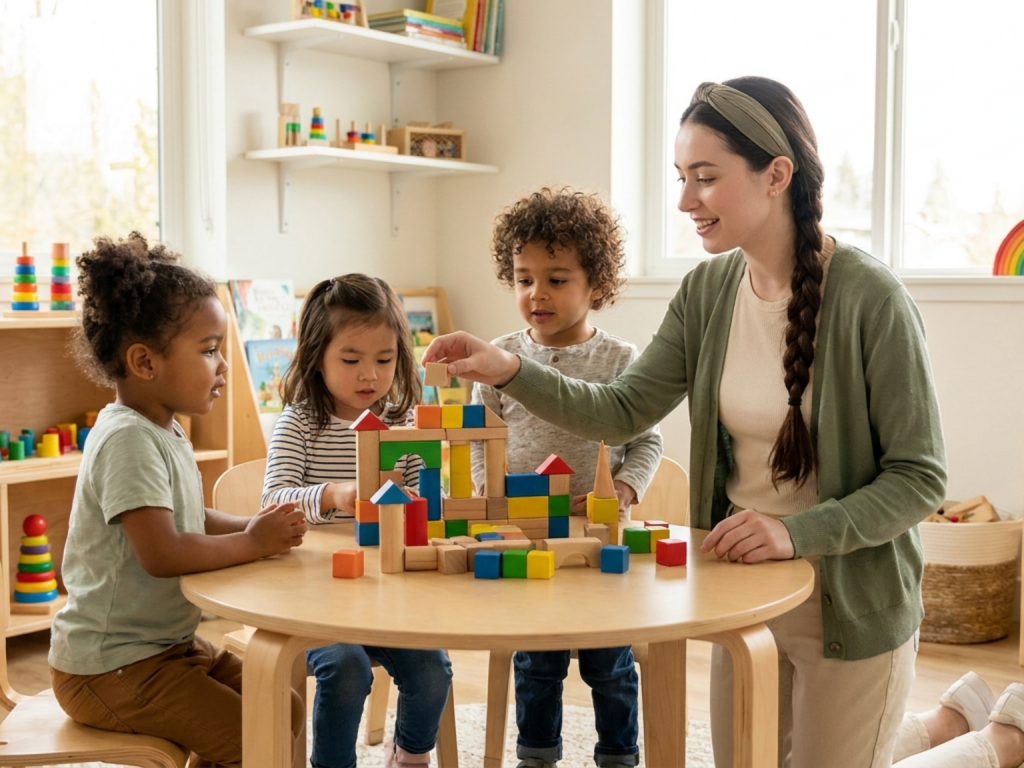
Preschool children gradually move toward associative and cooperative play. They may share materials, create pretend roles, argue about rules, and need adult help to repair conflicts. Cooperative play in preschool children often looks messy because the child’s desire to connect may exceed their impulse control and language skills. A child may understand the idea of sharing but still feel overwhelmed when a treasured toy is taken. Supportive adults can name feelings, simplify choices, and help children try again.
School-age children generally become more capable of group rules, loyalty, fairness, and negotiated roles. They can plan a fort, organize a team game, or solve a puzzle collaboratively. Still, fatigue, anxiety, neurodevelopmental differences, language delays, sensory overload, or social stress can temporarily reduce these skills. A child who struggles in one setting may do better with smaller groups, predictable routines, or clearer roles.
Developmental variation is wide. The goal is not to force a child to be socially outgoing but to help them build workable interaction skills: noticing others, communicating needs, tolerating brief waiting, contributing to a shared goal, and recovering after conflict.
The core interaction skills children practice during play
Play gives children repeated practice with skills that are difficult to teach through lectures. Many of these skills overlap with social communication, emotional regulation, and executive functions.
- Joint attention: sharing focus on an object, action, or idea, such as looking from a tower to a friend to celebrate that it stayed standing.
- Turn-taking: waiting, watching, anticipating, and responding when it is one’s turn to act.
- Perspective-taking: beginning to understand that another child may want a different role, rule, or outcome.
- Emotional regulation: managing disappointment when losing a game, when a block structure falls, or when a peer says no.
- Problem-solving: testing alternatives, negotiating materials, and adapting when the first plan does not work.
- Pragmatic communication: using words, gestures, facial expression, body position, and tone to enter play, maintain play, and repair misunderstandings.
These skills are neurologically demanding. A child must process social cues, control impulses, retrieve language, and regulate bodily arousal at the same time. This is why adult expectations matter. A preschooler who grabs a toy may not be intentionally unkind; they may lack the inhibitory control to pause and ask. A school-age child who dominates a game may need coaching in reading group cues, not shame.
Empathy also grows through play. Pretend play lets children explore feelings from multiple viewpoints: the patient, the doctor, the parent, the firefighter, the frightened animal. Peer play creates natural consequences: if the rules are unfair, others may leave; if everyone contributes, the game lasts longer. In this way, children learn both emotional meaning and social cause-and-effect.
Play activities that build cooperation without pressure
The most effective activities are simple, flexible, and matched to the child’s developmental level. They should create a real reason to communicate rather than requiring perfect social behavior. For children who become overwhelmed, begin with one familiar adult or one calm peer before increasing group size.
- Limited-material games: Offer one ball, one set of blocks, or one container of art materials so children have a natural reason to request, wait, pass, and share. Keep the mood light and step in before frustration becomes too high.
- Collaborative building: Blocks, train tracks, magnetic tiles, and construction toys encourage planning and shared goals. One child can choose pieces while another places them. A visual plan can help children who need predictability.
- Puzzles and sorting tasks: Each child can hold some pieces, making cooperation necessary. Adults can model phrases such as, “I have an edge piece,” or, “Can I try that one?”
- Board games and card games: These support turn-taking, patience, rule-following, and coping with winning or losing. Choose short games for younger children or children with limited frustration tolerance.
- Pretend play: Restaurant, clinic, grocery store, bus ride, or rescue scenarios help children practice roles, scripts, flexible thinking, and empathy.
- Movement games: Parachute play, obstacle courses, relay games, and cooperative scavenger hunts let children coordinate bodies and attention, especially when sitting still is difficult.
Role-playing can be especially useful when a child needs rehearsal for common social moments, such as asking to join a game, saying no respectfully, or handling a rule change. Keep scripts brief. Children often learn best when the adult demonstrates, practices once or twice, and then lets play continue naturally.
The adult’s role: scaffold, do not control
Adults are most helpful when they provide scaffolding: enough structure to support success, but not so much that the child loses ownership. This may include arranging the environment, simplifying rules, modeling language, and helping children repair conflicts. The adult does not need to solve every disagreement immediately. Small conflicts, when safe and supported, are valuable practice.
Useful scaffolds include clear visual and verbal cues. A timer, a turn card, a picture schedule, or a simple phrase such as “First Mia, then Jay” can reduce uncertainty. For some children, especially those with language delays, attention differences, autism spectrum traits, anxiety, or sensory processing challenges, visual cues may be less demanding than repeated verbal instructions.
Emotion coaching is another key support. Instead of saying, “Stop being upset,” an adult might say, “You wanted the red truck. Waiting is hard. Let’s take two breaths, then ask for a turn.” This validates the feeling while still teaching the expected behavior. Over time, children internalize these scripts.
Adults can also narrate positive teamwork: “You held the bridge while Sam added the block. That helped the tower stay up.” Specific feedback is more effective than broad praise because it tells the child what behavior worked. When play breaks down, focus on repair: “The game stopped because both of you wanted to be first. What is one fair way to restart?”
Importantly, children should not be forced into hugs, eye contact, or social performances to prove cooperation. Respecting bodily autonomy and communication differences supports safety and trust. Interaction skills can be built through gestures, shared attention, assistive communication, signs, pictures, or spoken language.
Supporting children who find peer play difficult
Some children avoid group play, become aggressive when frustrated, freeze in social situations, or repeatedly misunderstand peers. These patterns may reflect many possibilities, including temperament, limited exposure, sleep problems, stress, language delay, hearing difficulty, anxiety, trauma exposure, neurodevelopmental differences, or sensory overload. Families should avoid self-blame. Social play is complex, and difficulty does not mean a child is “bad” or that caregivers have failed.
Start by lowering the demand. A child who struggles in a noisy group may succeed with one peer in a quiet room for ten minutes. A child who grabs may do better when duplicate toys are available at first, then gradually practice sharing one item. A child who cannot manage losing may need cooperative games before competitive games. Small, repeated successes are more therapeutic than long sessions that end in distress.
Watch for patterns: Does the child struggle mainly with language-heavy play, physical games, transitions, waiting, pretend roles, or unexpected changes? Does hunger, fatigue, pain, constipation, medication timing, or sensory input affect behavior? These observations can help pediatricians, therapists, and educators understand what support may be appropriate.
Consult a healthcare professional if concerns are persistent, intense, or associated with regression, significant language delay, loss of previously acquired social skills, limited response to name, very restricted interests that prevent interaction, severe aggression, self-injury, or marked anxiety. Developmental surveillance and screening can help identify whether speech-language therapy, occupational therapy, behavioral support, early childhood mental health consultation, or a developmental evaluation may be useful. The purpose of seeking help is not to label a child negatively, but to understand their needs and support participation.
Creating a play-rich environment at home and school
A play-rich environment does not require expensive toys. Children need time, space, safe materials, and emotionally available adults. Open-ended materials such as boxes, blocks, scarves, pretend food, dolls, vehicles, art supplies, and outdoor objects can support many kinds of interaction. The more flexible the material, the more opportunities children have to negotiate meaning and roles.
Predictable routines help. Regular playdates, classroom centers, family game nights, or playground visits give children repeated chances to practice. Short, successful interactions are often better than long, unstructured sessions. For children who need more support, preview the plan: who will be there, what they might play, how turns will work, and what to do if they need a break.
Digital media can be enjoyable, but it should not replace embodied, relational play. Children learn teamwork by reading real-time cues, adjusting to another person’s actions, moving their bodies, and experiencing shared emotion. When screens are used, co-viewing and discussion can make the experience more interactive, but face-to-face play remains uniquely valuable.
Finally, protect downtime. Overscheduling can reduce spontaneous peer play and increase irritability. Unhurried play allows children to invent rules, make mistakes, become bored, recover, and create something together. Those ordinary moments are where teamwork becomes part of daily life.
When to seek guidance
- Ask a pediatrician about any loss of previously acquired language, play, or social skills.
- Seek urgent help if play difficulties include self-injury, serious aggression, or safety risks.
- Consider hearing, vision, sleep, pain, and language concerns when social interaction suddenly worsens.
- Persistent lack of response to name, limited joint attention, or very restricted play should be discussed with a qualified clinician.
- Do not use play strategies as a substitute for individualized medical, developmental, or mental health care.
Tools & Assistance
- Keep a brief play observation journal noting triggers, strengths, and successful supports.
- Use simple visual turn-taking supports such as timers, picture cards, or first-then boards.
- Ask your child’s pediatrician about developmental screening if concerns persist.
- Coordinate with teachers, speech-language therapists, occupational therapists, or child psychologists when needed.
- Choose short cooperative games before moving to longer competitive games.
FAQ
Is it normal for toddlers to play next to each other instead of together?
Yes. Parallel play is common in toddlerhood and can be a normal step toward more reciprocal peer interaction.
How can I teach sharing without constant conflict?
Start with brief turns, visual cues, and adult narration. Use duplicate toys when frustration is high, then gradually introduce shared materials.
Should I force my child to join group games?
Usually no. Gentle invitations, smaller groups, predictable roles, and breaks are more supportive than forcing participation.
When should I worry about social play?
Discuss concerns with a pediatrician if difficulties are persistent, severe, associated with regression, or accompanied by significant language, sensory, behavioral, or anxiety concerns.
Sources
- American Academy of Pediatrics — The Power of Play: A Pediatric Role in Enhancing Development in Children
- National Institutes of Health / StatPearls — Peer Play
- Thrive ABA Therapy — Play-Based ABA Activities to Build Social Skills
Disclaimer
This article is for informational purposes only and does not diagnose, treat, or replace professional medical advice. Consult a pediatrician or qualified child development professional for concerns about your child’s health, behavior, or development.
















Please log in to leave a comment.