
Intro
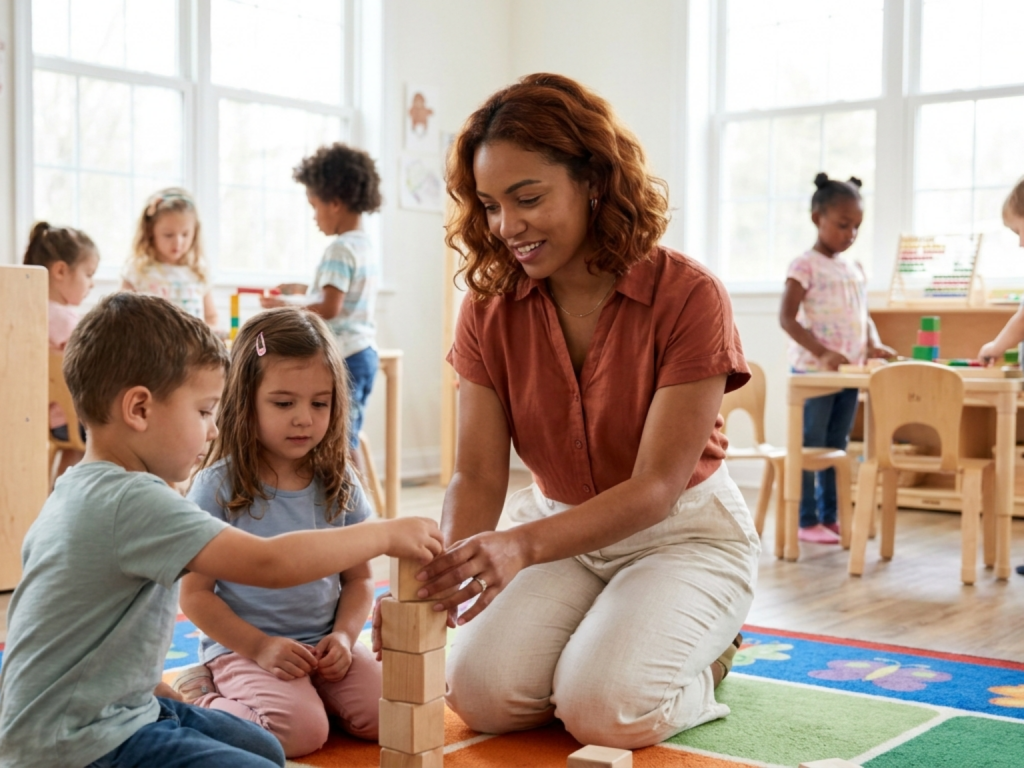
Between ages 3 and 5, children are learning how to enter play, share attention, manage frustration, understand feelings, and build early friendships. These abilities do not appear all at once; they grow through repeated practice with warm adults, predictable routines, language development, and safe opportunities to interact with peers.
Highlights
Preschool social skills include sharing, turn-taking, empathy, cooperative play, conflict repair, and using words to express needs.
Many social difficulties at this age are developmental rather than intentional misbehavior; young children still have immature impulse control and perspective-taking.
Responsive caregiving, play-based learning, physical activity, and emotion coaching can support social-emotional learning in preschool.
Persistent aggression, extreme withdrawal, loss of skills, or major functional impairment should be discussed with a pediatrician, early childhood specialist, or mental health professional.
What social skills look like from ages 3 to 5
Preschool social skills are the everyday abilities that help a child participate in family life, classroom routines, and peer play. They include greeting others, listening briefly, waiting for a turn, sharing materials, asking to join an activity, accepting limits, noticing another person’s feelings, and beginning to solve small conflicts. At this age, these skills are closely linked with preschool emotional development and growth, because a child who is overwhelmed, hungry, tired, anxious, or overstimulated may not be able to use the social behavior they have practiced.
A 3-year-old may enjoy playing near or briefly with other children, but still need substantial adult help to share toys or tolerate frustration. Many 3-year-olds use simple phrases such as “my turn,” “stop,” or “I’m mad,” but they may still grab, cry, or run away when emotions rise. By age 4, many children begin more cooperative pretend play, can follow simple game rules, and may show concern when another child is hurt. By age 5, children often negotiate roles in play, understand basic fairness, and can use more complex language to explain feelings, although they still need adult support during conflict.
Variation is expected. Temperament, language exposure, neurodevelopment, sleep, culture, family stress, childcare experience, and health conditions can all influence how social behavior appears. A cautious child may observe before joining; an energetic child may need more movement before sitting for group time. The goal is not to make every child socially identical, but to help each child build safe, respectful, developmentally appropriate ways to connect.
The brain skills underneath friendship and cooperation
Social behavior in preschool is not only a matter of manners. It depends on developing brain systems for language, attention, inhibitory control, working memory, emotional regulation, and social cognition. Executive functions in preschool children are still immature; this means a child may know a rule, repeat it aloud, and still be unable to follow it when excited. This gap between knowledge and performance is common in early childhood.
Language is especially important. When children can label internal states such as “sad,” “scared,” “angry,” “disappointed,” or “proud,” they have more options than hitting or screaming. The American Psychological Association notes that children aged 3 to 5 are developing the ability to use words for anger and sadness, while still struggling to fully take another person’s perspective. This is why a preschooler may comfort a crying friend one moment and insist that everyone must play their preferred game the next.
Cause-and-effect thinking is also emerging. Preschoolers are beginning to anticipate physical consequences, such as “If I push the tower, it will fall,” and social consequences, such as “If I take the truck, my friend may cry.” However, this understanding is fragile during strong emotion. Adults can help by narrating the connection: “You wanted the shovel. When you grabbed it, Sam felt upset. Let’s try asking, ‘Can I have a turn when you’re done?’”
Imitation remains a powerful mechanism. Children copy how adults speak to them, repair mistakes, handle waiting, and treat service workers, relatives, and peers. Modeling courtesy is not superficial; it is a form of neural and behavioral teaching. A child who repeatedly sees adults apologize, breathe before reacting, and use respectful words is more likely to practice those scripts with other children.
Core skills to teach: empathy, turn-taking, sharing, and repair
Empathy in preschool is practical and concrete. Instead of expecting a young child to understand another person’s complex inner world, adults can start with visible cues: “Maya is covering her ears; the drum is too loud for her,” or “Leo is smiling because you gave back the block.” Puppets, dolls, picture books, and pretend play are useful because they create emotional distance. A child may find it easier to say what a puppet feels than to talk directly about their own embarrassment or anger.
Turn-taking and sharing require impulse control, time awareness, and trust that the adult will be fair. Short turns work better than vague instructions. For example, “Two more scoops, then it is Ana’s turn,” is clearer than “Share nicely.” Timers can help some children, but they should not replace adult guidance. The message is: your desire matters, and other people’s desires matter too.
Repair is one of the most valuable preschool social skills. A forced apology may teach performance rather than responsibility. A more developmentally useful approach is to help the child notice impact and take action. Adults might say, “The tower fell and Ben is crying. You can help rebuild it or bring him the blocks.” Repair can include returning an item, helping clean up, rebuilding, checking on another child, or trying the interaction again with words.
Useful phrases to practice include:
- “Can I play?”
- “Can I have a turn when you are done?”
- “Stop, I don’t like that.”
- “I’m using this now.”
- “Let’s trade.”
- “I’m sorry I hurt you. I can help fix it.”
Children need these scripts practiced during calm moments, not only during conflict. Role-play at breakfast, in the car, or before preschool can make the words more available when stress rises.
Supporting social-emotional learning in preschool at home and school
Social-emotional learning in preschool works best when adults combine warmth, structure, and repeated practice. Warmth helps the child feel safe enough to learn. Structure gives predictable expectations. Practice turns a skill from an adult instruction into a child’s usable habit.
Daily routines offer many teaching moments. During meals, children can pass items, wait briefly, say “please” and “thank you,” and notice who needs help. During cleanup, they can cooperate toward a shared goal. During bedtime, adults can review the day: “You were frustrated when the red crayon broke, and you asked for help. That was a strong choice.” This kind of reflection builds emotional memory.
Emotion coaching is particularly helpful for Preschool emotional challenges. It usually involves naming the feeling, validating the child’s experience, setting a limit if needed, and guiding a safer behavior. For example: “You are angry because playtime ended. It is hard to stop. I will not let you throw blocks. You can stomp your feet here, then we will put the blocks in the bin together.” Validation does not mean allowing unsafe behavior; it means acknowledging the internal state while maintaining boundaries.
The State of Michigan’s guidance for preschool social and emotional development recommends practical strategies such as using puppets to role-play empathy, helping children manage emotions with deep breathing, and modeling courteous behavior. Deep breathing should be simple and playful: smelling a pretend flower, cooling pretend soup, or taking “balloon breaths” with hands expanding and shrinking. These strategies are not quick fixes, but they help children develop body-based tools for arousal regulation.
Teachers and caregivers can support inclusion by preparing children for transitions, using visual routines, pairing children thoughtfully, and coaching entry into play. Instead of saying, “Go play with them,” an adult can scaffold: “They are building a zoo. You could ask, ‘Can I make a gate?’” This reduces the social demand and gives the child a concrete role.
Play, movement, and physical activity as social practice
Play is the preschooler’s main laboratory for social development. Pretend play lets children experiment with roles, rules, symbols, and emotional themes. A child pretending to be a doctor, shopkeeper, firefighter, parent, or animal is practicing negotiation, sequencing, perspective-taking, and flexible thinking. Adults do not need to control the play, but they can enrich it by adding language: “The patient looks worried. What could the doctor say?”
Movement-based activities can also strengthen social skills. Games such as obstacle courses, follow-the-leader, parachute play, freeze dance, beanbag passing, and cooperative building tasks require children to watch others, wait, coordinate, and respond to shared rules. A scientific review on designed physical activities targeting preschool social skills found a significant positive effect on social skills, with particularly strong findings for interventions lasting about 12 weeks. This supports what many early childhood educators observe: structured movement can be a powerful setting for practicing cooperation.
Physical activity is especially useful for children who struggle to sit still during verbal instruction. When the body is engaged, some children can participate more successfully in turn-taking and peer awareness. The key is design. A chaotic free-for-all may increase conflict, while a well-planned game with clear roles can build competence. For example, in a cooperative obstacle course, one child holds a hoop, another carries a beanbag, and another gives a start signal. Each child has a job that matters.
Parents can adapt this at home or in the park. Try “team clean-up races” where the goal is collective rather than individual victory, or “animal rescue” pretend play where children must work together to move stuffed animals to a safe place. The adult’s language should highlight cooperation: “You waited for your sister to move the tunnel. That helped the team,” or “You noticed your friend needed more space.”
Common difficulties and when to seek guidance
It is normal for preschoolers to have conflicts. Grabbing, crying, refusing to share, interrupting, tattling, or saying “You can’t come to my party” may occur as children test power, belonging, and boundaries. These behaviors still need guidance, but they do not automatically indicate a disorder. A supportive adult response focuses on safety, skill-building, and repair rather than shame.
Some patterns deserve closer attention. Consider speaking with a pediatrician, early childhood educator, developmental specialist, speech-language pathologist, occupational therapist, or child mental health professional if social difficulties are persistent, intense, or impairing. Examples include frequent aggression that injures others, minimal interest in people across settings, loss of previously acquired social or language skills, extreme distress with routine peer interaction, inability to communicate basic needs, or behavior that leads to repeated exclusion from childcare. Hearing, vision, sleep problems, language delay, trauma exposure, anxiety, autism spectrum differences, attention regulation difficulties, and other developmental or medical factors can all affect social functioning.
Professional evaluation is not about labeling a child as “bad.” It can clarify strengths, identify barriers, and connect the family with appropriate support. Sometimes a child needs speech-language pathology evaluation because peer conflict is driven by limited expressive language. Sometimes an occupational therapy evaluation for preschoolers helps when sensory processing or motor planning affects group participation. Sometimes early childhood mental health consultation supports caregivers and teachers in responding consistently.
Families should also monitor the environment. A child may look socially delayed in a setting with unrealistic expectations, too many transitions, limited outdoor play, or harsh discipline. Conversely, a child may do well at home but struggle in a noisy classroom. Gathering observations across settings helps professionals understand whether the difficulty is broad, context-specific, or related to a mismatch between the child’s needs and the environment.
Building a realistic plan for progress
A realistic plan begins with one or two target skills, not a long list. Choose a behavior that would improve daily life and can be practiced often. For a 3-year-old, the target might be using “my turn” instead of grabbing. For a 4-year-old, it might be asking to join play. For a 5-year-old, it might be negotiating a role in pretend play or repairing after hurting someone’s feelings.
Use the sequence: prepare, model, practice, prompt, praise, and review. Preparation might sound like, “At the playground, children may be using the slide. We can wait or choose the swings.” Modeling means the adult demonstrates the phrase. Practice happens through role-play. Prompting occurs in the real moment: “Try, ‘Can I have a turn?’” Praise should be specific: “You waited while he finished sliding; that was patient.” Review later reinforces learning: “Waiting was hard, and you did it.”
Progress is usually uneven. Illness, poor sleep, hunger, family changes, new classrooms, or developmental leaps can temporarily reduce social skills. This does not mean the teaching has failed. Preschoolers often borrow regulation from adults before they can regulate independently. Calm repetition is therapeutic in the broad developmental sense, even when it feels slow.
Caregivers also need compassion for themselves. Supporting preschool peer relationship skills can be emotionally demanding, especially when a child is aggressive, rejected, or very shy. Adults may feel embarrassed in public or worried about the future. It is appropriate to seek help early, ask teachers for observations, request developmental screening for emotional behavior, and build a team around the child. The aim is steady growth: more words, more flexibility, more repair, more confidence, and more moments of genuine connection.
When to get extra help promptly
- Seek urgent help if a child is seriously hurting themselves, other children, or animals.
- Discuss loss of previously acquired speech, play, or social skills with a healthcare professional.
- Ask for evaluation if aggression, withdrawal, or distress is persistent across settings and disrupts daily functioning.
- Consider hearing, vision, sleep, language, and developmental screening when social progress is unexpectedly limited.
- If caregivers feel overwhelmed or unsafe, contact a pediatrician, mental health professional, or local crisis service.
Tools & Assistance
- Use short role-play scripts before playdates, preschool drop-off, or playground visits.
- Create a simple feelings chart with faces and body clues for daily check-ins.
- Ask the preschool teacher for specific observations about peer play, transitions, and conflict.
- Request developmental screening through a pediatrician or early childhood program if concerns persist.
- Practice calming routines such as balloon breaths, quiet corners, and predictable transition warnings.
FAQ
Is it normal for a 3-year-old not to share well?
Yes. Many 3-year-olds are still developing impulse control and ownership concepts. They need short turns, adult coaching, and repeated practice rather than punishment alone.
Should I force my child to apologize?
A scripted apology may be less useful than guided repair. Help the child notice the impact and take an action such as returning a toy, helping rebuild, or checking if the other child is okay.
What if my preschooler prefers to play alone?
Some solitary play is normal, especially for cautious or introverted children. Seek guidance if the child rarely responds to people, shows major distress with peers, or has limited communication across settings.
Can physical activity really improve social skills?
Structured movement games can support cooperation, turn-taking, and shared attention. Research suggests designed physical activity programs can improve preschool social skills, especially when sustained over time.
When should I talk to a professional?
Consult a pediatrician or developmental professional if concerns are persistent, intense, worsening, associated with loss of skills, or causing exclusion from childcare or family activities.
Sources
- Frontiers in Psychology — Designed physical activities targeting social skills in preschoolers
- State of Michigan Department of Education — Social and Emotional Development For Preschoolers (3-5 Years)
- American Psychological Association — Cognitive and Social Skills to Expect From 3 to 5 Years
Disclaimer
This article is for general educational purposes and is not a medical diagnosis or treatment plan. Consult a pediatrician, developmental specialist, or licensed mental health professional for concerns about an individual child.












Please log in to leave a comment.