
Intro
School-age children learn through a rich interaction of brain maturation, curiosity, relationships, practice, culture, and health. A child who seems distracted, intense, cautious, or unusually energetic may still be trying very hard to understand the world; learning is rarely a straight line.
This article explains how children in the school years build knowledge, skills, confidence, and self-regulation. It is written for medically literate readers while keeping a supportive, practical focus for families and educators.
Highlights
Children enter school with meaningful reasoning abilities; they can ask questions, compare evidence, notice patterns, and build early explanations.
Learning is strengthened when adults connect new ideas to prior knowledge, provide emotionally safe relationships, and allow repeated practice.
Attention, sleep, nutrition, language, sensory processing, motor skills, and mental health can all influence classroom performance.
Difficulties with learning should be approached with curiosity rather than blame; persistent concerns deserve discussion with teachers and healthcare professionals.
Learning is active, not passive
School-age children do not simply absorb information like empty containers. They interpret new experiences through what they already know, what they expect, and what matters to them. Even before formal schooling, children show early forms of inductive reasoning, deductive reasoning, causal thinking, and source evaluation. By the time they reach kindergarten and the primary grades, many can compare explanations, notice exceptions, and revise ideas when evidence changes.
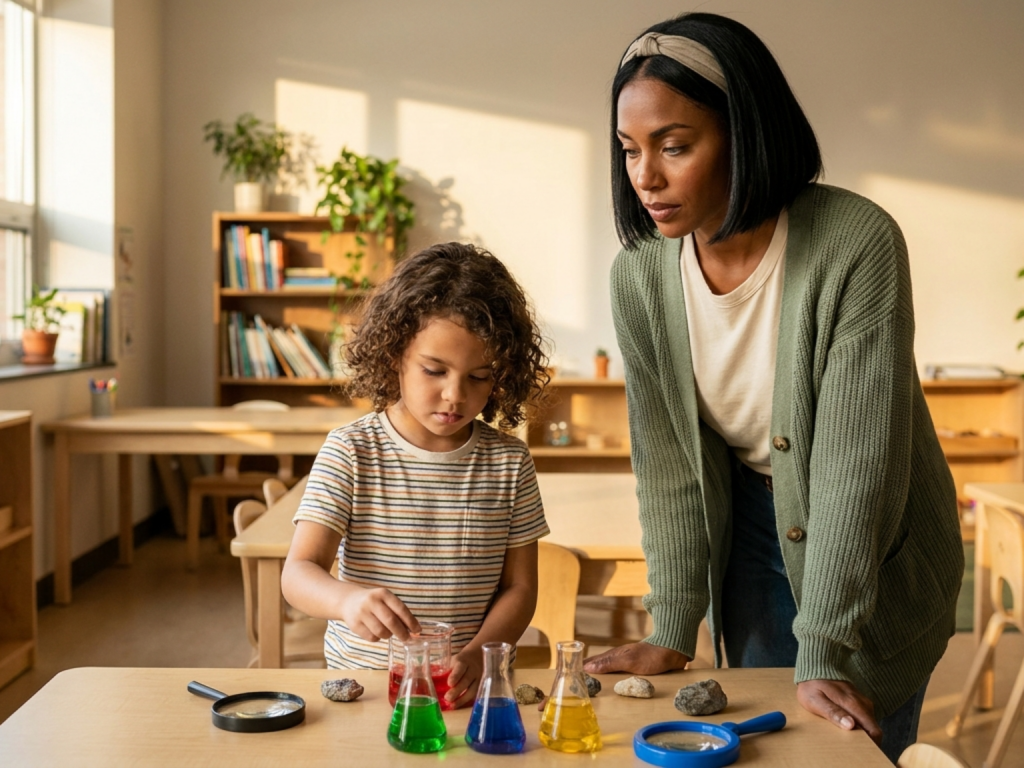
This matters because effective teaching is not only about presenting facts. Children learn best when they are invited to think: What do you notice? What do you predict? How could we test that? What changed your mind? These questions mirror the practices used in science and problem solving. They also communicate respect: the child is not merely being corrected but is being guided to reason more clearly.
School-age learning also depends on connection. A child is more likely to attempt a difficult task when an adult feels safe, predictable, and interested. Warm relationships reduce threat responses and make persistence more possible. This does not mean lowering expectations; it means pairing expectations with scaffolding, encouragement, and enough time for skills to consolidate.
The developing brain: attention, memory, and executive function
During the school years, the brain systems that support attention, working memory, processing speed, and executive function continue to mature. Executive functions include inhibitory control, cognitive flexibility, planning, error monitoring, and goal-directed persistence. These capacities are essential for reading a paragraph, solving multi-step arithmetic, organizing a backpack, waiting for a turn, and remembering instructions long enough to act on them.
Because these neural networks are still developing, inconsistent performance is common. A child may understand a concept one day and seem to forget it the next, especially when tired, hungry, anxious, overstimulated, or rushed. Working memory is particularly vulnerable. A child who cannot follow a three-step instruction may not be defiant; the information may have exceeded their current cognitive load.
Helpful adult strategies include breaking tasks into smaller steps, using visual reminders, checking understanding, and allowing practice in varied contexts. Repetition is not a sign of failure. It is one way the brain strengthens neural pathways, automates basic skills, and frees cognitive resources for more complex thinking.
Children build knowledge from prior knowledge
New learning attaches to existing mental frameworks, sometimes called schemas. A child who understands that plants need water and light can more easily learn about photosynthesis later. A child who has handled coins, compared prices, or measured ingredients may grasp arithmetic concepts more deeply than a child who has only completed worksheets.
Prior knowledge can also be incomplete or inaccurate. For example, a child may believe heavier objects always fall faster or that a longer word must name a larger object. These misconceptions are not signs of poor intelligence; they are working theories. Skilled adults help children test and refine those theories through observation, conversation, modeling, and gentle challenge.
Everyday life offers powerful learning opportunities. Cooking can teach measurement and fractions. Grocery shopping can teach categorization, estimation, and budgeting. A walk outside can teach classification, ecosystems, weather, and careful observation. Museums, libraries, parks, community programs, and classrooms all add different forms of experience. Children benefit when adults make thinking visible: I wonder why that happened, I am comparing these two, I changed my plan because the first one did not work.
Language, conversation, and social learning
Language is a major pathway for learning. Vocabulary, narrative skills, phonological awareness, listening comprehension, and pragmatic language all support reading, writing, mathematics, and social participation. Children learn words not only from direct instruction but also from meaningful conversation, shared reading, storytelling, and explanations that connect words to real experiences.
Social learning is equally important. Children watch how adults solve problems, manage frustration, apologize, ask for help, and evaluate information. They also learn from peers through collaboration, imitation, disagreement, and shared play. Group work can build perspective-taking and flexible thinking, but some children need explicit teaching in turn-taking, interpreting social cues, or tolerating different opinions.
Questions are especially valuable. When adults ask open-ended questions and wait long enough for an answer, they support expressive language and metacognition, the ability to think about one’s own thinking. A child who can say, I got confused when the problem changed, is developing a skill that supports lifelong learning.
Emotion and the body shape learning readiness
Learning is biologically embodied. Attention, memory, and reasoning are affected by sleep, nutrition, pain, illness, sensory input, movement, and emotional state. A child who is worried about a friendship conflict, recovering from poor sleep, or coping with chronic headaches may have less cognitive bandwidth for academic tasks.
Stress physiology can be helpful in small doses. Mild challenge may sharpen attention and promote effort. However, excessive or prolonged stress can interfere with working memory, impulse control, and flexible reasoning. Emotional regulation in school-age children is therefore not separate from learning; it is part of learning. Children often need co-regulation first, meaning a calm adult helps them name feelings, slow breathing, reduce threat, and return to the task.
Basic health routines also matter. Sleep hygiene for school-age children supports memory consolidation and daytime attention. Balanced meals for school-age children help stabilize energy and may reduce irritability related to hunger. Regular physical activity supports mood, motor coordination, and cognitive engagement. If a child has snoring, frequent daytime sleepiness, recurrent pain, significant appetite changes, or marked anxiety, families should discuss concerns with a pediatric clinician rather than assuming the issue is purely motivational.
Curiosity, play, and scientific thinking
Young children are capable of surprisingly sophisticated scientific thinking. They ask causal questions, create models, compare outcomes, and use evidence in simple ways. School-age children expand these capacities by learning to measure, record, classify, predict, and explain. They can begin to understand that a fair test changes one variable at a time and that data may support or weaken a hypothesis.
Play remains a serious form of learning. Building a bridge from blocks involves engineering, spatial reasoning, balance, trial and error, and persistence. Pretend play can develop narrative structure, symbolic thinking, negotiation, and emotional processing. Board games may strengthen counting, probability, inhibition, and turn-taking. Outdoor play supports observation, gross motor skills, risk assessment, and resilience.
Adults can deepen play-based learning without taking it over. Useful prompts include: What are you trying to make? What happened when you changed that? How could you keep track? What else could explain it? This approach respects the child’s agency while introducing habits of inquiry. It also helps children experience mistakes as information rather than humiliation.
Practice, feedback, and motivation
Children need repeated practice, but the quality of practice matters. Skills become stronger when practice is spaced over time, matched to the child’s current level, and connected to clear feedback. Too-easy work may lead to boredom; too-hard work may lead to avoidance. The most useful zone is often where the child can succeed with support and gradually need less help.
Feedback should be specific and behavior-based. Instead of saying, You are so smart, an adult might say, You checked the problem again and found where the sign changed. This reinforces strategies rather than fixed identity. Process-focused feedback can support a growth mindset while still acknowledging that some children have genuine neurodevelopmental differences and may need specialized instruction.
Motivation is not simply willpower. It is influenced by autonomy, competence, belonging, interest, fatigue, and prior experiences of success or shame. A child who refuses homework may be overwhelmed, confused, perfectionistic, anxious, bored, or exhausted. Learning disorders and task refusal can appear similar on the surface, so persistent avoidance should be explored carefully with teachers, caregivers, and appropriate professionals.
When learning looks different
Children vary widely in developmental pace, temperament, sensory preferences, language exposure, motor coordination, and neurocognitive profile. Some learn best by seeing; others need to move, speak aloud, manipulate objects, or draw. Variation is expected, but persistent difficulties may warrant further evaluation.
Concerns may include slow acquisition of reading despite instruction, difficulty understanding spoken language, frequent loss of learned skills, extreme trouble with attention across settings, major handwriting difficulty, persistent math confusion, school refusal, or distress that interferes with daily life. These patterns do not automatically indicate a diagnosis, but they are reasons to gather information.
Families can start by documenting examples: what task was difficult, what helped, how long the concern has been present, and whether it occurs at home, school, or both. Teachers can provide academic data and observations. Pediatric clinicians can screen for hearing, vision, sleep, medical, developmental, and mental health contributors. When appropriate, educational evaluation, speech-language assessment, occupational therapy assessment, psychology, or neuropsychology may clarify needs and guide supports.
How adults can support learning at home and school
Supportive adults do not need to become perfect tutors. The goal is to create conditions in which a child can think, practice, recover from mistakes, and ask for help. Predictable routines, calm transitions, organized materials, and reasonable limits on distractions often make learning less effortful.
Practical supports include:
- Use short, clear instructions and ask the child to repeat the plan in their own words.
- Connect new ideas to real life, stories, movement, drawing, or hands-on materials.
- Offer choices when possible, such as which problem to start with or where to read.
- Build breaks into demanding tasks, especially for children who fatigue quickly.
- Notice effort, strategy, and persistence rather than only correct answers.
- Communicate with teachers early when a pattern of struggle appears.
Most importantly, protect the child’s sense of worth. Academic performance is only one part of development. A child who feels seen as capable, loved, and supported is better positioned to take intellectual risks, tolerate frustration, and keep learning over time.
When to seek extra help
- Seek professional advice if learning difficulties persist despite appropriate instruction and support.
- Discuss sudden academic decline, loss of skills, severe anxiety, or school refusal with a pediatric clinician.
- Arrange hearing and vision checks when a child struggles with reading, attention, speech, or classroom participation.
- Do not assume laziness or defiance when a child repeatedly avoids schoolwork; medical, developmental, emotional, or educational factors may contribute.
- Urgent support is needed if a child talks about self-harm, feels unsafe, or shows severe behavioral or emotional changes.
Tools & Assistance
- A brief learning diary noting tasks, triggers, supports, sleep, and mood
- Teacher conference with examples of strengths and difficulties
- Pediatric visit to review hearing, vision, sleep, pain, development, and mental health
- School-based educational evaluation when concerns affect academic progress
- Library, museum, outdoor, and hands-on activities that connect learning to real life
FAQ
Is it normal for a school-age child to learn unevenly?
Yes. Children often show uneven skills because attention, memory, language, motor coordination, and emotional regulation mature at different rates. Persistent or worsening difficulties should be reviewed.
How much should parents help with homework?
Parents can help by clarifying instructions, organizing time, and encouraging strategies. If a child needs constant direct teaching to complete assigned work, it may be useful to speak with the teacher.
Can stress affect learning?
Yes. Excessive stress can reduce working memory, flexibility, and attention. Calm adult support, predictable routines, and professional help when needed can improve learning readiness.
Do young children really understand scientific ideas?
They can show early scientific reasoning, such as asking questions, noticing patterns, testing ideas, and revising explanations. Adults can strengthen this through everyday inquiry and conversation.
When should a child be evaluated for a learning concern?
Consider evaluation when difficulties are persistent, occur despite instruction, interfere with daily functioning, or cause significant distress. Start with the teacher and pediatric clinician.
Sources
- National Academies of Sciences, Engineering, and Medicine — Chapter: Part II - How Children Learn Science
- PubMed Central — Exploring Preschool Children's Science Content Knowledge
- informalscience.org — How young children learn science
Disclaimer
This article is for general educational information and is not a diagnosis or treatment plan. Consult a qualified healthcare professional or educational specialist for concerns about a child’s learning, development, or mental health.

















Please log in to leave a comment.