
Intro
Baby proofing is an ongoing risk-reduction process rather than a single weekend project. Infants gain new abilities quickly: rolling becomes crawling, crawling becomes pulling to stand, and reaching expands the hazards within range. A safe home therefore needs regular reassessment as your baby’s mobility, curiosity, and coordination change.
Start with the spaces where your baby spends time, then work through hazards systematically. The goal is not to eliminate every ordinary household risk or to create anxiety. It is to reduce preventable injuries while keeping essential caregiving areas practical and ensuring that attentive supervision remains part of the safety plan.
Highlights
Begin at floor level and inspect every room from your baby’s perspective.
Secure hazards involving falls, entrapment, burns, poisoning, drowning, choking, and furniture tip-over.
Use safety devices correctly, but remember that no device replaces active supervision.
Recheck the home whenever your baby learns a new skill or your household setup changes.
1. Start with a developmental safety assessment
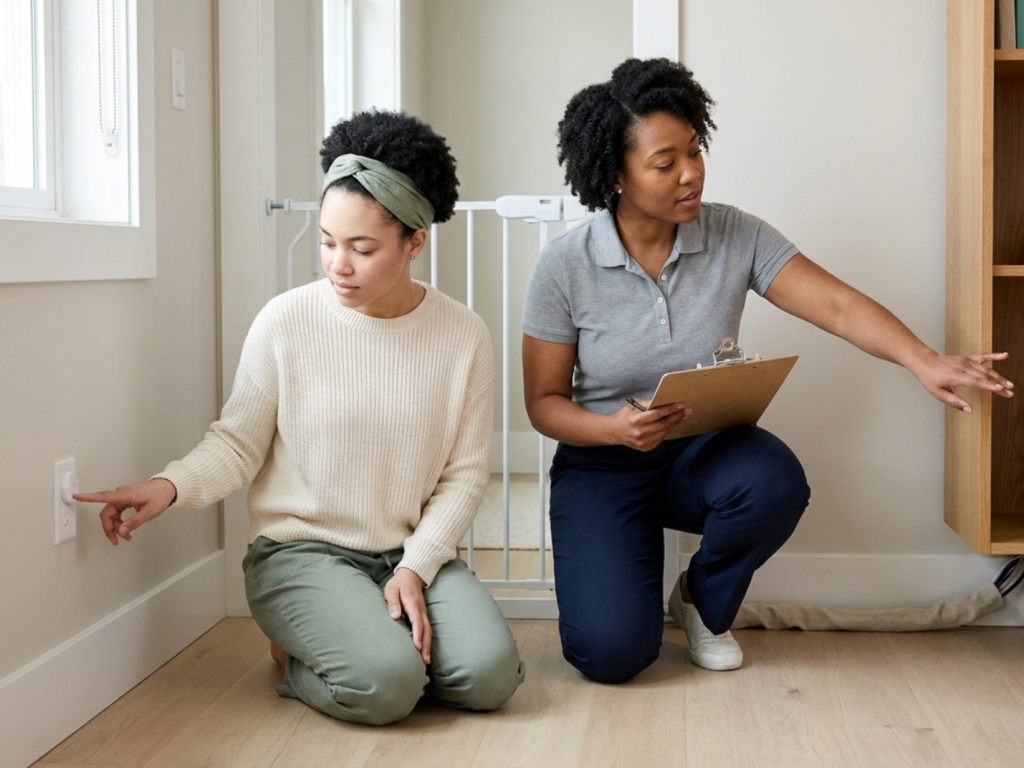
Choose a quiet time to walk through the home at floor level. Crawl or kneel where your baby will play and look for objects that can be pulled, swallowed, reached, climbed, or used to gain access to another hazard. Inspect not only the main living area but also bedrooms, bathrooms, the kitchen, laundry area, garage, balconies, and any room a caregiver may leave open accidentally.
Consider the next developmental stage, not only your baby’s current abilities. A nonmobile infant may soon roll toward an electrical cord; a crawler may pull up on a low table; a standing infant may reach a hot mug or a window latch. Pay particular attention to fall hazards, strangulation hazards, burns, drowning, poisoning, choking, and entrapment.
Make a written checklist and assign a responsible adult to each task. Remove hazards that do not need to remain in the home before purchasing devices. For example, relocate a fragile floor lamp rather than relying solely on a barrier, and place small decorative objects in storage rather than attempting to monitor them continuously.
- Inspect from floor level and from your baby’s maximum likely reach.
- Identify hazards in both ordinary use and foreseeable misuse.
- Keep emergency contact information accessible to every caregiver.
- Repeat the assessment after each major motor milestone.
2. Establish a safe sleep and nursery area
The crib or bassinet should be used only as intended, with a firm, flat sleep surface and a fitted sheet designed for that product. Keep the sleep space free of pillows, quilts, loose blankets, bumper pads, stuffed toys, and other soft items that may obstruct the airway or contribute to suffocation. Follow current guidance from your pediatric healthcare professional regarding sleep position and the appropriate sleep environment.
Position the crib away from windows, blinds, curtain cords, heaters, radiators, lamps, shelves, and furniture that could be pulled or climbed. Do not hang toys, mobiles, cords, or decorative items where your baby can grasp them. As soon as your child can push up, pull to stand, or reach, reassess the crib and remove anything that could be used to climb out.
Use the changing table only when an adult is within immediate reach. Keep one hand on the baby during changes and place diapers, wipes, and clothing within reach before beginning. Never leave an infant unattended on a bed, sofa, counter, or changing surface, even for a brief task. If you must retrieve something, take the baby with you or place the baby in a safe location such as an empty crib.
Keep cords from monitors and other equipment well away from the crib and route them according to the manufacturer’s instructions. Check that the crib, mattress, monitor, and changing equipment are intact, assembled correctly, and free of recalled or improvised parts. A monitor can support observation but cannot prevent a fall, airway obstruction, or other emergency.
3. Secure falls, windows, stairs, and furniture
Falls are among the most common preventable household injuries in young children. Install appropriate safety gates at the top and bottom of stairs, and use a hardware-mounted gate where a fall could occur from a height. Pressure-mounted gates may be unsuitable at the top of stairs because they can dislodge. Gates should be installed exactly as directed, checked regularly, and replaced if damaged.
Window screens are not fall-prevention devices. Keep furniture away from windows, install window guards or stops that are appropriate for the window type, and ensure that an adult can release any guard quickly in an emergency. Avoid placing chairs, sofas, toy bins, or other climbable objects beneath windows. Do not depend on a closed window alone to prevent access.
Anchor dressers, bookcases, televisions, shelving units, and other heavy furniture to wall studs or an appropriate structural support using hardware designed for that purpose. Secure drawers so they cannot be opened as steps, but do not treat drawer latches as a substitute for anchoring. Keep heavy items on lower shelves and avoid placing attractive objects at the edge of furniture.
Check that tablecloths, appliance cords, and hanging bags cannot be pulled down. Use doorstops or door holders where they reduce finger-crush risks, and consider devices that prevent access to rooms containing hazards. Inspect every barrier after moving furniture, cleaning, or rearranging the room.
4. Control electrical, heat, and strangulation hazards
Cover unused electrical outlets with products that cannot be easily removed by a child, and consider tamper-resistant receptacles where appropriate. Keep power strips, chargers, extension cords, and appliance cords out of reach and away from water. Replace frayed cords and avoid daisy-chaining extension cords. Secure cords along walls or behind furniture without creating loops that could encircle a neck.
Keep hot drinks, cookware, irons, hair-styling tools, space heaters, candles, matches, lighters, and fireplaces inaccessible. A baby can pull a mug from a table or grab a pot handle before an adult recognizes the movement. Turn pot handles toward the back of the stove, use rear burners when possible, and establish a clear zone around heat sources. Test bath water with an appropriate method and discuss water-heater settings with a qualified professional if you are uncertain about the temperature control.
Inspect window-blind and curtain cords, baby-monitor wires, appliance cables, and drawstrings. Eliminate loops, secure cords well above reach, and follow current product-safety instructions for cord management. Keep necklaces, pacifier cords, ribbons, plastic bags, and loose straps away from the sleep and play areas.
Do not allow infants to handle batteries, especially button or coin batteries. Store spare batteries securely and check battery compartments on remote controls, toys, and other devices. If a battery may have been swallowed, seek urgent medical assistance or contact the appropriate poison-control service immediately rather than waiting for symptoms.
5. Prevent choking, poisoning, and medication exposure
Babies explore through mouthing, so inspect floors, low shelves, sofa cushions, bags, and under furniture daily. Small objects can become choking hazards even when they seem harmless to an adult. Keep coins, pen caps, toy parts, latex balloons, magnets, batteries, jewelry, and food that is not developmentally appropriate out of reach. Examine toys for loose components and follow age recommendations, while recognizing that labels do not replace supervision.
Store medicines, vitamins, supplements, nicotine products, alcohol, cosmetics, pesticides, and cleaning products in locked storage, preferably high and out of sight. Child-resistant packaging reduces risk but is not childproof. Keep products in their original containers with labels intact, and never transfer chemicals into drink bottles, food containers, or unmarked jars. Dispose of unwanted medicines through an approved program rather than leaving them in a drawer.
Cleaning products require attention even when a surface appears dry. Keep concentrated detergents, disinfectants, dishwasher products, and fragranced sprays secured. Ventilate according to product directions and prevent access to recently cleaned areas if residue could be transferred to hands or mouths. For guidance on household chemicals and baby safety, review the relevant safety information and ask a pharmacist or poison-control specialist about a possible exposure.
Install functioning smoke alarms and carbon monoxide alarms as recommended for your home, test them regularly, and replace batteries or units according to manufacturer instructions. Keep emergency numbers accessible. If ingestion, inhalation, eye exposure, or a chemical spill occurs, contact emergency services or poison control promptly and follow their instructions; do not induce vomiting unless specifically directed.
6. Make the kitchen, bathroom, and water areas safer
The kitchen combines sharp objects, heat, electricity, chemicals, and choking hazards. Use back burners, keep knives and appliances locked or inaccessible, and secure the oven, dishwasher, refrigerator, and trash container when needed. Do not leave hot food, drinks, cords, or utensils near an edge. Consider a clearly defined safe play area outside the kitchen so a caregiver can work without placing the baby near active cooking.
In the bathroom, keep medicines, cosmetics, razors, hair appliances, toilet cleaners, and toiletries locked away. Toilets, buckets, pet bowls, bathtubs, and other containers can present a drowning risk. An infant should remain within arm’s reach and under constant, undistracted supervision during bathing. Never rely on a bath seat, ring, or flotation device to prevent drowning, and empty containers immediately after use.
Keep bathroom floors dry and address slipping hazards. Store electrical appliances away from sinks and tubs, unplug them after use, and keep cords inaccessible. Adjust the environment so that a caregiver can reach towels, diapers, and supplies before placing the baby in water. A second adult can help during bathing, but responsibility should remain clearly assigned to one supervising adult.
Check laundry areas, garages, workshops, and balconies with the same level of care. Keep detergent pods, tools, paints, fuels, fertilizers, pet medications, and automotive fluids locked away. Close doors and restrict access whenever active supervision is not available.
7. Maintain and update the safety system
Baby proofing is effective only when equipment remains functional and caregivers use it consistently. Test gates, latches, window stops, outlet covers, furniture anchors, smoke alarms, and carbon monoxide alarms on a regular schedule. Look for loose screws, damaged plastic, detached adhesive, recalled products, and changes caused by humidity, cleaning, or repeated use.
Review the home after developmental changes such as rolling, crawling, cruising, climbing, and independent walking. Lower shelves may become reachable, barriers may become climbable, and objects once considered inaccessible may be within grasp. Reconsider safety devices that create new risks, including unstable gates, loops in cords, or furniture positioned to bypass a barrier.
Give every caregiver a brief, specific orientation. Explain which rooms are restricted, where medicines and chemicals are stored, how gates operate, who supervises bathing, and what to do during a suspected poisoning or injury. Include babysitters and visiting relatives, because unfamiliar routines can create predictable gaps.
Finally, pair environmental changes with supervision and emergency readiness. Learn infant cardiopulmonary resuscitation and choking first aid from a recognized training organization, keep a stocked first-aid kit, and know how to access local emergency services. Professional advice is particularly important when your child has a medical condition, developmental difference, mobility limitation, or equipment needs that alter ordinary safety recommendations.
Safety warnings
- Never leave a baby unattended on a changing table, bed, sofa, counter, or near water.
- Window screens do not prevent falls, and pressure-mounted gates may not be suitable at the top of stairs.
- Keep medicines, chemicals, batteries, magnets, and nicotine products locked and out of reach.
- A crib should contain only the sleep surface and fitted sheet unless a healthcare professional advises otherwise.
- Seek urgent help for suspected button-battery or magnet ingestion, poisoning, drowning, serious burns, or breathing difficulty.
Tools & Assistance
- A room-by-room hazard checklist reviewed at each developmental milestone
- Hardware-mounted gates, window guards or stops, and furniture-anchoring kits installed according to instructions
- Locked storage for medicines, chemicals, batteries, and other toxic or high-risk products
- Working smoke and carbon monoxide alarms with scheduled testing
- Infant CPR and choking-response training from a recognized provider
FAQ
When should I start baby proofing?
Begin before your baby becomes mobile, ideally during pregnancy or early infancy. Complete the highest-risk tasks first, including securing furniture, restricting stairs, managing windows and cords, locking chemicals and medicines, and preparing a safe sleep area.
Do I need to baby proof every room?
Restrict access to rooms that contain hazards, but assess every area your baby may enter. Kitchens, bathrooms, laundry rooms, garages, balconies, and home offices can contain risks that are easily overlooked.
Are child-resistant packages enough for medicines and cleaning products?
No. Child-resistant packaging lowers risk but does not prevent access. Store these products in locked storage, keep them in original labeled containers, and return them immediately after use.
How often should I reassess the home?
Reassess whenever your baby gains a new skill, furniture moves, a new product enters the home, or a safety device becomes loose or damaged. A brief monthly inspection can help identify gradual changes.
What should I do if I suspect poisoning or ingestion?
Contact local emergency services or your regional poison-control center immediately, especially for batteries, magnets, medicines, or chemicals. Keep the product container available and follow professional instructions rather than inducing vomiting or waiting for symptoms.
Sources
- MedlinePlus — Home safety - children: MedlinePlus Medical Encyclopedia
- Mayo Clinic — Babyproofing your home
- U.S. Consumer Product Safety Commission — Childproofing Your Home - Several Safety Devices to Help Protect Children
Disclaimer
This article provides general educational information and does not diagnose, treat, or replace advice from a pediatrician, other healthcare professional, poison-control center, or emergency service. Seek prompt professional help for any suspected injury, poisoning, ingestion, breathing problem, or drowning event.
















Please log in to leave a comment.