
Intro
When a child does not listen, it can feel exhausting, personal, and even worrying. In many families, however, “not listening” is less about defiance and more about attention, developmental stage, language comprehension, emotional regulation, sleep, sensory load, or the way instructions are delivered.
A supportive approach combines calm, specific communication with consistent follow-through. It also keeps medical and developmental possibilities in view, especially if the pattern is severe, sudden, associated with hearing or language concerns, or causing major impairment at home, school, or childcare.
Highlights
Children often respond better to brief, direct, positively worded commands than to repeated questions, lectures, or distant instructions.
Getting close, using the child’s name, making eye contact when appropriate, and pausing before giving the direction can improve compliance.
Praise for cooperation is not “spoiling”; it strengthens the behavior you want to see again.
Persistent non-listening may require evaluation for hearing, language, attention, anxiety, sleep problems, or developmental concerns.
Discipline works best when it is predictable, proportionate, and connected to the original instruction.
Start by reframing the behavior
A child who “doesn’t listen” may be refusing, but they may also be overloaded, distracted, tired, hungry, anxious, or developmentally unable to process the instruction as given. Young children have immature executive function: the brain systems that support inhibition, working memory, flexible attention, and planning are still developing. This means a child may hear the words but fail to stop playing, organize the steps, and act on them.
It helps to separate three questions. First, did the child hear you? Second, did the child understand the instruction? Third, did the child have enough regulation and motivation to follow it? Each problem needs a different response. A child who cannot hear well needs a hearing evaluation, not louder scolding. A child with weak receptive language may need simpler directions and possibly speech-language support. A child who understands but resists may need clearer limits and consistent consequences.
Age also matters. A toddler may manage one concrete step, such as “Shoes on,” but struggle with “Get ready because we’re leaving soon.” A preschooler may follow one- or two-step directions if distractions are low. A school-age child can usually handle more complex routines, but may still need written reminders, visual schedules, or fewer competing demands. Comparing the child’s behavior with speech and language developmental milestones and broader developmental surveillance and screening can help identify when “not listening” may reflect a developmental mismatch rather than willful misconduct.
Give commands the brain can process
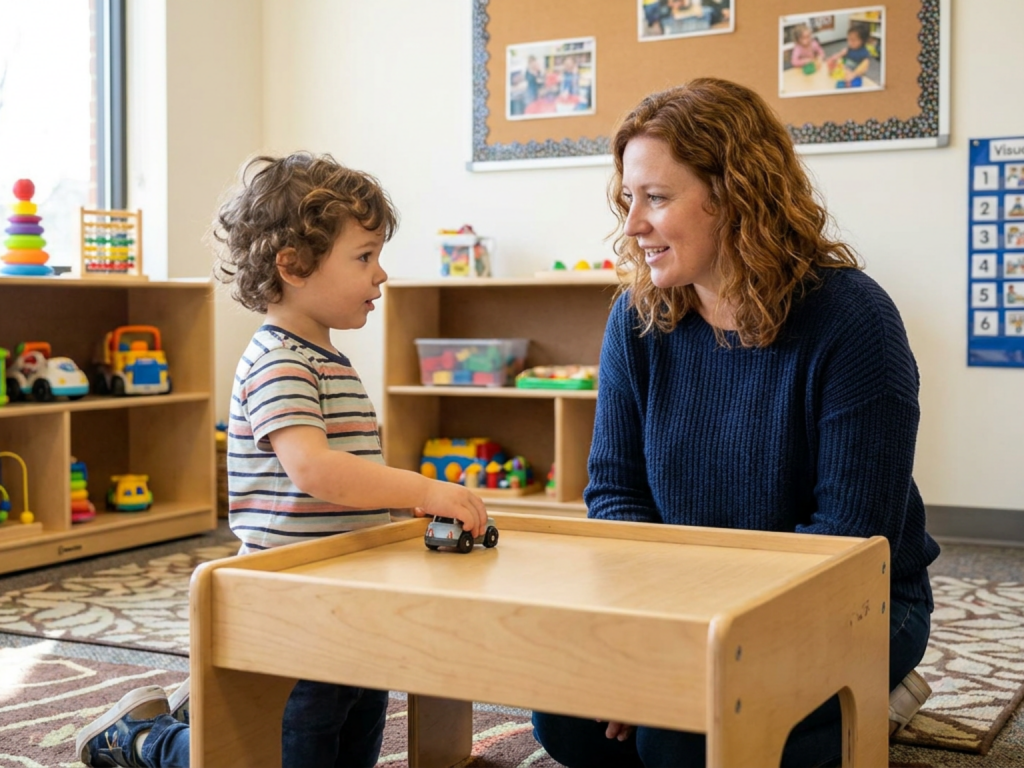
The most effective instruction is close, calm, specific, and brief. Move within a few feet of the child instead of calling from another room. Say the child’s name once, wait until you have their attention, and use a neutral tone. For some children, direct eye contact helps; for others, especially children who become overwhelmed by face-to-face intensity, standing nearby and using a calm voice may work better.
Use commands rather than questions when the task is not optional. “Please put the blocks in the bin now” is clearer than “Can you clean up?” A question invites negotiation or refusal. Keep the instruction positively stated: tell the child what to do, not only what to stop doing. “Walk next to me” is easier to act on than “Don’t run away.”
One command at a time is often enough. If you give a chain of directions, working memory may fail before cooperation even begins. Instead of “Go upstairs, brush your teeth, put pajamas on, and choose a book,” start with “Go upstairs now.” After that is complete, give the next step. Some children benefit from a 15- to 18-second pause after you state the direction; adults often repeat too quickly, which can train children to wait for the third or fourth command.
A practical formula is: get close, say the child’s name, give one clear direction, end with “now,” pause, and then follow through. For example: “Maya, put the tablet on the counter now.” Then wait quietly. This structure is not cold or harsh; it reduces ambiguity and emotional noise.
Use calm follow-through instead of escalation
Repeated pleading, bargaining, and threats usually make listening worse over time. They teach the child that the first instruction is not the real one. Yelling can produce short-term movement, but it often increases stress physiology, models dysregulation, and makes cooperation dependent on adult intensity. The goal is not to sound more alarming; it is to become more predictable.
Before giving a command, decide whether you are prepared to follow through. If the instruction is not important enough to enforce, it may be better not to give it. If it is important, state it once clearly and calmly. If the child complies, acknowledge it right away. If the child does not comply, use the planned consequence or assistance without a long lecture.
Follow-through should be immediate, proportionate, and related when possible. If a child will not put away a toy after a clear command, the toy may be unavailable for a short period. If a child refuses to turn off a screen, the adult may calmly take the device and reduce screen access later. The child should not receive a large emotional reaction as the main consequence, because for some children that reaction becomes reinforcing.
Consistency does not mean rigidity in every situation. Illness, neurodevelopmental differences, trauma exposure, sleep deprivation, and major transitions can lower a child’s capacity. Even then, the adult can keep the tone calm and the instruction simple. Support and limits can coexist: “You’re upset, and it is still time to get in the car.”
Reinforce the behavior you want
Adults naturally notice noncompliance because it interrupts the day. But if a child receives the most attention when they ignore, argue, or tantrum, those behaviors can strengthen. Deliberately noticing compliance changes the reinforcement pattern. Praise should be brief, specific, and immediate: “You came when I called. That was helpful.” “You put the cup in the sink the first time.”
This is not about constant applause. It is about giving the child clear feedback that cooperation works. Specific praise also helps children understand exactly which behavior to repeat. For children with attention or behavioral difficulties, frequent positive feedback may be especially important because correction often dominates their day.
Planned ignoring can be useful for minor disrespectful comments, whining, or tantrum behavior that is not dangerous and does not require a response. The adult withholds attention from the behavior while remaining physically present and emotionally steady. As soon as the child returns to appropriate behavior, the adult reconnects and gives the original instruction again. Planned ignoring should not be used for aggression, self-injury, running away, destruction, or any behavior that requires safety intervention.
Some families use reward systems for repeated problem times, such as morning routines. Keep them small and concrete. A sticker, token, or point can follow a specific behavior, such as “shoes on after one reminder.” Avoid vague goals like “be good all morning,” because the child cannot easily translate that into action.
Make consequences predictable and respectful
Consequences are most effective when they teach, not when they shame. A child should understand what will happen and why. The adult’s tone matters: calm delivery communicates that the limit is stable and not dependent on anger. Long explanations during conflict often prolong the episode. Save teaching for later, when the nervous system has settled.
Time-out can help some children when it is used carefully, briefly, and consistently. It should be a low-attention break from reinforcement, not a frightening isolation or a debate. During time-out, the adult should avoid arguing, lecturing, or repeatedly checking whether the child is sorry. After the time-out, the child should return to the original command if it is still relevant. This is important because the goal is compliance with the instruction, not simply serving time.
For time-out to work, time-in must also be strong. A child who rarely receives warm attention may escalate when attention is removed. Daily positive connection, play, reading, and cooperative routines make discipline more effective because the child has something meaningful to return to.
Natural and logical consequences are often preferable. If a child throws crayons, crayons are put away. If a child delays getting dressed, there may be less time for a preferred activity before leaving. Avoid consequences that are extreme, unrelated, humiliating, or impossible to enforce. Predictability is more powerful than severity.
Check for medical, developmental, and emotional contributors
If a child’s non-listening is persistent, severe, or new, consider whether there is an underlying contributor. Hearing problems can look like ignoring, especially if the child responds inconsistently, turns up volume, asks for repetition, has frequent ear infections, or struggles in noisy environments. Vision problems, sleep-disordered breathing, chronic pain, constipation, medication effects, and fatigue can also affect attention and cooperation.
Language comprehension deserves special attention. A child with expressive language that sounds fluent may still have difficulty understanding complex directions, temporal words such as “before” and “after,” or multi-step instructions. Concerns about receptive and expressive language skills are a reason to discuss evaluation with a pediatrician or speech-language pathologist.
Behavioral and emotional factors can also interfere. Anxiety may lead a child to avoid tasks that feel uncertain. Attention-deficit/hyperactivity traits may make it hard to shift from a preferred activity, hold instructions in mind, or inhibit impulses. Autism-related differences, sensory processing challenges, learning disorders, trauma, family stress, and mood symptoms can all affect responsiveness. These are not conclusions to make from one behavior, but they are reasons to seek professional guidance if the pattern is impairing.
Red flags include loss of previously acquired skills, no response to name in a toddler, suspected hearing loss, major language delay, frequent aggression, self-injury, dangerous elopement, severe sleep problems, or behavior that prevents normal childcare or school participation. In these situations, consult a pediatrician, developmental-behavioral specialist, child psychologist, audiologist, or other appropriate clinician.
Build routines that reduce conflict
Many listening problems cluster around predictable transitions: leaving the house, stopping screens, bedtime, homework, and mealtimes. These moments are hard because they require cognitive shifting. Routines reduce the number of verbal commands needed. A visual schedule, timer, first-then statement, or consistent sequence can make expectations easier to follow.
Prepare the child before transitions, but do not over-negotiate. “Five minutes, then bath” can be paired with a timer. When the timer ends, use the direct command: “Tablet on the counter now.” If the child protests, acknowledge briefly and keep the limit: “You wanted more time. Tablet on the counter now.”
Offer limited choices when either option is acceptable. “Do you want the blue cup or the green cup?” supports autonomy. “Do you want to brush teeth?” does not, unless skipping is truly allowed. Choices work best before conflict escalates, not after a child has ignored a direct instruction.
Finally, examine adult pacing. Children often receive rapid-fire directions while adults are multitasking. Slowing down for ten seconds, getting close, and giving one concrete instruction may save ten minutes of conflict. The aim is not perfect obedience. The aim is a family pattern in which the child can understand expectations, practice self-regulation, and experience adults as both warm and dependable.
When to seek help promptly
- Your child suddenly stops responding normally or loses previously acquired skills.
- You suspect hearing loss, speech delay, or difficulty understanding everyday directions.
- Non-listening is paired with aggression, self-injury, running away, or unsafe behavior.
- Behavior problems are causing major impairment at school, childcare, or home.
- Sleep problems, anxiety, developmental concerns, or family stress seem to be worsening the pattern.
Tools & Assistance
- Pediatrician visit to review hearing, sleep, development, medication effects, and behavior concerns
- Audiology evaluation if hearing or inconsistent response is suspected
- Speech-language pathologist evaluation for receptive or expressive language concerns
- Parent management training or child psychologist support for persistent noncompliance
- Visual routines, timers, first-then cards, and brief behavior charts for difficult transitions
FAQ
Should I repeat myself until my child listens?
Usually no. Repeating many times can teach the child that early instructions do not matter. Give one clear, calm direction, pause, then follow through consistently.
Is my child being disrespectful on purpose?
Sometimes a child is testing limits, but non-listening can also reflect attention, language, hearing, sleep, anxiety, or developmental factors. Look for patterns before assuming intent.
Is yelling harmful?
Occasional frustration happens, but yelling is not a reliable long-term strategy. Calm, direct instructions and predictable consequences are usually more effective and less stressful.
When should I consider a professional evaluation?
Seek guidance if the problem is severe, persistent, sudden, unsafe, associated with developmental concerns, or interfering with school, childcare, family routines, or relationships.
Sources
- Boys Town National Research Hospital — How To Get Your Toddler to Listen
- Understood.org — How I got my child to listen (without yelling)
- Child Mind Institute — 5-Year-Old Doesn't Listen? Effective Parenting Solutions
Disclaimer
This article is for informational purposes only and does not diagnose or treat any child. Consult a qualified healthcare professional for concerns about hearing, development, behavior, mental health, or safety.


















Please log in to leave a comment.