
Intro
Preschool physical skills development is the gradual growth of movement abilities that help a child run, climb, balance, draw, dress, feed themselves, and participate in play with confidence. These skills reflect the interaction of the musculoskeletal system, nervous system, sensory processing, cognition, motivation, sleep, nutrition, and the child’s opportunities to move safely.
Highlights
Preschoolers develop best through frequent active play, not formal performance pressure.
Gross motor skills and fine motor skills grow together and are closely linked with confidence, self-regulation, and school readiness.
Parents and caregivers matter: modeling active behavior and creating safe opportunities for movement support healthy motor development.
Variation is common, but persistent loss of skills, marked asymmetry, pain, or major delays should be discussed with a healthcare professional.
What physical development means in preschool
Preschool physical skills development usually refers to children between about 3 and 5 years of age, although individual timing varies. During this period, the brain refines motor planning, balance reactions, visual-motor integration, bilateral coordination, and postural control. The child is not simply getting stronger; they are learning how to organize movement efficiently in response to a changing environment.
Gross motor skills involve large muscle groups and whole-body movement. Examples include running, jumping, hopping, climbing stairs, throwing, catching, pedaling, and balancing. Fine motor skills involve smaller, more precise movements of the hands and fingers, such as using utensils, turning pages, manipulating blocks, drawing simple shapes, and beginning to use scissors with supervision.
These domains overlap. A child who draws at a table also needs trunk stability, shoulder control, visual attention, and sensory feedback from the hand. A child who climbs playground equipment uses strength, coordination, depth perception, problem-solving, and emotional regulation. This is why physical development is best understood as a whole-child process rather than a checklist of isolated milestones.
Typical preschool movement milestones
Milestones are useful reference points, not exact deadlines. Many healthy children acquire skills in a different order or show temporary unevenness. By age 3, many children can run more smoothly, climb well, walk up stairs with alternating feet, kick a ball, and begin to pedal a tricycle. Fine motor skills may include stacking blocks, copying simple lines or circles, turning one page at a time, and helping with dressing.
By age 4, many children can hop briefly on one foot, catch a large ball with arms, pour with some spills, use child-safe scissors, and draw a person with a few body parts. By age 5, many can skip or attempt skipping, balance on one foot for longer, throw with more direction, copy some shapes, dress with less help, and manage more complex hand tasks such as buttons or simple fasteners.
Context matters. A child living in a small apartment, recovering from illness, or spending long hours in sedentary settings may have fewer chances to practice. Conversely, a highly active child may be advanced in climbing and running but still need support for pencil grasp or self-care tasks. If a child consistently avoids movement, seems unusually fatigued, has frequent falls, or loses skills they previously had, it is appropriate to ask a pediatric clinician for individualized advice.
Why movement supports learning and health
Physical activity in early childhood is associated with motor competence, healthier body composition, cardiometabolic benefits, and psychosocial well-being. Research on structured physical education in preschoolers also suggests benefits for learning capacity, mental aspects of health, and broader developmental outcomes. Movement is not a distraction from learning; for many children, it is one of the main pathways into learning.
Active play challenges executive functions such as inhibition, working memory, flexible thinking, and attention shifting. A child who waits for a turn, changes direction in a game, follows a two-step movement instruction, or adapts to a new playground obstacle is practicing cognitive control. These experiences can support school readiness without turning play into a lesson.
Movement also provides sensory input that helps children understand where their bodies are in space. Proprioceptive input from pushing, pulling, jumping, and climbing can be organizing for some children. Vestibular input from swinging, rolling, or balancing contributes to equilibrium and spatial orientation. Children differ in how they respond to sensory experiences, so the goal is not to force one type of play but to offer varied, safe choices.
The role of parents, caregivers, and preschool environments
Children learn movement partly by observation. When adults walk, stretch, dance, garden, carry groceries, play ball, or choose stairs when appropriate, they model the idea that movement is a normal part of daily life. Parental involvement is especially important because preschool children usually cannot independently access safe spaces, equipment, transportation, or regular routines.
A supportive environment does not require expensive programs. Useful options include floor play, obstacle courses made from cushions, supervised playground time, music and movement games, ball play, water play where safe, nature walks, and simple household participation such as carrying light items or wiping a table. The most effective activities are usually enjoyable, repeatable, and matched to the child’s current ability.
Preschool settings can strengthen development by offering daily opportunities for free play and guided movement. Structured physical education may help children learn specific skills such as throwing, balancing, jumping, and coordinated running. However, structure should remain developmentally appropriate: short instructions, playful repetition, warm encouragement, and flexibility for different temperaments and abilities.
Supporting gross motor skills safely
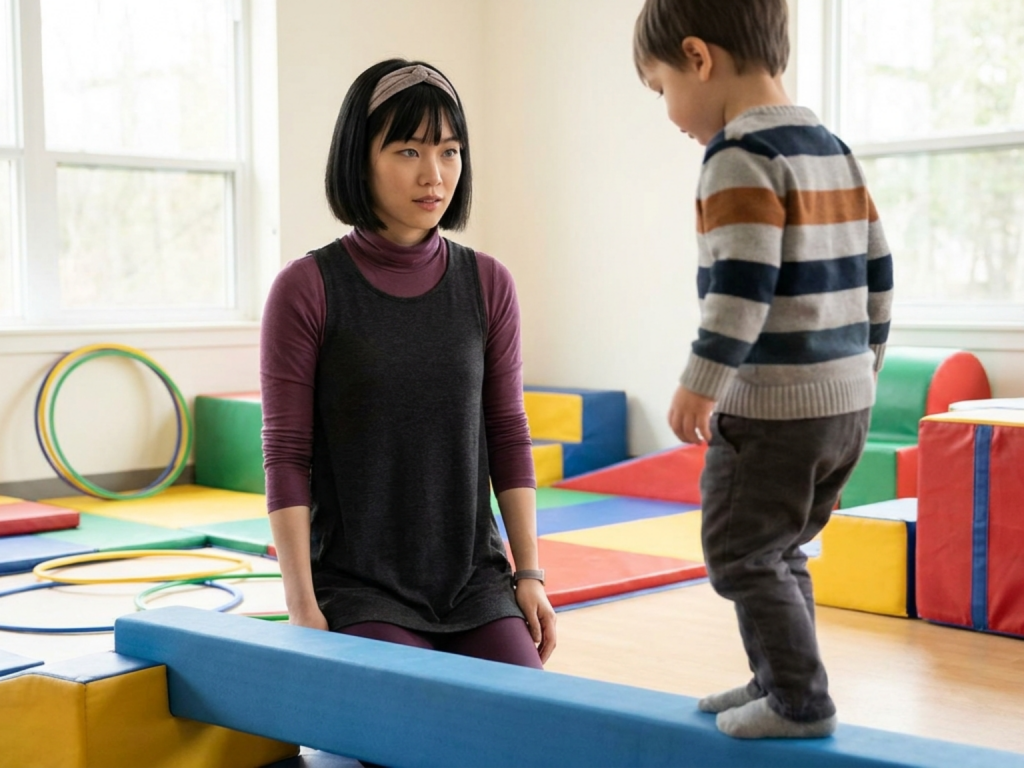
Gross motor development thrives on variety. Children need chances to move fast and slow, high and low, forward and backward, with both sides of the body. Activities that support this include running games, animal walks, hopping paths, climbing playground structures, dancing, swimming lessons when available and supervised, ball games, balance beams close to the ground, and riding a tricycle or balance bike with a helmet.
Safety should reduce serious injury risk without eliminating all challenge. Children develop balance and judgment by encountering manageable risk: stepping over a log, climbing a low structure, or learning how to land from a small jump. Adult supervision, appropriate surfaces, well-maintained equipment, sun protection, hydration, and properly fitted protective gear matter.
Watch the child’s quality of movement. Persistent toe walking, very frequent tripping, marked stiffness or floppiness, clear asymmetry between sides, pain with activity, or avoidance of stairs and climbing may warrant professional evaluation. These signs do not automatically indicate a diagnosis, but they are good reasons to discuss development with a pediatrician, physical therapist, or other qualified clinician.
Supporting fine motor and self-care skills
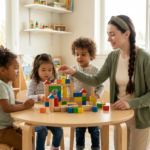
Fine motor development is built through everyday hand use. Preschoolers benefit from manipulating clay, tearing paper, stringing large beads, building with blocks, using tongs, painting with brushes, drawing with crayons, turning knobs, opening containers, and helping with age-appropriate food preparation. These activities strengthen the intrinsic hand muscles and improve coordination between vision and movement.
Self-care tasks are particularly powerful because they are meaningful. Pulling on socks, zipping a jacket after it is started, washing hands, using utensils, and cleaning up toys all require sequencing, postural stability, sensory tolerance, and motor planning. Expect effort and inconsistency. A child may manage a zipper one day and struggle the next when tired, hungry, rushed, or emotionally overwhelmed.
For writing readiness, avoid pushing formal handwriting too early. Many preschoolers need time with large arm movements, vertical surfaces such as easels, finger games, tracing in sand, and playful drawing before sustained pencil tasks feel comfortable. If a child has persistent hand pain, extreme frustration, very weak grasp, inability to use both hands together, or major difficulty with feeding and dressing compared with peers, an occupational therapy assessment may be helpful.
Screen time, sleep, nutrition, and recovery
Physical skills do not develop in isolation from daily physiology. Adequate sleep supports motor learning, attention, mood regulation, and tissue recovery. Hunger, iron deficiency, dehydration, constipation, poorly controlled asthma, chronic pain, or recurrent illness can reduce a child’s energy for movement. If fatigue or low endurance seems disproportionate, medical review is appropriate.
Sedentary time is sometimes unavoidable, but long stretches can crowd out active practice. Families often do better with realistic routines rather than guilt. Short movement breaks, walking part of a route, stretching after screen time, dancing during cleanup, or visiting a playground after errands can add meaningful activity. The aim is a rhythm of daily movement, not perfection.
Nutrition supports growth, bone mineralization, muscle function, and neural development. Balanced meals and snacks with adequate protein, iron-rich foods, calcium, vitamin D sources, fruits, vegetables, and fluids can help children participate actively. Supplements or restrictive diets should be discussed with a clinician, especially if the child has medical conditions, feeding difficulties, poor growth, or selective eating that limits major food groups.
When differences deserve professional guidance
Children develop at different rates, and comparison can create unnecessary anxiety. Still, caregivers know their child well, and persistent concerns deserve to be heard. Consider seeking guidance if the child loses previously acquired motor skills, has repeated unexplained falls, cannot keep up with peers in basic play, shows persistent one-sided weakness, has unusual muscle tone, experiences pain, or avoids most physical activity despite encouragement.
Developmental evaluation may involve a pediatrician, pediatric physical therapist, occupational therapist, developmental-behavioral pediatrician, neurologist, orthopedist, or speech-language pathologist depending on the concern. Assessment may look at strength, range of motion, tone, coordination, reflexes, balance, gait, sensory processing, vision, hearing, and functional participation.
Early support is not a label of failure. It can help a child access play, preschool routines, and self-care with less frustration. The most helpful plans are individualized, family-centered, and coordinated with medical history. If a caregiver feels dismissed, it is reasonable to ask what should be monitored, when to follow up, and whether a referral is appropriate.
Seek medical advice promptly if
- A child loses physical skills they previously had.
- Movement is associated with persistent pain, swelling, limping, or refusal to bear weight.
- There is marked weakness, stiffness, floppiness, or asymmetry between sides.
- Falls are frequent, severe, or increasing without a clear explanation.
- Fatigue, breathlessness, or poor endurance seems out of proportion to activity.
Tools & Assistance
- Keep a simple observation log of skills, concerns, fatigue, pain, and falls.
- Ask the child’s pediatrician about developmental screening if concerns persist.
- Use safe daily play routines that include climbing, balancing, throwing, drawing, and self-care practice.
- Consider pediatric physical therapy or occupational therapy when recommended by a qualified clinician.
- Coordinate with preschool teachers to understand how the child moves in group settings.
FAQ
Should preschoolers do formal exercise?
Most preschoolers do best with active play, short guided games, and skill practice rather than adult-style exercise. Structured physical education can help when it remains playful and age appropriate.
Is clumsiness always a medical concern?
No. Many preschoolers are temporarily clumsy while skills are emerging. Persistent frequent falls, pain, asymmetry, regression, or major difficulty with daily activities should be discussed with a healthcare professional.
How can I help fine motor skills without forcing handwriting?
Offer play with clay, blocks, crayons, tongs, beads, puzzles, pouring, dressing, and supervised scissors. These build hand strength and coordination before formal writing demands.
What if my child avoids playground equipment?
Avoidance can reflect fear, temperament, limited practice, sensory sensitivity, weakness, or coordination difficulty. Gentle exposure and choice may help, but persistent avoidance or distress is worth discussing with a clinician.
Sources
- Frontiers in Psychology — Examining the impact of physical education and physical skills on preschoolers' learning and health
- ScienceDirect — Importance, unique aspects and guidelines, and building blocks of physical activity in preschoolers
- National Institutes of Health / PubMed Central — Physical Activity During Early Childhood: The Importance of Parental Involvement and Modeling
Disclaimer
This article is for general educational purposes and does not diagnose, treat, or replace medical care. Consult a qualified healthcare professional for concerns about a child’s development, pain, regression, or activity tolerance.









Please log in to leave a comment.