
Intro
Labor is not meant to be experienced in only one position. For many birthing people, being upright, mobile, and supported can make contractions feel more purposeful and can help the pelvis respond dynamically as the baby descends.
Upright positions are not a single technique; they include standing, walking, slow dancing, leaning forward, kneeling, sitting upright, using a birth ball, supported squatting, and hands-and-knees variations. The safest and most helpful choices depend on your clinical situation, comfort, fetal status, mobility, pain relief, and guidance from your maternity care team.
Highlights
Upright positions can use gravity, pelvic mobility, and maternal comfort to support physiological labor progress.
Evidence links upright laboring with shorter labor duration, less pain, and higher satisfaction for many birthing people.
Position choice should remain flexible; what helps in early labor may feel different during transition or pushing.
Medical factors such as epidural analgesia, continuous fetal monitoring, bleeding, dizziness, or fetal heart rate concerns may change which upright options are safe.
What counts as an upright position in labor
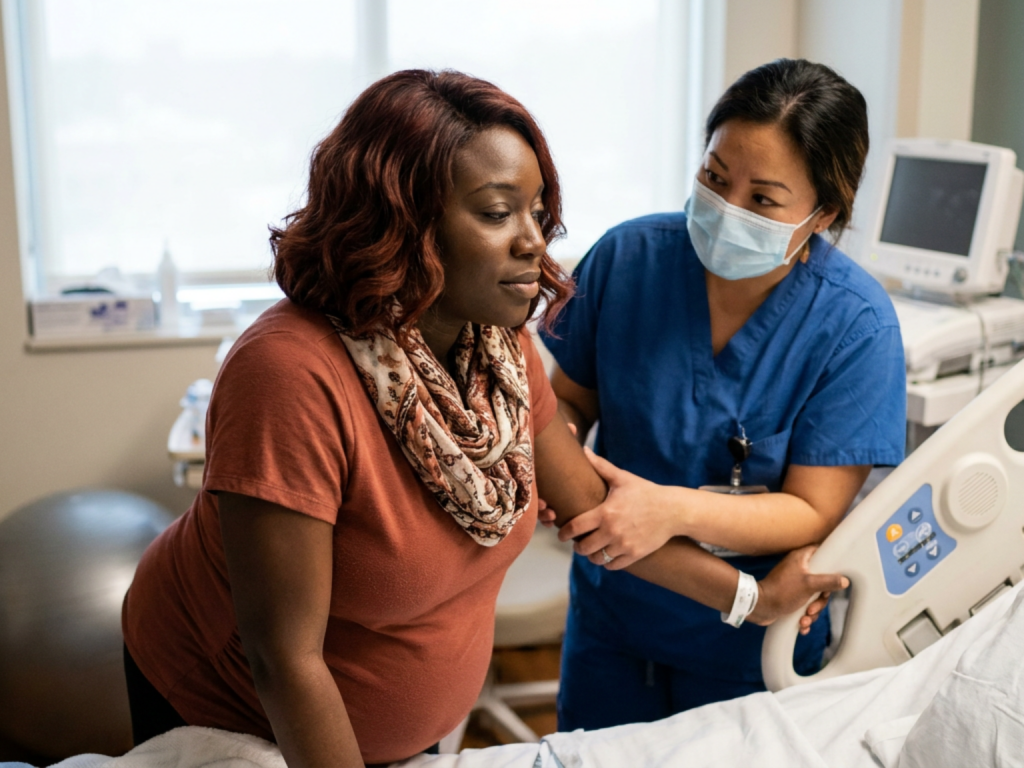
In birth care, “upright” usually means that the torso is vertical or angled forward rather than lying flat on the back. This can include standing beside the bed, walking in the room or hallway, leaning over a raised bed, swaying with a partner, sitting upright on a birth ball, kneeling while supported by pillows, using hands-and-knees for back labor, or resting in a throne-like position in bed. Some positions are fully weight-bearing, while others are semi-upright and supported.
The goal is not to perform a perfect posture. The goal is to create space, comfort, and responsiveness. Labor is rhythmic and changing, so upright positions during labor often work best when they are adapted from contraction to contraction. A birthing person may stand and sway for several contractions, sit to rest, lean forward during intense waves, then use side-lying if fatigue becomes prominent.
Compared with flat supine positioning, upright positions tend to allow more movement of the sacrum and coccyx. This matters because the pelvis is not a rigid ring during birth; its joints and soft tissues respond to pressure, fetal rotation, and maternal movement. Keeping the sacrum less compressed may help the baby navigate the pelvic inlet, midpelvis, and outlet more effectively.
Physiological benefits: gravity, contractions, and pelvic mechanics
One of the most intuitive benefits of upright labor is gravity. When the uterus contracts, the baby’s presenting part can apply more direct pressure to the cervix. This pressure may support cervical effacement and dilation through neurohormonal feedback, including oxytocin release. For some people, contractions feel stronger but more productive in upright positions; for others, the main benefit is reduced back pressure or a greater sense of control.
Research comparing upright and recumbent positions has reported faster labor progress and shorter childbirth duration among people using upright positions. One study found a reduction in overall childbirth duration of about 1 hour and 22 minutes, along with less pain and higher maternal satisfaction. Other reviews and clinical discussions note potential reductions in assisted delivery, episiotomy, abnormal fetal heart rate patterns, and perineal trauma, although individual outcomes vary and depend on many clinical factors.
Pelvic alignment is another important mechanism. Standing, kneeling, lunging, and squatting can change pelvic diameters and alter the angle between the uterus, cervix, and birth canal. Forward-leaning labor positions may be particularly helpful when the birthing person feels pressure in the back or when the baby is working to rotate. These positions can encourage abdominal suspension, reduce direct sacral pressure, and allow subtle rocking or asymmetrical movement.
Upright positioning may also support maternal cardiovascular physiology. Lying flat on the back in late pregnancy can compress the inferior vena cava and aorta in some people, reducing venous return and potentially affecting maternal blood pressure and uteroplacental blood flow. Semi-upright, lateral, or forward-leaning alternatives can reduce this concern while still allowing clinical access when needed.
Comfort, coping, and the psychological benefit of agency
Labor pain is complex. It is shaped by cervical change, uterine intensity, fetal position, tissue stretching, fatigue, fear, and the surrounding environment. Upright movement does not remove labor pain, but it can change how pain is experienced. Many people find that swaying, rocking, leaning, or walking makes contractions feel less overwhelming because the body is actively responding rather than bracing.
Position choice can also reduce specific pain patterns. Hands-and-knees for back labor may ease sacral pressure, especially when contractions radiate through the lower back. Sitting on a birth ball can allow pelvic circles and gentle bouncing between contractions. Standing and slow dancing with a support person can combine upright posture with touch, reassurance, and rhythmic breathing.
Agency is clinically meaningful. When a birthing person can choose, adjust, and communicate about position, the birth environment often feels less passive. Higher satisfaction in upright-position studies may reflect not only physiology but also autonomy, mobility, and respectful support. Feeling heard during labor can reduce fear and help the nervous system stay more regulated.
That said, comfort is individual. Some people strongly prefer side-lying, especially when exhausted, nauseated, or receiving epidural analgesia. Others find upright positions too intense during transition. A supportive approach avoids treating upright positioning as a rule. Instead, it offers options and helps the person notice what is working now.
When to use upright positions in each stage of labor
In early labor, upright positions can be useful if contractions are manageable and the person wants to stay mobile. Walking, showering while standing if permitted, leaning on a counter, or using a birth ball may help conserve energy while encouraging fetal descent. Early labor is often long, so frequent rest remains essential.
In active labor, changing positions during contractions can help the pelvis adapt as dilation progresses. Standing and swaying may feel good during one phase, while kneeling over the head of the bed may feel better when contractions intensify. If the baby is high, an upright posture may help engagement. If back pain dominates, forward-leaning or hands-and-knees positions may reduce discomfort.
During transition, upright positions can feel powerful but demanding. Some people prefer supported standing, high kneeling, or sitting upright so they can bear down instinctively if appropriate. Others need a stable rest position. This is a time for close communication with the care team, especially if there is involuntary pushing before full dilation is confirmed.
In the second stage, upright pushing positions include supported squatting, kneeling, standing with support, sitting on a birth stool, or semi-upright pushing in bed. These may shorten the pushing phase for some people and can use gravity to assist descent. However, prolonged squatting can be tiring and may not be suitable for everyone. Perineal support, fetal heart rate monitoring, and controlled birth of the head may influence the final position recommended by the clinician.
After birth, immediate priorities may include assessment of bleeding, placental delivery, newborn transition, and repair if needed. Upright or semi-upright positions may still be possible for skin-to-skin contact, but medical stability comes first.
Situations that call for extra caution or modification
Upright positions are often safe and beneficial, but they are not automatically appropriate in every circumstance. If there are fetal heart rate concerns, significant bleeding, severe hypertension symptoms, dizziness, faintness, heavy sedation, infection concerns, or urgent need for obstetric intervention, the care team may recommend a different position or closer monitoring. This is not a failure of physiological birth; it is a safety adjustment.
Epidural analgesia changes the mobility plan. Some people with low-dose epidurals can use supported sitting, side-lying, peanut ball positions, or assisted semi-upright positions. Others have reduced leg strength and should not stand or squat. Position changes after epidural analgesia should be guided by staff assessment of motor function, blood pressure, fetal status, and fall risk.
Continuous fetal monitoring does not always mean staying in bed, but it may require planning. Wireless telemetry, portable monitors, or careful bedside positioning may allow safe movement during fetal monitoring. If monitoring signals are difficult to maintain, staff may suggest positions that balance maternal comfort with reliable fetal assessment.
Ruptured membranes, a high presenting part, or concern for cord prolapse may also affect movement recommendations. Likewise, people with pelvic girdle pain, hip injury, neurologic conditions, or severe fatigue may need modified positions that reduce strain. Always ask what is safe in your specific context rather than assuming a general birth plan applies to every moment.
How to use upright positions safely and sustainably
The most effective upright positioning is usually supported, flexible, and energy-conscious. Labor can last many hours, and the body needs recovery between contractions. Alternating active positions with rest can prevent exhaustion. A useful pattern might be standing for several contractions, sitting on a ball for a few, then lying on the side with pillows for a longer rest.
Support people can help by offering stable contact, not by pulling or forcing posture. A partner, doula, nurse, or midwife may steady the birthing person during swaying, adjust bed height for leaning, place pillows under knees, provide sacral counterpressure during contractions, or remind the person to unclench the jaw and shoulders. Good support respects consent and stops immediately if a position feels wrong.
Practical safety measures include wearing non-slip socks if walking, keeping IV lines and monitor cords organized, rising slowly to prevent dizziness, and asking for help before standing after medication, exhaustion, or long periods in bed. Hydration, bladder emptying, and nutrition according to local policy can also influence stamina and comfort.
A helpful mindset is “position as communication.” If pressure increases, back pain changes, or the urge to push appears, tell the care team. These sensations may be normal labor progress, but they may also indicate that assessment is needed. Upright positioning works best when it is integrated with clinical observation, not separated from it.
Choosing the right position without pressure
Upright positions offer meaningful benefits, but they should never become another standard that a laboring person feels pressured to meet. The best position is one that supports safety, physiology, and coping in the present moment. For one person, that may be walking through early labor and kneeling for pushing. For another, it may be mostly side-lying with brief assisted upright intervals.
Before labor, it can help to discuss preferences with your obstetrician, midwife, or birth team. Ask which positions are available in your birth setting, whether birth balls or stools are provided, how monitoring is handled, and what options exist if you choose or need epidural analgesia. These conversations make it easier to adapt if plans change.
During labor, use upright positions as tools rather than tests. If a position improves coping, supports progress, or gives you a sense of steadiness, it is worth continuing. If it increases distress, pain, or instability, it is reasonable to change. Birth is dynamic, and compassionate care leaves room for movement, rest, medical judgment, and personal preference.
When to ask for immediate help
- Tell your care team right away if you feel faint, dizzy, short of breath, or unable to support your weight.
- Report vaginal bleeding, sudden severe pain, or a dramatic change in fetal movement before hospital arrival.
- Do not stand or squat without assistance after epidural analgesia unless staff confirm it is safe.
- Follow urgent instructions if fetal heart rate concerns, cord prolapse concern, or heavy bleeding occur.
- Stop any position that causes numbness, sharp joint pain, or a feeling of instability.
Tools & Assistance
- Discuss upright labor options during a prenatal visit with your obstetrician or midwife.
- Ask your birth setting whether birth balls, squat bars, wireless monitoring, or birth stools are available.
- Practice supported standing, kneeling, side-lying, and birth ball positions before labor if comfortable.
- Use a doula, nurse, midwife, or trained support person for stability and position changes.
- Create a flexible birth preferences document that includes mobility, monitoring, and epidural-related options.
FAQ
Are upright positions always better than lying down?
No. Upright positions can be very helpful, but side-lying or semi-recumbent positions may be safer or more comfortable in some situations, especially with fatigue, epidural analgesia, or medical concerns.
Can I use upright positions with continuous fetal monitoring?
Often, yes, but it depends on the equipment, signal quality, and fetal status. Ask your care team about wireless monitoring, bedside standing, or supported sitting options.
Is squatting necessary for an unmedicated birth?
No. Squatting is one option, not a requirement. Kneeling, standing, sitting upright, hands-and-knees, and side-lying may all be useful depending on comfort and clinical circumstances.
Can upright positions reduce the chance of assisted birth?
Some evidence suggests upright positions may reduce assisted vaginal birth and episiotomy rates, but outcomes depend on fetal position, labor progress, maternal health, pain relief, and clinical decision-making.
What if I want an epidural but also want movement?
Ask about low-dose epidural protocols and supported position changes. Many people can still use side-lying, semi-upright, throne, or peanut ball positions, but standing is not safe unless staff specifically approve it.
Sources
- National Institutes of Health / PubMed Central — Examining the impact of upright and recumbent positions on labor progress and childbirth outcomes
- Roseman University of Health Professions eCommons — Benefits of Using an Upright Laboring Position as Compared to Supine
- Dr. Sara Wickham — Upright positions in labour - the benefits
Disclaimer
This article is for informational purposes only and does not replace individualized medical advice. Always consult your obstetrician, midwife, or maternity care team about safe labor positions for your situation.
















Please log in to leave a comment.