
Intro
Watching a baby’s weight change from week to week can be reassuring, confusing, and sometimes emotionally intense. Many caregivers look for an average baby weight by age because they want to know whether feeding is going well, whether growth is on track, or whether a recent slowdown should prompt concern. The most helpful answer is not a single number, but a pattern: clinicians interpret weight using standardized growth charts, sex-specific percentiles, age, gestational age, length, head circumference, feeding history, and the baby’s overall clinical picture.
Healthy babies vary widely in size. Some are constitutionally small and grow steadily; others are larger and follow a higher percentile. A baby’s position on a chart matters less than whether the baby follows a consistent growth trajectory and appears well nourished, hydrated, and developmentally appropriate. If you are worried about your baby’s weight, it is reasonable and appropriate to ask your pediatrician or child health clinician for an individualized interpretation.
Highlights
Average baby weight is best understood through growth charts, not as a single universal target.
Clinicians usually evaluate weight-for-age together with length, head circumference, feeding history, and growth velocity in infancy.
Many babies lose a small amount of weight after birth, then regain birth weight within the early newborn period under routine clinical monitoring.
A steady percentile pattern is often more informative than whether a baby is exactly at the 50th percentile.
Rapid weight change, poor feeding, dehydration signs, or lethargy should be discussed promptly with a healthcare professional.
What average baby weight means
The word “average” can be misleading in infant growth. In clinical pediatrics, weight is usually assessed on a percentile curve or by a z-score, which describes how far a measurement is from the reference population mean. The World Health Organization provides weight-for-age standards that are commonly used to assess infants and young children, with separate charts for boys and girls. These standards help clinicians compare a baby’s weight with expected patterns for age and sex.
The 50th percentile is often described as the median, meaning half of babies in the reference population weigh more and half weigh less. It is not a goal that every baby should reach. A baby at the 15th percentile who has always tracked near that curve may be growing appropriately. Similarly, a baby at the 85th percentile may be healthy if weight, length, feeding, and physical examination are reassuring.
CDC growth chart guidance also emphasizes that charts are tools for monitoring growth over time. They do not diagnose a condition by themselves. A single point can be affected by scale differences, clothing, hydration, recent feeding, or measurement technique. Trends across multiple visits are usually more meaningful than one isolated value.
Average baby weight by age in the first year
Published month-by-month tables commonly based on WHO-derived data show broad typical ranges. Exact values vary by sex, and individual babies may be healthy above or below these averages. As a practical orientation, many full-term newborns weigh around 7 to 8 pounds at birth, though normal birth weight varies substantially.
- Birth: many term babies weigh about 3.2 to 3.4 kg, or about 7 to 7.5 lb.
- 1 month: average weights are often around 4.2 to 4.5 kg, or about 9 to 10 lb.
- 2 months: many babies average around 5.1 to 5.6 kg, or about 11 to 12 lb.
- 3 months: average weights are often around 5.8 to 6.4 kg, or about 13 to 14 lb.
- 4 months: many babies average around 6.4 to 7.0 kg, or about 14 to 15.5 lb.
- 6 months: average weights are often around 7.3 to 7.9 kg, or about 16 to 17.5 lb.
- 9 months: many babies average around 8.2 to 8.9 kg, or about 18 to 19.5 lb.
- 12 months: average weights are often around 8.9 to 9.6 kg, or about 19.5 to 21 lb.
These numbers are approximate reference points, not requirements. A pediatrician will usually plot the baby’s exact weight on a sex-specific growth chart and compare it with previous measurements. If a baby was born early, clinicians often use corrected age for preterm babies, especially during infancy, because comparing a premature baby with full-term peers by chronological age alone can be misleading.
Normal weight patterns after birth
In the first few days of life, many newborns lose weight as they pass fluid, establish feeding, and adjust to life outside the uterus. Clinicians monitor this closely because excessive loss, poor intake, jaundice, or dehydration can need prompt attention. Most babies are expected to regain birth weight within the early newborn period, although the exact timing depends on feeding, gestational age, birth circumstances, and clinical status.
After feeding is established, weight gain is usually fastest in the early months. A commonly cited milestone is that many infants double birth weight by around 4 to 6 months and triple it by about 12 months, but there is individual variation. Babies do not gain the same amount every day. Growth often occurs in spurts, and short-term plateaus can happen around illness, feeding transitions, or increased activity.
Because weight is only one part of growth, pediatricians also consider length and head circumference. A baby whose weight percentile drops while length and head circumference continue appropriately may need a different assessment than a baby whose all-around growth slows. Weight-for-length in babies can help clinicians evaluate proportionality, especially when weight alone does not tell the whole story.
Factors that influence baby weight
Several factors can influence where a baby falls on a growth chart. Genetics matter: babies often resemble family growth patterns. Birth weight is influenced by gestational age, placental function, maternal health, multiple pregnancy, and intrauterine growth. A baby born at 37 weeks may have a different starting point than a baby born at 41 weeks, even though both can be considered term.
Feeding also affects early growth patterns. Breastfed and formula-fed infants may show somewhat different growth trajectories, especially after the first few months. What matters clinically is whether the baby is transferring enough breast milk or infant formula, producing expected wet and stool diapers, waking to feed appropriately, and appearing satisfied after at least some feeds. If bottle feeding is used, formula preparation and feeding volumes should be reviewed with a clinician when growth is a concern.
Illness can temporarily affect weight gain. Reflux, vomiting, diarrhea, respiratory infections, congenital conditions, cardiac or endocrine disorders, food allergy, and feeding coordination difficulties are examples of issues clinicians may consider if growth is unexpectedly slow. This does not mean a small baby is ill; it means persistent or significant growth changes deserve a careful, individualized evaluation rather than guesswork.
How pediatricians interpret growth charts
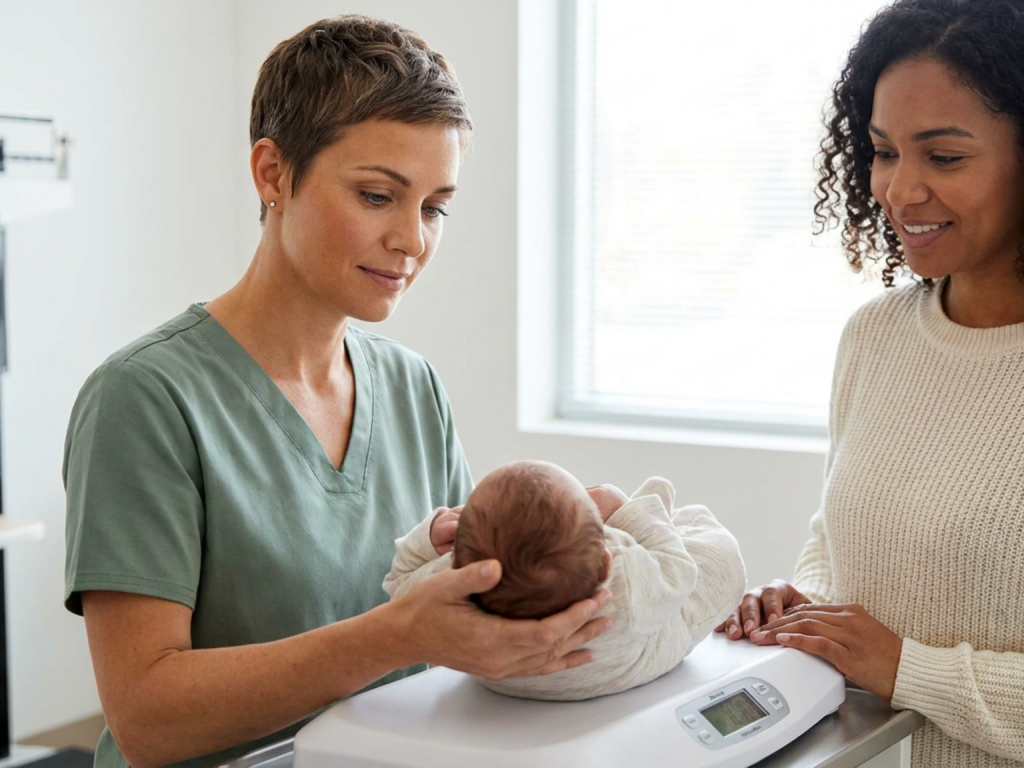
During routine visits, pediatric teams measure weight, length, and head circumference, then plot them on standardized charts. For babies under 2 years, recumbent length is used rather than standing height. Small measurement errors can shift percentiles, so trained technique matters. If a measurement seems inconsistent with the baby’s history or appearance, it may be repeated.
Clinicians look for growth trends across multiple visits. A baby who remains near the same percentile curve is often demonstrating expected growth, even if that curve is below or above the median. A baby who crosses several major percentile lines downward, has poor intake, or shows signs of systemic illness may need closer follow-up. Conversely, very rapid weight gain may prompt a review of feeding practices, medical history, and proportional growth, but it should not be interpreted in isolation.
Some visits may include a short-interval weight check if the baby is a newborn, was premature, has feeding difficulties, recently had an illness, or is being monitored after a concerning change. These checks are not a judgment on caregiving. They are a practical way to collect enough data to understand whether a baby is stabilizing, catching up, or needing additional support.
Feeding, solids, and weight changes
In the first months, breast milk or infant formula provides the baby’s nutrition. Around 6 months, many babies are developmentally ready for complementary foods around 6 months while continuing breast milk or formula. Starting solids is not usually meant to replace milk feeds immediately. Early foods add iron, texture practice, and exposure to new flavors, while milk remains an important calorie and nutrient source.
If weight gain is a concern, caregivers may feel tempted to force larger feeds, add cereal to bottles, change formula, or start solids early. These decisions should be discussed with a healthcare professional, because the safest approach depends on age, swallowing ability, medical history, and the reason for the growth concern. Responsive feeding, attention to hunger and fullness cues, and accurate preparation of formula when used are often more useful than trying to meet a rigid ounce target.
Useful information for a visit may include a newborn feeding and diaper log, frequency and duration of feeds, bottle volumes, vomiting or spit-up patterns, stool frequency, signs of discomfort, and any recent illness. This context helps clinicians distinguish normal variation from a feeding or medical issue that needs attention.
When to ask for medical guidance
It is always acceptable to ask your baby’s clinician to explain the growth chart. You do not need to wait until a problem is severe. Many concerns can be addressed with observation, feeding support, lactation consultation, or scheduled follow-up.
Seek prompt medical advice if your baby has fewer wet diapers than expected, persistent vomiting, repeated diarrhea, poor feeding, unusual sleepiness, fever in a young infant, signs of dehydration, breathing difficulty, or a sudden drop in weight. Also contact a clinician if your baby is not regaining birth weight as expected, has a major change in feeding behavior, or crosses downward through several percentile curves.
Caregivers often blame themselves when weight is discussed, but infant growth is biologically complex. A calm, data-informed approach is usually best: measure accurately, review feeding and symptoms, consider gestational age and medical history, and make a plan with the pediatric team. The goal is not to make every baby average; it is to help each baby grow safely along their own healthy trajectory.
Call a clinician promptly if
- Your baby has poor feeding, unusual lethargy, or is difficult to wake for feeds.
- There are signs of dehydration, such as markedly fewer wet diapers or a very dry mouth.
- Vomiting is persistent, green, bloody, forceful, or accompanied by a swollen abdomen.
- A young infant has fever, breathing difficulty, or appears acutely unwell.
- Weight drops suddenly or your baby is not regaining birth weight as expected.
Tools & Assistance
- Ask your pediatrician to plot weight on a sex-specific growth chart.
- Bring recent weights, feeding details, and diaper counts to baby checkups.
- Request lactation or feeding support if milk transfer or bottle intake is uncertain.
- Use corrected age for preterm babies when your clinician recommends it.
- Schedule a short-interval weight check if advised by your healthcare team.
FAQ
Is the 50th percentile the ideal baby weight?
No. The 50th percentile is the median of the reference population, not a goal. Many healthy babies grow consistently on lower or higher percentiles.
How often should my baby be weighed?
Routine well-baby visits usually include weight checks. Newborns, premature infants, or babies with feeding or growth concerns may need more frequent monitoring.
Should I worry if my baby is smaller than average?
Not automatically. A smaller baby may be healthy if growth is steady, feeding is adequate, and examination is reassuring. Ask your clinician to interpret the trend.
Can starting solids help a baby gain weight?
Sometimes nutrition planning includes complementary foods when age-appropriate, but solids should not be used as a quick fix without professional guidance, especially before developmental readiness.
Do breastfed babies and formula-fed babies gain weight differently?
They can have different growth patterns, particularly after the early months. Clinicians consider feeding method while still focusing on overall growth, hydration, and wellbeing.
Sources
- World Health Organization — Weight-for-age
- Centers for Disease Control and Prevention — Growth Charts
- Medical News Today — Average baby weight: Charts and development
Disclaimer
This article is for general educational purposes and is not a diagnosis or treatment plan. Always consult a pediatrician or qualified healthcare professional about concerns with your baby’s growth, feeding, or health.

















Please log in to leave a comment.