
Intro
At 2 months, your baby is still very young, but their nervous system is rapidly organizing. Many babies are becoming more alert, making brief eye contact, reacting to familiar voices, and beginning to communicate through coos, facial expressions, and body movements. This stage can feel deeply rewarding and, at times, uncertain: small daily changes may be exciting, while feeding, sleep, crying, and comparison with other babies can raise understandable questions.
Milestones are best viewed as a developmental map, not a strict exam. A 2-month-old’s skills reflect brain maturation, sensory processing, muscle tone, temperament, feeding patterns, sleep, and medical history. If your baby was born preterm, clinicians often use corrected age for developmental expectations. When you have concerns, especially about feeding, alertness, movement symmetry, vision, hearing, or loss of skills, your pediatric clinician is the right partner for assessment and guidance.
Highlights
At 2 months, many babies start smiling responsively, watching faces, and calming briefly when spoken to or picked up.
Early communication often includes cooing, varied cries, and turning toward familiar sounds, although timing varies among healthy infants.
Motor development commonly includes smoother arm and leg movements, brief head lifting during tummy time, and hands opening more often.
Development is not a race; patterns, progression, and caregiver concerns matter more than one isolated missed behavior.
Seek medical advice promptly for poor feeding, marked lethargy, breathing difficulty, absent response to sound, or loss of previously acquired skills.
What 2-month development usually means
Two months is a transition point between the reflex-dominant newborn period and more socially engaged early infancy. Your baby’s cerebral cortex, brainstem systems, visual pathways, vestibular system, and motor circuits are maturing together. This is why development appears across several domains at once: a baby may look at your face, quiet to your voice, move their arms more smoothly, and then become tired very quickly.
A typical infant developmental milestones discussion at this age usually includes four broad categories: social-emotional behavior, language and communication, cognition, and movement. These categories overlap. For example, when your baby watches your face while you speak, they are practicing visual attention, auditory processing, emotional regulation, and early communication at the same time.
It is also normal for skills to appear inconsistently at first. A baby may smile one day and seem less interactive the next, especially if hungry, overstimulated, gassy, sleepy, or recovering from a busy day. Clinicians look for trends over time, not perfect performance on demand.
Social and emotional milestones
One of the most memorable 2-month milestones is the emerging social smile. Unlike earlier reflexive smiles that may occur during sleep or after feeding, a social smile is often triggered by a caregiver’s face, voice, or gentle interaction. This is an early sign of social reciprocity: your baby is beginning to participate in a back-and-forth relationship.
Many 2-month-old babies also look at faces more deliberately. They may watch you as you move, become calmer when you speak, or show excitement through widening eyes, small body movements, or a change in breathing rhythm. Some babies briefly soothe when picked up or spoken to, although they still need substantial help with regulation.
Crying remains a normal communication tool. At this age, babies cry because of hunger, fatigue, discomfort, overstimulation, gas, temperature changes, or the need for closeness. Persistent crying can be exhausting for caregivers and does not mean you are failing. If crying is intense, accompanied by fever, poor feeding, vomiting, abnormal breathing, or a change in responsiveness, contact a healthcare professional.
Communication, hearing, and early language
At 2 months, early language development is mostly pre-verbal. Your baby may coo, make vowel-like sounds, gurgle, or produce soft vocalizations during calm alert periods. They may also turn their head or shift attention toward voices, especially familiar ones. These early sounds are not words, but they are part of the developing communication system.
Caregivers can support communication by speaking slowly, narrating everyday care, pausing as if waiting for a reply, and responding warmly to coos or facial expressions. This kind of responsive interaction helps babies learn that sounds and expressions have social meaning.
Hearing is important for language development. A baby who does not startle to loud sounds, does not seem to notice voices, or had risk factors such as neonatal intensive care, congenital infection, or family history of childhood hearing loss should be discussed with a clinician. Newborn hearing screening is valuable, but ongoing observation still matters.
Vision, attention, and cognitive growth
At 2 months, babies are becoming better at focusing on nearby faces and high-contrast objects. They may follow a moving person or object briefly with their eyes, especially within a close range. Visual tracking can be uneven because eye muscles and brain pathways are still maturing, but attention to faces is a meaningful early cognitive and social behavior.
Cognition at this age is not about problem-solving in the older-child sense. It is about alertness, sensory integration, memory for familiar voices and routines, and early cause-and-effect learning. When your baby calms during a familiar feeding routine or becomes alert when hearing your voice, their brain is connecting sensory input with emotional safety.
Short, frequent interactions are usually better than long sessions. A 2-month-old can become overstimulated quickly. Turning away, yawning, hiccupping, arching, finger splaying, fussing, or staring off may be signs that your baby needs a pause.
Movement and physical development
Physical development at 2 months includes gradual improvement in head control, posture, and limb movement. During supervised tummy time, many babies can lift their head briefly or turn it from side to side. Their arms and legs may move more smoothly than in the newborn period, although movements are still variable and sometimes jerky.
Hands may begin to open more often, and babies may bring their hands toward their mouth. Primitive reflexes, such as the Moro reflex, are still present but should gradually become less dominant over the coming months. Muscle tone should generally feel balanced: not persistently floppy and not extremely stiff.
Place your baby on their tummy only while awake and supervised. Start with short sessions, even one to three minutes at a time, and build gradually based on tolerance. Chest-to-chest tummy time, a firm play mat, or placing a toy or caregiver’s face within view can make the experience more comfortable. Always place babies on their back for sleep, following safe sleep guidance.
Feeding, sleep, and daily rhythms
Feeding and sleep strongly influence how a 2-month-old appears developmentally. A hungry, sleepy, reflux-prone, or overstimulated baby may show fewer social behaviors during a particular moment. Many babies still feed frequently, including overnight, and sleep patterns remain immature. Longer stretches may begin for some infants, but frequent waking can still be normal.
Whether your baby is breastfed, formula-fed, or both, adequate intake is assessed through growth patterns, wet diapers, stooling pattern, feeding comfort, and clinical evaluation. If feeding is persistently painful, inefficient, associated with choking, cyanosis, poor weight gain, repeated forceful vomiting, or dehydration signs, seek medical advice.
Screen time is not recommended for babies this young, except for video chatting with supportive interaction if families choose. Human faces, voices, touch, safe floor time for infants, and predictable caregiving routines are more developmentally useful than passive media.
How caregivers can support development
You do not need expensive toys or a rigid schedule. The most powerful developmental tools at 2 months are safe care, responsive interaction, and repeated everyday experiences. Talk during diaper changes, make gentle eye contact, sing, offer brief tummy time, and let your baby rest when they show fatigue cues.
Helpful activities include:
- Hold your baby face-to-face and wait for small responses such as eye contact, cooing, or mouth movements.
- Offer supervised tummy time several times daily while your baby is awake.
- Move a high-contrast toy slowly from side to side within your baby’s visual range.
- Respond to cries consistently; this supports attachment and does not spoil a young infant.
- Vary positions during awake time, including holding, side-lying play while supervised, and safe floor play for babies.
If you are overwhelmed, place your baby safely on their back in a crib or bassinet and take a brief pause. Caregiver regulation is part of infant safety. Ask for help from a trusted person or healthcare professional if crying, sleep deprivation, anxiety, or sadness feels unmanageable.
Variation, screening, and when to ask for help
Developmental variation is common. Some babies are highly social early, while others are quieter observers. Some tolerate tummy time easily; others protest until their neck and shoulder strength improves. A Normal baby development timeline can help provide context, but it should not replace individualized clinical judgment.
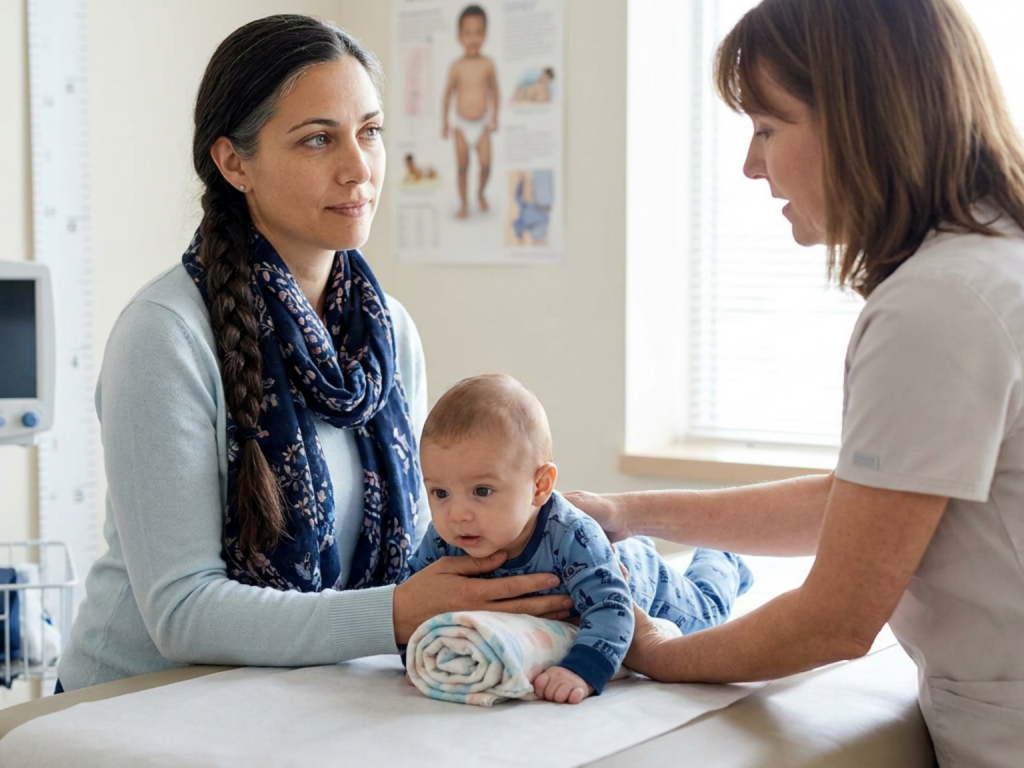
During well-child visits, clinicians monitor growth, feeding, physical examination findings, neurologic tone, reflexes, vision and hearing concerns, and developmental progression. Pediatric developmental screening may involve structured questionnaires at specific ages, but caregiver observations are valuable at every visit.
Contact your baby’s healthcare professional if you notice persistent concerns rather than waiting for the next routine appointment. Early evaluation does not mean something is seriously wrong; it means you are using support appropriately. If intervention is needed, earlier services often provide more opportunity to support feeding, movement, communication, and family confidence.
Call a clinician promptly if you notice
- Poor feeding, fewer wet diapers, repeated forceful vomiting, or signs of dehydration.
- Fever, breathing difficulty, blue color around lips, extreme sleepiness, or unusual limpness.
- No response to loud sounds or little visual attention to faces by around 2 months.
- Persistent stiffness, marked floppiness, or one-sided movement that does not improve.
- Loss of previously acquired skills or a sudden major change in alertness or behavior.
- Caregiver exhaustion, thoughts of harming yourself or the baby, or feeling unable to cope safely.
Tools & Assistance
- Write down questions before the 2-month well-child visit.
- Track feeding, wet diapers, sleep, and crying patterns if concerns arise.
- Use short daily supervised tummy time sessions while your baby is awake.
- Ask your pediatric clinician about developmental screening if you are worried.
- Contact urgent medical services for breathing trouble, blue color, severe lethargy, or emergency concerns.
FAQ
Should every baby smile by exactly 2 months?
Many babies begin social smiling around this age, but timing varies. If your baby rarely looks at faces, never smiles responsively by the next visits, or you feel concerned, discuss it with a pediatric clinician.
How much tummy time should a 2-month-old do?
Start with brief, supervised sessions while awake and increase gradually as tolerated. Frequent short sessions are often more successful than one long session.
Is it normal for a 2-month-old to still wake often at night?
Yes. Sleep regulation is immature, and many babies still need frequent feeding or soothing. Ask a clinician if sleepiness interferes with feeding or your baby is unusually difficult to wake.
What if my baby was born early?
For preterm infants, clinicians often use corrected age when interpreting milestones. Your pediatric or neonatal follow-up team can explain which expectations fit your baby.
Can I compare my baby with milestone checklists?
Checklists are helpful for noticing patterns, but they are not diagnostic. Use them to guide questions for your healthcare professional rather than to label your baby.
Sources
- Centers for Disease Control and Prevention — Milestones by 2 Months | Learn the Signs. Act Early.
- Cleveland Clinic — Baby Developmental Milestones By Month
- Raising Children Network — Baby development at 2-3 months
Disclaimer
This article is for general educational purposes only and is not a diagnosis or treatment plan. Always consult a qualified healthcare professional about concerns regarding your baby’s feeding, growth, development, or urgent symptoms.

















Please log in to leave a comment.