
Intro
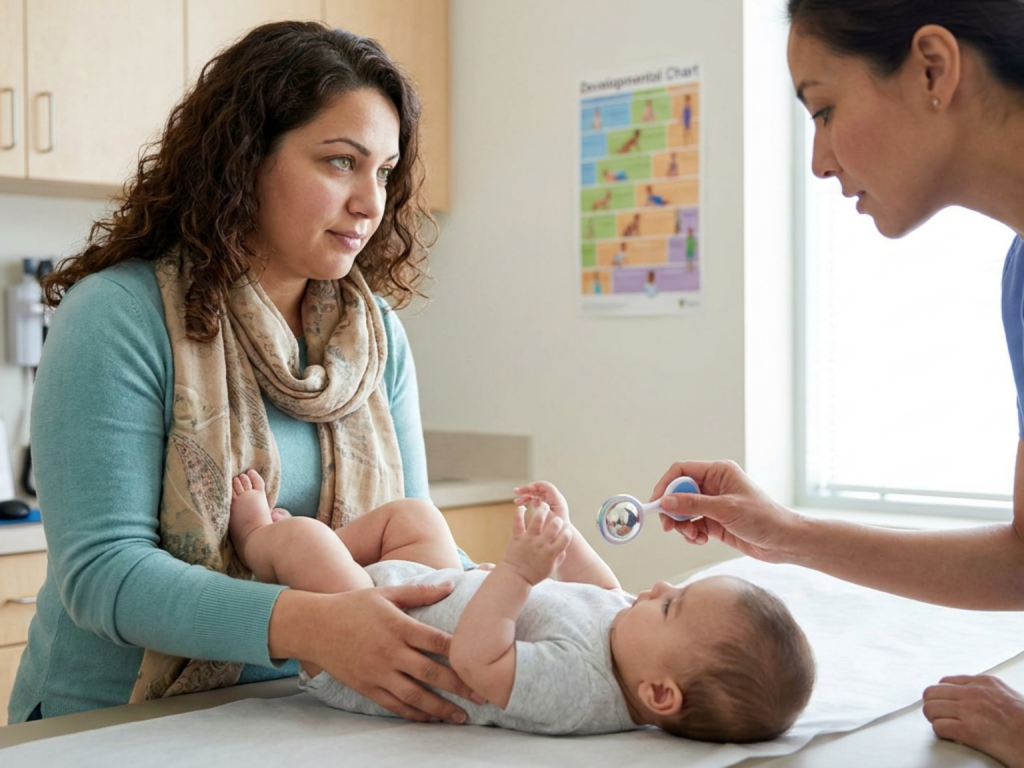
Watching a baby grow is joyful, fascinating, and sometimes anxiety-provoking. Development is not a race: healthy babies acquire skills across a range of ages, and temporary variation is common. A normal baby development timeline is best understood as a set of expected patterns in motor, language, cognitive, social, and sensory development rather than a strict checklist that every infant must follow exactly.
This guide summarizes typical milestones from birth through 12 months, with medically oriented explanations of what caregivers and clinicians often monitor. It is not meant to diagnose delays. If a baby loses a skill, seems unusually floppy or stiff, has feeding or breathing concerns, or is not meeting several expected milestones, a pediatric clinician or early intervention specialist can provide individualized assessment and support.
Highlights
Development usually progresses from head control to trunk stability, then to sitting, crawling or other mobility, pulling to stand, and early walking.
Social communication begins early: eye contact, calming to familiar voices, smiling, babbling, gestures, and shared attention all matter.
Milestones have normal ranges. A single late skill may be less concerning than a pattern of delays, regression, or abnormal muscle tone.
Caregivers can support development through responsive interaction, tummy time while awake, safe sleep habits for newborns, reading, singing, and play.
Trust your observations. Parents often notice subtle changes first, and timely consultation can reduce worry or connect a baby with helpful services.
How to read a baby development timeline
A milestone is a skill that many children can do by a certain age, such as smiling responsively, rolling, sitting, babbling, or using gestures. Milestones are population-based markers, not a guarantee that every baby will perform a skill on the exact day or month listed. Clinicians look at the whole developmental picture: quality of movement, symmetry, social engagement, feeding, hearing and vision responses, caregiver concerns, medical history, and whether skills are emerging over time.
Development is often described in domains. Gross motor skills involve large muscles, posture, head control, rolling, sitting, crawling, standing, and walking. Fine motor skills include hand opening, reaching, grasping, transferring objects, and using fingers. Language includes receptive skills, such as responding to voices, and expressive skills, such as cooing, babbling, and early words. Social-emotional and cognitive development include bonding, imitation, object exploration, problem-solving, and early joint attention.
Prematurity matters. For babies born early, clinicians often use corrected age, also called adjusted age, during the first years of life. For example, a 4-month-old born 8 weeks early may be expected to behave more like a 2-month-old in some areas. Medical conditions, prolonged hospitalization, sensory impairment, neuromuscular differences, and feeding difficulties can also change the pace of development, which is why individualized guidance is important.
Birth to 1 month: adaptation, reflexes, and early connection
The first month is a period of physiologic transition. Newborns sleep much of the day, wake frequently to feed, and communicate mainly through crying, facial expression, body movement, and subtle cues. Many caregivers find that a newborn schedule first month is less like a clock-based routine and more like a repeating pattern of feeding, sleeping, diaper changes, and observation.
Typical newborn findings include flexed posture, brief head lifting during tummy time, turning toward a cheek touch, grasping a finger reflexively, startling to sound, and focusing best on faces or objects held close. Newborns often recognize familiar voices and may calm with holding, feeding, gentle rocking, or skin-to-skin contact. They cannot self-regulate reliably, so responsive caregiving is not spoiling; it is neurologically supportive.
Important early observations include feeding effectiveness, wet and stool diaper patterns, weight trends, jaundice, temperature stability, and alertness. Newborn hunger and tiredness cues can be subtle: rooting, hand-to-mouth movements, sucking motions, grimacing, gaze aversion, yawning, and fussing may appear before intense crying. Caregivers should place babies on their backs for sleep, on a firm flat surface, and follow safe sleep guidance from their healthcare team.
1 to 3 months: head control, smiling, and cooing
Between 1 and 3 months, babies typically become more alert and socially responsive. Many begin to lift the head briefly while prone, move arms and legs more smoothly, bring hands toward the mouth, and visually track faces or high-contrast objects. Head control is still developing, so the neck and head need support during holding and transfers.
Social smiling often emerges around this period and is one of the most rewarding early milestones. Babies may quiet to a familiar voice, look toward caregivers, show pleasure during interaction, and make cooing or vowel-like sounds. These early vocalizations are building blocks for later speech and also reflect social engagement, hearing, and oral-motor coordination.
Tummy time while awake and supervised helps strengthen neck, shoulder, and trunk muscles. Short, frequent sessions are usually better tolerated than long sessions. Caregivers can place a baby chest-to-chest, across the lap, or on a safe floor surface while engaging with facial expressions and voice. If a baby consistently cannot lift the head at all, seems persistently very floppy or very stiff, feeds poorly, or does not respond to sound, prompt medical discussion is appropriate.
4 to 6 months: rolling, reaching, and early interaction
By 4 to 6 months, many babies show stronger head and trunk control. They may roll from tummy to back and later back to tummy, push up on forearms or hands, sit with support, and bear some weight through the legs when held upright. Rolling changes safety needs: babies should not be left unattended on beds, sofas, changing tables, or other elevated surfaces.
Fine motor and cognitive skills also expand. Babies commonly reach for toys, bring objects to the mouth, transfer items between hands near the later part of this period, and explore textures and sounds. Mouthing is a normal sensory-learning behavior, so small objects and choking hazards must be kept away.
Communication becomes more reciprocal. Babies may laugh, squeal, turn toward voices, respond to tone of voice, and produce more varied sounds. They often enjoy face-to-face play, songs, mirrors, and simple turn-taking routines. If solid foods are being considered around 6 months, readiness depends on developmental signs such as good head control, interest in food, and ability to sit with support; feeding decisions should be discussed with a pediatric clinician, especially for babies with prematurity, growth concerns, reflux, allergies, or swallowing issues.
7 to 9 months: sitting, mobility, and object permanence
From 7 to 9 months, many babies can sit without support, pivot while on the belly, move by rolling, creeping, crawling, or scooting, and begin pulling toward standing. Not every baby crawls in the classic hands-and-knees pattern; some use alternative mobility patterns and still develop normally. What matters is progressive strength, coordination, symmetry, and curiosity about moving through the environment.
Cognitive development becomes easier to see. Babies may search for a dropped object, enjoy peekaboo, bang objects together, inspect toys carefully, and understand that people and objects continue to exist when briefly out of sight. This developing object permanence can also contribute to separation distress, which is a normal attachment-related behavior.
Language often includes canonical babbling such as repeated consonant-vowel sounds. Babies may respond to their name, recognize familiar people, and use facial expressions, gestures, and vocalizations to communicate. Caregivers can support this by narrating daily routines, reading simple books, responding to babble as if it is conversation, and giving safe opportunities for floor play.
10 to 12 months: standing, gestures, and first words
Near the end of the first year, many babies pull to stand, cruise along furniture, lower themselves with improving control, and may take independent steps. Walking can occur before or after the first birthday and still be within a broad normal range. Good footwear is not usually needed for learning indoors; safe barefoot practice or flexible footwear may help sensory feedback, while outdoor surfaces require protection.
Fine motor skills become more precise. Babies often use a raking grasp first and then develop a pincer grasp, picking up small items between thumb and index finger. Because this creates new choking risks, meals and play areas require close supervision. Babies may put objects into containers, clap, wave, point, imitate simple actions, and use gestures to request or share attention.
Speech and understanding grow quickly. Some babies say meaningful words such as “mama” or “dada,” while others rely more on gestures and babble at 12 months. Receptive language is especially important: many babies understand simple routines, respond to “no” or their name, and look toward familiar objects or people when named. If a baby is not gesturing, not responding to sound, or seems socially disengaged, it is reasonable to ask for hearing evaluation and developmental screening.
What influences normal variation
Several factors can influence milestone timing without necessarily indicating disease. Temperament affects practice: a cautious baby may observe before moving, while an active baby may attempt mobility earlier. Opportunities matter too; supervised floor time supports motor exploration, while prolonged time in restrictive devices may reduce practice. Sleep, feeding, illness, and family routines can temporarily affect performance.
Biologic and medical factors are also relevant. Prematurity, low birth weight, neonatal intensive care, congenital conditions, visual or hearing impairment, recurrent infections, anemia, nutrition problems, and neurologic or musculoskeletal differences can alter developmental trajectories. A medically literate approach avoids both extremes: it does not panic over every variation, but it also does not dismiss persistent caregiver concern.
Culture and caregiving practices influence how skills appear. Some families emphasize early independent movement; others carry babies more often or use different play routines. The goal is not to force milestones but to create a safe, responsive environment where the baby can practice emerging abilities. Regular well-child visits are designed to combine growth measurements, physical examination, immunization review, developmental surveillance, and screening when indicated.
Supporting development at home
Everyday care is developmental care. Talking, singing, reading, cuddling, feeding responsively, and noticing cues all build neural connections. Babies learn through repeated, warm interactions; expensive toys are not required.
- Offer supervised tummy time while awake, increasing duration gradually as tolerated.
- Use responsive communication: pause, watch the baby’s face, imitate sounds, and answer babbles.
- Rotate safe toys with different textures, shapes, and sounds rather than overwhelming the baby.
- Read aloud daily, even if the baby only mouths the book or looks briefly at pictures.
- Provide safe floor space for rolling, reaching, pivoting, and crawling attempts.
- Protect sleep and feeding routines, because fatigue and hunger can make skills harder to practice.
Parents should also protect their own wellbeing. Exhaustion, postpartum mood symptoms, isolation, and feeding stress can make normal variation feel frightening. Asking for help is not a failure; it is part of a safe developmental environment for both baby and caregiver.
When to seek professional guidance
Developmental concerns deserve respectful attention. Contact a pediatric clinician promptly if a baby loses a previously acquired skill, has persistent feeding difficulty, poor weight gain, abnormal breathing, seizures, marked asymmetry, very stiff or very floppy muscle tone, or reduced responsiveness. Also seek advice if the baby does not respond to loud sounds, does not make eye contact or smile socially by the expected period, has no babbling later in infancy, or is not using gestures near the end of the first year.
Screening does not label a child unnecessarily; it helps identify who may benefit from hearing testing, vision assessment, physical therapy, occupational therapy, speech-language evaluation, or early intervention services. Early support can improve function and reduce family stress, even when the final explanation is benign variation.
If you are unsure, bring specific observations to the visit: what the baby can do, what seems difficult, whether skills are changing, and whether concerns occur all the time or only when tired, hungry, or ill. Short videos can be helpful for clinicians because babies do not always demonstrate skills during appointments.
Call a clinician urgently if
- Your baby has trouble breathing, blue color around the lips, seizures, or extreme lethargy.
- Your baby feeds poorly, has signs of dehydration, or is not gaining weight as expected.
- Your baby loses a skill they previously had, such as smiling, rolling, babbling, or sitting.
- Your baby seems persistently very floppy, very stiff, or uses one side much less than the other.
- Your baby does not respond to sound, has poor visual engagement, or shows markedly reduced social interaction.
Tools & Assistance
- Keep a dated milestone note on your phone for well-child visits
- Record short videos of movements or behaviors that concern you
- Use pediatric well-child appointments for developmental surveillance and screening
- Ask about early intervention services if delays are suspected
- Discuss hearing, vision, feeding, and motor concerns with qualified healthcare professionals
FAQ
Is it normal if my baby skips crawling?
Some babies use rolling, scooting, or cruising instead of classic hands-and-knees crawling. Clinicians focus on overall strength, symmetry, coordination, and progression, so ask your pediatrician if mobility seems delayed or one-sided.
Should I worry if my baby reaches a milestone later than a friend’s baby?
Not necessarily. Milestones occur across a range, and comparison can create unnecessary worry. Persistent delays across several domains, regression, or caregiver concern should be discussed with a healthcare professional.
How does prematurity affect milestones?
Many clinicians use corrected age for premature infants, especially in the first two years. This means expectations are adjusted based on the baby’s due date rather than only the birth date.
Can I teach my baby to develop faster?
You cannot safely force neurologic readiness, but you can support development with responsive interaction, supervised tummy time, reading, singing, safe floor play, and appropriate medical follow-up.
When should a baby say first words?
Some babies use meaningful words near 12 months, while others rely more on gestures and babble. Receptive language, response to sound, gestures, and social engagement are also important to review with a clinician.
Sources
- Centers for Disease Control and Prevention — CDC's Developmental Milestones | Learn the Signs. Act Early.
- March of Dimes — Developmental milestones for baby
- Mayo Clinic — Infant development: Birth to 3 months
Disclaimer
This article is for informational purposes only and does not replace medical evaluation, diagnosis, or treatment. Always consult a pediatrician or qualified healthcare professional about concerns regarding your baby’s development.
















Please log in to leave a comment.