
Intro
Teaching self discipline children is less about making children obey instantly and more about helping them gradually build self-regulation: the ability to pause, manage impulses, tolerate frustration, and choose behavior that fits a goal or value. This skill develops over years, supported by maturation of executive functions such as inhibitory control, working memory, cognitive flexibility, and emotional regulation.
Parents often feel pressure to “get discipline right,” especially when a child melts down in public, refuses routines, or repeatedly breaks rules. A supportive approach starts with a reassuring truth: self-discipline is learned through repeated coaching, predictable boundaries, warm relationships, and developmentally realistic expectations. Effective discipline is guidance, not humiliation or fear.
Highlights
Self-discipline is a developmental skill, not a fixed personality trait. Children need practice, modeling, and adult co-regulation before they can consistently regulate themselves.
Effective discipline as teaching uses clear expectations, consistent consequences, praise, and safety-focused limits rather than harsh punishment.
A child’s age, temperament, sleep, neurodevelopment, stress level, and family context all affect self-control. When behavior is extreme or impairing, professional support can be helpful.
Parents can reduce conflict by designing environments that make self-control easier: fewer temptations, predictable routines, reminders, and chances to repair mistakes.
Understanding self-discipline as a developmental skill
Self-discipline is the child’s growing capacity to control impulses, delay gratification, follow rules, persist with tasks, and recover after emotional activation. In medical and developmental terms, it overlaps with executive function, affect regulation, and behavioral inhibition. These capacities depend on brain networks that continue developing into young adulthood, especially prefrontal systems involved in planning and impulse control.
This is why a three-year-old who grabs a toy, a seven-year-old who argues about homework, and a teenager who stays up too late are not simply “bad” or “lazy.” They are at different stages of learning how to connect choices with consequences. Discipline that teaches self-regulation gives the child repeated, structured opportunities to practice a better response.
Effective discipline is best understood as instruction. It helps children know what is expected, why the rule matters, what happens if the rule is ignored, and how to try again. The goal is not perfect compliance; the goal is internalized self-control over time.
Start with connection, then add structure
Children are more likely to learn from adults who feel safe, predictable, and emotionally available. Warmth does not mean permissiveness. In fact, many children regulate best when caregivers combine warmth with clear expectations. This balance is sometimes called authoritative parenting: responsive, firm, and respectful.
Before correcting behavior, it often helps to connect briefly: get near the child, use a calm voice, name the problem, and state the limit. For example: “You are angry that screen time is over. I will not let you throw the tablet. It goes on the counter now.” This approach validates the emotion without allowing unsafe behavior.
Structure works best when rules are few, concrete, and consistently enforced. Instead of a long list of prohibitions, focus on core family rules such as safety, respect, honesty, and completing basic responsibilities. Young children especially need rules they can see and practice: “Hands are for helping,” “Feet stay on the floor,” or “Toys go in the bin before dinner.”
Use consequences that teach rather than punish
Consequences are most useful when they are immediate, proportionate, predictable, and related to the behavior. The purpose is to teach cause and effect, not to make a child feel ashamed. For example, if a child throws blocks, the blocks are put away for a short period. If a teenager misses an agreed curfew, a temporary change in privileges may be reasonable while trust is rebuilt.
Logical consequences for children should be explained calmly and followed through consistently. Repeated warnings without action can train children to ignore limits. On the other hand, severe or unpredictable consequences can increase anxiety, resentment, and oppositional behavior.
Consequences are only one part of discipline. Children also need instruction in the replacement behavior: “When you want a turn, say, ‘Can I have it next?’” or “When you are too frustrated to keep studying, take a five-minute break and then restart.” Repair is also powerful. A child who hurt someone can help fix the harm through apology, cleanup, replacement, or a kind action, depending on age and situation.
Praise the behavior you want to grow
Self-discipline strengthens when children notice that effort and restraint are valued. Praise should be specific and linked to the behavior: “You stopped yourself before grabbing. That was self-control,” or “You started your homework before the reminder. That shows responsibility.” Specific praise is more instructive than general approval because it tells the child exactly what to repeat.
For some children, small rewards can help establish a new habit, especially when the task requires repeated effort, such as morning routines, toileting steps, reading practice, or managing screen transitions. Rewards do not need to be expensive. Extra reading time, choosing a game, earning points toward an activity, or special one-on-one time can be meaningful.
Rewards work best when they reinforce a skill, not when they become bribes during a conflict. A bribe is offered in the heat of the moment to stop behavior immediately. A planned reinforcement system is explained in advance, tied to a clear goal, and paired with coaching.
Make self-control easier by changing the environment
Adults sometimes expect children to resist temptations that would challenge many adults. Environmental design reduces unnecessary battles. If a child struggles with snacks before dinner, keep snacks out of sight. If homework is derailed by a tablet, charge devices outside the study area. If mornings are chaotic, lay out clothes and pack bags the night before.
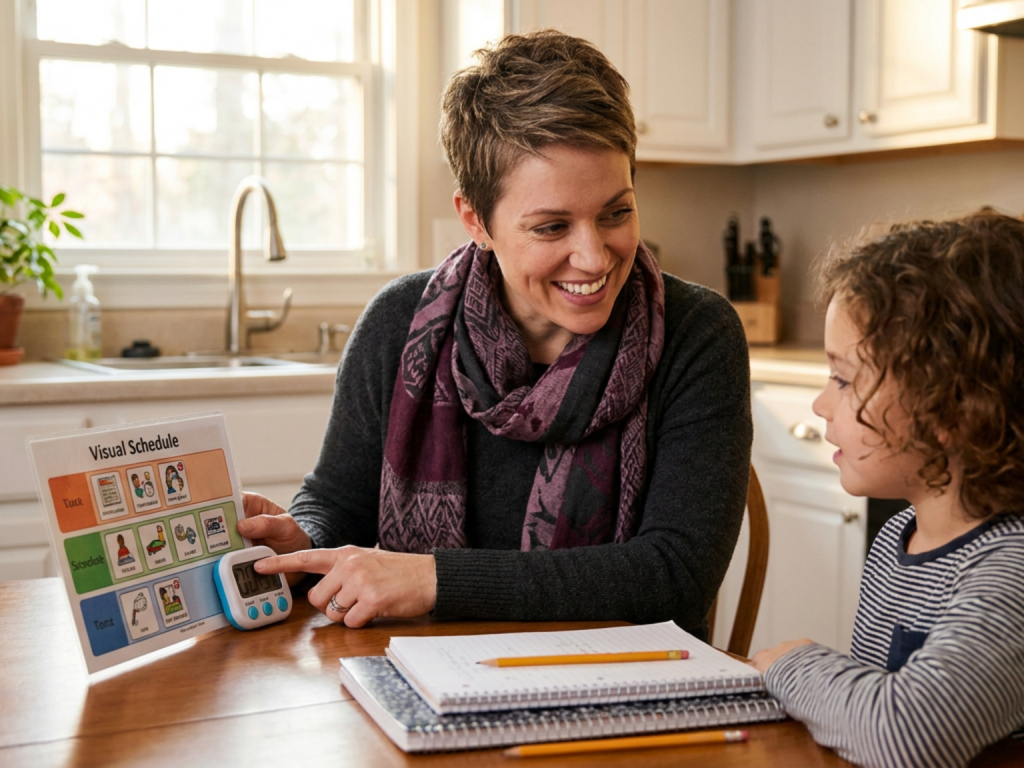
Research-informed parenting advice often emphasizes that self-control improves when children are not constantly forced to rely on willpower. Timely reminders, visual schedules, timers, and clear transition warnings can support working memory and reduce emotional escalation. A child who hears “Five minutes until cleanup, then bath” has more time to adjust than a child who is abruptly told to stop.
Planning skills are part of self-discipline. Teach children to break tasks into steps: “What do you need first?” “How long do you think it will take?” “What might distract you?” These questions build metacognition, the ability to think about one’s own thinking and behavior.
Teach calming skills before the crisis
Children cannot learn complex problem-solving when their nervous system is highly activated. During a tantrum, panic, or rage episode, the priority is safety and co-regulation: reducing stimulation, using few words, and helping the child return to baseline. Teaching works better later, when the child is calm.
Practice calming skills during neutral moments. Options include slow breathing, counting, squeezing a stress ball, drawing, taking space, asking for help, or using a simple phrase such as “I need a break.” Younger children may need a parent nearby to guide them. Older children and adolescents may prefer privacy, music, movement, or journaling.
Time-outs can be useful for some young children when used as a brief, calm break from reinforcement, not as isolation or rejection. Time-ins, where the parent stays close while helping the child calm, may be better for children who become frightened or dysregulated when separated. The best strategy depends on the child’s age, temperament, developmental profile, and safety needs.
Age-appropriate approaches from toddlers to teens
Developmentally realistic expectations prevent unnecessary conflict. Toddlers have limited impulse control and need simple rules, close supervision, redirection, and immediate consequences. Preschoolers can begin learning waiting, turn-taking, and naming emotions, but still need frequent reminders.
School-age children can understand routines, family rules, restitution, and delayed rewards. They benefit from charts, checklists, practice scenarios, and consistent follow-through. This is also a good stage to involve them in problem-solving: “Homework has been starting too late. What plan should we try this week?”
Adolescents need more autonomy, but not an absence of limits. Self-discipline in teens often includes sleep hygiene, digital boundaries, school responsibilities, driving safety, substance-risk discussions, and peer pressure. Privileges can be linked to demonstrated responsibility. The tone matters: collaboration is usually more effective than control battles.
Model the self-discipline you want children to learn
Children learn self-control partly by watching how adults handle frustration, conflict, fatigue, and mistakes. A parent who says, “I am getting upset, so I am going to take a breath before I answer,” is making emotional regulation visible. This is not weakness; it is teaching.
Repair also matters. Every parent loses patience sometimes. Returning to say, “I yelled earlier. That was not the way I wanted to handle it. I’m sorry, and I will try again,” teaches accountability without shame. It also shows children that mistakes can be repaired.
Parents under chronic stress, sleep deprivation, financial pressure, grief, relationship conflict, or single-caregiver strain may find consistent discipline much harder. That does not mean they are failing. Parental stress and child discipline are closely connected, and seeking professional support for parenting stress can be a protective step for the whole family.
When behavior may need extra support
Variation in self-control is normal. However, consider consulting a pediatrician, child psychologist, licensed therapist, school counselor, or developmental specialist if behavior is severe, persistent, unsafe, or impairing daily life. Examples include aggression that causes injury, repeated school suspensions, extreme sleep disruption, marked anxiety, developmental regression, self-harm talk, or behavior that does not improve despite consistent strategies.
Medical, neurodevelopmental, and psychosocial factors can affect self-regulation, including sleep disorders, hearing or vision problems, learning disorders, attention-related difficulties, autism spectrum traits, anxiety, trauma exposure, mood symptoms, medication effects, and family stressors. This article cannot diagnose or prescribe treatment. A professional can help assess context, rule out contributing conditions, and tailor support.
Families should also seek urgent help if a child may harm themselves or others, is experiencing abuse, or is in immediate danger. In those situations, local emergency services or crisis resources are appropriate.
Cautions for parents
- Avoid physical punishment, humiliation, threats of abandonment, or discipline that causes fear rather than learning.
- Do not expect adult-level impulse control from young children; executive function develops gradually.
- Seek professional guidance if behavior is unsafe, escalating, or significantly impairing school, sleep, relationships, or family life.
- Consider medical and developmental contributors when self-control difficulties are persistent or extreme.
- If there is risk of self-harm, harm to others, abuse, or immediate danger, contact emergency or crisis services.
Tools & Assistance
- Create three to five clear family rules focused on safety, respect, and responsibility.
- Use visual routines, timers, and transition warnings for predictable daily structure.
- Practice calming skills when everyone is calm, not only during conflict.
- Track one target behavior at a time and praise specific effort toward self-control.
- Consult a pediatrician, child mental health professional, or school support team when concerns persist.
FAQ
At what age can children learn self-discipline?
Children begin learning the foundations in toddlerhood, but reliable self-discipline develops gradually through childhood and adolescence. Expectations should match the child’s developmental stage.
Is punishment necessary to teach self-control?
Children need limits and consequences, but effective discipline is guidance rather than harsh punishment. Consequences should be calm, consistent, proportionate, and connected to the behavior.
What if my child only behaves when rewards are offered?
Planned rewards can help build new habits, but they should be paired with skill-building, praise, and gradually increasing internal motivation. Avoid offering rewards only during a meltdown.
How can I teach self-discipline without constant arguing?
Use fewer rules, give clear choices, follow through calmly, and discuss problem-solving when the child is calm. Predictable routines and environmental changes can reduce repeated power struggles.
When should I get professional help?
Seek support if behavior is dangerous, persistent, developmentally concerning, or interfering with school, sleep, friendships, or family functioning. A healthcare or mental health professional can help evaluate contributing factors.
Sources
- National Institutes of Health / PubMed Central — Effective discipline for children
- Nemours KidsHealth — Teaching Your Child Self-Control
- Parenting Science — Teaching self-control: Evidence-based tips
Disclaimer
This article is for informational purposes only and is not a substitute for medical, developmental, or mental health advice. Consult a qualified healthcare professional for concerns about your child’s behavior, safety, or development.


















Please log in to leave a comment.