
Intro
Pregnancy often brings a new awareness of the environments we live, work, eat, breathe, and rest in. For many people, reading about pesticides, plastics, and endocrine-disrupting chemicals can feel alarming, especially because these exposures are common and not always easy to avoid. The goal is not to create guilt or a sense that everything is dangerous, but to help you understand where the evidence is strongest and which practical steps may reduce unnecessary exposure.
Endocrine-disrupting chemicals, often called EDCs, are substances that can interfere with hormonal signaling. Hormones guide ovulation, implantation, placental function, fetal organ development, metabolism, thyroid activity, and later lactation. Because pregnancy is a period of rapid endocrine and developmental change, clinicians and public health organizations view avoidable toxic exposures as an important prevention topic.
Highlights
Endocrine-disrupting chemicals may mimic, block, or alter the metabolism of hormones such as estrogen, androgens, thyroid hormones, and glucocorticoids.
Pesticides and plastic-related chemicals can reach people through food, water, dust, air, skin contact, and occupational exposure.
Risk is influenced by dose, timing, mixture effects, route of exposure, and individual factors such as pregnancy, underlying endocrine conditions, and workplace setting.
Practical exposure reduction is possible without aiming for perfection: food handling, ventilation, safer storage, and careful product choices can all help.
Anyone with high occupational exposure, poisoning symptoms, or concerns about pregnancy-specific risks should speak with a qualified healthcare professional or occupational health specialist.
Why hormone disruption matters in pregnancy
The endocrine system works through small, precisely timed chemical signals. During pregnancy, these signals coordinate corpus luteum support, placental hormone production, maternal insulin sensitivity, thyroid hormone availability, fetal growth, and differentiation of organs such as the brain and reproductive tract. A chemical does not need to be acutely poisonous to be biologically relevant; some concerns involve subtle changes in signaling at vulnerable developmental windows.
Endocrine-disrupting chemicals may act in several ways. Some bind to hormone receptors and imitate natural hormones. Others block receptors, alter hormone synthesis, change binding proteins, influence liver metabolism of hormones, or interfere with epigenetic regulation. Thyroid disruption is especially important in early pregnancy because fetal neurodevelopment depends partly on adequate maternal thyroid hormone before the fetal thyroid is fully functional.
It is also important to be medically balanced. Most individual exposures in daily life are low-level, and the effect of any single product may be difficult to measure in one person. However, public health concern arises because exposures are widespread, can occur in mixtures, and may affect large populations even when individual risk increments are modest.
Pesticides: routes of exposure and reproductive relevance
Pesticides include insecticides, herbicides, fungicides, rodenticides, and other agents designed to control living organisms. Their toxicology varies widely. Some are rapidly degraded; others persist in the environment. Exposure can occur through residues on food, contaminated drinking water, indoor pest control products, garden chemicals, agricultural drift, treated clothing, pet products, and occupational handling.
The National Institute of Environmental Health Sciences notes that pesticide exposures have been associated with a range of health concerns, and that some pesticides can affect the nervous, reproductive, and endocrine systems. For pregnancy, the concern is not only maternal symptoms after a high exposure, but also potential effects on placental function, fetal development, and endocrine signaling. People who mix, spray, harvest, clean equipment, or live close to intensive agricultural use may have higher exposure than the general population.
Practical reduction strategies include washing produce under running water, peeling when appropriate, varying the diet to avoid repeated exposure to one residue source, following label instructions exactly for home pest products, and avoiding pesticide application during pregnancy when feasible. Integrated pest management can reduce reliance on chemical products by sealing entry points, removing standing water, storing food securely, and using targeted nonchemical methods first.
Plastics, BPA, phthalates, and chemical migration
Plastics are not chemically inert in every circumstance. Additives used to make plastics flexible, durable, flame-resistant, colorful, or heat-stable can migrate into food, dust, water, or air. Scientific reviews describe plastic waste and degradation as sources of hazardous compounds, including bisphenol A, phthalates, dioxins, furans, and heavy metals. These compounds can move through soil, air, water, and food chains.
Bisphenol A, known as BPA, has been used in polycarbonate plastics and epoxy resins, including some food and beverage can linings. It has estrogenic activity, meaning it can interact with pathways normally influenced by estrogen. Phthalates are used in some flexible plastics and fragranced products; several phthalates have been studied for anti-androgenic or reproductive effects. Not all plastics contain the same additives, and labels such as “BPA-free” do not automatically prove that every substitute chemical is risk-free.
Heat, acidity, fat content, aging, and repeated wear can increase migration of some chemicals from packaging or containers. Sensible steps include avoiding microwaving food in plastic unless the container is clearly intended for that use, letting hot foods cool before placing them in plastic, choosing glass or stainless steel for frequent hot food storage, avoiding heavily scratched plastic containers, and reducing reliance on highly packaged foods when practical.
Other environmental toxins that may interact with endocrine pathways
Environmental toxin exposure is broader than pesticides and plastics. Persistent organic pollutants, industrial solvents, flame retardants, per- and polyfluoroalkyl substances, heavy metals, and combustion byproducts can also be relevant depending on geography, diet, housing age, occupation, and local industry. Some compounds persist in body fat or the environment for long periods; others have short half-lives but frequent exposure can keep body levels measurable.
Lead, mercury, cadmium, and arsenic are not classic endocrine disruptors in the same way as receptor-binding chemicals, but they can affect neurologic development, placental physiology, kidney function, blood pressure, or oxidative stress pathways. Dioxins and furans may be generated through combustion and some industrial processes, and can enter food chains. Indoor dust can contain mixtures of plasticizers, flame retardants, pesticides, and particles from consumer products.
Pregnant people should not attempt unverified detox regimens, chelation, extreme diets, or supplement protocols without medical supervision. Some detox approaches are ineffective, and others can be dangerous in pregnancy. If there is a specific suspected exposure, testing and management should be guided by an obstetric clinician, occupational medicine specialist, toxicologist, or public health department.
Potential health concerns: what the evidence can and cannot say
Research on endocrine disruptors often combines laboratory studies, animal models, biomonitoring, occupational cohorts, and population studies. These methods can identify plausible mechanisms and associations, but they do not always prove that a specific exposure caused a specific outcome in an individual pregnancy. This distinction matters emotionally: people should not blame themselves for past exposures that were common, invisible, or outside their control.
Areas of scientific concern include fertility, time to pregnancy, semen parameters, ovarian function, miscarriage risk, fetal growth, preterm birth, congenital anomalies, thyroid function, neurodevelopment, metabolic programming, and later reproductive health. Some exposures may have sex-specific effects because androgen and estrogen pathways influence fetal reproductive tract development. Others may affect the placenta or maternal metabolism rather than acting directly on fetal tissues.
Mixture effects are particularly challenging. Real life does not involve one chemical at a time; people encounter multiple low-level exposures from food, water, air, personal care products, workplaces, and household dust. Timing also matters. A brief exposure during a key window may carry different implications from the same exposure outside that window. This is why prevention focuses on reducing avoidable exposures rather than achieving an impossible zero-exposure environment.
Food, water, and kitchen choices that can lower exposure
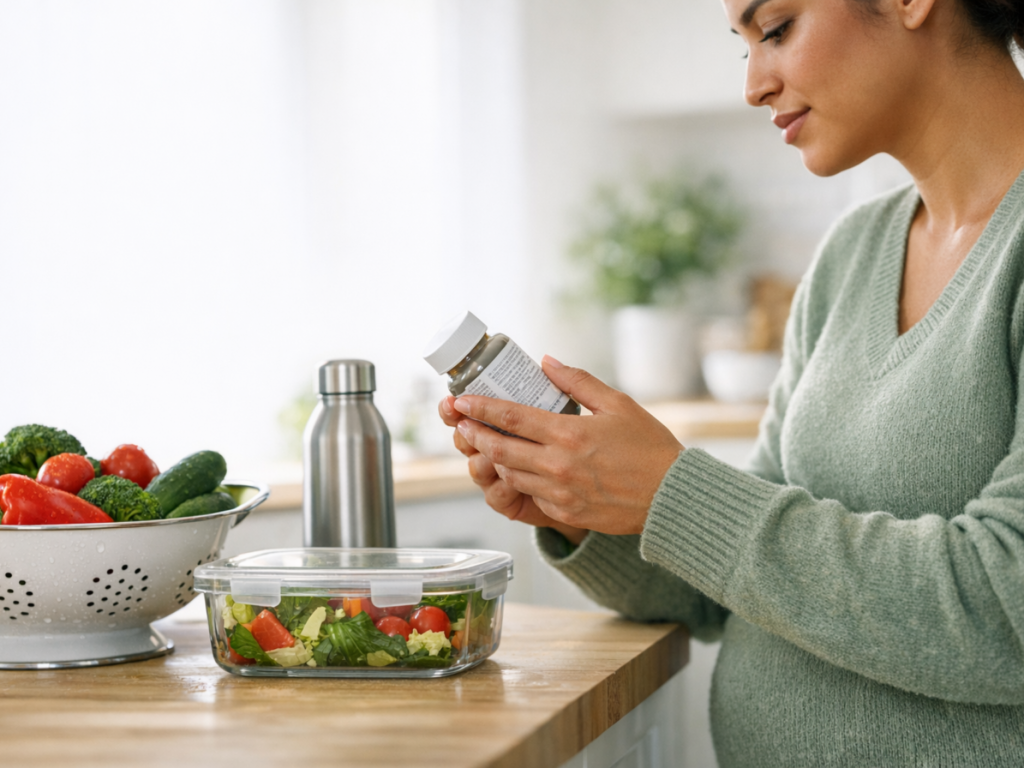
Nutrition during pregnancy should remain adequate, balanced, and enjoyable. Exposure reduction should not lead to overly restrictive eating. Fruits, vegetables, whole grains, proteins, and healthy fats provide benefits that usually outweigh concerns about trace residues. The aim is to reduce avoidable contamination while preserving dietary quality.
- Wash fruits and vegetables under running water; use a clean produce brush for firm skins.
- Peel outer leaves of leafy vegetables when they are visibly damaged or dirty.
- Vary produce choices rather than eating large amounts of one item every day.
- Use glass, ceramic, or stainless steel for hot food and beverages when possible.
- Avoid burning or charring foods frequently, since combustion byproducts may add chemical exposure.
- If water contamination is a local concern, ask your municipal supplier, health department, or clinician about appropriate testing and filtration rather than guessing.
Organic foods may reduce exposure to some synthetic pesticide residues, but they are not always accessible, affordable, or residue-free. If choosing between eating produce and avoiding produce due to cost or fear, eating washed produce is generally the healthier choice for most pregnant people.
Home, personal care, and indoor air
Indoor environments can concentrate exposures through dust, cleaning products, fragrances, pest treatments, paints, renovation materials, and plastics. Small changes can reduce contact with mixtures without turning daily life into a constant hazard assessment.
- Ventilate when cleaning, painting, using adhesives, or bringing new furnishings into the home.
- Choose fragrance-free products if scents trigger symptoms or if you want to reduce phthalate-containing fragrance mixtures.
- Wet-mop and use a vacuum with a high-efficiency filter if available, especially in homes with crawling children or heavy dust.
- Store pesticides, solvents, and fuels away from living spaces and never decant them into food or drink containers.
- Avoid smoking and secondhand smoke; combustion products are a major indoor air exposure concern.
Renovation in older housing deserves special caution because lead-based paint, asbestos-containing materials, and solvent exposure can be relevant. Pregnant people should avoid sanding old paint or participating in poorly ventilated renovation work unless hazards have been professionally assessed and controlled.
Workplace and high-exposure situations
Some people have higher exposures through agriculture, landscaping, manufacturing, laboratory work, nail salons, cleaning, painting, plastics production, waste management, pest control, healthcare sterilization, or industrial maintenance. Pregnancy does not automatically mean someone cannot work, but it may justify a confidential risk review and reasonable exposure controls.
Useful steps include requesting safety data sheets, reviewing ventilation and personal protective equipment, avoiding tasks with direct pesticide mixing or solvent exposure when possible, and speaking with occupational health services. In many settings, substitutions, closed systems, improved ventilation, task reassignment, or schedule modifications can substantially reduce exposure.
If an acute spill, inhalation event, skin contamination, or accidental ingestion occurs, follow workplace emergency procedures and seek medical guidance promptly. Bring the product label or safety data sheet if it can be obtained safely. Do not wait for symptoms if the exposure involved a highly toxic pesticide, solvent, heavy metal compound, or unknown industrial chemical.
When to seek urgent or specialized advice
- Call emergency services or poison control after accidental ingestion, major inhalation, or significant skin exposure to pesticides, solvents, or unknown chemicals.
- Seek prompt care for trouble breathing, chest tightness, confusion, seizures, fainting, severe vomiting, or heavy sweating after a suspected exposure.
- Contact your obstetric clinician if you have ongoing occupational exposure to pesticides, solvents, plastic manufacturing chemicals, heavy metals, or combustion byproducts.
- Do not start detox products, chelation, high-dose supplements, or restrictive diets in pregnancy without medical supervision.
- Ask for professional guidance if you live in older housing with peeling paint, recent renovation dust, or suspected contaminated drinking water.
Tools & Assistance
- Obstetrician or midwife consultation for pregnancy-specific exposure questions
- Poison control center or emergency department for acute chemical exposure
- Occupational medicine clinic for workplace pesticide, solvent, or plastic additive exposure
- Local public health department for water testing, lead hazards, or environmental contamination concerns
- Registered dietitian for balanced pregnancy nutrition while reducing avoidable contaminants
FAQ
Do I need to throw away all plastic containers during pregnancy?
Usually no. A practical approach is to avoid heating food in plastic, replace scratched containers, and use glass or stainless steel for frequent hot food storage when feasible.
Are all pesticides endocrine disruptors?
No. Pesticides are a broad group with different chemical structures and toxicities. Some have endocrine, reproductive, or neurologic concerns, while others have different risk profiles.
Is organic food necessary for a healthy pregnancy?
Organic food is optional and may reduce some pesticide residues, but it is not required. Eating a varied diet with washed fruits and vegetables is more important than avoiding produce because it is not organic.
Can one exposure harm my baby?
Risk depends on the chemical, dose, route, timing, and duration. Many everyday low-level exposures are unlikely to cause identifiable harm, but high or unusual exposures should be discussed with a clinician or poison control.
Should I get tested for endocrine-disrupting chemicals?
Routine testing is not usually helpful because many tests are not clinically interpretable for individual pregnancy care. Testing may be appropriate for specific exposures such as lead, mercury, or certain workplace hazards.
Sources
- World Health Organization — Endocrine-Disrupting Chemicals (EDCs)
- PubMed Central — Toxic threats from plastic waste: human health impacts, challenges, and sustainable mitigation strategies
- National Institute of Environmental Health Sciences — Pesticides and Human Health
Disclaimer
This article is for informational purposes only and does not replace medical care. For personal exposure concerns, pregnancy questions, or symptoms, consult a qualified healthcare professional or poison control service.
















Please log in to leave a comment.