
Intro
Emergencies can be frightening for children and adults alike. Preparation cannot remove every risk, but it can give children clear actions, familiar routines, and reassurance when normal plans change. The aim is not to alarm children or make them responsible for adult decisions; it is to help them know whom to trust, where to go, and how to communicate.
A useful plan covers the home, school, childcare, and other caregiving settings. It should also account for a child’s developmental stage, communication abilities, medications, medical equipment, and emotional needs. Review the plan regularly with the adults who may care for the child, and ask the child’s healthcare professionals for individualized guidance when medical complexity is involved.
Highlights
Use simple, calm language and focus on practical actions rather than frightening details.
Create one coordinated plan for home, school, childcare, and other caregivers, then review it at least yearly.
Teach children how and when to call emergency services, memorize key contact information, and practise these skills.
Keep child-specific supplies available, including medications, feeding supplies, comfort items, and backup power for essential equipment when applicable.
After an emergency, monitor emotional and physical wellbeing and seek professional support when concerns persist.
Start with calm, age-appropriate communication
Children often notice adult fear and uncertainty, even when conversations are not directed at them. Introduce preparedness as a normal family safety activity, similar to learning a home address or practising a fire escape route. Use concrete language: explain that an emergency is a situation in which people may need extra help or need to move to a safer place. Avoid graphic descriptions and avoid promising that nothing frightening will ever happen.
Adapt the explanation to developmental level. A preschool child may need only one or two instructions, such as staying with a trusted adult and moving away from danger. A school-age child can learn the family meeting place, the names of caregivers, and how to call emergency services. An adolescent can participate in planning, help check supplies, and learn how to communicate responsibly without being made the primary protector of younger siblings.
Invite questions and acknowledge feelings: “It makes sense to feel worried, and we have a plan to help us.” Children may ask the same questions repeatedly as they process information. Answer honestly, correct misinformation, and limit exposure to distressing media. If a child has a disability, developmental difference, sensory sensitivity, or communication limitation, involve the child in choosing signals, visual instructions, assistive tools, or other approaches that make the plan accessible.
Build one plan across home, school, and caregivers
Begin by identifying hazards that are reasonably likely in your area, such as severe weather, wildfire, flooding, earthquake, hazardous-material release, or a prolonged power interruption. The relevant plan may involve evacuation, sheltering indoors, or temporarily separating from caregivers. Follow local public-health and emergency-management instructions rather than relying on a generic response.
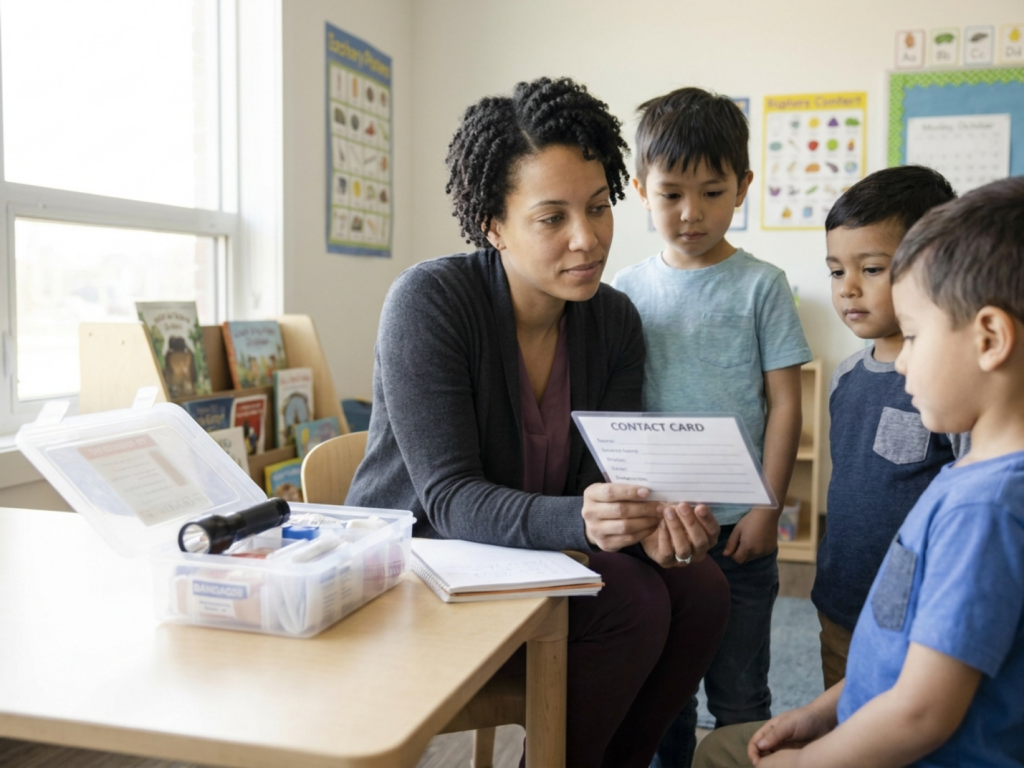
Write down how family members will communicate if telephone networks are busy or normal travel is interrupted. Choose an out-of-area contact when appropriate, identify two meeting places—one near the home and one outside the immediate neighborhood—and explain when each would be used. Prepare a family emergency contact card containing caregiver names, telephone numbers, the child’s address, school or childcare information, and key medical information. Children should know how to show the card to a trusted adult, but they should not be expected to share private information indiscriminately.
Coordinate the plan with schools, childcare providers, relatives, babysitters, and other regular caregivers. Confirm who is authorized to collect the child, how identity will be verified, and where the school’s reunification location is. Update telephone numbers, addresses, permissions, and emergency contacts whenever circumstances change. Review the plan at least yearly and after a move, a new school placement, a change in custody or caregiving, or a significant change in the child’s health.
For children with complex medical needs, the plan should identify responsible adults, essential equipment, medication schedules, communication needs, and the clinician or service that should be contacted for individualized advice. Discuss contingency arrangements with the child’s healthcare team rather than improvising changes to treatment during a crisis.
Assemble a child-focused emergency kit
Store supplies where adults can reach them quickly and consider a smaller portable kit for evacuation. The contents should reflect the child’s age, health, feeding method, mobility, communication, and comfort needs. Label supplies clearly and check them regularly for expiration, damage, size changes, and depleted batteries.
A child-focused kit may include water and shelf-stable food suitable for the child, diapers or continence supplies, wipes, clothing, blankets, hygiene products, a flashlight, batteries, a first-aid kit, copies of important documents, and a comfort item. Include books, simple activities, or familiar objects that can help reduce distress while waiting or travelling. Infants and young children may require formula, bottles, feeding accessories, and a safe way to prepare feeds according to professional guidance.
For prescription medicines, keep an up-to-date medication list with names, formulations, doses, schedules, allergies, and prescribing-clinician details. Ask the child’s healthcare professional or pharmacist how to maintain an appropriate emergency supply and how storage requirements apply during evacuation or power loss. Do not alter doses, substitute medicines, or use another person’s medication without professional direction.
Children who depend on powered medical equipment may need backup batteries, charging options, or other equipment-specific supplies. Ask the healthcare team and equipment provider about safe backup planning, temperature requirements, maintenance, and what to do if the device fails. If refrigeration is required for a medication or nutrition product, obtain individualized instructions before an emergency occurs.
Teach essential skills without assigning adult responsibility
Every child who is developmentally able should learn a few simple actions: recognize a trusted adult, move away from immediate danger, follow instructions, and tell an adult what happened. Teach the child their full name, the names of primary caregivers, and, when appropriate, their home address. Young children may learn this through songs, repetition, picture cards, or brief games.
Explain when to call 911 or the local emergency number: when someone is seriously hurt or very ill, when there is an immediate threat to safety, or when a dangerous event such as a fire requires urgent help. Teach the child to state the location first, describe what happened, answer the dispatcher’s questions, and stay on the line unless told to disconnect. Make clear that emergency services are not for games or routine questions. Practise calling emergency services using a pretend phone or a device that cannot accidentally place a call, and confirm the correct number for the country or region.
Role-play practical situations without creating frightening scenarios. Ask, “What would you do if you could not find me in a store?” or “Who could help you if you were at school?” Reinforce that a child should go to a trusted adult, uniformed responder, teacher, or designated staff member rather than searching alone. Children should never be expected to re-enter a dangerous area, provide medical treatment beyond their training, or manage an emergency independently.
Teach children to recognize official instructions and to avoid sharing unverified information online. Adolescents can learn how to communicate their location, conserve phone battery, support younger children with reassurance, and follow evacuation or shelter instructions while still relying on adults and emergency professionals for major decisions.
Practise likely scenarios and make the plan familiar
Practice converts abstract instructions into a sequence children can remember. Use age-appropriate emergency drills for children, keeping them brief and predictable. Explain the purpose before beginning, announce the start and end, and allow the child to stop if distress becomes overwhelming. The exercise should build confidence, not test obedience through surprise or fear.
Practise the routes and actions most relevant to your setting. This may include leaving the home by two possible routes, moving to a designated shelter area, identifying an accessible exit, contacting a caregiver, or going to a school reunification location. Include children in checking that adults know where supplies are stored and that contact information remains current. Do not practise actions that could expose a child to smoke, fire, contaminated water, traffic, unstable structures, or other hazards.
Plan for children who may sleep deeply, panic, freeze, wander, have limited mobility, use hearing or visual aids, or rely on a communication device. A caregiver may need to provide direct assistance, and the school or childcare setting may need an individualized emergency support plan. Discuss these needs with the relevant professionals and caregivers in advance.
Keep drills developmentally appropriate and repeat them periodically rather than conducting one dramatic exercise. Afterward, ask what felt easy or difficult and revise the plan. Praise specific behaviours, such as staying with the group or remembering a meeting place, while emphasizing that adults are responsible for overall safety.
Respond during the emergency and support recovery
During an emergency, use short instructions delivered in a calm voice. Give one action at a time, such as “Hold my hand,” “Move to this room,” or “Stay here until the teacher tells us what to do.” Keep the child with a responsible adult whenever possible. Follow instructions from emergency responders and local authorities about evacuation, sheltering, transportation, water, food, and returning home.
If family members become separated, use the communication and reunification plan rather than sending the child to search independently. Schools and childcare programs may have specific release procedures designed to protect children during a chaotic event. Bring identification and follow staff instructions, even when this takes longer than expected.
Afterward, children may show temporary changes in sleep, appetite, concentration, toileting, mood, or behaviour. They may become clingy, irritable, quiet, or unusually active. Re-establish routines when possible, offer accurate reassurance, and let the child talk, draw, or play without forcing a detailed conversation. Limit repeated exposure to distressing news and avoid presenting the child’s reactions as misbehaviour.
Seek advice from the child’s healthcare professional or a qualified mental-health professional if distress is severe, persists, interferes with daily functioning, or includes safety concerns. Obtain urgent help if the child has an immediate medical or psychiatric danger. Caregivers also need support: an adult who is overwhelmed may benefit from asking another trusted person to help with transportation, supervision, communication, or supplies.
Safety reminders
- Call 911 or the local emergency number for immediate danger or a life-threatening situation.
- Do not leave a young child alone during an evacuation, shelter-in-place event, or family separation.
- Do not change a child’s medication, feeding plan, or medical-device settings without appropriate professional guidance.
- Keep children away from fire, floodwater, damaged buildings, downed power lines, smoke, and unknown substances.
- Follow official instructions even if social-media reports or informal advice say something different.
Tools & Assistance
- A written family emergency contact card for each child
- A child emergency preparedness kit checked on a regular schedule
- A printed medication and medical-equipment information sheet
- A list of school, childcare, caregiver, healthcare, and local emergency contacts
- A calendar reminder for yearly plan review and age-appropriate practice
FAQ
How should I talk about emergencies with a child who is anxious?
Use brief, factual explanations, emphasize the adults and systems available to help, and practise only a few manageable actions at a time. Validate feelings and pause if the child becomes overwhelmed. A healthcare or mental-health professional can help tailor support when anxiety is persistent or disabling.
What should a child know before calling emergency services?
The child should know the local emergency number, how to identify the location, how to describe the immediate problem, and how to answer the dispatcher’s questions. Practise with a pretend phone so the child learns the sequence without making an accidental call.
How often should the family emergency plan be reviewed?
Review it at least once a year and whenever contact information, school or childcare arrangements, living circumstances, custody, or the child’s health needs change.
What supplies are especially important for a child with medical needs?
Plan for prescribed medicines, medical-device supplies, backup batteries when applicable, feeding or continence supplies, relevant records, and communication tools. Storage and backup requirements vary, so ask the child’s healthcare team and equipment provider for individualized instructions.
Sources
- Centers for Disease Control and Prevention — Before, During, and After an Emergency
- Centers for Disease Control and Prevention — Keeping Children Safe in Disasters
- Government of Canada — Prepare children for emergencies: Tips for parents and caregivers
Disclaimer
This article provides general educational information and does not replace individualized medical, emergency-management, or mental-health advice. Consult the child’s healthcare professionals and follow local emergency-service instructions.
















Please log in to leave a comment.