
Intro
Choking is a sudden obstruction of the airway by food or another object. Babies are particularly vulnerable because they are still developing the oral-motor coordination needed to move food safely, their airways are narrow, and they explore objects by putting them in their mouths. Prevention can feel overwhelming, but a consistent approach to feeding, supervision, and home safety can substantially reduce risk.
This guide explains common food and non-food hazards, safer preparation practices, supervision, and what to do in an emergency. It is intended for education and does not replace advice from a pediatrician, health visitor, pediatric feeding specialist, or emergency clinician.
Highlights
Food is a common choking risk for babies, particularly when it is hard, round, sticky, chewy, or difficult to break apart.
Small household objects, toy parts, coins, batteries, balloons, and older children's toys can obstruct an infant airway.
Babies should eat sitting upright and remain actively supervised throughout meals; supervision means watching and staying close enough to respond.
Coughing and gagging are different from silent choking, but any breathing difficulty, color change, or loss of responsiveness requires urgent action.
A caregiver who regularly looks at the environment from a baby's perspective can identify many hazards before they become accessible.
Why babies are vulnerable to choking
Choking occurs when food or an object blocks the airway and prevents normal airflow. In infancy, several developmental factors increase vulnerability. Babies have relatively small airways, limited chewing ability, and developing coordination between breathing, swallowing, and tongue movement. They may also lack the judgment to distinguish safe objects from dangerous ones. The hand-to-mouth behavior that supports sensory exploration therefore carries a potential airway risk.
Pediatric choking is a significant public health concern, and research describes it as an important cause of injury and death in young children. Although choking can occur at any age, prevention is especially important during infancy and the toddler years, when oral exploration and independent eating increase. Risk is not limited to babies who have teeth; teeth do not guarantee that a child can safely grind or manage every food texture.
Choking risk is different from food allergy, reflux, or ordinary swallowing difficulty. A child may have more than one concern, but a suspected airway obstruction is an emergency. Families should ask a healthcare professional about any recurrent coughing during meals, wet or gurgly breathing after swallowing, prolonged mealtimes, fatigue while eating, or difficulty progressing through textures. A pediatrician or pediatric feeding and swallowing specialist can assess whether additional support is needed.
What foods are choking risks
Many nutritious foods become hazardous when served in a shape, size, or texture that a baby cannot manage. Common examples include whole grapes, nuts, popcorn, raw firm vegetables, chunks of raw fruit, hard sweets, chewy meat, sausage or hot-dog rounds, and pieces of cheese that are firm and difficult to break down. Sticky foods, including thick spoonfuls of nut or seed butter, can adhere to the palate and obstruct swallowing. Foods with bones, pits, tough skins, or hard seeds also require careful preparation.
Round, cylindrical, and coin-shaped pieces deserve particular attention because they can form a seal in a small airway. A whole grape or a coin-shaped slice of a food may be more dangerous than the same food cut into a safer form. Hard foods may need cooking until soft; round foods generally need to be quartered lengthwise or otherwise prepared according to advice from a pediatric healthcare professional. Remove pits, bones, tough peels, and inedible pieces before serving.
Age recommendations on packaged foods are not a substitute for assessing an individual baby’s developmental readiness. Read labels, consider texture rather than marketing claims, and introduce foods in a form that can be mashed or broken easily between the fingers when appropriate. Because feeding skills vary, a pediatrician, health visitor, or feeding specialist can provide individualized advice about safe textures and portions.
Safe preparation and upright infant feeding position
Preparation changes the mechanical properties of food. Cook firm vegetables and fruit until they are soft enough to mash, shred or finely flake meat, and offer soft foods in appropriately sized pieces. Avoid giving a baby large clumps of sticky food or dense mixtures that are difficult to clear from the mouth. Closely inspect fish and meat for bones, and do not assume that a food is safe simply because it is homemade.
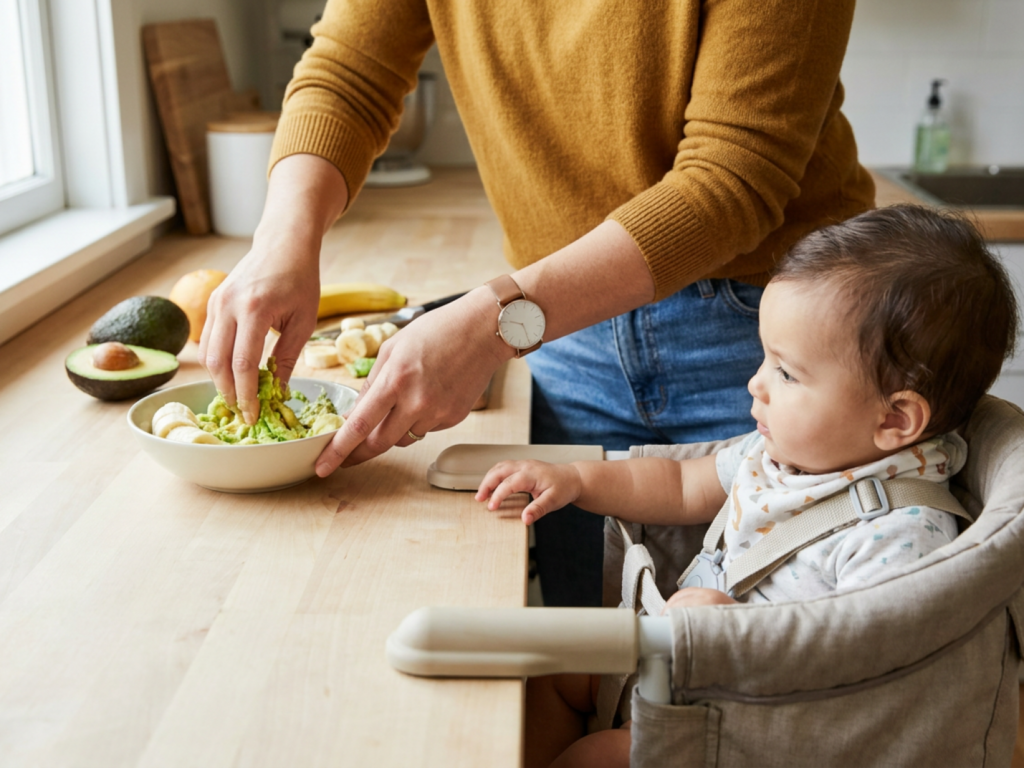
During eating, position the baby fully upright in a stable, well-supported high chair or feeding seat. The head and neck should be aligned, and the baby should not eat while lying down, reclining deeply, walking, crawling, or riding in a vehicle. Avoid feeding while a baby is distracted, crying intensely, laughing, or playing. Offer manageable amounts and allow the baby time to finish one mouthful before offering more. Do not force food into the mouth or attempt to hurry the meal.
Active supervision is essential. The supervising adult should remain within immediate reach, stay focused on the meal, and avoid relying on a screen or another task. Other children and pets should not be allowed to interfere with the feeding space. Learn infant choking first aid from a recognized provider, because written instructions cannot replace practical training and a calm, rehearsed response.
Common household choking hazards
Common household choking hazards include coins, buttons, pen caps, small batteries, beads, marbles, toy components, jewelry, detached parts of pacifiers, and fragments of balloons. Button batteries are especially dangerous because they can cause severe tissue injury if swallowed, in addition to creating an airway risk. Keep batteries secured inside devices and store spare batteries where children cannot access them. If a battery may have been swallowed, seek emergency medical advice immediately.
Inspect floors, low shelves, bags, bedside tables, and sofa gaps from the baby’s height. A crawling baby can reach farther than expected, and an older sibling’s toy may be appropriate for that child but unsafe for an infant. Follow toy age guidance, check for loose or broken pieces, and keep toys with small components in a separate area. Balloons and balloon fragments should never be available for babies to handle or chew.
Do not rely only on a closed door or a raised surface. Objects can be carried into the baby’s area, dropped during routine activities, or left in clothing and handbags. Establish a household habit of picking up small objects immediately, checking under furniture, and asking visitors to keep medications, coins, batteries, and personal items out of reach. These simple routines support broader choking prevention in shared living spaces.
Gagging, choking, and emergency response
Gagging is a protective reflex that may be noisy. A baby who is gagging may cough, retch, make sounds, or bring food forward while continuing to breathe. Choking may be quieter: the baby may be unable to cough or cry effectively, have difficulty breathing, make unusual or no sounds, become weak, or develop a blue or gray color around the lips or face. These signs require immediate attention.
If a baby is choking, use the infant choking first-aid procedure taught by an accredited emergency-care organization and direct someone to call local emergency services. If alone, follow local emergency guidance about calling and providing first aid. For a responsive infant under one year, standard first aid uses alternating back blows and chest thrusts; the exact technique and hand placement should be learned in person. Do not perform abdominal thrusts on an infant.
If the baby becomes unresponsive, place the baby on a firm, flat surface and begin infant cardiopulmonary resuscitation according to your training while emergency services are contacted. Do not put your fingers into the mouth unless you can clearly see and remove the object. Blind finger sweeps can push an obstruction deeper. After a choking episode, medical assessment may be appropriate even if the object appears to have been expelled, particularly if coughing, noisy breathing, swallowing difficulty, or behavior changes continue.
Building a practical prevention routine
Choking prevention works best as a routine shared by every caregiver. Before each meal, confirm that the baby is alert, seated upright, and not eating while moving. Prepare food deliberately, remove hard or inedible parts, and keep drinks and food within the adult’s control. During the meal, watch the baby’s breathing and swallowing rather than assuming quiet behavior means everything is safe.
At home, perform regular floor-level checks in every room where the baby spends time. Secure small items, use closed storage for batteries and other hazardous objects, and separate toys intended for older children. Ask grandparents, babysitters, childcare workers, and visitors to follow the same rules. Consistency matters because infants may encounter hazards in another room or home even when their usual environment is carefully prepared.
Speak with a healthcare professional if you are uncertain about readiness for solids, safe food textures, repeated gagging, coughing during meals, poor weight gain, or a history of choking. A pediatrician can consider developmental and medical factors and may refer the baby for a pediatric feeding assessment. Caregivers deserve support: learning the relevant first-aid skills and receiving individualized feeding guidance can reduce anxiety while preserving the baby’s opportunity to develop safe, enjoyable eating skills.
Seek emergency help immediately
- The baby cannot breathe, cry, or cough effectively.
- The baby becomes unresponsive, unusually weak, or changes color.
- A button battery may have been swallowed or is suspected to be lodged.
- Breathing remains noisy or difficult after an object was removed.
- Do not blindly sweep the mouth or use abdominal thrusts on an infant.
Tools & Assistance
- Infant choking and CPR course from a recognized first-aid organization
- Pediatrician or family doctor for individualized feeding guidance
- Health visitor or public health nurse for home-safety support
- Pediatric feeding and swallowing specialist for recurrent mealtime concerns
- Local emergency services or poison control service for urgent ingestion advice
FAQ
Can a baby choke on food even if the food is soft?
Yes. Soft foods can still be hazardous if they are sticky, dense, large, round, or difficult for the baby to control. Preparation, portion size, posture, developmental readiness, and supervision all matter.
Is gagging the same as choking?
No. Gagging is often noisy and may involve coughing or retching while the baby continues to breathe. Choking can prevent effective coughing or crying and may cause breathing difficulty or color change. Treat suspected airway obstruction as an emergency.
Are older children's toys safe around a baby if the baby is supervised?
They may not be. Small detachable parts can become accessible quickly, and active supervision does not eliminate the hazard. Keep toys with small components physically separated from the baby's play area.
When should a baby be assessed after choking?
Seek medical advice after a significant choking episode, especially if the baby had breathing difficulty, became unresponsive, needed rescue maneuvers, or continues to cough, wheeze, swallow poorly, or behave unusually.
Sources
- MedlinePlus — Choking - infant under 1 year: MedlinePlus Medical Encyclopedia
- National Health Service — Baby and toddler safety - NHS
- PubMed — Pediatric choking
Disclaimer
This article is for general health information and does not diagnose, treat, or replace advice from a qualified healthcare professional. In an emergency, contact local emergency services immediately.















Please log in to leave a comment.