
Intro
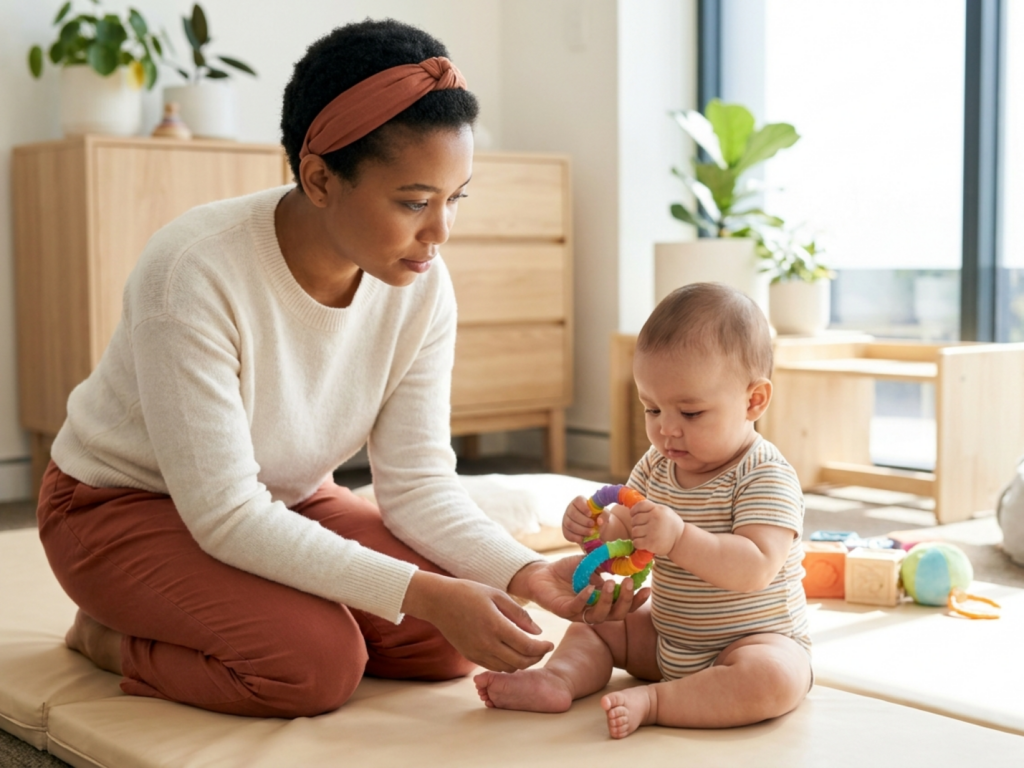
Moving an object from one hand to the other is a small but meaningful milestone in infant motor development. It requires a baby to notice an object, reach toward it, grasp it, stabilize the trunk and shoulder, and coordinate both hands while releasing and regrasping. The skill often becomes noticeable during the second half of the first year, although development is variable.
For many babies, hand-to-hand transfer emerges between approximately 6 and 9 months. Some infants show related forms of bilateral hand processing earlier, while others need more time and practice before the movement becomes consistent. Looking at the broader pattern of motor, sensory, and social development is more informative than focusing on one isolated performance.
Highlights
Many babies begin transferring toys between hands between 6 and 9 months.
The movement reflects visual-motor integration, grasp control, postural stability, and bilateral coordination.
A baby may transfer objects inconsistently at first, especially when tired, hungry, distracted, or holding a difficult shape.
Premature infants may need assessment according to corrected age, depending on clinical guidance.
Persistent asymmetry, loss of an acquired skill, or broader developmental concerns should be discussed with a healthcare professional.
What hand-to-hand transfer means
Hand-to-hand transfer occurs when a baby moves an object held in one hand into the other hand. The transfer may happen directly across the midline, or the baby may briefly bring the object to the mouth, chest, or lap before the opposite hand takes hold. Early attempts can look awkward: the infant may hold the object with both hands, drop it, rotate the wrist, or switch hands only after several seconds.
This action is more than a test of finger strength. It involves purposeful reaching and grasping, visual attention to the object, anticipatory postural adjustments, and the ability to coordinate the two sides of the body. The baby must maintain a grasp while the receiving hand approaches, then adjust pressure so the first hand can release without losing the object. These components develop gradually rather than appearing as a perfectly organized movement on a single day.
Hand-to-hand transfer also supports two-handed exploration. A baby can use one hand to stabilize a toy while the other pats, turns, squeezes, or examines it. These experiences contribute to bilateral coordination and help the infant learn about texture, shape, weight, sound, and cause and effect.
When does the milestone usually appear?
Clinically oriented milestone guidance commonly places transferring an object from one hand to the other in the 6- to 9-month period. This is a range, not a deadline. Around this stage, many infants are also developing more controlled reaching, stronger palmar grasp, improved sitting balance, and the ability to manipulate toys with increasing intention.
At first, a baby may transfer only lightweight, easy-to-hold objects such as a soft ring or broad teether. The movement may be more reliable when the toy is presented near the center of the body, where both hands can reach it. With maturation, the infant may retrieve an object from one side, bring it across the midline, and pass it deliberately to the opposite hand. The baby may then begin turning, banging, shaking, and inspecting the object after the transfer.
Research on infant object manipulation has described hand-to-hand transfer as part of manipulative exploration around 9 months, including in studies comparing preterm and full-term infants. The precise age of acquisition can differ because of posture, experience, object properties, temperament, and opportunities for floor-based play. A single missed transfer does not establish a problem.
Why the movement is neurologically interesting
Hand-to-hand transfer provides a window into the developing relationship between perception and action. The infant visually identifies a target, predicts where the receiving hand should move, and modifies grasp force according to the toy’s size and resistance. This is an example of visual-motor integration: sensory information guides a coordinated motor response.
The action also depends on communication between the two cerebral hemispheres and on networks involved in motor planning, proprioception, and postural control. Scientific work has shown that inter-manual transfer of object-related information can occur even in human neonates, before the corpus callosum is fully mature. That finding concerns transfer of texture and shape information rather than the later, observable milestone of passing a toy between hands. It is therefore useful background, but it should not be interpreted as evidence that a newborn is expected to perform mature toy transfer.
During later infancy, the behavior becomes increasingly purposeful and adaptable. A baby may transfer an object to free the preferred hand, make room to reach for another object, or use both hands together to investigate a toy. These variations are part of normal learning and do not require a caregiver to train the movement formally.
How prematurity and variation affect timing
Infants born preterm may acquire motor milestones according to a different timetable from infants born at term. Healthcare professionals often use corrected age for developmental assessment during the early months or years, depending on gestational age at birth and the child’s medical history. Corrected age is calculated by accounting for the weeks the infant was born before 40 weeks of gestation. Families should follow the approach recommended by their pediatric clinician or developmental team.
Timing can also vary among healthy full-term babies. A baby who is highly mobile may spend less time manipulating a single toy, while another infant may practice hand skills extensively. Differences in muscle tone, sitting stability, visual engagement, prior opportunities to play, and the shape or texture of available objects can affect what a caregiver observes.
Milestones are best interpreted as a pattern over time. Consider whether the baby is progressing in reaching, grasping, releasing, bringing objects to the mouth safely, using both hands, and interacting with people and surroundings. A range of abilities can be typical, but a lack of progression across several areas deserves attention, especially when paired with concerns about feeding, vision, alertness, or general movement.
How caregivers can support safe practice
Babies usually develop this skill through ordinary play rather than structured drills. Offer simple, washable objects that are large enough to avoid choking and easy to grasp. A soft block, large teething ring, textured cloth toy, or lightweight rattle can provide different sensory and motor experiences. Place one object within comfortable reach and allow the infant time to explore it without repeatedly repositioning the toy.
- Provide supervised floor play when the baby is awake and alert, with a stable surface and an adult nearby.
- Present toys near the midline or alternately on either side to invite reaching in both directions.
- Choose objects with varied textures, but inspect them regularly for tears, loose parts, or breakage.
- Let the baby mouth safe toys, while avoiding small items, detachable components, cords, and objects that can fit through a standard choking-test cylinder.
- Pause when the baby becomes frustrated, fatigued, overstimulated, or uninterested.
Caregivers can model the action slowly by moving a toy from one hand to the other, but imitation is not required. The goal is responsive interaction and exploration, not performance. Avoid pulling an object from the baby’s hand or forcing the receiving hand into position.
When to discuss the pattern with a professional
Variation in hand use is common in infancy, and many babies temporarily favor the hand closest to a toy. However, persistent movement asymmetry can be clinically relevant. Discuss concerns with a pediatrician, family physician, child health nurse, or pediatric occupational or physical therapist if a baby consistently uses one arm while rarely moving the other, keeps one hand fisted, appears unable to bear weight through one side, or shows a marked difference in reach, grasp, or release between hands.
Professional assessment is also appropriate if the baby is not making progress in several motor skills, seems unusually stiff or floppy, has persistent difficulty visually tracking objects, appears to have pain with movement, or loses a skill previously acquired. Developmental regression is different from ordinary day-to-day inconsistency and should be reported promptly.
These observations do not identify a diagnosis by themselves. A clinician may consider the infant’s corrected age, birth history, neurologic examination, vision and hearing, muscle tone, feeding, and overall developmental profile. Keeping brief notes or videos of natural play can help describe what happens at home, provided recording does not replace direct supervision.
Safety and medical cautions
- Do not offer small objects, loose parts, plastic bags, cords, or foods that pose a choking risk.
- Never leave a baby unattended with a toy, especially during mouthing or floor play.
- Persistent one-sided movement, unusual stiffness or floppiness, or loss of skills merits professional discussion.
- Do not use a milestone range to diagnose a developmental condition.
- Seek urgent care for choking, breathing difficulty, injury, or sudden neurologic change.
Tools & Assistance
- A clean, supervised floor-play area
- Large, age-appropriate graspable toys without detachable parts
- A developmental milestone record or caregiver observation log
- Routine assessment with a pediatric clinician or child health service
- Referral to pediatric occupational or physical therapy when clinically indicated
FAQ
At what age do babies usually pass toys between hands?
Many babies begin doing this between 6 and 9 months, although occasional attempts may appear earlier and consistent performance may emerge later. The overall developmental pattern matters more than one exact age.
Is it normal for my baby to drop the toy during transfer?
Yes. Releasing the first hand while securing the object with the second requires practice. Dropping, switching back and forth, or needing several attempts can be typical while coordination is developing.
Should a baby use both hands equally?
Not necessarily. Temporary preferences are common, particularly when an object is placed closer to one side. Consistent, marked avoidance or weakness of one arm should be discussed with a healthcare professional.
How should this milestone be considered in a premature baby?
Clinicians may use corrected age when interpreting early milestones, depending on the infant's history. Ask the baby's pediatric clinician which age framework is appropriate.
What if my baby stops transferring objects after learning to do it?
A true loss of an established skill should be reported to the baby's healthcare professional. A short period of inconsistency when tired or unwell is not the same as sustained regression.
Sources
- PubMed — Inter-manual transfer of object texture and shape in human neonates
- PubMed — Preterm infants' manipulative exploration of objects
- Children's Hospital of Richmond at VCU — Fine motor skills: birth to 2 years
Disclaimer
This article provides general educational information and does not diagnose, treat, or replace advice from a qualified healthcare professional. Contact your baby's clinician with concerns about development, safety, asymmetry, or loss of skills.














Please log in to leave a comment.