
Intro
Stranger anxiety can feel sudden and personal: a baby who smiled at everyone a few weeks ago may now bury their face, cry, stiffen, or reach urgently for a familiar caregiver. In most babies, this is not a sign that something has gone wrong. It is often a visible milestone in social, cognitive, and emotional maturation.
This article explains why stranger anxiety emerges, what it can look like, how it differs from other causes of crying or distress, and how caregivers can respond without forcing separation or avoiding all unfamiliar contact.
Highlights
Stranger anxiety is commonly seen in the second half of the first year, especially around the 7- to 9-month period.
A baby may cry, cling, hide their face, freeze, or watch silently when an unfamiliar person approaches.
This reaction reflects developing memory, attachment, threat appraisal, and social discrimination, not bad behavior or poor parenting.
Gentle, predictable introductions usually work better than sudden handoffs or pressuring a baby to perform socially.
Persistent loss of social skills, poor eye contact, or developmental regression should be discussed with a healthcare professional.
What stranger anxiety is
Stranger anxiety is an infant’s wary, avoidant, or distressed response to unfamiliar people. It may look like crying when someone new enters the room, turning away from a visiting relative, clinging tightly to a parent, refusing to be held by a babysitter, or watching a stranger with a still, serious expression. The term includes both obvious distress and quieter forms of behavioral inhibition.
Developmentally, stranger anxiety sits at the intersection of attachment, recognition memory, perceptual discrimination, and early emotional regulation. A younger infant may respond mainly to voice, touch, feeding, warmth, and general soothing. By the second half of the first year, many babies are better able to distinguish familiar caregivers from unfamiliar faces and to remember who usually provides comfort. That improved discrimination can make unfamiliar people feel uncertain.
This is why stranger anxiety is part of social development in babies rather than simply a problem to eliminate. It shows that the baby is forming expectations about familiar people and using caregivers as a secure base. The goal is not to make a baby fearless; it is to help the baby feel safe enough to explore new people gradually.
When it usually appears
Many babies show stranger anxiety during the 7- to 9-month window, although the timing varies. Some infants become wary a little earlier, some later, and some show only mild hesitation. Mayo Clinic describes wariness of strangers as a common feature of development in this age range, alongside advancing motor skills, improved hand-eye coordination, and evolving communication.
Research on infants’ reactions to an approaching stranger supports the idea that wary behavior changes across the second half of the first year. Importantly, these reactions are not always all-or-none crying. Some babies use subtler behaviors, such as looking away, pausing, moving closer to a caregiver, or monitoring the stranger before reengaging. In one classic description, wariness appeared to serve a coping function, helping infants avoid immediate overwhelm and sometimes allowing later reengagement.
The timing also makes practical sense. Around this age, babies often sit, crawl, reach, babble, play peekaboo, and become more interested in the world. At the same time, they are developing object permanence, the understanding that people and objects continue to exist when out of sight. A baby who knows a caregiver can leave may protest more intensely when someone unfamiliar tries to step in.
Why babies react this way
Stranger anxiety is not simply shyness in miniature. It reflects a developing neurobehavioral system that helps the infant evaluate novelty. The amygdala and related limbic circuits are involved in salience and threat detection, while the prefrontal and regulatory systems that help modulate emotion are still immature. In plain language, babies can detect that something feels unfamiliar before they can reliably calm themselves through reasoning or language.
Several factors influence the reaction. The stranger’s proximity, speed of approach, facial expression, voice, and whether they reach for the baby can all matter. Context matters too: a baby may tolerate a new person across the room but cry when that person leans in quickly or tries to pick them up. Fatigue, hunger, illness, overstimulation, and a busy environment can lower the threshold for distress.
Modern developmental reviews caution against assuming every infant response to a stranger is pure fear. Some behaviors may reflect uncertainty, perceptual novelty, motor readiness, learned expectations, or the need to check back with a caregiver. That nuance is useful for parents: a baby who hesitates is not necessarily terrified. The baby may be gathering information and asking, in the only way available, whether this new person is safe.
What it can look like
Stranger anxiety varies widely. One baby screams immediately when a new person says hello. Another becomes quiet and expressionless. Another tolerates interaction while seated on a caregiver’s lap but cries if passed into unfamiliar arms. This range is normal because infants differ in temperament, sensory thresholds, prior experience, and daily state.
Common signs include:
- Crying, fussing, or arching away when an unfamiliar person approaches.
- Clinging, reaching, or crawling back toward a familiar caregiver.
- Hiding the face against a caregiver’s chest or shoulder.
- Freezing, staring, or becoming unusually quiet.
- Refusing feeding, play, or being held by someone unfamiliar in that moment.
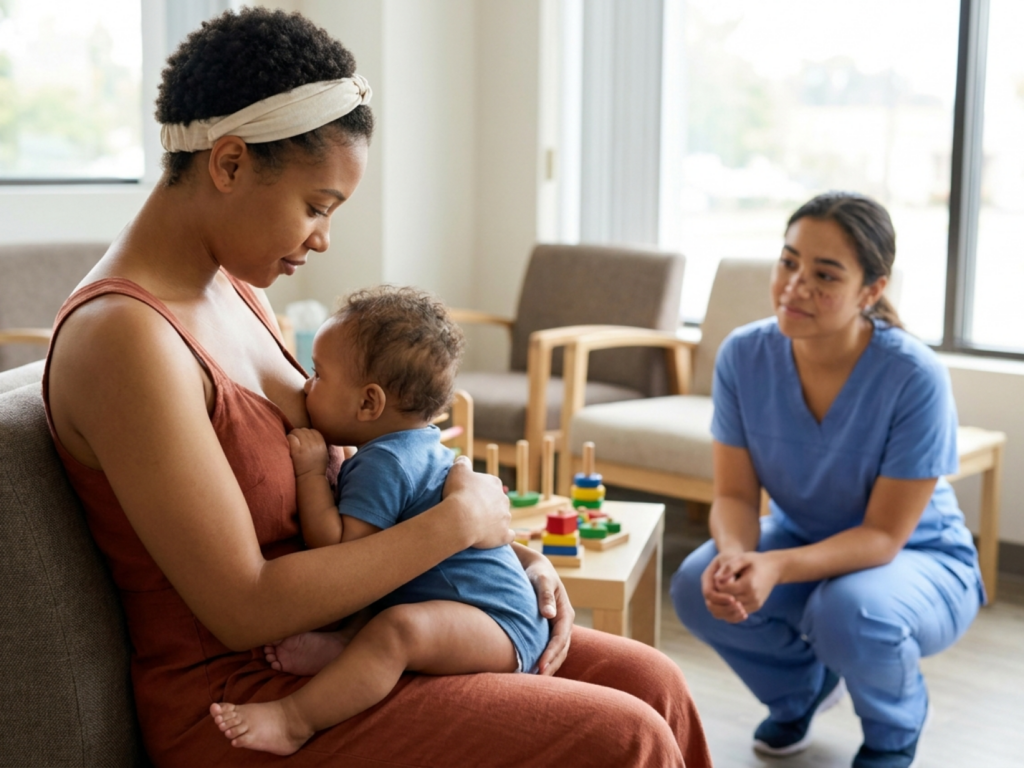
Caregiver-specific behavior is also common. A baby may accept one grandparent but not another, relax with a daycare worker after several visits, or tolerate a clinician until the physical examination begins. This does not mean the baby is being manipulative. It usually reflects memory, predictability, and how safe the baby feels in that specific setting.
How to respond gently
The most effective response is usually calm, gradual exposure with responsive caregiving. The caregiver’s body, voice, and facial expression help co-regulate the baby’s nervous system. If the adult stays relaxed and does not force contact, the baby often has more room to observe and warm up.
Practical strategies include letting the baby stay in a familiar caregiver’s arms at first, asking the new person to approach slowly, avoiding immediate handoffs, and giving the baby time to watch. A stranger can start by speaking softly to the caregiver rather than directly to the baby, then offer a toy or gentle interaction only if the baby shows readiness. Peekaboo, songs, and predictable routines can make the encounter feel less abrupt.
If separation is necessary, such as childcare drop-off or a medical appointment, keep the goodbye warm and brief rather than sneaking away. A transitional object, familiar blanket, or repeated routine may help. Some babies cry after a caregiver leaves but settle once engaged with a new toy, event, or trusted secondary caregiver. The key is to build predictability, not to shame the baby for needing reassurance.
What not to worry about
Parents often worry that stranger anxiety means their baby is antisocial, spoiled, or overly attached. In most cases, it means the opposite: the baby recognizes familiar caregivers and uses them as a reference point. Secure attachment does not require a baby to accept every person happily. A securely attached baby may still protest unfamiliar handling because the baby has a clear preference for known caregivers.
It is also normal for symptoms to fluctuate. A baby may be sociable after a nap but distressed in the evening. Travel, disrupted sleep, teething discomfort, minor illness, crowded rooms, and changes in routine can intensify wariness. The same infant may respond differently to a quiet visitor at home than to multiple relatives at a noisy gathering.
Try not to measure progress by whether the baby stops crying instantly. A better marker is whether the baby can gradually recover with support: looking back at the stranger, accepting a toy, returning to play, or tolerating brief interaction from the safety of a caregiver’s lap. Small recovery steps matter.
When to seek guidance
Stranger anxiety itself is usually not a medical problem. Still, caregivers should discuss concerns with a pediatrician or qualified child development professional if the pattern seems extreme, persistent, or paired with other developmental signs. Medical review is especially important when a baby loses previously acquired social or communication skills, rarely makes eye contact with familiar caregivers, does not respond to their name by the end of the ninth month, or does not use emerging gestures such as reaching or waving.
Also seek advice if distress prevents feeding, sleep, childcare participation, or necessary medical care despite gentle, consistent support. If crying is accompanied by fever, lethargy, breathing difficulty, repeated vomiting, injury, or other signs of illness, treat it as a health concern rather than assuming it is stranger anxiety.
Developmental screening questionnaires and routine well-child visits are useful because they place social behavior in context with motor, language, sensory, and relational development. A clinician can help distinguish typical infant stranger wariness from pain, illness, sensory overload, trauma exposure, visual or hearing concerns, or broader developmental differences. Asking for help is not overreacting; it is a careful way to protect both reassurance and early support when needed.
Seek medical advice promptly if
- Your baby loses social, motor, or communication skills they previously had.
- Your baby does not make eye contact or respond to their name by the end of month nine.
- Distress is severe, prolonged, or interferes with feeding, sleep, childcare, or medical care.
- Crying occurs with fever, lethargy, breathing difficulty, repeated vomiting, injury, or signs of pain.
- You feel something is not right about your baby's development or behavior.
Tools & Assistance
- Track when stranger anxiety happens, including time of day, setting, hunger, sleep, and illness.
- Use slow introductions with the baby held by a familiar caregiver at first.
- Share the baby's warm-up routine with relatives, babysitters, and childcare providers.
- Bring concerns to routine pediatric visits and ask about developmental screening questionnaires.
- Seek urgent medical care if distress appears linked to illness, breathing difficulty, injury, or dehydration.
FAQ
Is stranger anxiety normal in babies?
Yes. Stranger anxiety is commonly part of typical infant development, especially in the second half of the first year. It reflects growing recognition of familiar people and caution around unfamiliar ones.
Does stranger anxiety mean my baby is too attached to me?
Usually no. A preference for familiar caregivers can be a sign that the baby has formed reliable attachment expectations. The aim is gradual confidence, not forced independence.
Should I let relatives hold my baby if the baby cries?
Avoid forcing sudden handoffs. Let the baby observe from your arms first, then allow interaction slowly if the baby begins to settle or show interest.
How long does stranger anxiety last?
It varies. Many babies move through phases of stranger wariness over weeks to months, with intensity changing by temperament, routine, setting, and developmental stage.
When should I ask a doctor about it?
Ask a pediatrician if stranger anxiety is paired with developmental regression, poor eye contact, not responding to name by the end of month nine, feeding or sleep disruption, or signs of illness.
Sources
- Mayo Clinic — Infant development: Milestones from 7 to 9 months
- PubMed — Infants' reactions to an approaching stranger
- PubMed Central — Fear in Infancy: Lessons From Snakes, Spiders, Heights, and...
Disclaimer
This article is for informational purposes only and does not diagnose or treat any condition. Always consult a pediatrician or qualified healthcare professional for concerns about your baby's health, development, or behavior.















Please log in to leave a comment.