
Intro
Starting complementary foods is an exciting milestone, but choosing between spoon-fed purées and baby-led weaning can make caregivers feel as though one decision determines a baby's future eating habits. In practice, both approaches can be adapted to a baby's developmental readiness, family circumstances, cultural foods, and nutritional needs.
Purées and baby-led weaning are not necessarily opposing systems. Many families combine them, gradually progressing from smooth textures to mashed, lumpy, and finger foods. The central goals are safe feeding, adequate nutrition, responsive caregiving, and a positive relationship with food.
Highlights
There is no single universally correct way to introduce complementary foods.
Baby-led weaning emphasizes self-feeding with appropriately prepared finger foods, while traditional feeding usually begins with spoon-fed purées.
Texture progression matters whichever method a family chooses.
Iron-rich foods, safe preparation, supervision, and continued breast milk or formula remain central during the transition.
Evidence comparing the two approaches is still limited, and current research does not clearly establish that one is superior.
What the two approaches mean
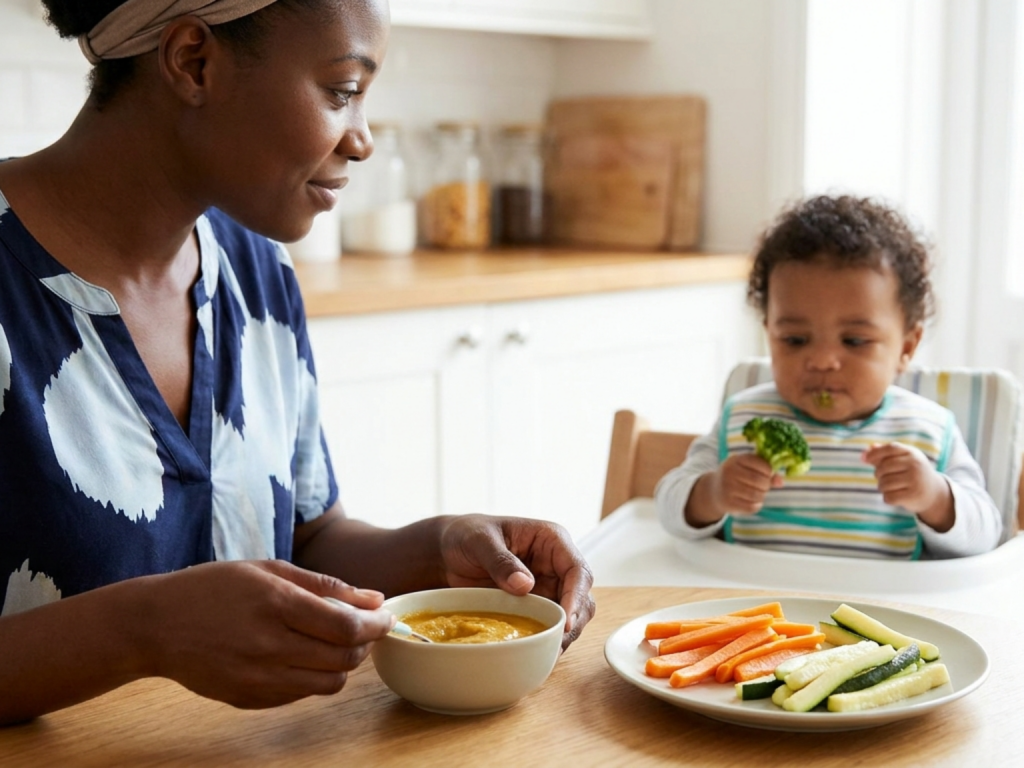
Traditional spoon-feeding generally introduces complementary foods as smooth or finely mashed purées. An adult offers small amounts on a spoon, observes the baby’s cues, and gradually increases texture and variety. Purées may be homemade or commercially prepared, provided that foods are prepared safely and products are suitable for the baby’s age and nutritional context.
Baby-led weaning is a child-led approach in which the baby is offered soft, graspable pieces of family-appropriate food and chooses whether, what, and how much to eat. The baby usually feeds themselves rather than being fed by spoon. Food is cut or shaped so it can be held securely, and it must be soft enough to reduce the risk of airway obstruction.
The distinction is useful, but real-life feeding is often less categorical. A baby may self-feed a strip of soft vegetable, accept a spoonful of yogurt, and eat mashed lentils from a preloaded spoon during the same meal. The NHS describes progression from purées to mashed foods and finger foods as an acceptable pathway when a baby is ready, rather than presenting one method as mandatory.
Readiness matters more than the label
Complementary foods are commonly introduced at around 6 months, while breast milk or infant formula remains the primary source of nutrition during the early transition. Calendar age alone is not enough to determine readiness. Relevant skills include sitting upright with stable head and trunk control, reaching for food, bringing objects to the mouth, and coordinating swallowing. A baby should be alert, supported in an upright position, and able to participate in a meal without being pressured.
Recognizing developmental readiness for solids helps caregivers choose an appropriate texture and feeding style. A baby who cannot maintain an upright posture or who has significant oral-motor difficulty may require individualized assessment from a pediatrician or feeding and swallowing professional. Prematurity, neuromuscular conditions, developmental differences, reflux-related problems, or previous aspiration concerns can change the safest plan.
Readiness also includes emotional and behavioral cues. Turning away, closing the mouth, losing interest, or becoming distressed may indicate that the baby has had enough or needs a break. Leaning forward, opening the mouth, and reaching toward food can signal interest. These cues support responsive feeding, in which the caregiver provides suitable options and the baby helps regulate intake.
Nutrition: the practical comparison
Purée feeding can make it easier to offer concentrated amounts of nutrient-dense foods. Smooth meat, fish, beans, lentils, eggs, tofu, or iron-fortified cereals can be blended or mashed into a texture a baby can manage. Caregivers can also monitor approximately how much has been accepted, although spoon contents should never be used to force a baby to continue eating.
Baby-led weaning can expose infants to the appearance, aroma, texture, and flavor of ordinary foods. It may support participation in family meals and allow the baby to practice grasping, hand-to-mouth movement, chewing-like oral exploration, and appetite regulation. However, a baby may initially consume very little, and large pieces of low-energy food alone may not provide enough iron or calories.
Regardless of method, prioritize first iron-rich complementary foods. Suitable options may include soft strips of meat or fish, well-cooked legumes, egg, tofu, iron-fortified cereals, and other foods recommended by the baby’s healthcare team. Include energy-dense foods such as full-fat yogurt, avocado, nut or seed butter spread thinly, and oils or other culturally appropriate fats when suitable. Avoid relying on fruit and vegetables alone, because they may be filling without supplying enough iron and energy.
Breast milk or formula generally continues alongside solids. Solid foods are complementary rather than an immediate replacement. A health professional can advise about growth, feeding volume, vitamin supplementation, and dietary restrictions, especially when a baby has poor weight gain, anemia risk, food allergy, or a restricted diet.
Choking, gagging, and food safety
Choking is different from gagging. Gagging is a protective reflex that may involve coughing, noisy retching, or bringing food forward as the baby learns to manage textures. Choking can be silent or associated with an inability to breathe, cry, or cough effectively and is an emergency. Learning infant first aid is valuable for every caregiver, irrespective of feeding method.
Choking prevention for baby solids includes keeping the baby seated upright and closely supervised throughout the meal. Food should be soft enough to flatten between the thumb and forefinger. Avoid hard, round, sticky, or rubbery foods in their unmodified forms, including whole nuts, whole grapes, chunks of raw apple or carrot, popcorn, hard sweets, and large pieces of meat or cheese. Grapes and similar round foods should be prepared according to current infant-feeding guidance, and nut butter should be thinned or spread very thinly rather than offered as a sticky spoonful.
Purées do not eliminate risk. Thick, sticky, or poorly blended foods can be difficult to manage, and spoon-feeding can become unsafe if an adult pushes food into a baby’s mouth or feeds while the baby is reclined, distracted, crying, or moving. Baby-led weaning also requires careful food preparation; a large finger-food shape is not automatically safe.
Use clean preparation surfaces, cook animal products thoroughly, avoid honey before 12 months because of infant botulism risk, and follow local advice about salt, added sugar, unpasteurized products, and high-mercury fish. Discuss allergen introduction with a clinician when there is severe eczema, an existing food allergy, or another elevated-risk circumstance. Caregivers should know the possible allergic reaction signs that warrant urgent medical attention, such as breathing difficulty, facial or tongue swelling, widespread hives, repeated vomiting, pallor, or sudden lethargy.
What does the evidence say?
Baby-led weaning has attracted interest because it may encourage autonomy, family-meal participation, and exposure to varied textures. Observational studies have reported possible differences in feeding behavior, satiety responsiveness, and food preferences. These findings are difficult to interpret because families who choose baby-led weaning may differ from families who use purées in education, income, breastfeeding history, health beliefs, and access to fresh foods.
A systematic review in PubMed Central found that the evidence base was relatively small and included limited randomized research. Results concerning safety, nutrient intake, weight, and developmental benefits were mixed. The review supports cautious interpretation rather than strong claims that baby-led weaning prevents obesity, improves intelligence, or guarantees better eating behavior.
A later PubMed article similarly describes baby-led weaning as a child-led strategy while raising unresolved questions about adequate intake of key nutrients and choking risk. Current evidence does not clearly support recommending baby-led weaning over conventional spoon-feeding for every infant. Conversely, there is no sound reason to treat responsive spoon-feeding as inherently inferior. The quality of implementation, food choices, supervision, and respect for the baby’s cues may matter more than the label.
A flexible combination approach
Combination feeding can preserve the advantages of both methods. A caregiver might offer soft finger foods for self-feeding alongside mashed foods on a preloaded spoon. This can be especially practical when a baby is learning to manage texture, when family meals are not nutritionally complete for an infant, or when caregivers need a predictable way to provide iron-rich foods.
In a responsive approach, the adult decides what foods are offered, when meals occur, and how food is prepared. The baby decides whether to eat and how much. Avoid coaxing, distraction, bargaining, or forcing the last spoonful. Mealtimes can remain brief and calm, with milk feeds continuing according to the baby’s usual needs and healthcare guidance.
Progress textures gradually. Smooth purées can move toward thicker purées, mashed foods with soft lumps, finely chopped foods, and soft graspable pieces. Delaying all texture progression for too long may reduce opportunities to practice oral skills, while advancing texture too quickly can be unsafe. Observe the baby’s response and seek professional support if coughing, choking-like episodes, persistent distress, wet or gurgly breathing, prolonged meals, or significant food refusal occurs.
Families do not need to make a permanent decision on the first day. Feeding preferences may change as the baby’s skills develop, household routines shift, or professional advice evolves. A compassionate plan is one that supports nutrition and safety while remaining realistic for the people providing care.
Safety reminders
- Never leave a baby alone with food or feed while the baby is reclined, walking, or playing.
- Do not use whole nuts, whole grapes, popcorn, hard raw vegetables, hard sweets, or sticky spoonfuls of nut butter in unsafe forms.
- Seek urgent help for choking or signs of a severe allergic reaction, including breathing difficulty or facial swelling.
- Ask a pediatrician or feeding specialist for individualized advice when there are swallowing concerns, prematurity, poor growth, anemia risk, or significant developmental differences.
- Breast milk or infant formula remains important during the early complementary-feeding period.
Tools & Assistance
- Infant CPR and choking first-aid training
- Pediatrician, family doctor, or public health nurse
- Registered dietitian specializing in infant feeding
- Speech-language pathologist or occupational therapist for feeding and swallowing assessment
- A food and texture log to discuss patterns with a healthcare professional
FAQ
Is baby-led weaning safer than purées?
Neither method is automatically safer. Safety depends on developmental readiness, upright positioning, close supervision, appropriate texture, and careful food preparation. Research has not conclusively established that baby-led weaning has a lower choking risk.
Can a baby have both purées and finger foods?
Yes. Combining mashed or puréed foods with soft finger foods is a common and flexible approach. A preloaded spoon can allow self-feeding while still making nutrient-dense foods easier to offer.
How can caregivers provide enough iron with baby-led weaning?
Offer iron-rich foods regularly, such as soft meat, fish, beans, lentils, egg, tofu, or iron-fortified cereal, using textures the baby can manage. Discuss dietary restrictions, supplementation, and growth with a healthcare professional.
Does starting with purées mean a baby will reject textured foods?
No. Babies can progress from smooth foods to thicker, lumpy, and finger-food textures. Gradual progression and repeated, pressure-free exposure are more relevant than whether purées were offered initially.
When should a caregiver seek feeding advice?
Seek advice for recurrent coughing or choking-like episodes, wet breathing during or after meals, prolonged or exhausting feeds, persistent refusal, suspected allergy, poor growth, or concern that the baby cannot manage offered textures.
Sources
- NHS — 6 months - Feeding your baby - Best Start in Life
- PubMed Central — Baby-led weaning: what a systematic review of the literature reveals
- PubMed — Baby-led weaning - Progress in infant feeding or risky trend?
Disclaimer
This article provides general educational information and does not diagnose, treat, or replace advice from a qualified healthcare professional. Consult your baby's clinician for individualized feeding and safety guidance.













Please log in to leave a comment.