
Intro
Before a baby stands or walks independently, the nervous system is learning to organize posture, movement, and sensory information. Balance development is not a single milestone that appears suddenly; it is a gradual process involving trunk control, leg strength, weight shifting, visual guidance, vestibular input, and the ability to respond to small losses of stability.
Babies develop these skills at different rates and in different sequences. Some spend considerable time crawling, kneeling, or cruising along furniture, while others move through these stages briefly. Supportive caregiving focuses on providing safe opportunities to practise rather than forcing a particular posture or comparing one baby with another.
Highlights
Independent walking is preceded by months of postural control, weight shifting, and supported upright practice.
A baby may sway more, less, or differently as balance strategies become more sophisticated; visible movement is not automatically a sign of poor control.
Safe floor-based exploration, stable furniture, and responsive supervision offer useful practice without requiring specialised equipment.
Prematurity, medical conditions, asymmetry, loss of previously acquired skills, or persistent difficulty bearing weight warrant discussion with a healthcare professional.
Balance Begins Before Upright Postures
Balance control develops long before a baby pulls to stand. During early infancy, the developing brain and spinal cord gradually learn to coordinate head position, trunk stability, and limb movement against gravity. Tummy time and varied floor positions provide opportunities to strengthen the cervical, thoracic, and abdominal musculature while helping the baby learn where the body is in space.
As head and trunk control improve, a baby can rotate, reach, pivot, roll, sit, and transition between positions with increasing efficiency. These movements are not separate from later walking. They help establish anticipatory postural adjustments, meaning the body prepares for movement before the movement occurs. For example, reaching from sitting requires the trunk and pelvis to stabilize while the arm moves toward a toy.
Balance also depends on sensory integration. Vision helps a baby orient to surfaces and objects; the vestibular system contributes information about head movement and acceleration; and proprioception provides feedback from muscles and joints about limb position and loading. Tactile information from the feet and hands adds further clues about contact with the floor or furniture. These systems gradually become better coordinated through ordinary play and movement.
Caregivers do not need to teach each component directly. Providing safe floor time for infants on a clear, firm surface allows the baby to experiment with movement, pause, recover, and try again. Short, frequent opportunities are often more useful than prolonged practice when the baby is tired or frustrated.
From Sitting and Kneeling to Supported Standing
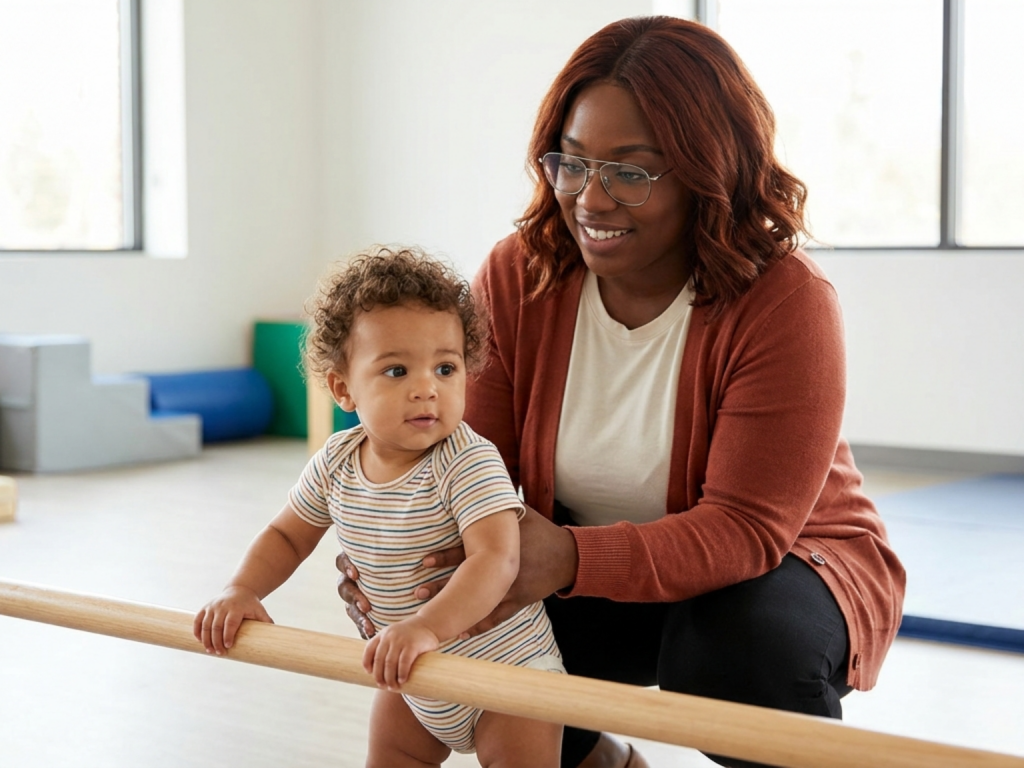
Standing typically emerges through a progression of supported postures. A baby may first bear weight through the legs when held, then rise into kneeling, half-kneeling, or a squat while holding a stable object. Pulling to stand requires coordinated hip and knee extension, foot placement, trunk stabilization, and the ability to shift the center of mass over the base of support.
At first, the baby may rely heavily on the arms and keep the trunk close to furniture. The feet may be widely spaced, the knees may remain flexed, and the body may wobble. These adaptations increase stability while the nervous system learns how to control the upright position. Over time, the baby commonly uses the hands less, stands more erect, and moves weight from one foot to the other.
Supported standing is not only a strength exercise. It is also a problem-solving activity. The baby learns how far to reach, how much force to use through the hands, and how to bend the knees when lowering back to the floor. Controlled descent is an important part of balance because it teaches the body how to respond when the center of mass moves beyond the feet.
Furniture should be heavy and stable enough not to slide or tip. Avoid placing tempting objects on unstable surfaces or encouraging a baby to pull on lightweight tables, wheeled items, or unsecured shelving. A caregiver can stay close, especially during transitions, while allowing the baby to initiate movement. Gentle support at the pelvis or trunk may help when needed, but lifting the baby into standing repeatedly does not replace the active learning that occurs when the baby chooses how to move.
Cruising and the Development of Weight Shifting
Cruising describes sideways movement while holding furniture. It requires a baby to shift weight onto one leg, unload the other foot, place it in a new position, and recover balance. This alternating sequence integrates lower-limb strength with lateral trunk control. Turning around a corner, moving between adjacent surfaces, or reaching for a toy adds further demands because the base of support changes.
Early cruisers often use a wide stance and move in short, stiff steps. They may lead with the same foot, lock the knees, or keep both hands in contact with the furniture. These strategies can be effective temporary solutions. With practice, many babies begin to rotate the pelvis, bend the knees, adjust foot placement, and release one hand briefly.
Push toys require caution. A fast-moving or lightweight toy can travel away from the baby and create a sudden loss of balance. A stationary, weighted surface for cruising is generally more predictable. Bare feet indoors can provide useful tactile and proprioceptive feedback when the floor is safe and comfortably warm; footwear may be needed outdoors or for protection, but it should fit properly and allow natural foot movement.
Balance is also affected by attention and emotional state. A baby who is excited, hungry, fatigued, or overstimulated may appear less coordinated than usual. Pausing, reducing noise, and offering a familiar toy at floor level can help the baby regulate. Responsive caregiving supports exploration while respecting signs that the baby needs rest or reassurance.
Why Sway Changes as Balance Improves
It is tempting to judge balance by asking whether a baby sways less. Research on infant upright posture suggests a more nuanced pattern: as upright experience increases, infants may sway differently rather than simply showing progressively smaller movements. Early standing can involve large, variable movements because the baby is discovering how the body responds to gravity and surface contact.
With experience, postural control becomes more adaptable. The baby may use ankle, knee, hip, and trunk strategies in different combinations, depending on the task and the amount of support available. A baby standing near furniture may use touch to reduce uncertainty, whereas a baby briefly standing without support must rely more heavily on visual, vestibular, and proprioceptive information.
Touch support is informative rather than merely mechanical. Light contact with a hand or furniture can help the nervous system detect body motion and refine the relationship between movement and stability. This is one reason a baby may stand longer while touching a surface and then lose balance quickly when the hand is removed. The difference does not necessarily indicate a problem; independent standing is a new sensory and motor challenge.
Balance control continues to mature after walking begins. Studies examining posture during the first year after walking onset show ongoing changes in upright stance and the influence of experience. Early walkers may take stiff, broad-based steps and fall frequently, then gradually develop more efficient control of speed, direction, stopping, and obstacle negotiation. Walking onset is therefore the beginning of another learning phase, not the endpoint of balance development.
Practical Ways to Support Practice
The most useful home environment is safe, varied, and responsive. Place age-appropriate toys at different heights and positions so the baby has reasons to reach, rotate, squat, kneel, and move laterally. A low, stable surface can support pulling to stand and cruising. Leave enough open floor space for the baby to move away from furniture and practise transitions.
- Use a clear, non-slip floor area away from stairs, cords, sharp edges, hot surfaces, and small objects.
- Stay within arm’s reach during new standing or cruising attempts, particularly near hard corners or elevated surfaces.
- Offer toys that encourage reaching to both sides so the baby practises weight shifting symmetrically.
- Allow the baby to change positions independently when possible instead of repeatedly placing the baby into a posture.
- Pause when the baby shows fatigue, distress, breathlessness, or reduced interest.
Daily routines can provide natural practice. Getting down to the floor for play, placing a toy just beyond reach, and allowing time for the baby to move between sitting, kneeling, and standing can be sufficient. Expensive balance devices, jumpers, and activity centres are not necessary for typical motor learning and may restrict movement or create hazards if used without careful supervision.
Caregivers should also consider the baby’s corrected age when interpreting motor skills after preterm birth. A clinician can explain whether corrected age is appropriate and how it should be used. The goal is not to accelerate walking but to support active, comfortable participation in movement.
Variation, Asymmetry, and When to Seek Advice
There is broad normal variation in the timing and order of standing and walking. Some babies bottom-shuffle, crawl asymmetrically for a period, or prefer one route of movement. A preference is not automatically concerning, especially if the baby can use both sides, change positions, and continues to gain skills.
Professional advice is appropriate when caregivers notice persistent or marked asymmetry, a consistently clenched hand, one leg that is rarely used, inability to bear weight when expected for the child’s developmental history, unusual stiffness or floppiness, frequent distress during movement, or a clear plateau that causes concern. A loss of previously acquired motor skills should be discussed promptly. These observations do not establish a diagnosis, but they provide useful information for a pediatrician, family physician, physiotherapist, or other qualified clinician.
Assessment should account for the whole child, including muscle tone, joint range of motion, neurologic status, vision, hearing, general health, and opportunities for movement. Babies with known neuromuscular, orthopedic, neurologic, or developmental conditions may need individualized guidance. Early intervention services for infants can offer assessment and family-centered support when indicated.
Seek urgent medical care for an injury, significant pain, sudden inability to use a limb, breathing difficulty, altered responsiveness, or another acute change. For nonurgent developmental questions, record what you observe, including which positions are comfortable, whether both sides are used, and how the baby responds to support. Concrete examples help clinicians distinguish ordinary variability from a pattern needing closer evaluation.
Safety and Medical Caution
- Never leave a newly standing baby unattended near stairs, windows, water, heaters, or elevated surfaces.
- Secure furniture and remove objects that can be pulled down or used to climb.
- Do not use wheeled baby walkers as a balance-training device; they can increase injury risk.
- Contact a healthcare professional about regression, persistent asymmetry, unusual tone, pain, or inability to bear weight.
- Use corrected age when discussing motor development after preterm birth, according to clinical guidance.
Tools & Assistance
- A daily observation note tracking positions, transitions, side-to-side use, and fatigue
- A childproofed floor area with stable furniture and clear walking space
- A pediatric developmental screening visit
- Pediatric physiotherapy or early intervention services when recommended
- A video of a concerning movement pattern to show a healthcare professional
FAQ
Does my baby need to stand before walking?
No. Many babies stand with support or cruise before independent walking, but the sequence and duration vary. A clinician can assess the broader pattern of movement if you have concerns.
Is wobbling while standing normal?
Some wobbling is expected when upright balance is new. Babies often change how they sway as sensory and motor control improve. Persistent asymmetry, pain, marked stiffness, or loss of skills deserves professional assessment.
Should I practise standing with my baby?
You can offer brief, supervised opportunities near stable furniture or provide gentle support when your baby initiates the activity. Forced or prolonged standing is unnecessary; active, self-directed floor movement is more useful.
Are baby walkers helpful for balance?
Wheeled walkers do not reliably teach the balance strategies needed for independent walking and can create hazards. Stable, supervised floor play and cruising opportunities are safer choices.
When should I ask about delayed standing or walking?
Ask your pediatrician or another qualified healthcare professional whenever the pattern worries you, particularly if there is regression, persistent asymmetry, unusual muscle tone, pain, or difficulty bearing weight.
Sources
- NIH / PubMed Central — The development of motor behavior
- PubMed — The temporal organization of posture changes during the first year of independent walking
- PubMed — The development of infant upright posture: sway less or sway differently?
Disclaimer
This article provides general educational information and is not a diagnosis or a substitute for individualized medical advice. Consult a qualified healthcare professional about your baby’s development, safety, or any concerning change.















Please log in to leave a comment.