
Intro
During labor, position changes can support the natural mechanics of descent, rotation, and pelvic opening. They do not force labor to progress, and they are not a substitute for clinical assessment, but they can improve comfort and may help the baby navigate the pelvis more efficiently.
This article reviews the positions most often used to encourage descent and create more space in the pelvis, including upright, forward-leaning, hands-and-knees, squatting, and side-lying options. The best choice depends on the stage of labor, fetal position, pain management, mobility, and the advice of the birth team.
Highlights
Gravity matters. Upright and forward-leaning positions can encourage descent and may help the baby rotate into a better fit.
Pelvic shape is dynamic. Small changes in posture can alter the relationship between the sacrum, the pelvic inlet, and the outlet.
Hands-and-knees, lunging, squatting, and side-lying positions each have different strengths, so the right posture changes across labor.
No position works for everyone. Comfort, fetal position, monitoring, epidural use, and exhaustion all influence what is practical.
Positions can support labor progress, but persistent delay, severe pain, or abnormal findings need clinical review.
How positions affect descent and pelvic space
Labor positions work by changing the relationship between the fetus, the uterus, and the maternal pelvis. An upright posture uses gravity to help the presenting part descend, while forward-leaning or hands-and-knees positions can reduce pressure on the sacrum and allow the pelvic outlet to open more freely. This does not guarantee faster labor, but it can support the normal mechanics that many birthing people need in order for the baby to move lower.
The pelvis is not a rigid tunnel. Its functional diameter changes with posture, hip flexion, pelvic tilt, and how the sacrum is allowed to move. When the sacrum is less restricted, the outlet may feel less crowded. That is one reason labor teams often encourage movement and birth positions during labor rather than keeping one fixed posture for long periods. The goal is not a dramatic maneuver; it is a series of small mechanical advantages that can add up across contractions.
These changes are especially relevant when the baby needs room to rotate. Many fetuses descend in stages rather than moving straight down. As labor advances, well-chosen positions can support the cardinal movements of labor and the baby’s descent through the birth canal.
Upright positions that use gravity well
Upright positions are often the simplest way to support progress. Standing, walking, slow swaying, marching in place, leaning on a counter or the bed, and using a birthing ball all let gravity assist the baby’s descent while also keeping the pelvis mobile. Many women find that these positions feel more active and less restrictive than lying flat, especially in early labor or between stronger contractions.
Gentle lunges and asymmetrical stances can be useful when the baby needs a little more room on one side of the pelvis. A supported lunge, with one foot elevated or one knee bent, can change pelvic dimensions temporarily and may help the baby settle into a better angle. This is one reason upright positions during labor are commonly recommended in professional guidance: they are flexible, easy to modify, and compatible with frequent reassessment.
Upright work is not limited to intense movement. Even subtle posture changes can matter. Standing with one foot on a low stool, rocking the pelvis side to side, or shifting weight during contractions may create more room than staying still. The most useful position is often the one that is sustainable, safe, and repeatable.
Forward-leaning and hands-and-knees positions
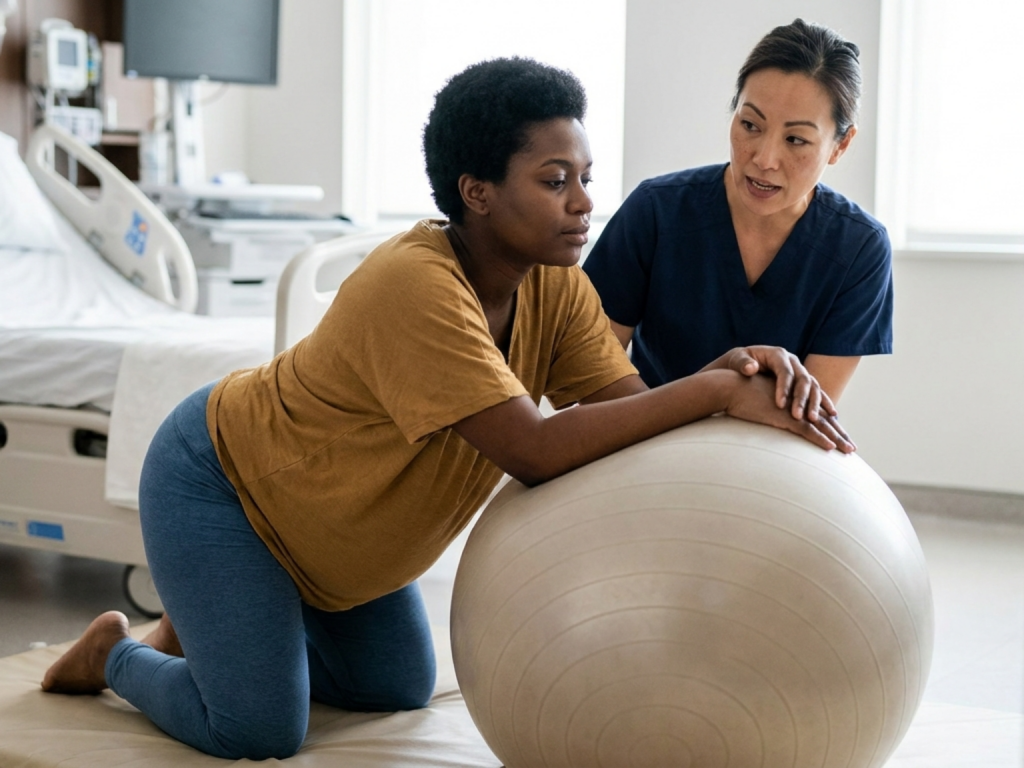
Forward-leaning positions are especially helpful when the back feels strained or when the baby is in a position that makes descent less efficient. Hands-and-knees birth position, kneeling while leaning over a bed or a birth ball, and chest-supported forward lean can reduce direct pressure on the lower back and allow the uterus to sit more forward. For many people, this makes contractions feel more manageable while also encouraging the fetal head to rotate.
Hands-and-knees position for back labor is a common phrase because the posture can relieve pressure on the sacrum and shift the baby’s weight away from the spine. It is not a cure for back pain, and it is not always tolerated for long, but it is a reasonable option to try when the back is the dominant source of discomfort. The same posture can be used during active labor, between contractions, or briefly during pushing if the birth team feels it is appropriate.
These positions are also useful when the baby seems to need space to complete rotation. By changing how the pelvis is loaded, they may support the baby’s descent through the birth canal without adding unnecessary strain on the mother.
Squatting, deep squat support, and side-lying
Squatting is a classic position for opening the pelvic outlet. A well-supported squat can widen the lower pelvis, encourage the thighs to externally rotate, and use gravity to help the baby descend. It can be performed with a partner, a squat bar, a bed, or a sturdy support rail. In labor, the key is not how low the squat looks; it is whether the position is stable enough to be held without excess strain.
Deep squatting is not ideal for every person, especially if there is fatigue, knee discomfort, a need for continuous monitoring, or a history of limited mobility. In those settings, side-lying pushing position may be a better choice. Side-lying can reduce physical load, preserve energy, and still give the pelvis enough openness for effective pushing. It is often a practical option when the birth team wants more control of the pushing phase or when the person needs a rest without completely losing progress.
Both positions show how labor can be supported without forcing one rigid posture. The right choice is often the one that opens the pelvis enough while still letting the birthing person relax between contractions.
How to choose a position across labor
Position choice usually changes with labor stage. In early labor, movement and upright positions often feel easiest because they allow walking, swaying, and a wider range of rest positions. As contractions become stronger, many people shift toward leaning, kneeling, or supported asymmetrical positions that preserve comfort while still encouraging descent. During passive descent during labor, a less strenuous posture may be useful until the body and baby have moved lower on their own.
In active pushing, the best posture depends on fetal station, maternal energy, and the clinical situation. Some people push best upright; others do better in a side-lying pushing position because it preserves strength and reduces pressure. If a monitor, epidural, or IV limits movement, the team may still be able to modify the bed or use wedges, pillows, or assistive devices to preserve pelvic opening.
There is no single schedule for changing positions, but frequent reassessment is useful. A posture that helps for one contraction may not help for the next 20 minutes. Good labor support is responsive, not rigid. The practical question is always: what position is safe, sustainable, and most likely to help this baby descend now?
When position changes are not enough
Positions can make a meaningful difference, but they have limits. If the cervix is not changing, the baby is persistently high, contractions are no longer effective, or the birthing person is becoming exhausted, the labor team needs to reassess rather than simply repeat the same maneuver. Sometimes the issue is fetal position, sometimes it is uterine pattern, and sometimes it is that the current position is no longer the right fit.
Medical evaluation is especially important if there is significant bleeding, fever, severe pain that is out of proportion to labor, decreased fetal movement before labor, or any abnormal fetal heart rate pattern. In some cases, clinicians may recommend manual position changes, closer monitoring, or other interventions. The purpose is not to override normal birth physiology, but to prevent delay from becoming unsafe.
A useful way to think about labor positions is that they are tools, not verdicts. They can support progress, but they do not replace clinical judgment. When progress stalls, the safest next step is often a careful assessment of the labor as a whole.
When to get immediate clinical guidance
- Do not persist with a painful position if it causes dizziness, numbness, shortness of breath, or worsening distress.
- Seek urgent evaluation for heavy bleeding, fever, severe abdominal pain, or reduced fetal movement before labor.
- Call the birth team if contractions remain strong but the baby seems not to descend at all.
- Use caution with deep squats or kneeling if you have unstable joints, prior injury, or balance problems.
- If an epidural, monitoring setup, or medical condition limits movement, ask staff which positions are safe.
Tools & Assistance
- Labor nurse or midwife for position coaching during contractions
- Obstetrician or certified nurse-midwife for assessment if progress stalls
- Birthing ball, squat bar, or bed rail for supported upright work
- Pelvic floor physical therapy or childbirth education for movement strategies before labor
FAQ
Do labor positions really help the baby descend?
They can. Positions that use gravity, open the pelvis, or free the sacrum may support descent and rotation, although they do not work the same way for everyone.
Is squatting always the best position for birth?
No. Squatting can open the outlet, but it may be too demanding or impractical in some labors. Side-lying, kneeling, or leaning positions may work better.
Can I use these positions if I have an epidural?
Often yes, but the range of movement is narrower. Staff can help with side-lying, supported tilt, or modified upright positions if they are safe for you.
What if the baby is not descending despite position changes?
That needs clinical reassessment. The issue may be fetal position, contraction pattern, or another labor factor that positions alone cannot fix.
Sources
- Mayo Clinic — Labor positions
- Illinois Perinatal Quality Collaborative — Positions for Labor
- Lamaze International — 9 Helpful Movements for Labor and Birth
Disclaimer
This article is for educational purposes only and does not replace individualized medical advice, diagnosis, or labor management from a qualified clinician.

















Please log in to leave a comment.