

Intro
In labor, birth, and even early feeding, it is common to hope that one position will be the answer. In practice, that is rarely how the body works. A posture can be useful for one person, one stage of labor, or one symptom pattern and then become less effective later, or feel wrong from the start.
This is not a sign of failure. It usually means that anatomy, fetal position, pain pattern, fatigue, medical monitoring, or recovery needs are changing. A position is a tool, not a verdict. The goal is to match the tool to the moment, with guidance from the care team when needed.
Highlights
One position may help at the start of labor and become less useful as contractions, fatigue, or fetal descent change the mechanics.
Comfort, circulation, monitoring, and pain relief can all change which posture works best at a given time.
Side-lying, upright, hands-and-knees, and supported back-lying positions each solve different problems and create different tradeoffs.
The same idea applies after birth: breastfeeding positions may need adjustment because latch, breast size, and milk flow vary.
Labor is dynamic, not static
Birth positions during labor are best understood as adjustable supports, not a single correct answer. A posture that opens the pelvis, reduces back pressure, or helps relaxation at one moment may feel tiring or ineffective an hour later. That is expected, because labor itself is a moving physiologic process. Contractions change in frequency and intensity, the baby descends, soft tissues stretch, and the person in labor may move through pain, rest, and fatigue in the same stretch of time.
Mayo Clinic notes that changing positions can help with pain relief and can increase a sense of control. That matters clinically. When a person can shift instead of being locked into one arrangement, they may tolerate labor better and conserve energy. A position therefore has to be judged by what it does right now: Does it help relaxation? Does it reduce pressure? Can the person breathe, rest, and bear down effectively if it is time to push? If the answer changes, the position may no longer fit, even if it was helpful earlier.
Why the same posture can stop helping
Several variables can make one posture work well at one point and poorly at another. Fetal position is a major one. A baby who is rotated posteriorly, asynclitic, or simply not descending smoothly may create back pain or uneven pressure that makes a previously comfortable stance feel useless. Maternal anatomy also matters. Pelvic shape, joint mobility, prior injury, and the pattern of uterine contractions all influence whether a posture gives room or resistance.
Supine or semi-supine positions can also be limited by circulation. When the uterus compresses major vessels, venous return may fall and some people feel dizzy, nauseated, or faint. Even when that does not happen, a flat position may increase discomfort or make contractions feel more intense. In contrast, upright, forward-leaning, or side-lying positions may reduce that burden for some people. The same applies to the emotional side of labor: if a person feels trapped, unsupported, or unable to respond to contractions, the position is not functioning well even if it looks acceptable on paper.
This is where careful reassessment matters. The body is giving continuous feedback. The useful question is not whether the position is “correct,” but whether it is still meeting the clinical need.
When a different position is the better tool
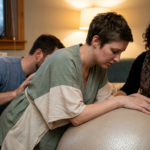
Some positions are better suited to specific problems. Side-lying positions can be valuable when rest is needed, when pelvic pressure is intense, or when a person needs relief from continuous upright effort. They may also be easier to maintain during a long labor because they save energy. Hands-and-knees position for back labor is another classic example: it can reduce direct sacral pressure and may help when back pain is the dominant symptom. Upright or forward-leaning positions may improve comfort and sometimes promote fetal rotation, especially when the baby is not descending cleanly.
No single posture solves every problem. What matters is matching the position to the complaint. If the issue is exhaustion, a supported side-lying choice may be more useful than another upright effort. If the issue is back pressure, a hands-and-knees position may be worth trying. If the issue is bearing down, a position that preserves pelvic opening and the ability to work with contractions may be preferable. This is one reason many clinicians encourage movement rather than committing early to one fixed plan.
Mobility-compatible fetal monitoring can make that flexibility more realistic, because it allows some people to remain active while still receiving the monitoring they need. The clinical tradeoff is straightforward: preserve safety, but avoid narrowing the number of workable positions more than necessary.
Medical factors can narrow the options
Sometimes the problem is not that a position is inherently bad, but that the medical context makes it less workable. Epidural analgesia may reduce mobility, proprioception, or the ability to maintain a narrow stance safely. Intravenous lines, blood pressure concerns, continuous fetal monitoring, or the need for rapid access in case of an emergency can also limit movement. In those settings, the team may recommend a supported alternative rather than the person’s preferred posture.
That kind of restriction is not arbitrary. It reflects risk management. For example, if the fetal tracing needs close surveillance, the team may need a position that keeps the tracing reliable. If blood pressure is unstable, a flat posture may not be appropriate. If there is concern about rapid deterioration, the safest setup may favor access and speed over freedom. That can be frustrating, especially if the person feels the position is worsening pain. Still, the right question is whether the limitation is protecting circulation, fetal status, or clinical access.
When a position must be restricted, the most useful step is to ask what problem the team is trying to solve and whether a modified version is possible. Often the answer is not “no movement,” but “move within this range.”
The same principle applies after birth
The idea that one position may not work does not stop when the baby is born. Breastfeeding positions can fail for very ordinary mechanical reasons. Mayo Clinic points out that breast size, latch quality, and milk flow all influence which feeding position is most effective. That means a position that seems comfortable in theory may not transfer milk well, may strain the back or shoulders, or may make latch shallow and unstable.
Postpartum recovery adds another layer. A person healing from a perineal tear, a cesarean birth, or general exhaustion may need a posture that protects painful areas and reduces holding strain. Some parents need the baby higher or lower; some need support for the breast tissue; some need a position that helps the infant stay aligned at the breast. The point is not that one position is right and another is wrong. It is that the best position is the one that creates a stable latch, protects the parent’s body, and can actually be repeated many times a day.
This is a useful reminder in the broader birth context. Even after delivery, fit remains practical, not ideological.
How to reassess fit in real time
When a position is not working, the next step is usually reassessment, not endurance. Start by asking what is failing: pain relief, breathing, fetal descent, balance, access for monitoring, or energy conservation. Then change one variable at a time. A small modification, such as additional pillows, a different angle at the hips, or a switch from upright to side-lying, can be more informative than a full reset.
It also helps to keep timing in view. A posture that is poor during a strong contraction may be fine between contractions. A posture that works during early labor may not be enough once pushing starts. And a posture that is comfortable for the birthing person may still need adjustment if the fetal heart rate pattern changes. The best teams treat position choice as iterative care. They watch, adjust, and revisit the plan as labor unfolds.
That approach respects both physiology and autonomy. It recognizes that one position may not work because the situation is genuinely changing, not because the person is doing anything wrong.
When to seek prompt assessment
- Heavy bleeding, severe pain, or a sudden change in the baby’s movement needs urgent clinical review.
- Do not force a position that causes dizziness, shortness of breath, numbness, or faintness.
- If monitoring or an epidural limits movement, ask the team how to adjust safely instead of improvising alone.
- Persistent back pain, pelvic pain, or latch failure after birth may need professional assessment rather than trial-and-error only.
Tools & Assistance
- Obstetrician or midwife for labor position planning
- Labor and delivery nurse for bedside position coaching
- Pelvic floor physical therapist for mobility, pelvic pain, or recovery issues
- Lactation consultant for postpartum feeding-position troubleshooting
- Hospital education materials on fetal monitoring and movement options
FAQ
Is there one best labor position?
No. The best position depends on labor stage, comfort, fetal position, monitoring needs, and any medical restrictions.
Why did a position that helped earlier stop working?
Labor changes over time. Fatigue, fetal descent, pain pattern, and interventions such as epidural analgesia can make the same posture less effective later.
What should I do if my preferred position is not allowed?
Ask the team what risk they are trying to reduce and whether a modified or supported version is possible.
Do feeding positions matter after birth?
Yes. Breast size, latch quality, milk flow, and maternal recovery can make one breastfeeding position work better than another.
Sources
- Mayo Clinic — Labor positions
- Mayo Clinic — Breastfeeding positions
- Dementia Researcher — The research insider debate in qualitative research
Disclaimer
This article is for general information only and does not replace assessment by an obstetric, midwifery, or lactation professional. Seek urgent care for bleeding, severe pain, breathing trouble, or reduced fetal movement.
















Please log in to leave a comment.