
Intro
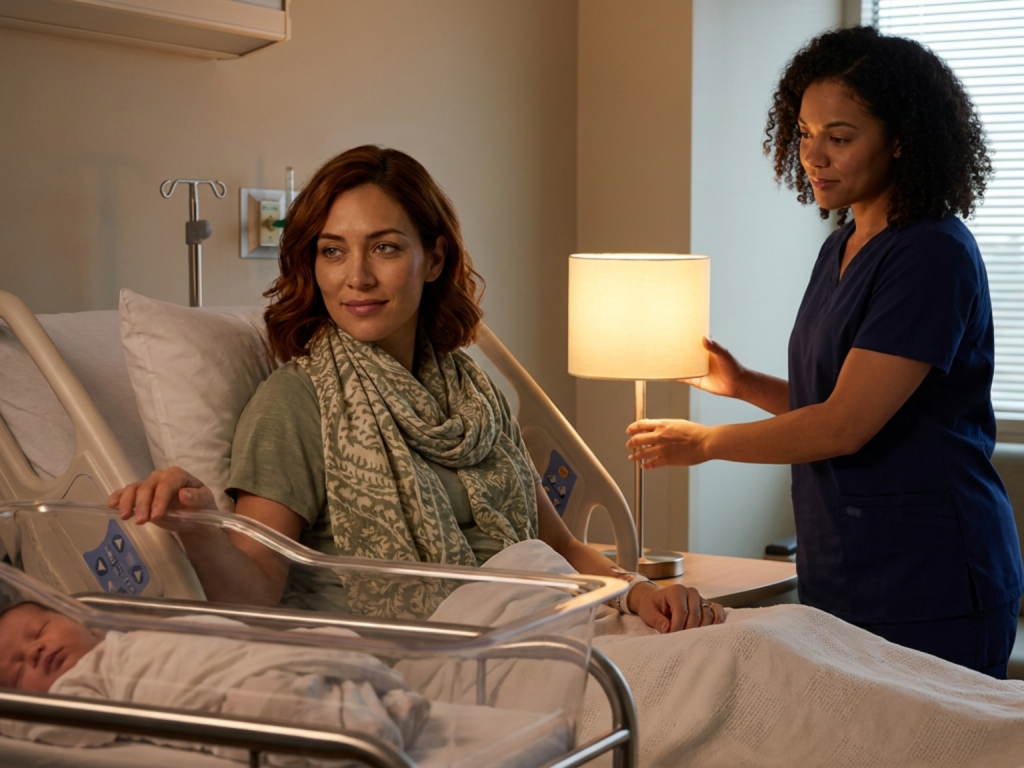
Birth settings are not only defined by monitors, beds, and clinical routines. They are also shaped by the background conditions that influence rest, stress, communication, and the sense of bodily privacy. In labor, during recovery, and in shared postpartum areas, lighting, noise, and room layout can either support comfort or make each interaction feel sharper and harder to manage.
For medically literate readers, the practical question is how to tune these environmental variables without compromising observation, safety, or timely care. The answer is usually not to eliminate light or silence entirely, but to create conditions that are adjustable, predictable, and respectful of the person giving birth and the newborn who may need assessment and support.
Highlights
Lighting that can be dimmed, redirected, or adapted to the task helps support rest while still allowing clinical observation when needed.
Excess noise can make shared birth spaces feel less private and less comfortable, especially when conversations carry easily between beds.
Small environmental adjustments often matter more than dramatic changes: glare control, quieter nighttime checks, and clear privacy boundaries can reduce strain.
Comfort settings should always preserve safety, including the ability to respond quickly to maternal or newborn concerns.
People vary in what feels tolerable during labor and recovery, so the best environment is usually one that can be adjusted in real time.
Why the room environment matters
Birth care happens in a physiologically demanding moment, but the setting still affects how that moment is experienced. A room that is overly bright, noisy, or visually exposed can heighten vigilance and make it harder to rest between contractions, feed a newborn, or recover after delivery. By contrast, a calmer environment can reduce cognitive load and help the person giving birth conserve energy for the work that matters.
Environmental quality is not cosmetic. In healthcare settings, it shapes perceived dignity, communication quality, and the ability to sleep, settle, and think clearly. That is why lighting, noise, and privacy should be treated as clinical comfort variables, not merely aesthetic preferences.
Lighting that supports comfort and observation
Good lighting in birth settings has to do two things at once: support clinical tasks and avoid unnecessary stimulation. Guidance for healthcare premises emphasizes daylight where appropriate, glare reduction, and adaptable electric lighting so the room can shift from active care to rest without losing utility.
Practical lighting settings often include dimmable overhead lights, local task lighting for examinations, and the ability to keep the room low-lit when the person is laboring or trying to sleep. Harsh light can feel intrusive, especially when someone is exhausted, nauseated, or sensitive to sensory input. A softer baseline, paired with focused light only when needed, is usually easier to tolerate.
Glare matters more than many people expect. Light bouncing off glossy surfaces, monitors, or white walls can feel sharper than the total brightness suggests. Lowering glare can make a room feel calmer without making it unsafe.
Noise, privacy, and the feeling of being exposed
Noise does more than interrupt sleep. In shared clinical spaces, it can reduce the sense of privacy because conversations become audible, staff movement becomes harder to ignore, and ordinary care tasks feel public. A review of open-plan work settings found that background noise can affect privacy and perceived comfort, and the same principles are relevant in shared care environments even though the setting is different.
Hospital and maternity units often need enough ambient sound for communication and safety, but avoidable noise can still be reduced. International occupational health guidance has long treated quieter hospital environments as part of good care, not a luxury. Lower noise supports rest, clearer communication, and less emotional strain.
Sound masking and acoustic planning can help in shared rooms, but the simplest improvements are often behavioral: softer voices at night, closing doors when appropriate, limiting unnecessary alarms, and organizing staff conversations away from bedside when possible. None of these steps removes the need for vigilance. They just make vigilance less disruptive.
Balancing rest with necessary care
A common tension in birth settings is that rest and surveillance pull in opposite directions. People need sleep, privacy, and a sense of control, yet newborn checks, maternal observations, and routine documentation still have to happen. Good care finds the middle path: predictable timing, brief explanations, and lighting or noise changes that make routine checks less jarring.
This is especially relevant after delivery, when the room may serve both the parent and newborn. If a baby needs bedside newborn assessments or other routine newborn procedures, staff can often preserve comfort by using the lowest light level that still permits safe observation, speaking quietly, and clustering tasks when clinically appropriate. The goal is not to avoid care; it is to deliver care without repeatedly resetting the room into full alert mode.
Families sometimes worry that asking for a quieter or darker room will interfere with safety. In practice, the better question is whether the unit can keep observation effective while reducing unnecessary disturbance. In many settings, that is possible with thoughtful workflow and clear communication.
Practical adjustments families can ask about
Some comfort settings are built into the room, while others depend on staff habit and unit culture. It is reasonable to ask what can be adjusted before labor intensifies or before a postpartum rest period begins. The most useful changes are usually simple and immediate.
- Can the room lights be dimmed, zoned, or aimed away from the bed?
- Are there quieter periods for nonurgent checks or documentation?
- Can doors, curtains, or screens be used to improve privacy during exams or conversations?
- Is there a way to reduce monitor brightness or avoid direct glare?
- Can staff explain ahead of time when brighter light will be needed for a procedure?
These requests are not about control for its own sake. They help align the room with the realities of labor, exhaustion, and recovery. A person who understands when light will change or why noise is temporarily necessary is often better able to relax between interruptions.
When environmental comfort becomes a safety issue
Comfort settings should not be treated as separate from safety. If a room is so dim that staff cannot assess color change, bleeding, or respiratory effort, lighting needs to increase. If noise is masking alarms, medical conversations, or signs of deterioration, the unit needs a different strategy. The same is true if a private room is unavailable and shared-room setup makes it difficult to communicate clearly.
That is why the best approach is flexible rather than absolute. In a labor room, postpartum room, or shared ward, the environment should be able to shift quickly when clinical needs change. If there are concerns about maternal instability, heavy bleeding, severe pain out of proportion to the expected course, or a newborn who appears unwell, the priority moves immediately from comfort to assessment and response. Environmental adjustments should support that response, not delay it.
For that reason, comfort planning works best when it is discussed alongside broader care planning, not after a problem has already emerged. A unit that is accustomed to low-light, low-noise care can still escalate without confusion when needed.
Choosing settings that feel respectful and workable
There is no single ideal configuration for lighting, noise, and privacy in birth care. Some people want a very quiet, dim room. Others feel safer when they can see staff clearly and hear what is happening. Many want both, depending on the phase of labor or recovery. The right setting is the one that adapts without making the person feel trapped or ignored.
That flexibility is also why birth planning should include environmental preferences alongside clinical preferences. If you know that bright overhead light increases distress, or that repeated hallway noise makes it hard to rest, say so early. If you would like the room darkened after a feeding, or want explanations before lights are raised for an assessment, those are reasonable requests to place on the care team’s radar.
In practice, lighting, noise, privacy, and comfort are not minor extras. They are part of how birth care becomes humane, legible, and tolerable in real time.
When to escalate concerns
- Report sudden severe pain, heavy bleeding, fainting, shortness of breath, or a change in consciousness immediately.
- Do not ask staff to keep the room dark or quiet if they say brighter light, open access, or more frequent checks are needed for safety.
- If you cannot hear explanations clearly because of noise, ask for the information to be repeated before a procedure begins.
- If privacy is inadequate during examinations or discussions, ask for curtains, a closed door, or a quieter location when feasible.
- If the newborn looks poorly, feeds weakly, or seems unusually sleepy or hard to wake, request prompt clinical review.
Tools & Assistance
- Ask the maternity unit about dimmable lighting and nighttime quiet routines.
- Request a privacy screen or closed-door exam when available.
- Use earplugs or a sleep mask only if staff say they will not interfere with monitoring.
- Speak with the charge nurse or midwife about room adjustments if the environment is disrupting rest.
- Bring your birth preferences to the care team early, especially if sensory sensitivity is a concern.
FAQ
Is it reasonable to ask for dim lights during labor?
Yes. Dimmable or indirect lighting is often helpful for comfort, as long as staff can still assess you safely when needed.
Does more quiet always mean better care?
Not necessarily. The goal is lower avoidable noise, not silence at the expense of communication, alarms, or timely assessment.
Can privacy be improved in shared postpartum areas?
Often, yes. Curtains, quieter conversation, and careful room organization can improve privacy even when a private room is not available.
Should newborn checks always be done under bright light?
No. Many routine checks can be done with lower light if visibility remains adequate. Some assessments do require more light for safety.
When should I raise a concern about the room environment?
Raise it whenever lighting, noise, or lack of privacy is making it harder to rest, communicate, or feel safe, and especially if symptoms need urgent attention.
Sources
- SAGE Journals — Self-rated health implications of noise for open-plan office workers: An overview of the literature
- CIBSE — Lighting Guide 02: Lighting for healthcare premises (2019)
- International Labour Organization / Encyclopaedia of Occupational Health and Safety — Ergonomics of the Physical Work Environment
Disclaimer
This article is for general information only and does not replace individualized medical advice. For questions about labor, recovery, newborn care, or room safety, consult your obstetric, midwifery, or neonatal care team.














Please log in to leave a comment.