
Intro
Back labor describes intense pain or pressure concentrated in the lower back during labor. Some people feel the discomfort mainly during contractions, while others have substantial aching that continues between contractions. It can be exhausting and unsettling, particularly when the sensation differs from what you expected labor to feel like.
Back pain alone cannot confirm that labor has begun, and not every person with labor-related back pain has the same pattern. The most useful clues are how the pain behaves over time, whether it occurs with other signs of labor, and whether your contractions are becoming more regular, longer, and stronger. If you are unsure or the pain is severe, contact your maternity team for individualized guidance.
Highlights
Back labor commonly feels like intense lower-back pressure or pain that worsens during uterine contractions.
Pain may radiate toward the hips or remain present between contractions, distinguishing it from some typical contraction patterns.
Backache can occur alongside other labor signs, including regular contractions, a mucus show, pelvic pressure, or rupture of the membranes.
Persistent or severe pain should be discussed with a healthcare professional because back pain has causes other than labor.
What back labor contractions feel like
Back labor is usually described as pronounced pain, pressure, or aching in the sacral or lower-lumbar region. Rather than feeling the strongest sensation in the abdomen, a person may experience each uterine contraction as a tightening that is perceived predominantly in the back. The pain can be deep, intense, and difficult to ignore. Some people describe it as a powerful menstrual-like ache, while others experience sharp pressure, throbbing, or a sensation of compression.
A characteristic feature is that the pain may intensify as a contraction builds and ease as the uterus relaxes. However, it may not disappear completely between contractions. Cleveland Clinic describes back labor as lower-back pain during labor that can worsen with contractions and sometimes persist during the intervals between them. A PubMed-indexed study reported severe continuous low-back pain during labor in about 33% of participants, emphasizing that sustained discomfort is a recognized experience rather than an indication that someone is coping incorrectly.
Back labor can also radiate from the lower back into the hips, pelvis, or upper thighs. Pain distribution varies according to uterine activity, fetal position, pelvic anatomy, and individual pain processing. The intensity of the sensation does not, by itself, indicate how quickly labor will progress or whether a complication is present.
The contraction pattern to watch
The timing and evolution of the pain are often more informative than its location. In early labor, contractions may be irregular, relatively brief, and separated by changing intervals. As labor becomes established, contractions generally develop a more organized pattern: they occur at increasingly predictable intervals, last longer, and become stronger or harder to talk through. Back pain that rises and falls in synchrony with this pattern may be part of labor.
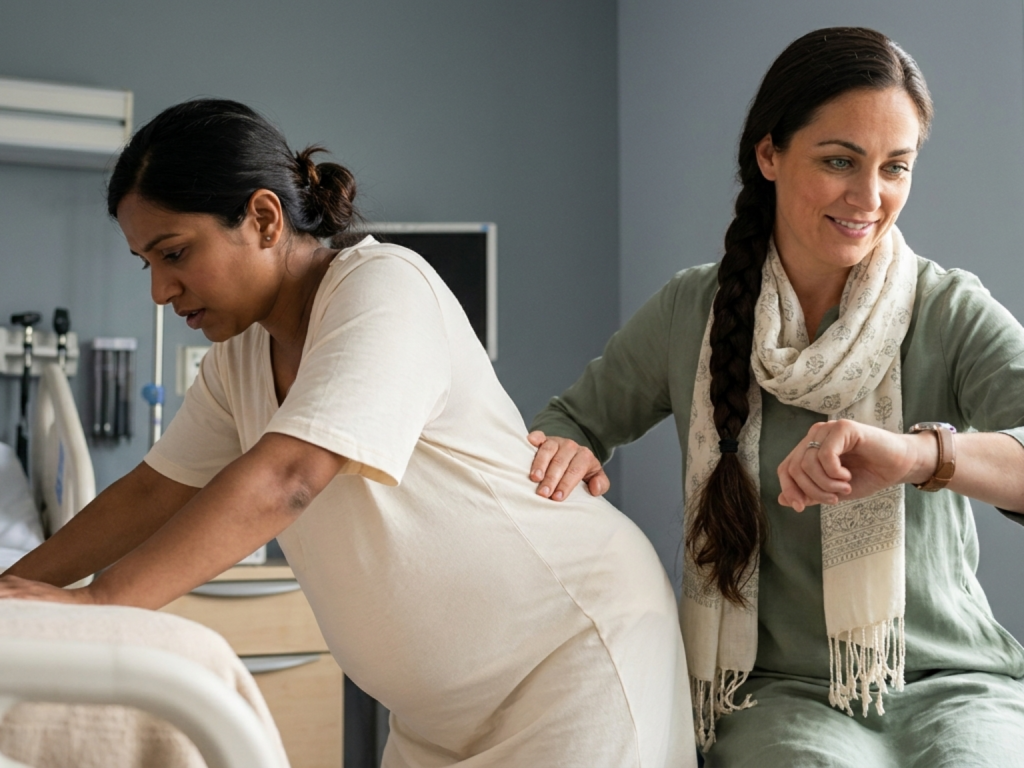
When observing labor contractions, note the beginning of one contraction, its duration, and the interval from the beginning of one contraction to the beginning of the next. A written record or a contraction-timing application can help communicate the pattern to your clinician, although timing does not replace assessment. Try to observe whether the back pain follows the same rhythm as the abdominal tightening, whether it is becoming more intense, and whether rest, hydration, or a change in activity alters it.
Braxton Hicks contractions, sometimes called practice contractions, are often irregular and may settle when activity changes or the body is rested. They can still be uncomfortable, and some people feel them in the back. The distinction is not absolute, especially before active labor. A maternity professional can help determine whether the pattern is consistent with labor, particularly if you are near term or have risk factors for preterm birth.
Why fetal position may influence back pain
One commonly discussed association is fetal occiput posterior positioning, in which the back of the fetal head is oriented toward the pregnant person’s back. This position may increase pressure on the sacral area and contribute to back-focused pain, although fetal position can change during labor and back labor can occur without a persistent occiput posterior position. It is therefore not appropriate to infer fetal position from pain alone.
The uterus, cervix, pelvic floor, sacroiliac joints, and surrounding nerves all contribute to labor sensations. Cervical dilation and effacement produce visceral pain, while pressure on pelvic structures can create somatic pain that is more localized. Referred pain may also make a contraction originating in the uterus feel strongest in the back, hips, or thighs.
Back pain in labor is not evidence that the pregnant person caused a problem through posture, movement, or anything eaten or done before labor. Labor physiology is variable. If the pain is unusually severe, constant, unilateral, accompanied by abdominal tenderness, or unlike your expected contraction pattern, seek clinical advice rather than attributing it automatically to fetal position.
Back labor compared with other late-pregnancy pain
Late pregnancy commonly causes mechanical low-back pain because the center of gravity shifts, ligaments become more flexible, and the growing uterus changes loading across the spine and pelvis. Musculoskeletal pain may be related to walking, prolonged standing, turning in bed, or a particular posture. It may improve with rest or a change of position and may not follow a rhythmic contraction pattern.
Possible back labor is more likely when the discomfort accompanies regular uterine tightening, pelvic or rectal pressure, progressive cramping, a mucus show, or rupture of the membranes. The NHS lists backache among signs that labor may be beginning, alongside contractions, a mucus show, an urge to go to the toilet, and the waters breaking. These signs may occur in different combinations, and some people do not notice every sign.
Back pain can also have non-obstetric causes, including urinary tract or kidney conditions, muscle strain, nerve irritation, or other medical problems. Fever, painful urination, flank pain, vomiting, new weakness, numbness, or loss of bladder or bowel control warrants prompt medical evaluation. If you have had a spinal procedure, epidural, trauma, or a condition affecting your back, tell the maternity team about it.
What you can observe and discuss with your care team
If your clinician has advised you to monitor early labor at home, record the contraction pattern and associated symptoms. Note whether your membranes have ruptured, the color and odor of any fluid, the presence of vaginal bleeding or bloody mucus, fetal movement, and your temperature if you feel unwell. Include whether the pain is continuous or intermittent and whether it spreads to the hips or legs.
Comfort strategies should be individualized, especially if pregnancy complications or restrictions are present. Depending on your care plan, options may include changing positions, walking gently, leaning forward over a stable surface, using hands-and-knees positioning, applying warmth to the lower back, receiving counterpressure or massage, breathing slowly through contractions, and using water in a shower or bath when approved. A support person can help with timing and physical reassurance, but should not press directly over an area of unexplained severe pain or delay medical contact.
Discuss analgesia and anesthesia options before or during labor with your obstetric, midwifery, or anesthesia team. Epidural analgesia and other pain-relief approaches have indications, contraindications, timing considerations, and potential adverse effects that require professional assessment. You do not need to prove that the pain is severe enough to deserve support; communicating clearly about the intensity and pattern helps the team respond appropriately.
When to contact the maternity unit
Follow the individualized instructions given by your obstetrician, midwife, or birth facility. In general, contact the maternity unit when contractions become regular and increasingly painful according to the facility’s guidance, when your waters break, or when you are concerned that labor may be starting. Contacting the team is also appropriate when back pain is intense, continuous, or difficult to distinguish from another medical problem.
Seek urgent assessment for heavy vaginal bleeding, severe abdominal pain between contractions, fever or feeling acutely unwell, fainting, chest pain, shortness of breath, new neurological symptoms, or a marked reduction in fetal movement. Green or brown amniotic fluid, foul-smelling fluid, or suspected rupture of the membranes before term also requires prompt clinical advice. If you have a high-risk pregnancy, a history of rapid labor, a prior cesarean birth, or possible preterm labor, use a lower threshold for calling.
A clinician may ask questions about timing, pain location, fluid loss, bleeding, fetal movement, and gestational age. Assessment may include maternal vital signs, abdominal examination, fetal heart-rate monitoring, and evaluation of cervical change when clinically indicated. These steps distinguish normal labor progression from conditions requiring additional care.
Contact your maternity team urgently if
- You have heavy vaginal bleeding or severe abdominal pain between contractions.
- Your waters break and the fluid is green, brown, foul-smelling, or blood-stained.
- You develop fever, fainting, severe weakness, chest pain, or shortness of breath.
- Fetal movement is markedly reduced or feels substantially different from usual.
- You have severe continuous back pain, new numbness or weakness, or loss of bladder or bowel control.
- You may be in preterm labor or have been told to seek care promptly for any concerning symptom.
Tools & Assistance
- A written contraction log or clinician-approved contraction timer
- Your maternity unit, obstetrician, midwife, or maternity triage service
- A support person who can record timing and communicate changes
- A birth plan documenting preferred comfort and pain-relief discussions
FAQ
Is back labor always felt between contractions?
No. Some people feel back pain mainly during contractions, while others have persistent aching or pressure between contractions. Either pattern can occur, so the overall contraction pattern and associated signs matter.
Does back labor mean the baby is facing the wrong way?
Not necessarily. Occiput posterior positioning may contribute to sacral pressure in some labors, but fetal position can change and pain alone cannot identify fetal position.
Can Braxton Hicks contractions cause back pain?
Yes. Practice contractions may be felt in the back, but they are often irregular and may settle with rest or a change in activity. Contact your clinician if you are uncertain.
Should I go to the hospital because of back pain alone?
Follow the instructions of your maternity team. Severe, persistent, unusual, or concerning back pain warrants a call, particularly if it occurs with bleeding, fluid leakage, fever, reduced fetal movement, or other warning signs.
What can help relieve back labor?
Depending on your circumstances and care plan, position changes, counterpressure, warmth, movement, breathing techniques, hydrotherapy, and medical analgesia may help. Discuss safe options with your healthcare professionals.
Sources
- PubMed — Low-back pain during labor
- Cleveland Clinic — Back Labor: Signs, How It Feels, Causes & Relief
- NHS — Signs that labour has begun
Disclaimer
This article is for general educational purposes and does not diagnose or treat any condition. Contact your obstetrician, midwife, or maternity unit for personalized advice, and seek urgent care for warning signs.















Please log in to leave a comment.