
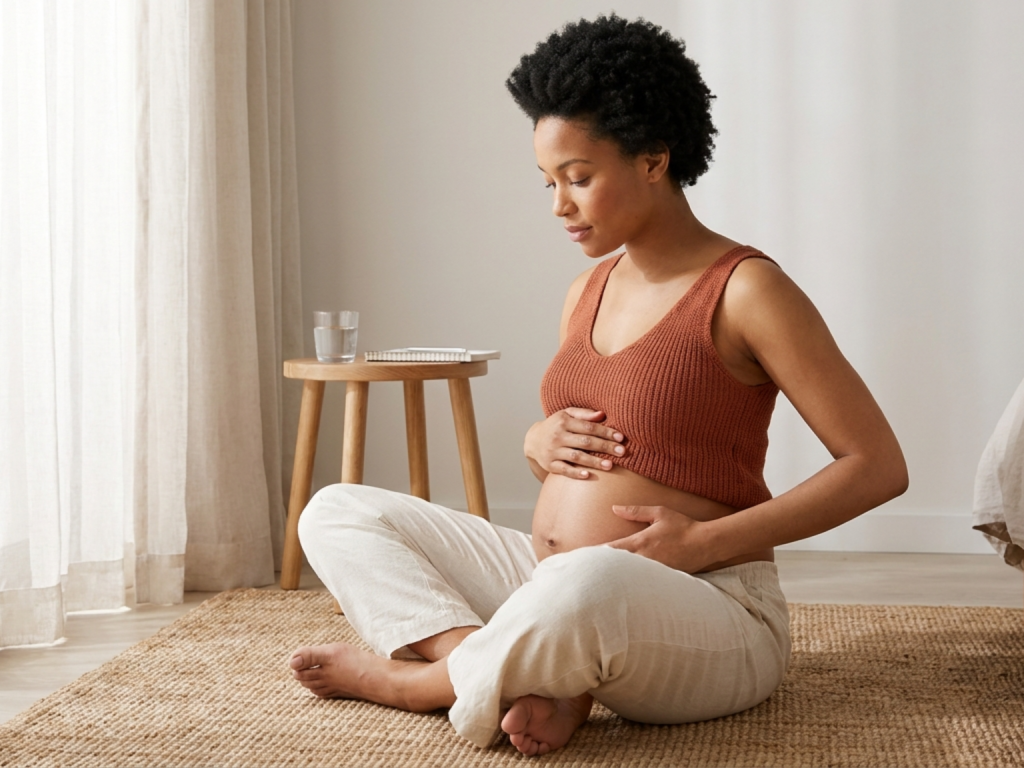
Intro
Pregnancy can amplify both ordinary stress and deeply personal worries: sleep may be lighter, the body may feel unfamiliar, and even small uncertainties can start to feel urgent. Mindfulness and meditation are not about forcing calm or pretending everything is easy. They are practices for noticing what is happening in the mind and body with less automatic reactivity, which can be especially helpful when emotions fluctuate across trimesters.
For many pregnant people, gentle meditation offers a practical way to create brief pauses in the day, reduce tension, and support emotional regulation. The aim is not perfection. It is to build a small, repeatable skill set that can fit around prenatal care, work, family demands, nausea, pelvic discomfort, and fatigue, while staying attentive to safety and to your own limits.
Highlights
Mindfulness trains attention and acceptance, helping you notice thoughts, sensations, and emotions without immediately reacting to them.
Pregnancy-friendly practices usually include slow breathing, body scan meditation, and short walking meditation sessions that can be adapted to changing comfort levels.
Meditation may support stress reduction, sleep, and coping, but it does not replace prenatal care, therapy, or urgent medical evaluation when needed.
If a technique increases dizziness, panic, dissociation, or physical discomfort, it is reasonable to stop and try a different approach with professional guidance.
What mindfulness means in a pregnancy context
In clinical and psychological terms, mindfulness is the deliberate, nonjudgmental attention to present-moment experience. Instead of trying to suppress thoughts or judge them as good or bad, you notice them, name them if helpful, and let them pass. That may sound simple, but it can interrupt the loop of rumination that often accompanies antenatal anxiety, body-image changes, or fear about labor and parenting.
Meditation is one way to practice mindfulness. It can be formal, such as a seated session with attention on the breath, or informal, such as pausing to notice your footing while walking. Research reviewed by major health organizations suggests meditation can reduce stress and improve coping for many people, although results vary and it is not a universal solution. During pregnancy, that matters: the goal is not to eliminate every worry, but to change your relationship with worry so it becomes less consuming.
From a physiology perspective, mindful attention may help shift the nervous system away from chronic sympathetic activation, the state associated with alertness and stress, and toward parasympathetic activity, which supports rest and recovery. That does not mean mindfulness fixes hormone changes or obstetric complications. It means the practice can complement prenatal care by making stress a little more manageable.
Pregnancy-friendly meditation techniques to start with
For most beginners, the safest and most sustainable methods are simple. A seated breath practice is often the easiest place to begin. Sit upright with support behind your back, relax your jaw and shoulders, and notice the natural movement of the breath without trying to deepen it. If attention drifts, gently return. Short sessions of three to ten minutes can be enough.
A body scan is another useful option. Slowly move attention from the forehead to the toes, observing areas of warmth, tightness, numbness, or comfort. This can be grounding when pregnancy sensations feel overwhelming. If any region is painful, you do not have to force awareness there; you can skip it or keep the scan very brief.
Walking meditation may suit people who find sitting uncomfortable. Walk slowly, notice the heel-to-toe rhythm, and keep your attention on movement, balance, and the contact of each step. Some people also benefit from loving-kindness or compassion-based meditation, which uses phrases of goodwill such as wishing safety and ease for oneself and the baby. The point is to choose a form that feels nourishing rather than demanding.
How to adapt practice to common pregnancy symptoms
Pregnancy changes what “comfortable” looks like from week to week. If nausea is prominent, practicing immediately after meals may be unhelpful; a brief session in fresh air or while sitting near an open window may be easier. If reflux or shortness of breath worsens when you recline, choose an upright or side-lying position. If prolonged lying flat makes you lightheaded in later pregnancy, avoid it and ask your clinician about positional comfort if you are unsure.
Breath-based practices should remain gentle. There is usually no need for breath retention, forceful breathing, or intense breathwork. Those approaches can provoke dizziness or anxiety in some people and are not necessary for mindfulness. Many pregnant people do best with a natural, unforced breath and a slow exhale.
It can also help to lower the standard for what counts as a “successful” session. If you can notice three breaths before an ultrasound appointment, that is still meaningful. If you can pause once during a busy day to place a hand on your abdomen and relax your shoulders, that is a valid practice. Consistency matters more than duration, and flexibility matters more than discipline.
Using mindfulness for stress management in pregnancy
One of the most practical roles of meditation is stress management in pregnancy. Many worries are repetitive rather than solvable in the moment: birth plans, fetal development, finances, work leave, family dynamics, or uncertainty about labor. Mindfulness does not erase those concerns, but it can create enough space to respond instead of spiraling. For example, you may notice a thought such as “something is wrong,” label it as a worry, and return to the present task rather than treating the thought as a fact.
This approach can be especially useful before appointments, at night when the mind becomes busy, or after a difficult conversation. A brief mindfulness pause can reduce physiological arousal and make sleep routines more predictable. Some people find it helpful to pair meditation with journaling: write down the main concern, note what is known, and park the rest until you can speak with a clinician or trusted support person.
For some people, breathing exercises for prenatal anxiety are most useful when they are short, structured, and paired with grounding. That might mean counting exhalations, feeling the feet on the floor, or naming five objects in the room. The goal is not to “perform calm,” but to reduce the intensity of anxious activation enough to think clearly.
When meditation helps less, and support should increase
Mindfulness is not always the right first step. If you notice that closing your eyes increases panic, if body awareness triggers trauma memories, or if silence makes intrusive thoughts louder, a different strategy may be safer. Some people need guided, trauma-informed approaches rather than unguided meditation. Others need treatment for depression, panic disorder, obsessive-compulsive symptoms, or post-traumatic stress that goes beyond self-care.
This is where perinatal mental health support becomes important. A midwife, obstetrician, family doctor, psychiatrist, psychologist, or therapist can help you decide whether mindfulness should be part of a broader care plan. If symptoms are persistent, worsening, or affecting eating, sleep, bonding, work, or daily functioning, it is appropriate to ask about pregnancy anxiety therapy options and a formal perinatal mental health assessment. Mindfulness can be one tool, but it should not delay care when clinical symptoms are significant.
Seek prompt medical advice if you also have chest pain, fainting, vaginal bleeding, severe headache, reduced fetal movement, or thoughts of self-harm. Those are not meditation problems; they are reasons to contact your prenatal team or emergency services without delay.
Building a realistic routine that lasts
The most effective meditation routine is usually the one you will actually keep. Many pregnant people do better with a predictable anchor, such as practicing right after brushing teeth, before an evening shower, or after a morning ultrasound or blood pressure check. A routine can be as small as two minutes. If your schedule is unpredictable, pair mindfulness with an existing habit rather than trying to add a brand-new obligation.
Guided audio can be helpful because it reduces the effort of self-directing attention. Reputable meditation recordings, prenatal classes, or brief sessions recommended by your care team may be easier to sustain than a silent practice at first. If you are comfortable, invite a partner or support person to join a short session; shared practice can make the habit feel less isolated and can also teach them how to support you during stressful moments.
Finally, approach the practice with the same compassion you would offer a friend. Some days you will feel focused, and other days you will feel distracted or irritable. Neither outcome means you failed. The real outcome is that you returned to the practice, even briefly, and gave your nervous system a chance to rest.
When to pause and seek medical advice
- Stop the practice if it causes dizziness, shortness of breath, panic, or a feeling of losing touch with reality.
- Get urgent care for chest pain, fainting, heavy bleeding, severe abdominal pain, or reduced fetal movement.
- Do not rely on meditation alone if you have persistent depression, panic attacks, intrusive thoughts, or trauma symptoms.
- Ask your prenatal clinician before using breathwork styles that feel intense, prolonged, or physically uncomfortable.
Tools & Assistance
- A quiet chair, cushion, or side-lying position that supports comfortable breathing.
- A reputable guided meditation app or audio track with short sessions.
- A prenatal clinician, midwife, or therapist who can advise on safe coping strategies in pregnancy.
- A simple timer, notebook, or phone reminder to help build a consistent practice.
FAQ
Is mindfulness safe in pregnancy?
Gentle mindfulness and meditation are generally considered low risk for most people, but they should be adapted to your symptoms and medical situation. If a practice feels distressing or physically uncomfortable, stop and ask your clinician.
How long should I meditate?
There is no required duration. Even two to ten minutes can be useful if practiced regularly and without pressure.
Can meditation help with pregnancy anxiety?
It may help reduce reactivity, improve attention, and support calm breathing, but it is not a substitute for therapy or medical care when anxiety is severe or persistent.
What if I cannot clear my mind?
That is normal. Mindfulness is not about emptying the mind; it is about noticing thoughts and returning attention gently, again and again.
Sources
- National Center for Complementary and Integrative Health (NCCIH), NIH — Meditation and Mindfulness: Effectiveness and Safety
- Mayo Clinic — Meditation: A simple, fast way to reduce stress
- American Psychological Association — Mindfulness meditation: A research-proven way to reduce stress
Disclaimer
This article is for educational purposes only and does not replace individualized medical, obstetric, or mental health care. If you have concerning symptoms or a mental health crisis, contact your prenatal team or emergency services promptly.















Please log in to leave a comment.