
Intro
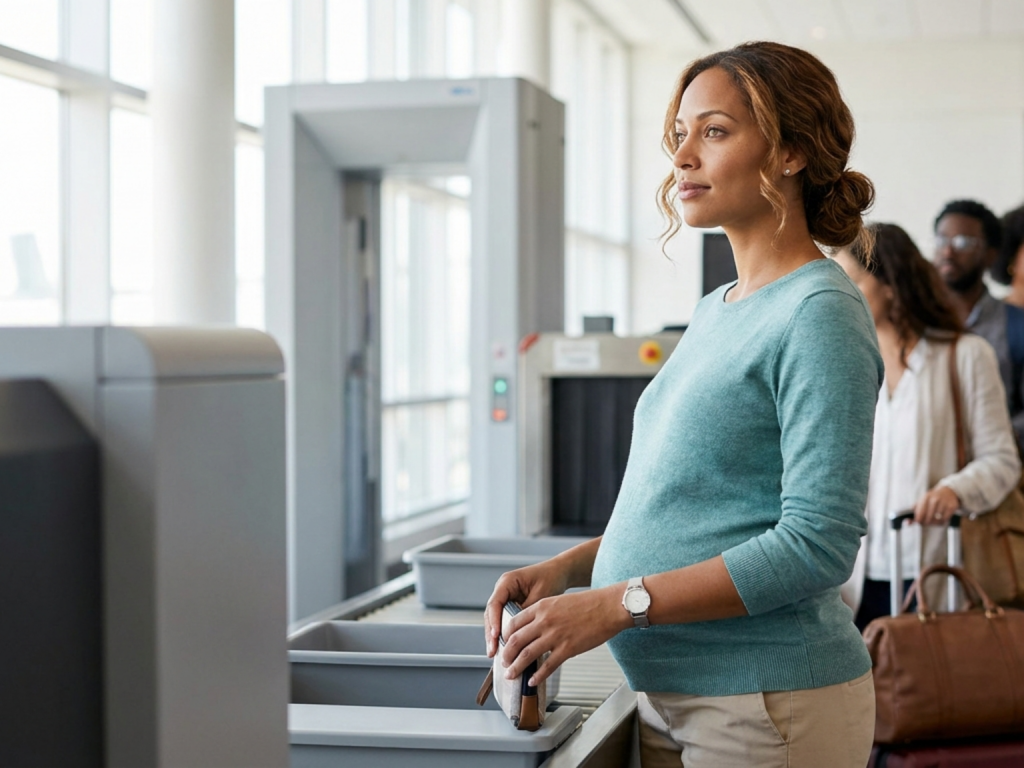
It is completely understandable to wonder whether airport security screening is safe during pregnancy. When you are caring for yourself and your developing baby, even routine travel steps can feel loaded with uncertainty.
The reassuring answer from major public-health and radiation-safety organizations is that airport security screening is considered safe for pregnant travelers. The details matter, though, and understanding what the machines actually use can make the process feel less intimidating.
Highlights
Airport security screening is considered safe in pregnancy by the CDC, TSA, and Health Physics Society.
Older magnetometer-style detectors do not harm the fetus, and modern scanners use either non-ionizing energy or extremely low radiation.
The exposure from passing through a checkpoint scanner is very small and not thought to pose a fetal risk.
If you have a high-risk pregnancy or new symptoms, the bigger question is your overall travel plan, not the security checkpoint itself.
The short answer: yes, airport security is generally safe
For most pregnant travelers, airport security screening is considered safe. The CDC states that older airport security machines, such as magnetometers, are not harmful to the fetus. The Transportation Security Administration also says that all screening equipment at the checkpoint is safe for all travelers, including pregnant women. The Health Physics Society reaches the same conclusion: passing through an airport security portal does not pose a risk to a pregnant woman or her unborn child.
That consensus is important because it comes from different angles: public health, radiation safety, and the agency that operates airport checkpoint screening in the United States. In practical terms, this means that the walk-through itself is not something you need to fear as a source of meaningful fetal exposure. For a medically literate reader, the key concept is that the level and type of exposure are far below what would be expected to cause harm in pregnancy.
If you are already anxious about travel, it can help to separate the checkpoint from the rest of the trip. Security screening is one small moment in a much larger journey, and the available evidence is reassuring.
What airport scanners actually use
Airport screening is often talked about as if it were one single technology, but there are several different systems. Older checkpoints used magnetometers, which detect metal. They do not involve radiation and are not harmful to a fetus. More modern full-body scanners may use millimeter-wave technology or x-ray backscatter technology, depending on the airport and the equipment in use.
This distinction matters because not all radiation is the same. Millimeter-wave scanners use radiofrequency energy, which is non-ionizing. Non-ionizing energy does not have enough energy to remove electrons from atoms and therefore does not have the same biologic effect as ionizing radiation. X-ray backscatter scanners do use x-rays, but the radiation dose is extremely low and the energy is described as very low and low-intensity by the Health Physics Society.
So while the word x-ray can sound alarming, the dose from airport screening is not comparable to diagnostic imaging studies. The CDC notes that the radiation risk from these scanners is extremely low. In other words, the technology is designed for brief screening, not for delivering a medically significant radiation exposure.
Why the fetal risk is considered extremely low
When clinicians assess pregnancy exposures, they often consider whether a source involves ionizing radiation, the amount of exposure, and the timing in gestation. Airport screening does not come close to the levels that are typically associated with fetal harm. That is why the expert consensus is so reassuring.
The Health Physics Society explains that a radiofrequency scanner does not use ionizing radiation at all, while the x-ray scanner uses very low-energy, low-intensity radiation. The practical takeaway is that simply walking through an airport security portal is not considered a meaningful fetal radiation exposure. The CDC and TSA align with this view, which is helpful because it means the reassurance is not based on a single opinion.
For many patients, the word radiation is the source of the worry, not the checkpoint itself. It is reasonable to be cautious in pregnancy, but caution works best when it is informed by dose and physics rather than by the label alone. Airport security screening is one of those situations where the technical details substantially reduce the concern.
When to ask your obstetric clinician before traveling
Although the checkpoint itself is considered safe, the overall decision to travel may deserve individualized medical advice. That is especially true if you have a high-risk pregnancy, placenta previa, vaginal bleeding, contractions, blood pressure concerns, diabetes requiring close monitoring, a recent hospitalization, or any condition your clinician has already flagged as needing extra attention.
Travel timing can matter more than security screening. Some people are comfortable traveling earlier in pregnancy and then adjusting plans later on, which is why conversations about second trimester travel planning or third trimester travel restrictions often come up in prenatal care. If you are unsure about flying at all, the question may be broader than airport security and may belong in a discussion about air travel in uncomplicated pregnancy versus travel in a pregnancy with added medical complexity.
It is also wise to seek medical guidance if you have new symptoms before departure, such as bleeding, fluid leakage, painful contractions, or decreased fetal movement. Those symptoms are not a reason to second-guess the scanner; they are a reason to get evaluated before you travel.
How to make airport screening easier in pregnancy
Even when a screening process is medically safe, it may still feel physically tiring. Long lines, standing in one place, or carrying bags can be uncomfortable as pregnancy advances. Planning ahead can reduce stress. Arriving early gives you time to move at a slower pace, ask questions, and avoid rushing through the checkpoint.
Comfort also matters. Wear clothing and shoes that are easy to remove if needed, keep important documents and medications accessible, and avoid lifting heavy luggage when you do not need to. If standing for long periods makes you lightheaded or uncomfortable, plan breaks when possible and use airport assistance services if you need them. These are not medical treatments; they are practical ways to lower strain.
If your clinician has given you specific travel instructions, follow those first. For example, someone with a medical complication may need a different plan than someone with an uncomplicated pregnancy. The security checkpoint itself is not usually the problem, but travel logistics can still affect how you feel physically and emotionally.
Putting airport security in context
It helps to remember what airport security is and is not. It is a brief screening step designed to keep air travel safe. It is not a medical procedure, and it is not considered a source of significant fetal exposure. The major organizations cited here are aligned: the CDC says the scanners are not harmful to the fetus, the TSA says the equipment is safe for pregnant women, and the Health Physics Society explains why the radiation concern is so small.
That does not mean every pregnant traveler should ignore the rest of the trip. Dehydration, long periods of sitting, nausea, fatigue, and the emotional strain of travel can still matter. If you are already thinking about trip timing, it can be helpful to frame the whole journey carefully rather than focusing only on the checkpoint. Many people look at second trimester travel planning when deciding whether to travel, while others need a clinician’s input because of symptoms or medical history.
The bottom line is simple: for most pregnant women, airport security screening is a reassuringly low-risk part of travel. The bigger safety questions are usually about the pregnancy itself and the overall travel plan, not the scanner.
When to pause and get medical advice
- Do not rely on general travel advice if you have a high-risk pregnancy or a recent complication.
- Seek urgent evaluation for vaginal bleeding, fluid leakage, painful contractions, or reduced fetal movement.
- Ask your obstetric clinician before travel if you have placenta previa, preterm labor risk, or another condition requiring close follow-up.
- If anxiety about screening is overwhelming, discuss your travel plan with a healthcare professional before departure.
Tools & Assistance
- Your obstetric clinician or midwife
- Airport customer service or special assistance desk
- TSA checkpoint officer or TSA traveler support resources
- Your prenatal care summary or medication list if your clinician recommends carrying it
FAQ
Can airport scanners harm the baby during pregnancy?
According to the CDC, TSA, and Health Physics Society, the standard security screening systems used at airports are considered safe in pregnancy and are not thought to harm the fetus.
Is the x-ray scanner at airport security dangerous if I am pregnant?
The x-ray backscatter scanners used in some airports deliver very low-energy, low-intensity radiation, and the overall risk is considered extremely low.
Do older metal detectors pose any risk in pregnancy?
No. Older magnetometer-style detectors are not harmful to the fetus.
Should I ask my doctor before flying if I am pregnant?
It is a good idea to ask if you have a high-risk pregnancy, recent symptoms, or any condition that makes travel more complicated.
Sources
- Centers for Disease Control and Prevention (CDC) — Pregnant Travelers
- Health Physics Society — Pregnancy and Security Screening
- Transportation Security Administration — Pregnant Travelers
Disclaimer
This article is for informational purposes only and does not replace individualized medical advice. If you have a high-risk pregnancy or new symptoms, contact your obstetric clinician or seek urgent care.

















Please log in to leave a comment.