
Intro
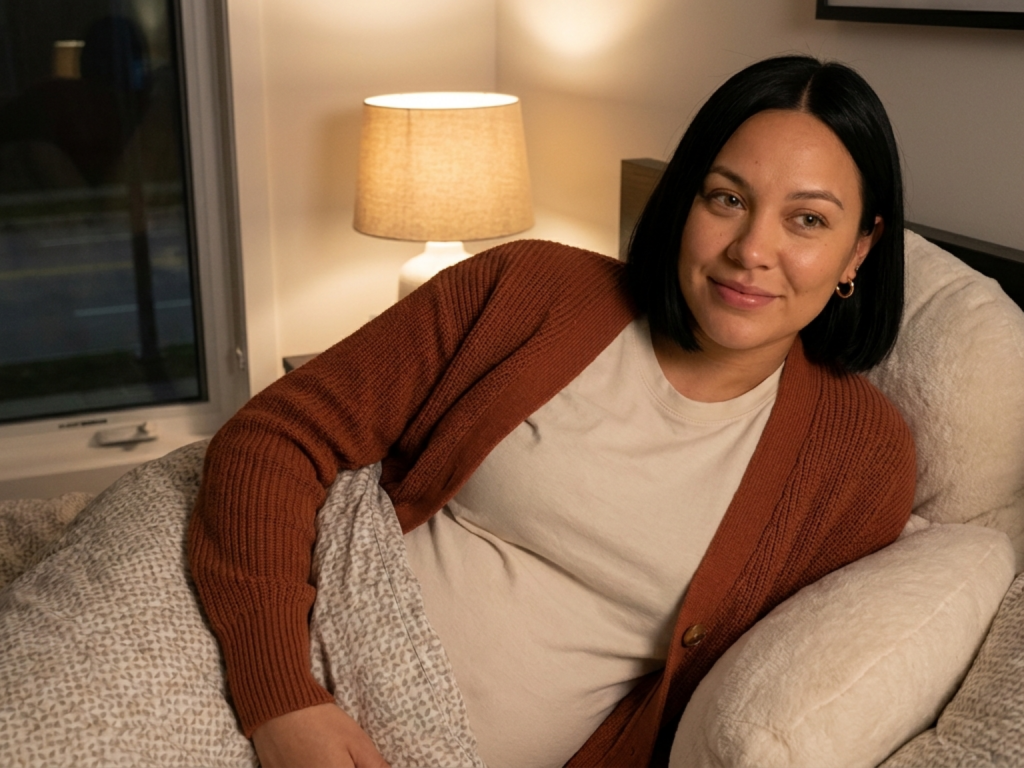
If you are pregnant and suddenly paying close attention to every way you lie down, you are not alone. Sleep advice in pregnancy can sound more alarming than it needs to be, especially when you are trying to rest and your body is already changing every week.
The reassuring part is that the evidence is trimester-specific. For most of early pregnancy, there is no evidence that sleep posture affects outcomes. The more important shift comes later, around 28 weeks’ gestation, when guidance changes toward side sleeping and away from going to sleep on your back. This article breaks down what that means in practical terms, while keeping the focus on comfort, reassurance, and individualized medical advice when needed.
Highlights
Before 28 weeks, the best available evidence does not show that sleeping posture affects pregnancy outcomes, so early pregnancy is usually about comfort rather than strict positioning.
Starting at 28 weeks, the main recommendation is to avoid going to sleep on your back and to favor side sleeping instead.
Right-side sleeping in pregnancy appears to be as safe as left-side sleeping, so the goal is side sleeping, not forcing one perfect side.
The late-pregnancy side-sleeping advice applies to both night sleep and daytime naps.
If you have a high-risk pregnancy or specific symptoms, your maternity team should guide any sleep-position advice.
What the evidence says about sleep position
The most useful way to think about sleep position in pregnancy is by timing. A recent review found that before 28 weeks’ gestation, sleeping posture does not appear to affect pregnancy outcomes. That is a reassuring finding, because it means the early and middle stages of pregnancy are not defined by a need to micromanage every position you take at night.
The recommendation becomes more specific at 28 weeks. From that point onward, pregnant patients are generally advised to avoid going to sleep on their back. The concern is tied to late-pregnancy physiology: when the uterus is larger, the supine sleep position in pregnancy can place more pressure on major blood vessels, which may reduce uteroplacental blood flow in some people. The evidence base is not about perfection or fear; it is about choosing the safest default once the pregnancy is far enough along that anatomy and circulation matter more.
An NIH update also reported that sleeping on the back or side through the 30th week did not appear to increase stillbirth risk, reduced size at birth, or hypertensive disorders of pregnancy. That is important because it shows the strongest evidence for sleep-position restrictions is later in pregnancy, not in the first or early second trimester. In practice, the safest approach is a balanced one: respect the later-pregnancy guidance, but do not let early-pregnancy sleep worries become a source of unnecessary stress.
First trimester: comfort first, not perfection
In the first trimester, the safest sleeping position is usually the one that lets you sleep at all. Based on the available evidence, sleeping posture before 28 weeks has not been shown to affect pregnancy outcomes, so there is no need to force a side-sleeping routine if it leaves you tense, awake, or in pain.
This is often the most symptom-heavy part of pregnancy, and sleep may already be fragmented by nausea, fatigue, breast tenderness, or emotional stress. Because the evidence does not show a pregnancy-outcome penalty from your sleep position this early, you can prioritize rest and use whatever position is most tolerable. If you have a pre-existing condition that affects sleep, such as reflux, back pain, or a sleep disorder, it is still worth mentioning it to a clinician, but not because the first trimester demands a strict posture rule.
The main message for this stage is simple: you do not need to police your body overnight. Early pregnancy is a reasonable time to focus on healthy sleep habits, regular bedtime routines, and enough rest, rather than on one prescribed position.
Second trimester: an easy time to build side-sleep habits
The second trimester is often when people feel better physically and start planning for later pregnancy. It is also a practical window to try side sleeping if that feels comfortable, even though the evidence still does not show that sleep posture affects pregnancy outcomes before 28 weeks. In other words, you can experiment without feeling that you are preventing a problem that already exists.
Some people use this period to get used to sleeping on their side before the abdomen becomes larger and back lying feels less comfortable. That can make the transition smoother later on. Still, there is no reason to treat the left side as the only acceptable option. The current evidence suggests right-side sleeping in pregnancy appears to be as safe as left-side sleeping, so you can choose whichever side is easier on your hips, ribs, or shoulders.
This is also the stage where people often ask whether they should start changing position now to “get ahead” of third-trimester advice. The honest answer is that there is no medical need to do that for outcomes before 28 weeks. If side sleeping helps you rest, great. If not, that is also okay. The goal is a sustainable habit, not a rigid rule.
Third trimester: side sleeping becomes the default
From 28 weeks onward, the advice becomes clearer: avoid going to sleep on your back and use side sleeping as your default. That recommendation comes from the combination of physiologic reasoning and research linking back-sleeping after 28 weeks with a higher stillbirth risk. Importantly, this advice applies to both night sleep and daytime naps, so it is not just a bedtime rule.
For many people, the most reassuring detail is that the evidence does not favor one side over the other. Left versus right side sleeping does not seem to make a meaningful difference for most pregnancies, and right-side sleeping in pregnancy appears to be as safe as left-side sleeping. If one side is more comfortable, choose it. If you switch sides during the night, that is fine too.
If you wake up on your back, do not panic. The advice is about the position you go to sleep in, and many people move naturally during the night. The practical aim is to start sleep on your side and return to it if you notice you have drifted flat. If you are unsure whether you should have stricter guidance because of a complication, such as a growth concern or blood pressure issue, ask your maternity team for individualized advice rather than trying to self-interpret the data.
How to make sleeping on your side more comfortable
Side sleeping is safer in late pregnancy, but it is not always easy. Comfort matters, because a position that keeps you awake will not help your body recover. Many people find that a few small adjustments make sleeping on your side much more tolerable.
- Use a pillow between your knees to reduce hip and lower-back strain.
- Place a pillow behind your back if you tend to roll flat during the night.
- Try a pregnancy pillow for side sleeping if you want more full-body support.
- Keep the room cool and the bedding light, since overheating can worsen sleep disruption.
- Experiment with a slightly bent-knee position instead of lying completely straight on your side.
There is no prize for enduring discomfort. If one side is painful, the other side is acceptable. If you need to reposition often, that is normal. The best sleep position is the one that is both safer and realistically sustainable for your body. For some people, the challenge is not the side itself but the pressure on the shoulder, hips, or pelvis. In those cases, supporting the body with pillows and adjusting the mattress or bedding can make a meaningful difference.
If discomfort persists despite these changes, that is a good reason to bring it up at your next prenatal visit. You may be able to get advice that is tailored to your anatomy and pregnancy history.
When to ask your healthcare professional
General sleep-position guidance is helpful, but it does not replace individualized obstetric or midwifery advice. That matters especially if your pregnancy is considered higher risk, if you have been given special instructions already, or if symptoms make any position hard to tolerate.
Contact your healthcare professional if you are unsure whether the standard third-trimester advice applies to you, if side sleeping causes significant pain or dizziness, or if you are worried about fetal well-being. The same is true if you notice reduced fetal movements, because that should always be assessed promptly and should not be explained away by sleep posture. In late pregnancy, sleep position is only one part of the picture; your overall symptoms, blood pressure, fetal growth, and other clinical factors may matter more than the position itself.
It can help to think of sleep guidance as a safety framework, not a rulebook. The point is to reduce avoidable risk while preserving rest, and sometimes that balance is best made with a clinician who knows your pregnancy in detail.
When to seek medical advice promptly
- If you are 28 weeks or beyond and repeatedly fall asleep on your back, mention it to your maternity team.
- Reduced fetal movements should be assessed promptly, regardless of your sleep position.
- Seek urgent care if lying down causes severe shortness of breath, chest pain, fainting, or marked dizziness.
- If you have a high-risk pregnancy or specific obstetric instructions, follow those rather than general advice.
- Do not rely on sleep position alone if you are worried that something feels wrong.
Tools & Assistance
- Your midwife, obstetrician, or maternity triage line for individualized sleep-position advice
- A prenatal visit to review comfort, back pain, or other sleep barriers
- A pregnancy pillow or supportive bedding to help maintain side sleeping
- A note or phone reminder for the 28-week shift to side sleeping
- Hospital labor and delivery triage for urgent pregnancy concerns
FAQ
Is left-side sleeping better than right-side sleeping?
Not based on the evidence cited here. Right-side sleeping in pregnancy appears to be as safe as left-side sleeping, so either side is acceptable.
When should I stop going to sleep on my back?
The practical cutoff in the reviewed evidence is 28 weeks’ gestation. From that point, advice shifts toward avoiding going to sleep on your back.
Does the advice apply only at night?
No. The third-trimester side-sleep recommendation also applies to daytime naps.
What if I wake up on my back?
That is common. The advice is to start sleep on your side and return to that position if you notice you have drifted onto your back.
Do I need to change positions in the first trimester?
Usually no. Before 28 weeks, sleeping posture has not been shown to affect pregnancy outcomes, so comfort is the main priority.
Sources
- NIH / PubMed Central — Sleeping posture in pregnancy
- Tommy's — Sleeping position in pregnancy Q&A
- Eunice Kennedy Shriver National Institute of Child Health and Human Development — Science Update: Sleeping position during early and mid pregnancy does not affect risk of stillbirth, complications
Disclaimer
This article is for general educational purposes only and does not replace individualized medical advice. If you have symptoms, a high-risk pregnancy, or concerns about fetal movements, contact your healthcare professional promptly.
















Please log in to leave a comment.