
Intro
A predictable school day routine can protect a child’s learning, mood regulation, sleep, nutrition, and family relationships. For many children, the hardest part is not the school day itself but the transitions: waking, leaving home, arriving back tired or hungry, starting homework, and winding down for bed.
Structure does not mean rigidity. A supportive routine gives children a clear sequence, age-appropriate autonomy, and enough flexibility for illness, extracurricular activities, neurodevelopmental differences, and normal family unpredictability.
Highlights
A good routine reduces decision fatigue for both children and caregivers by making repeated tasks predictable.
After-school structure should include food, decompression, movement, homework, responsibilities, connection, and sleep preparation.
Visual schedules, checklists, and child participation can improve cooperation without relying on constant verbal reminders.
Persistent fatigue, distress, school refusal, sleep disruption, or behavioral escalation deserves thoughtful assessment and professional guidance.
Why routine matters for the school day
Children use predictable routines as an external regulatory system. The prefrontal cortex, which supports planning, inhibition, time management, and flexible problem solving, is still developing throughout childhood and adolescence. When adults create a stable sequence for mornings and after school, they reduce the cognitive load placed on a child’s immature executive function.
Routine also supports physiologic rhythms. Regular wake times, meals, physical activity, homework periods, and bedtime cues help align circadian rhythm, appetite regulation, attention, and emotional resilience. This is especially important for children who become dysregulated during transitions, including those with anxiety traits, attention difficulties, sensory sensitivities, learning differences, or high after-school fatigue.
A useful routine is not a punishment system. It is a shared map. Children are more likely to follow it when they understand what comes next, when expectations are visible, and when the plan includes recovery time rather than only demands. A child who has spent hours sitting, listening, navigating peer interactions, suppressing impulses, and processing academic material may need food, movement, quiet, or connection before they can manage homework or chores.
Building a calm morning sequence
The school day begins before the child wakes up. A smoother morning often depends on decisions made the previous evening: clothing chosen, backpack packed, forms signed, lunch prepared, and devices charged outside the bedroom if possible. This reduces early-morning conflict and protects the child from starting the day in a stress response.
A practical morning routine usually includes a consistent wake time, bathroom and hygiene tasks, getting dressed, breakfast, medication administration if prescribed, packing final items, and a predictable departure cue. For younger children or children with executive function challenges, a visual checklist can be more effective than repeated verbal prompting. Pictures, icons, or simple written steps allow the child to see progress and practice independence.
Breakfast should be realistic rather than idealized. A combination of carbohydrate, protein, and fluid can support attention and satiety, but families may need portable options when mornings are rushed. If appetite is low on waking, discuss patterns with a pediatric clinician or dietitian, particularly if growth, energy, or concentration is affected.
Caregivers can also protect the emotional climate by using neutral language: “The next step is shoes,” rather than “Why are you always late?” Children who hear repeated criticism in the morning may arrive at school already ashamed or activated. Calm repetition, limited choices, and a visible timer can be more effective than escalating urgency.
The after-school transition: food, decompression, and reconnection
The period immediately after school is a biologically vulnerable transition. Many children are hungry, dehydrated, socially depleted, overstimulated, or holding in emotions they could not express at school. A structured after-school routine should begin with recovery, not interrogation. Some children want to talk right away; others need silence, a snack, or movement before conversation.
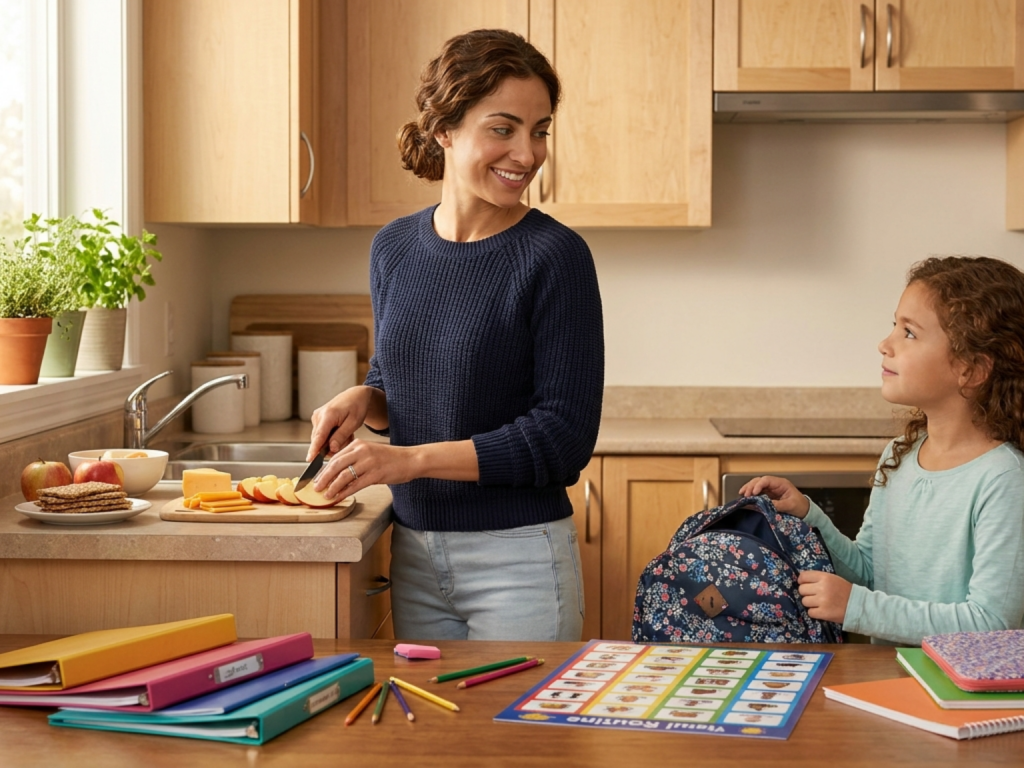
A dependable arrival routine might include placing the backpack in one location, washing hands, having a snack, emptying lunch containers, and putting school papers in a designated spot. For preschoolers and early elementary children, a picture-based sequence can make these tasks concrete: backpack on hook, shoes in bin, snack at table, then play. This type of visual schedule reduces anxiety because the child does not have to guess what adults expect.
Snack planning matters. A balanced snack with protein, fiber, and fluid may prevent irritability and help the child tolerate later homework. Examples include yogurt and fruit, cheese with whole-grain crackers, hummus with vegetables, nut or seed butter if safe for the child, or leftovers from a meal. Children with allergies, diabetes, feeding disorders, gastrointestinal disease, or medication-related appetite changes need individualized nutrition advice.
Reconnection can be brief but powerful. Ten minutes of undistracted attention, such as reading together, walking, building, drawing, or simply sitting nearby, may reduce attention-seeking behavior later. For some families, the best question is not “How was school?” but “Do you want quiet, a hug, or to tell me one thing?”
Homework without daily battles
Homework routines work best when the time, place, and expectations are predictable. A distraction-reduced area, necessary supplies, and a consistent start time decrease negotiation. This does not require a perfect desk; it may be a kitchen table, a library corner, or a quiet shared room. The goal is to reduce competing stimuli and make the task feel finite.
Many children benefit from a short decompression interval before homework. Others do better starting soon after snack, before fatigue deepens. The right sequence depends on temperament, workload, school demands, and extracurricular timing. Families can test a plan for one to two weeks, then adjust based on observable outcomes rather than daily arguments.
For children who procrastinate or become overwhelmed, break assignments into small units. Instead of “Do your homework,” try “Complete five math problems, then check in.” Timers, movement breaks, and checkboxes can support task initiation. Caregivers should avoid doing the work for the child, but they can help interpret directions, organize materials, and communicate with teachers if assignments regularly exceed the child’s capacity.
If homework routinely takes far longer than expected, triggers severe distress, or reveals reading, writing, attention, or comprehension difficulties, it may be appropriate to speak with the teacher, school psychologist, pediatrician, or a learning specialist. The issue may be workload mismatch, skill gaps, visual or hearing problems, sleep deprivation, anxiety, or another concern requiring evaluation.
Movement, chores, and downtime as health supports
After-school structure should not become a second school day. Children need physical activity, unstructured play, and recovery. Daily movement supports cardiometabolic health, motor development, sleep pressure, emotional regulation, and attention. A common target is about 60 minutes of physical activity per day, which can include recess, walking, playground time, sports, dancing, cycling, active games, or family movement.
Household responsibilities also belong in the routine, but they should be brief, specific, and developmentally appropriate. Examples include unpacking the backpack, feeding a pet with supervision, putting laundry in a basket, setting the table, or placing shoes in a designated area. Chores help children develop responsibility and self-efficacy when they are presented as contribution rather than punishment.
Downtime is equally legitimate. Some children need quiet sensory recovery after a noisy school day. Others need vigorous activity before they can sit. A supportive plan may include two different options: “quiet reset” or “active reset.” Quiet reset might be reading, drawing, puzzles, or listening to calm music. Active reset might be outdoor play, stretching, or a walk.
Screen time requires careful placement. A small amount of recreational screen time may fit some family routines, but if it consistently displaces homework, movement, meals, or sleep, it may need tighter boundaries. Many children transition away from screens with less distress when expectations are stated before use, a timer is visible, and the next activity is already known.
Adapting routines by age and temperament
Preschoolers need concrete, visual, and repetitive routines. They may not understand time-based instructions such as “in 20 minutes,” but they can understand a picture chart showing snack, bathroom, backpack, play, dinner, bath, and bedtime. Keep steps few and practice them when the child is calm.
School-age children can participate more actively. Invite them to help choose the order of snack, movement, homework, chores, and downtime. Offering controlled choices increases cooperation: “Would you rather do reading before math or math before reading?” This preserves adult boundaries while supporting autonomy.
Pre-teens often need routines that respect privacy and growing independence. They may manage a planner, digital calendar, or checklist, but still need adult oversight. A pre-teen who appears resistant may actually be overwhelmed by competing academic, social, and extracurricular demands. Collaborative planning is usually more effective than surveillance.
Temperament matters. A child who is slow-to-warm may need transition warnings. A highly active child may need movement before seated work. A sensory-sensitive child may need a low-noise space. A perfectionistic child may need reassurance that homework does not have to be flawless. Routines should fit the child, not force every child into the same template.
Linking after school structure to sleep and the next day
The after-school routine should gently point toward night. Dinner timing, homework completion, screen boundaries, bathing, reading, and calming activities all influence sleep onset. A consistent bedtime routine helps children anticipate rest and reduces last-minute conflict. Bedtime routines school age kids often work best when the same few steps happen in the same order, even if the exact clock time shifts slightly on busy days.
Sleep schedule school age children planning should consider wake time first. If a child must wake early for school, the evening routine must create enough sleep opportunity. Chronic insufficient sleep can present as irritability, inattention, hyperactivity, morning headaches, low frustration tolerance, or poor academic stamina. It can also intensify after-school meltdowns.
Families should watch for symptoms that routine alone may not fix: habitual snoring, witnessed pauses in breathing, restless sleep, persistent insomnia, severe morning difficulty, or daytime sleepiness. These signs warrant discussion with a pediatric clinician because sleep-disordered breathing, restless legs symptoms, anxiety, medication effects, or other medical factors may be involved.
A strong school day routine is therefore a 24-hour system. Morning preparation, school demands, after-school recovery, evening organization, and sleep all influence one another. Improving one part of the cycle can reduce stress across the whole family.
When the routine is not working
Even a thoughtful routine will fail sometimes. Illness, family stress, developmental leaps, school changes, bullying, grief, parental work schedules, and extracurricular overload can disrupt structure. The goal is not perfection; it is returning to predictable anchors after disruption.
If a child repeatedly melts down, refuses school, cannot complete basic routines, has marked appetite or sleep changes, or shows new withdrawal, aggression, panic, or regression, caregivers should look beyond “noncompliance.” Behavior is often communication. The child may be exhausted, anxious, depressed, overstimulated, struggling academically, experiencing peer conflict, or dealing with an unrecognized medical issue.
A practical review can begin with these questions: Is the child getting enough sleep? Are meals and snacks adequate? Is homework developmentally reasonable? Are transitions too abrupt? Is the child overscheduled? Are expectations clear and visible? Is there enough positive connection with caregivers?
Professional support may include the pediatrician, school nurse, teacher, school counselor, occupational therapist, psychologist, speech-language pathologist, dietitian, or developmental specialist, depending on the concern. Seeking help is not a failure of parenting. It is an appropriate response when a child’s daily functioning, health, or emotional safety is affected.
Seek extra support when routines reveal distress
- Contact a healthcare professional if fatigue, headaches, abdominal pain, appetite change, or sleep problems persist.
- Discuss school refusal, panic symptoms, bullying concerns, or sudden academic decline with the school and pediatric clinician.
- Do not use severe restriction of food, sleep, movement, or emotional contact as a behavior consequence.
- If a child talks about self-harm, feeling unsafe, or not wanting to live, seek urgent mental health or emergency support.
- Children with chronic illness, neurodevelopmental differences, or medication schedules may need individualized routine planning.
Tools & Assistance
- Create a one-page morning and after-school visual schedule with the child’s input.
- Use a backpack station for papers, lunch containers, shoes, and school supplies.
- Set a predictable homework start time and a visible timer for short work blocks.
- Plan daily movement before or after homework based on the child’s regulation needs.
- Ask the teacher or pediatric clinician for guidance if routines consistently break down.
FAQ
Should homework happen immediately after school?
Not always. Some children focus better after snack and a short break, while others need to start before fatigue increases. Test a consistent plan and adjust based on the child’s functioning.
How can I help a preschooler follow an after-school routine?
Use a simple picture schedule with only a few steps, such as hang backpack, wash hands, snack, play, and tidy up. Practice the sequence when the child is calm.
What if my child melts down every day after school?
Daily meltdowns may reflect hunger, fatigue, sensory overload, anxiety, academic strain, or too many demands. Start with food, decompression, and connection, and consult school or healthcare professionals if it persists.
How much physical activity should be included after school?
Many child health recommendations emphasize about 60 minutes of daily physical activity. This can be spread across recess, active play, walking, sports, or family movement.
Are checklists better than reminders?
For many children, yes. Checklists and visual charts reduce repeated verbal prompting and support independence, especially for children who struggle with working memory or transitions.
Sources
- Penn State University (Thrive) — Establishing an After-School Routine
- PBS Parents — How to Get Preschoolers Into a Routine After School
- Third Space Learning — How To Create An Amazing Before & After School Routines
Disclaimer
This article is for informational purposes only and does not replace medical, developmental, educational, or mental health advice. Consult a qualified professional for concerns about a child’s health, behavior, learning, or safety.


















Please log in to leave a comment.