
Intro
Preschool days are full of movement: waking up, getting dressed, separating at drop-off, shifting from free play to circle time, washing hands, eating, resting, cleaning up, going outside, and returning home. For many young children, these transitions are not small interruptions; they are neurologically demanding moments that require attention shifting, impulse control, language comprehension, sensory processing, and emotional regulation.
Consistent routines do not make a child rigid or dependent. When used warmly and flexibly, they create predictable cues that help the developing brain anticipate what comes next. This can reduce anxiety, limit power struggles, and support school readiness while still leaving room for play, curiosity, and real-life variation.
Highlights
Predictable routines help preschoolers understand time, sequence, and expectations before they can reliably manage these concepts independently.
Transitions are easier when adults combine clear cues, emotional connection, and enough time rather than relying on repeated commands.
Consistency should be supportive, not punitive; the goal is co-regulation and skill-building, not perfect compliance.
Visual schedules, songs, transitional objects, and specific praise can reduce confusion and increase engagement during daily shifts.
Why transitions are hard in the preschool years
A preschooler may appear to move quickly from one activity to another, but internally the shift can be complex. Transitioning from block play to handwashing, for example, requires stopping an enjoyable activity, inhibiting the impulse to continue, understanding an adult’s words, predicting the next step, and tolerating a change in sensory input. These abilities depend heavily on executive function skills, including cognitive flexibility, working memory, and inhibitory control. In preschool, these skills are emerging, not mature.
Young children also experience time differently from adults. “In five minutes” is abstract unless paired with concrete cues such as a timer, a song, or a visual schedule. A child who resists may not be deliberately defiant; they may be surprised, overwhelmed, tired, hungry, overstimulated, or unsure of what is expected. This distinction matters because supportive responses are more effective than escalating correction.
Transitions can also activate attachment and separation systems. Drop-off, pick-up, nap time, and moving away from a preferred caregiver can trigger physiologic stress responses, including increased arousal and vigilance. Some children become tearful or clingy; others run away, become silly, refuse, or melt down. These behaviors are often communication that the child needs help organizing their body and expectations.
Consistency as a developmental support, not a demand for sameness
Consistency means that the structure of the day is understandable and repeated often enough for the child to form a mental map. It does not mean every day must be identical. Preschoolers benefit when key anchors stay predictable: wake-up steps, meal and snack routines, arrival rituals, rest time expectations, outdoor play, clean-up, and bedtime routine. Within those anchors, adults can offer choices and flexibility.
Research on child routines and school readiness suggests that consistent daily patterns are associated with stronger developmental outcomes in preschoolers. Routines may support readiness by reducing environmental unpredictability, increasing opportunities for language and self-help practice, and allowing children to participate more independently. In practical terms, when a child knows what usually comes next, they can spend less cognitive energy scanning for uncertainty and more energy learning, playing, and connecting.
Consistency is also protective during stressful periods. Family conflict, caregiver work changes, illness, a new sibling, or a classroom change can all make children more reactive. A simple predictable sequence, such as “snack, shoes, car, school goodbye,” can become a stabilizing cue. Adults should still be responsive; a routine is a scaffold, not a script that must be enforced regardless of the child’s state.
Building a transition-friendly daily rhythm
A transition-friendly day has enough structure to be predictable and enough spaciousness to avoid rushing. Many preschool difficulties arise not because the routine is wrong, but because the schedule leaves no margin for developmentally normal dawdling, sensory needs, toileting, or emotional repair.
Helpful routines usually include a beginning cue, a participation step, a clear next action, and positive closure. For example, before leaving the house: “First we put shoes on, then you choose one small car for the ride, then we go to the door.” This sequence tells the child what is ending, what they can control, and what comes next.
- Use stable anchors: Keep wake-up, meals, rest, outdoor time, and bedtime as consistent as possible.
- Preview the day: A brief morning review helps children anticipate unusual events such as a substitute teacher or doctor visit.
- Give warnings that are concrete: Pair time language with a timer, picture, song, or “one more turn” cue.
- Limit unnecessary whole-group waiting: In classrooms, long lines and passive waiting often increase dysregulation.
- Allow active participation: Children transition better when they carry a basket, move their name card, choose a book, or help set up the next activity.
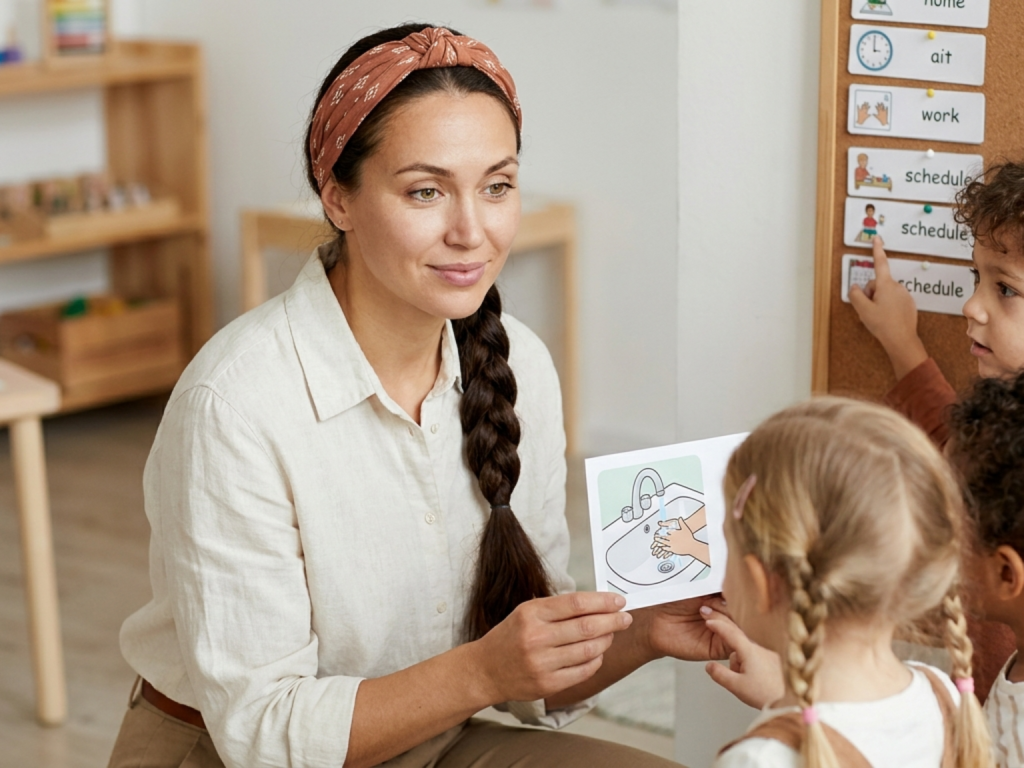
Visual schedules are especially useful because they make sequence visible. A schedule can use photos, drawings, or simple icons. The adult can point to the current activity, then the next one, and invite the child to move a marker when the step is complete. This supports receptive language, working memory, and autonomy.
Adult language that supports cooperation
During transitions, adult communication should be brief, warm, and specific. Preschoolers often process fewer words when emotionally activated. A long explanation may overwhelm the child and unintentionally prolong the conflict. Instead of repeating “Hurry up,” try naming the step: “Shoes on feet. Then we open the door.”
Clear expectations work best when paired with connection. A child who feels seen is more likely to accept adult guidance. For instance: “You worked hard on that tower. It is hard to stop. Take a picture in your mind, then blocks go in the bin.” This validates the emotional cost of the transition without removing the boundary.
Specific praise can also prevent challenging behaviors. Rather than general praise such as “Good job,” describe the regulated action: “You heard the clean-up song and put two blocks away.” This tells the child which behavior to repeat. In early childhood settings, research on engaging routines emphasizes clear expectations, praise, and planned supports such as transitional objects or visual cues to increase engagement and reduce disruptive behavior.
Choices should be real but limited. “Do you want the blue cup or the green cup?” is easier than “What do you want to do now?” If there is no choice, avoid phrasing the direction as a question. “It is time to wash hands” is clearer than “Can you wash your hands now?”
Common difficult transitions and what may help
Some transitions are predictably harder because they involve separation, fatigue, hunger, sensory change, or loss of control. Identifying the pattern allows adults to intervene before the child is overwhelmed.
Morning departure: Prepare clothing, bags, and lunch items the night before when possible. Use a short picture sequence for dressing, breakfast, toothbrushing, and shoes. If mornings are consistently chaotic, consider whether the child is getting adequate sleep or whether expectations exceed their current self-help skills.
Drop-off: A predictable goodbye ritual is more helpful than a prolonged uncertain exit. A brief routine might be hug, phrase, handoff to teacher, and caregiver leaves. Sneaking away can intensify anxiety for some children because it undermines predictability. If separation distress is severe or persistent, collaborate with teachers and consider professional guidance.
Clean-up: Clean-up is not one skill; it includes sorting, planning, motor coordination, and emotional tolerance for ending play. Break it into smaller tasks: “Cars in the red bin” or “You do blocks, I do animals.” A song or timer can mark the transition without making the adult the only signal.
Meals and snacks: Structured meal and snack times help children predict when food will be available. This can reduce grazing, irritability, and negotiation. Keep expectations realistic: preschoolers may eat variably across the day, and pressure around food can increase resistance.
Rest time: Some preschoolers still nap; others need quiet time instead of sleep. A consistent rest routine, dimmer environment, books, and calm expectations help the nervous system downshift. If snoring, labored breathing, restless sleep, or extreme daytime sleepiness is present, discuss sleep concerns with a pediatric clinician.
Pick-up and evening: Children often release emotional tension after holding it together at school. A snack, outdoor movement, or low-demand reconnection ritual may work better than immediate questions or errands.
Adapting routines for individual differences
Consistency should never be confused with one-size-fits-all management. Children vary in temperament, sensory thresholds, language processing, motor planning, sleep needs, and tolerance for novelty. A highly persistent child may need more advance notice and a meaningful role. A child with sensory sensitivity may struggle when moving from quiet play to a loud bathroom. A child with language delays may need pictures and gestures more than verbal reminders.
Some children benefit from transitional objects, such as carrying a small classroom token to the next area or bringing a familiar item from home according to program policy. Others respond well to proprioceptive input, such as pushing a chair in, carrying a light basket, or doing animal walks, if recommended by an occupational therapist or consistent with the classroom plan.
For multilingual children, routines can be reassuring when the verbal environment changes between home and school. Using consistent gestures, pictures, and repeated phrases in both settings can bridge understanding. Caregivers and educators should avoid assuming noncompliance when the child may be processing language demands.
Children with developmental disabilities, neurodevelopmental differences, trauma exposure, or anxiety symptoms may require more individualized transition planning. This does not mean lowering expectations indefinitely. It means adjusting the scaffold so the child can practice the skill successfully. Pediatricians, early intervention teams, speech-language pathologists, occupational therapists, and early childhood mental health clinicians can help when daily transitions are causing significant distress or functional impairment.
Home and preschool teamwork
Children do best when adults share information without blame. A teacher may observe that a child struggles most after lunch; a caregiver may know the child slept poorly or had a difficult goodbye that morning. These details help the team see the behavior in context.
Families can ask preschools what cues are used for transitions, such as songs, bells, picture cards, or hand signals. Using similar language at home can strengthen learning. Likewise, teachers can ask families about successful home rituals, comfort items, cultural routines, and words used for toileting, meals, and rest.
When problems persist, a simple observation log can be useful: What happened before the transition? What was the child asked to do? How did adults respond? What helped recovery? This resembles an antecedent-behavior-consequence approach, but the purpose is not to label the child. The goal is to identify modifiable stressors and teach replacement skills.
Consistency among adults matters, but perfect agreement is not always possible. The most important shared principles are predictable cues, emotionally safe boundaries, realistic timing, and repair after difficult moments. A child can learn that home and school have different routines if each environment is internally consistent and explained with warmth.
When to seek additional support
Transition struggles are common in preschool, especially during developmental leaps, schedule changes, sleep disruption, illness, or family stress. However, additional support is appropriate when distress is intense, prolonged, or interfering with participation in preschool, family routines, eating, sleep, toileting, or relationships.
Consider discussing concerns with a pediatrician or qualified child development professional if a child has frequent prolonged meltdowns, aggression that is difficult to keep safe, marked regression, extreme separation distress, persistent sleep problems, major language comprehension concerns, or sensory reactions that prevent ordinary activities. Medical factors such as hearing impairment, sleep-disordered breathing, constipation, pain, medication effects, or anxiety symptoms can sometimes contribute to transition difficulty.
Professional support does not mean something is “wrong” with the child or family. It can provide a clearer understanding of the child’s nervous system and practical strategies tailored to their needs. Early, collaborative support often reduces stress for everyone and protects the child’s sense of competence.
When transition distress needs prompt attention
- Seek urgent help if a child’s behavior creates immediate danger to self or others and cannot be safely contained.
- Consult a pediatric clinician if transition problems are accompanied by developmental regression, persistent sleep disruption, pain, or feeding concerns.
- Ask for professional guidance if separation distress is severe, prolonged, or prevents regular preschool participation.
- Do not assume defiance when hearing, language comprehension, sensory processing, trauma exposure, or medical discomfort may be contributing.
- Avoid harsh punishment, shaming, or forced isolation; these may worsen dysregulation and anxiety.
Tools & Assistance
- Create a simple photo-based visual schedule for the morning, preschool day, or bedtime.
- Use a consistent transition cue such as a song, timer, hand signal, or picture card.
- Build in 5 to 10 minutes of margin before predictable difficult transitions.
- Share a brief home-school transition plan with caregivers, teachers, and support staff.
- Consult a pediatrician, early childhood educator, occupational therapist, speech-language pathologist, or early childhood mental health clinician when concerns persist.
FAQ
Is it normal for preschoolers to cry or resist during transitions?
Yes, some resistance is developmentally common. Concern increases when distress is intense, prolonged, unsafe, or significantly disrupts daily life.
Do routines make children less flexible?
Supportive routines usually increase flexibility because children feel secure enough to handle small changes. The key is predictable structure with calm explanations when plans change.
How many warnings should I give before a transition?
One or two concrete warnings are usually better than many repeated reminders. Pair the warning with a visual cue, timer, song, or clear next step.
What if my child does well at preschool but melts down at home?
This is common. Home may feel safe enough for the child to release accumulated fatigue and emotion. Snack, movement, quiet connection, and low-demand time can help.
When should I ask for professional help?
Seek guidance if transition struggles are unsafe, persistent, associated with regression or medical symptoms, or interfering with preschool participation, sleep, eating, toileting, or relationships.
Sources
- ScienceDirect — Consistent routines matter: Child routines mediated the association between interparental functioning and school readiness among preschoolers
- SAGE Journals — Preventing Challenging Behaviors Through Engaging Routines
- First 5 OC — Crafting Consistency in Child Care: Daily Schedules, Routines, and Transitions
Disclaimer
This article is for informational purposes only and does not replace medical, developmental, or mental health evaluation. Consult a qualified healthcare professional for concerns about your child’s behavior, sleep, development, or safety.















Please log in to leave a comment.